30초 요약
Space architect Ariel Ekblaw wants to move beyond the size limits of a rocket by sending intelligent tiles into orbit to assemble larger structures. Her MIT research became the basis for Rendezvous Robotics, a startup targeting uses such as antennas and solar arrays. With Reid Hoffman, she also describes a proposed university biolab in orbit and argues that microgravity research could improve products used on Earth. Her broader vision includes lunar industry and tourism, though those remain predictions.
- 1Smart tiles could assemble structures too large for a rocketEkblaw describes Tessera, her MIT research into self-assembling units. Her proposed applications range from enclosed habitats to solar arrays and large antennas.
- 2Orbital biology could change how treatments are madeEkblaw points to research on crystallizing Keytruda in space and to delicate retinal tissue as examples of why microgravity may be useful.
- 3An orbital biolab is the first step in a university campus proposalHoffman and Ekblaw have been talking with potential donors. Ekblaw envisions a research module, followed in the longer term by opportunities for students.
- 4Rendezvous Robotics is commercializing the tile researchThe for-profit startup grew from research incubated at Aurelia Institute and is targeting larger infrastructure such as communications antennas.
- 5Ekblaw sees lunar deliveries as the start of a wider economyShe points to NASA contracts with commercial providers and identifies helium-3 as a possible resource, while predicting future lunar settlement and tourism.
핵심 정리
- Self-assembly could let orbital structures grow beyond what fits inside a single rocket fairing, Ekblaw argues.
- Ekblaw sees orbital biolabs as a near-term step toward a university campus in space.
- Microgravity can change biological experiments; Ekblaw points to research on drug crystals and retinal tissue.
- A commercial lunar delivery market could support further economic activity on the Moon.
- Ekblaw predicts much wider access to orbital travel in 15 to 20 years.
챕터별로 다듬은 전문 읽기
Self-assembling structures larger than a rocket
Ekblaw describes Tessera, her research into intelligent tiles that assemble in orbit. She imagines structures for habitats, solar arrays and other infrastructure.
Ariel Ekblaw says space exploration can expand humanity's awareness, but her immediate question is practical: how can infrastructure in space benefit people living on Earth? She imagines orbital laboratories and a university campus in space as well as much larger structures assembled beyond the constraints of a rocket.
Reid Hoffman asks what a space architect does. Ekblaw, who leads the nonprofit Aurelia Institute, says she works on large orbital structures and the next generation of infrastructure, including future habitats. Her starting point is not only where people might live, but what such infrastructure could do for Earth.
Tessera grew out of Ekblaw's MIT doctoral research on self-assembling robotics. Rather than building a structure on Earth and fitting it inside a rocket's payload fairing, she proposes intelligent tiles that join together in orbit, like smart Lego pieces, to form something much larger.
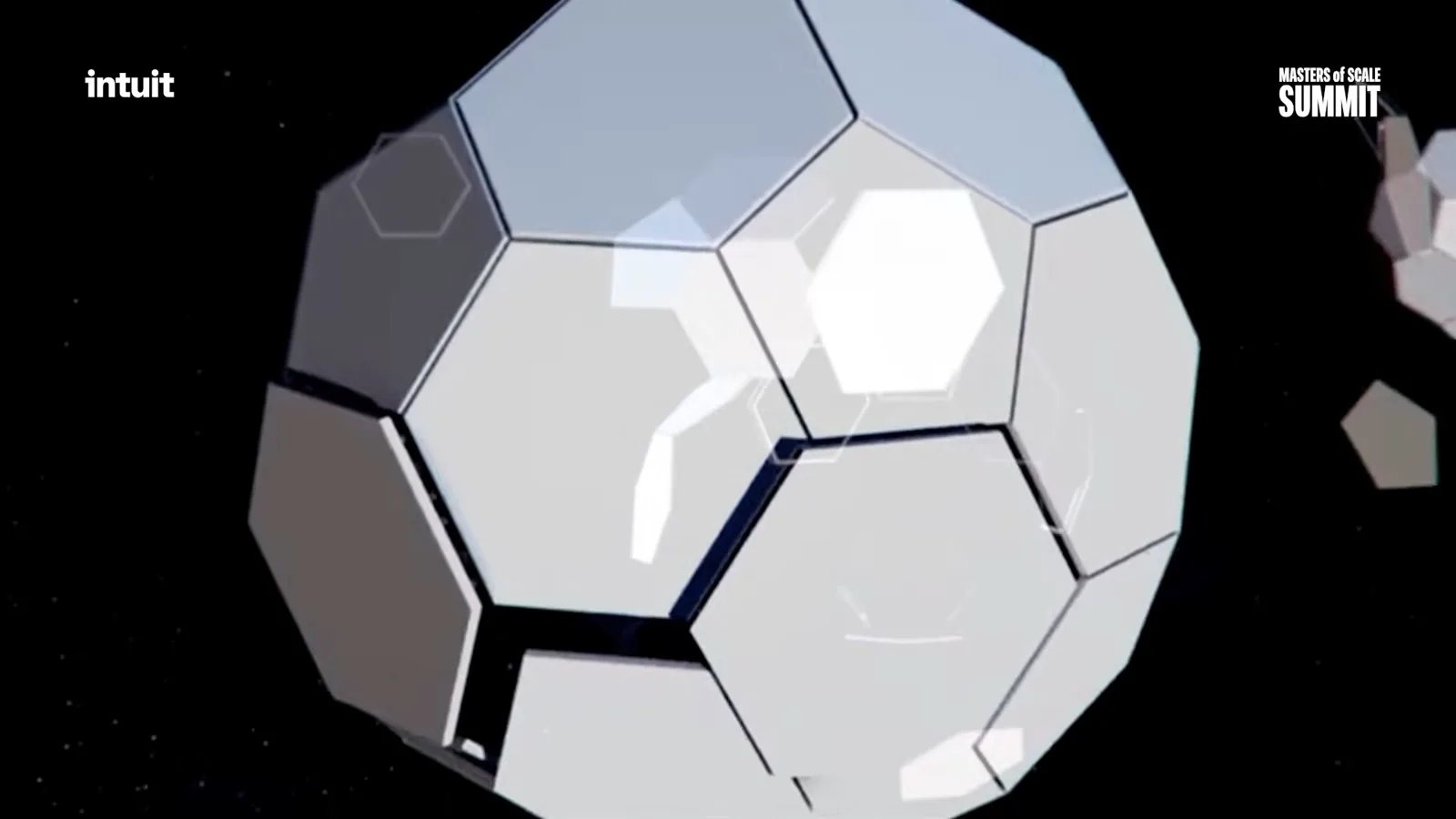
Her preferred form is a closed, soccer-ball-like structure that people could live inside. She says related self-assembly techniques could also make large solar arrays or, potentially, AI data centers. A video illustrates the pieces joining into a rounded structure.
Biology and solar power as benefits for Earth
Ekblaw says microgravity can enable experiments and manufacturing that are harder on Earth. She also envisions power generated in space and transmitted to the ground.
Ekblaw grew up with two pilot parents and read science fiction, both of which shaped her interest in space. She likes the idea of building at planetary scale, including the ring-shaped worlds imagined in fiction; she describes the challenges of such a project in terms of engineering, execution and funding.
For audiences who do not dream of living on Mars, she points to possible benefits closer to home. She envisions space-based solar power transmitting energy to Earth, including at night, as one way to address the intermittency of renewable power.
Ekblaw is especially interested in orbital biology. She describes Merck's research on crystallizing the cancer drug Keytruda in space, and says better crystals could help turn an intravenous formulation into a shot administered in a doctor's office. Her point is that microgravity may change how a medicine is made and delivered.
She also mentions artificial retinal tissue, which she says can be difficult to manufacture on Earth because gravity makes delicate tissue sag. These examples motivate her interest in expanding the space infrastructure available for biological research that might ultimately benefit patients.
A university campus and a construction startup in orbit
Hoffman and Ekblaw describe plans for orbital research facilities. Ekblaw explains how Rendezvous Robotics grew out of her research.
Hoffman says he and Ekblaw have been speaking with potential founding donors about a university in space. Ekblaw imagines an orbital campus where universities could have facilities for research, and eventually even opportunities akin to study abroad.
She sees a possible opening as the International Space Station approaches its planned retirement and commercial station developers prepare alternatives. In her vision, donors could fund a university's first orbital building within the coming decade, though the proposal remains a future project.
The nearer-term version would be an orbital biolab. Ekblaw says a larger module made with self-assembling tiles could give faculty and graduate students room to conduct biotechnology research; she calls it a real-estate opportunity rather than only a science-fiction idea.
Rendezvous Robotics grew from the Tessera research, first incubated at Aurelia Institute and then spun out as a for-profit startup. Ekblaw says the company's aim is to change how large structures are constructed in space, extending the progress made by reusable rockets that lower launch costs.
She says the company has completed a seed round and is preparing to scale. Potential projects include large orbital antennas for communications and space-based solar arrays. She also returns to the far more distant idea of a ring world.
Ekblaw and Hoffman discover that both encountered the ring-world concept through Larry Niven's novel. They acknowledge dated portrayals of women in the book while discussing how science fiction can still inspire ideas about engineering and future worlds.
A commercial economy on the Moon
Ekblaw points to NASA purchasing commercial lunar deliveries and identifies helium-3 as a potential resource. She offers predictions for space tourism and settlement.
For the Moon, Ekblaw points to NASA's Commercial Lunar Payload Services program, which pays private providers for deliveries. She and Hoffman argue that creating a commercial ecosystem could make sustained activity more viable than a one-off project.
She identifies helium-3 as a potential lunar resource, saying the isotope is scarce on Earth and useful in applications including cooling. She attributes lunar deposits to long exposure to the solar wind and imagines a future settlement supporting activity on the Moon.
Ekblaw predicts that travel to low Earth orbit could become comparable to commercial air travel within 15 to 20 years, with lunar travel possible for some people in the industry during their lifetimes. Hoffman imagines that a lunar tourism industry could eventually follow.
Microgravity data and the value of exploration
Ekblaw sees a possible role for space data in AI-assisted biology. She also describes exploration and knowledge as reasons to go beyond Earth.
Asked for lessons people can apply on Earth, she points to the intersection of space and AI. Beyond a possible orbital data center, she sees scientific value in rare microgravity datasets that could inform AI-assisted work in biology and other disciplines.
Ekblaw also argues for exploration as a human purpose. Alongside practical benefits from technologies developed for space programs, she values the pursuit of new knowledge and the experience of widening humanity's horizons.
For science-fiction recommendations, Ekblaw chooses Isaac Asimov's Foundation trilogy and Neal Stephenson's Seveneves, the latter an inspiration for her doctoral work on robotic swarms. Hoffman also mentions Murderbot and Ode to the Half-Broken before closing the conversation.
같은 채널의 다른 글
 24:35EN
 Masters of Scale· 2026년 11월 20일팟캐스트 · 2명Danny Meyer: A Company’s Culture Is What It Rewards and Tolerates게스트 Danny Meyer · 진행자 Baratunde ThurstonThe Shake Shack founder explains how to make people feel they belong—and why celebrating good behavior is only half the work.
 21:54ENMasters of Scale· 2026년 11월 19일팟캐스트 · 2명Josh Tyrangiel: Useful AI starts with a problem, not a rivalry게스트 Josh Tyrangiel · 진행자 Jeff BermanA journalist points to recycling, tax systems and sepsis care as places where small teams have put AI to work.
 22:24ENMasters of Scale· 2026년 11월 18일팟캐스트 · 2명Amjad Masad: Replit's AI turnaround rests on enterprise trust게스트 Amjad Masad · 진행자 Bob SafianReplit's CEO says security and reliability helped turn a stalled coding startup toward business customers as AI agents changed its own workplace.
 12:43ENMasters of Scale· 2026년 11월 16일팟캐스트Bill Gross Gives Away a Million AI-Generated Startup IdeasGross combined his 31-part idea-finding method with millions of documents, and now wants to help founders turn ideas into businesses.
 23:56ENMasters of Scale· 2026년 11월 12일팟캐스트 · 2명Walmart’s CEO wants faster change without losing the human connection게스트 John Furner · 진행자 Jeff BermanJohn Furner discusses agent shopping profiles, frontline tools and the leadership work needed to move a large retailer.
 21:35ENMasters of Scale· 2026년 11월 11일팟캐스트 · 2명Eric Ries: Why successful companies lose the purpose that made them work게스트 Eric Ries · 진행자 Krista TippettRies argues that pressure from capital can erode a company’s mission, and that trust deserves a place in business decisions.