30초 요약
In a guest video for 3Blue1Brown, Ben Syversen explores Viktor Blåsjö’s interpretation of Euclid’s Elements through constructions, diagrams and the parallel postulate. The video contrasts this historical account with modern formal proof and traces the influence of Euclidean methods on later mathematics.
- 1The equilateral triangleEuclid’s first construction uses two circles; modern formalization requires a justification that they intersect.
- 2What diagrams contributeBlåsjö distinguishes approximate positional facts from exact equalities that require proof.
- 3Copying a lengthProposition 2 establishes a reusable construction from the permitted operations.
- 4A misleading diagramAn inaccurate figure conceals an inside–outside error in a deliberately false proof.
- 5The parallel postulateThe construction of a square exposes dependence on assumptions about parallel lines.
핵심 정리
- A construction can be understood as a sequence of permitted operations that participates in a geometric argument.
- The video distinguishes exact properties, such as equal lengths, from positional relationships read from a properly constructed diagram.
- Euclid’s second proposition establishes that copying a length can be built from simpler operations.
- An inaccurate diagram can hide a false assumption about which points lie inside or outside a figure.
- The parallel postulate is independent of suitable modern formalizations of the other Euclidean assumptions; alternative geometries clarify its role.
- Physical drawings can motivate geometric reasoning, but finite precision alone does not formally prove an axiom system consistent.
챕터별로 다듬은 전문 읽기
Why construct?
The guest video asks why ruler-and-compass constructions mattered to Euclid. Proposition 1 introduces the role of diagrams in reasoning.
3Blue1Brown introduces a guest video by Ben Syversen, a creator of documentaries on the history of mathematics and science. Syversen asks what Euclid’s ruler-and-compass constructions were doing in the Elements, beyond producing neat diagrams.
The Elements influenced mathematics for centuries. The video argues that Greek geometric practice treated diagrams and constructions as part of the reasoning itself, a different approach from modern formal proofs in which the logical assumptions must be made explicit.
Euclid begins with definitions, common notions and geometric postulates. Proposition 1 constructs an equilateral triangle on a segment AB: draw a circle centered at A through B and another centered at B through A, then connect an intersection to the endpoints.
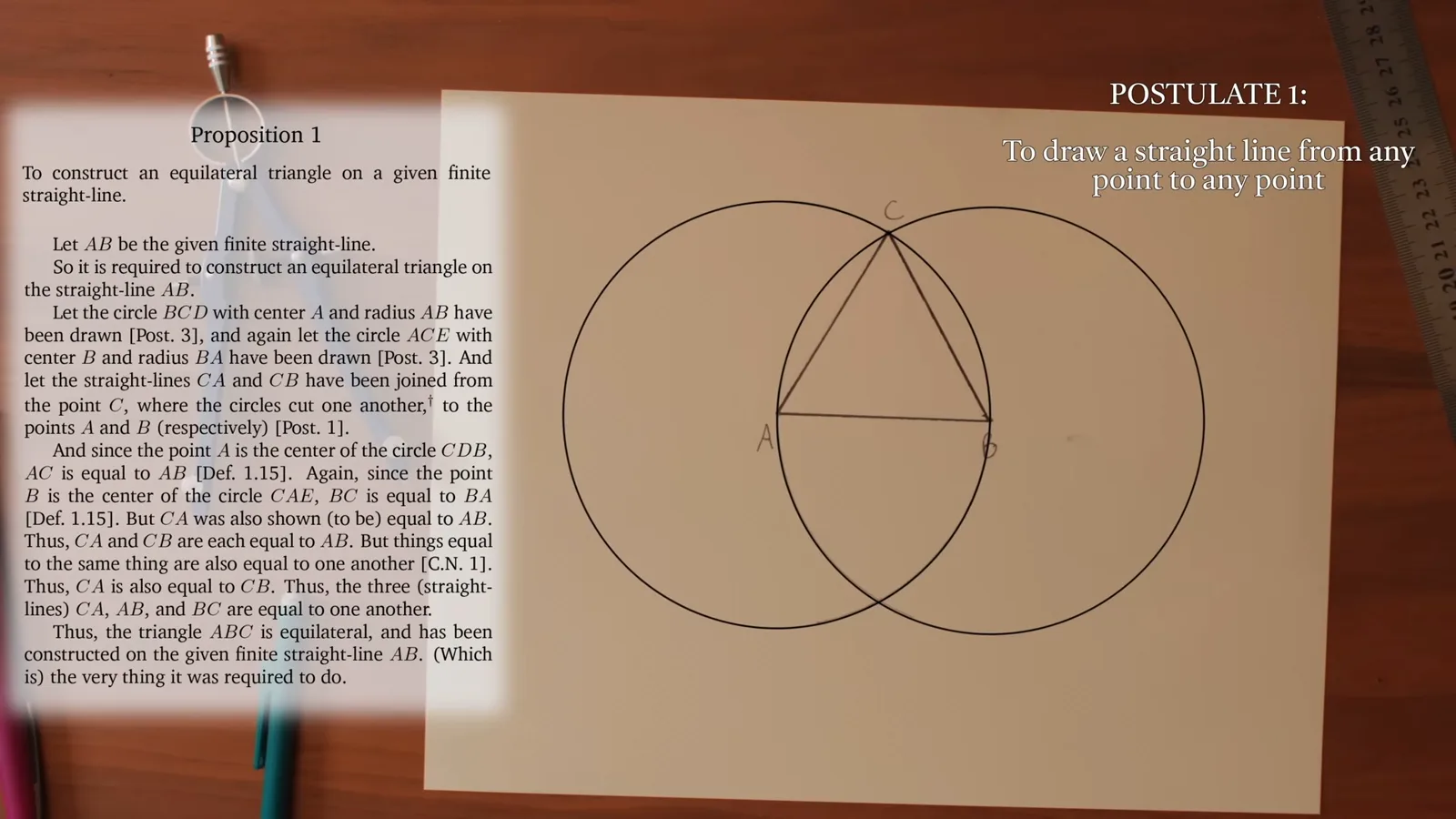
Both new sides are radii of the circles, so each equals AB; the common notion that things equal to the same thing are equal completes the equality argument. From a modern formal perspective, the construction also needs a justification that the circles intersect, which Euclid does not explicitly state as an axiom.
Historian Viktor Blåsjö offers another interpretation. He suggests imagining Greek proof in a setting of debate: a skeptic who has performed the prescribed construction can see the circles cross. On this reading, the diagrammatic construction does some of the argumentative work rather than merely decorating a complete verbal proof.
Diagrams and construction rules
Blåsjö distinguishes positional properties from exact equality. Proposition 2 shows how a construction can become a reusable operation.
Blåsjö distinguishes a robust positional fact such as crossing from an exact claim such as equality of lengths. A drawing that looks equilateral cannot establish exact equality on sight; that requires reasoning. The video presents this distinction as a historical interpretation, not a substitute for explicit assumptions in a modern formal system.
Diagrams have rules. When the Elements asks for an equilateral triangle, it refers back to the steps that construct one. A construction is thus a procedure for introducing a geometric object into an argument, and its result can be reused in later propositions.
Syversen cautions that reconstructing Greek mathematical philosophy from technical works requires inference. Proposition 2 offers another clue: it shows how to copy a given length to a given point using circles and the previously constructed equilateral triangle.
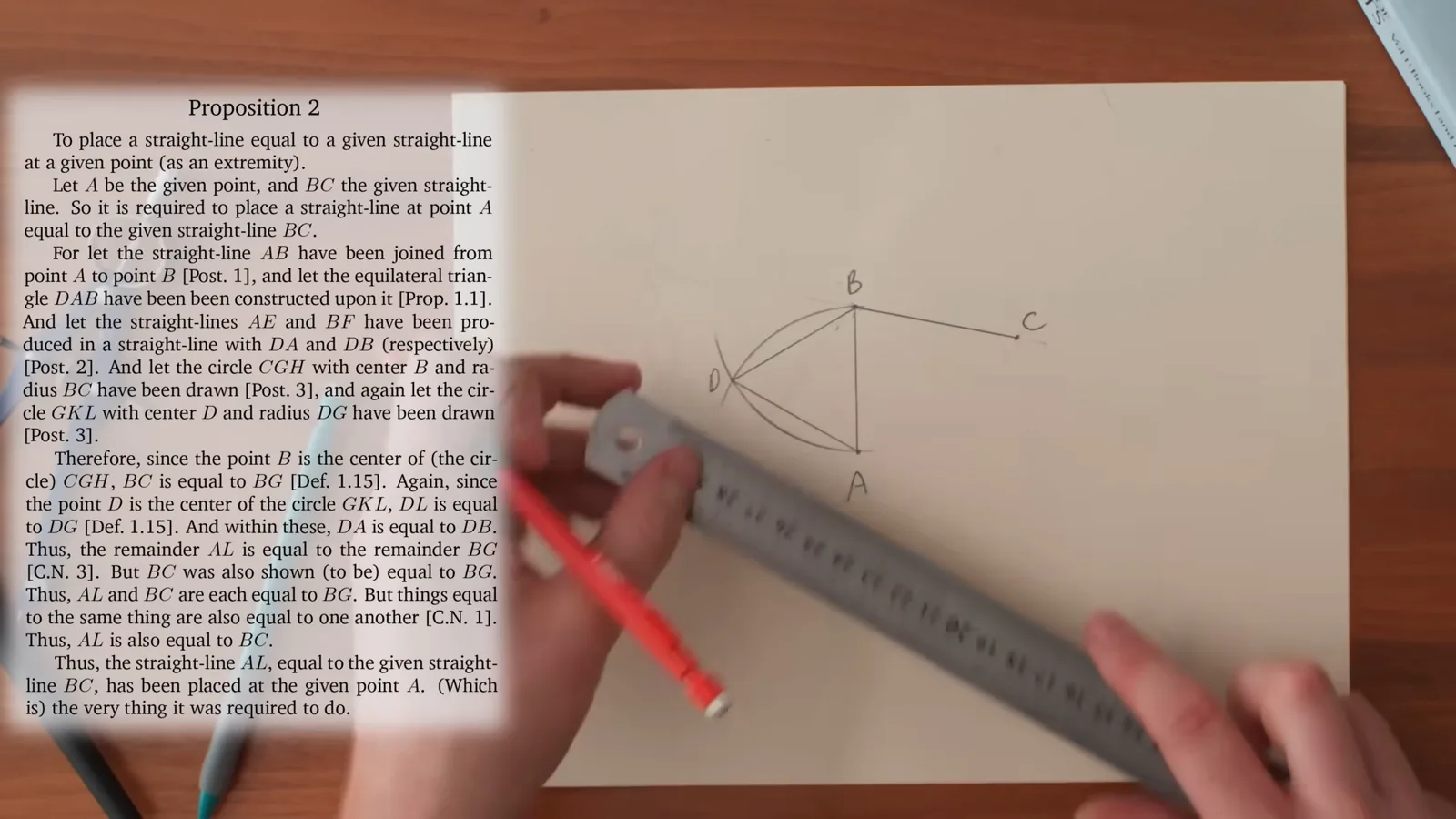
A craftsperson might simply carry a compass without changing its opening. Euclid’s more elaborate procedure instead establishes that the transfer is possible using the allowed basic operations. Once proved, it becomes a reusable subroutine rather than an instruction to repeat every line in everyday drawing.
Geometry as philosophy
The video presents constructions as a response to competing ideas about knowledge. It interprets postulates as operational starting points.
The video places these methods within a culture of philosophical debate. It contrasts idealized forms associated with Plato and observation associated with Aristotle, and proposes that constructions gave geometers a way to develop and test arguments without reducing geometry to either approach.
The first three postulates allow a straight segment between points, extension of a line and a circle with a chosen center and radius. Blåsjö argues that physically realizable operations helped make these starting points intelligible and credible to a skeptic.
The video uses physical drawing to motivate continuity and intersections. That philosophical motivation should be distinguished from a formal consistency proof: actual drawings have finite precision, and the consistency of a mathematical axiom system is a separate logical question.
A false diagrammatic proof
An apparently persuasive argument that right angles differ hides a positional mistake. Proper construction helps make the configuration visible.
Diagrams can mislead. Syversen demonstrates a deliberately false proof purporting to show unequal right angles. He draws a square, adds equal segments and perpendicular bisectors, then uses congruent triangles to arrive at a contradiction.
The hidden mistake is positional. Slightly inaccurate bisectors make one triangle look as though it sits where the argument needs it; a correct construction places it outside the square. The angle addition used in the purported proof therefore fails.
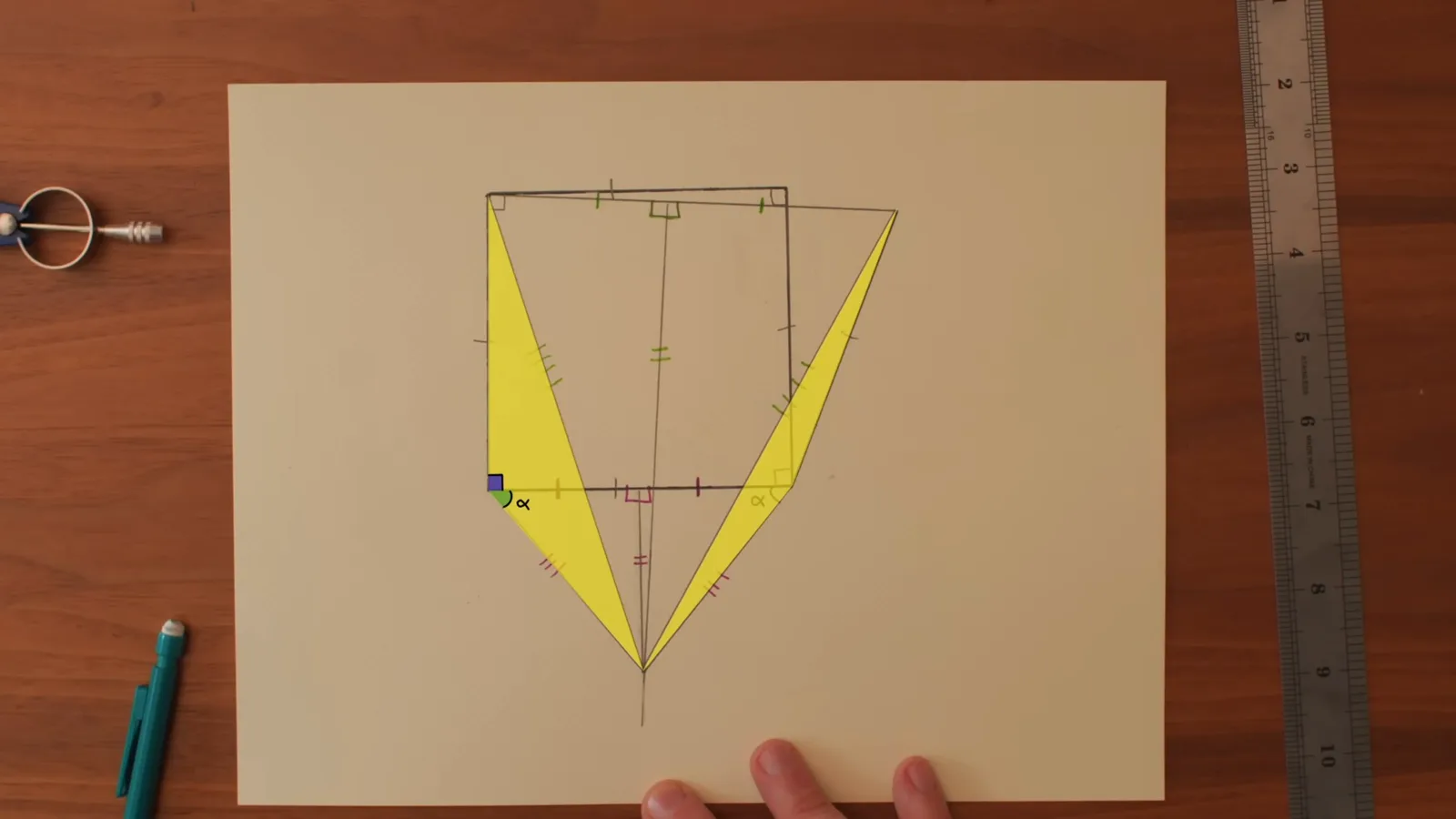
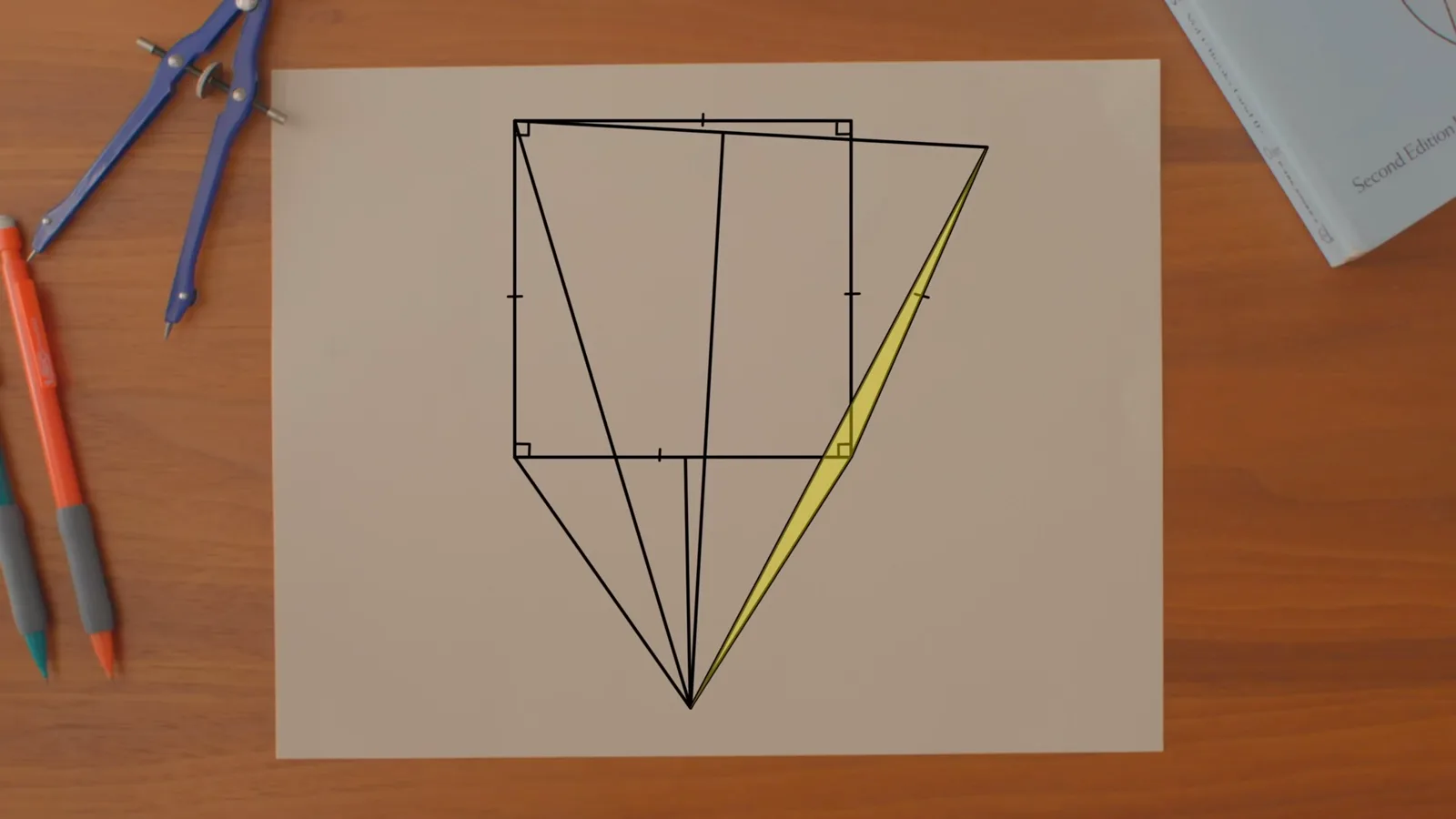
Following construction procedures helps reveal such inside–outside relationships even though physical drawings are not exact. In the video’s interpretation, the figure must be constructed according to the established rules before it can play its role in the proof.
Squares and the parallel postulate
Building and proving a square reveals dependencies on results about parallels. Non-Euclidean geometry later clarified the role of the postulate.
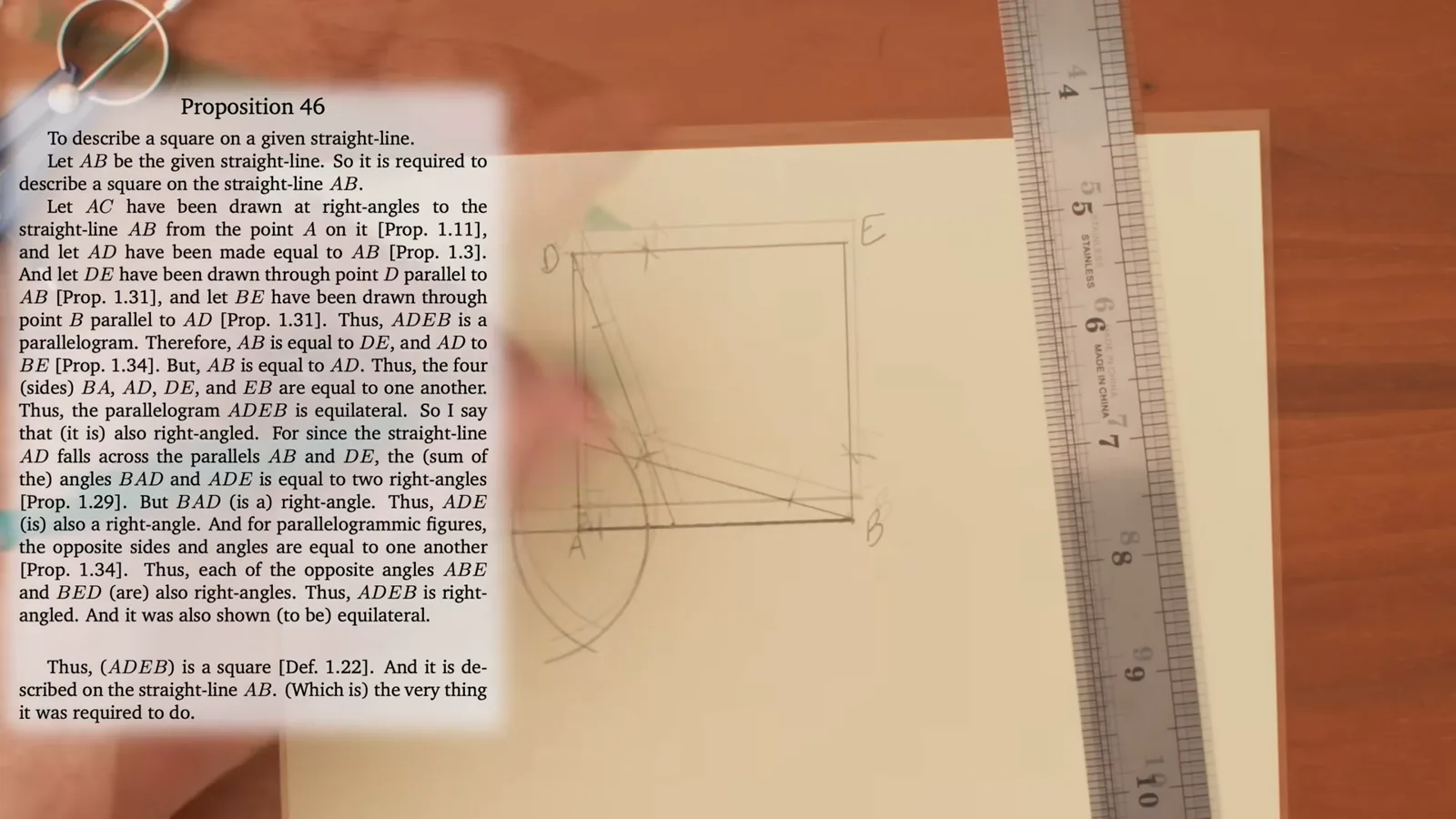
Squares offer a subtler example. A seemingly simple construction uses equal perpendicular sides, but proving the opposite side and angles have the desired properties requires results about parallel lines. Euclid introduces his fifth postulate before the relevant later propositions.
The fifth postulate states that if a transversal makes the interior angles on one side sum to less than two right angles, the two lines, extended far enough, meet on that side. A familiar modern equivalent, in an appropriate axiomatic setting, is the uniqueness of a parallel through a point outside a line.
Syversen contrasts Euclid’s formulation, which speaks of lines eventually meeting, with a description of lines that never meet. He argues that the former fits the constructive perspective, while also acknowledging that geometry derives consequences beyond what a finite physical drawing can directly check.
Euclid’s square construction uses earlier propositions to erect an equal perpendicular side and draw parallels. Properties of the resulting parallelogram establish the remaining equal sides and right angles. Expanding all those earlier steps makes the physical drawing surprisingly elaborate.
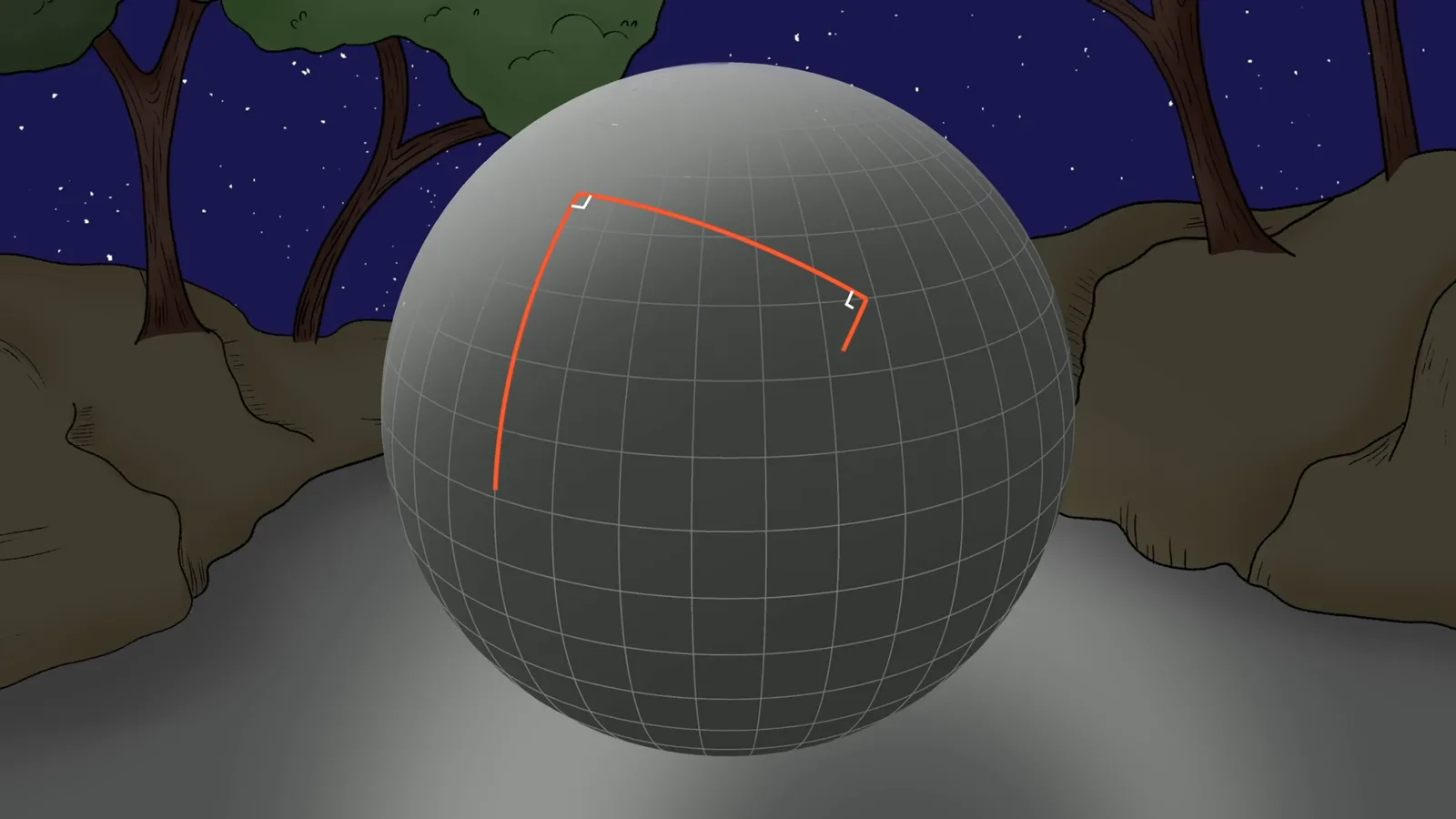
The example also illuminates non-Euclidean geometry. In standard hyperbolic geometry, a quadrilateral constructed with a base and equal perpendicular sides does not close as a Euclidean square with four right angles. Euclid did not anticipate non-Euclidean geometry, but analyzing dependencies makes its assumptions visible.
For centuries mathematicians tried to prove the parallel postulate from the other assumptions. The video mentions Ibn al-Haytham, Omar Khayyam, Lagrange and Legendre. Later development of non-Euclidean models demonstrated independence in suitable modern formulations, explaining why those attempted proofs could not succeed as intended.
From Euclid to formal proof
The video surveys the Elements and its later influence. It compares constructions with modern proof-checking tools.
The Elements continues from the square to the Pythagorean theorem, then through plane geometry, number theory and solid geometry. Syversen emphasizes its organization as a cumulative structure: each established construction and result supports later work, drawing on generations of mathematicians.
The video traces the book’s influence through scholarship in the Islamic world and later Europe. It describes an enduring preference for geometrical constructions as a source of certainty even as algebra became increasingly powerful. These are broad historical interpretations, and the traditions involved were diverse.
Descartes’ analytic geometry connected coordinates and algebra with geometry, yet the video notes that he still used constructions and mechanical devices to justify curves beyond ordinary ruler-and-compass constructions. The relationship between symbolic calculation and constructive geometry changed gradually.
In the nineteenth century, non-Euclidean geometries and other developments encouraged more explicit formal foundations. Modern systems such as Lean check proofs against specified rules. Syversen compares them with the earlier desire for verifiable procedures, without claiming the systems or their assumptions are identical.
Syversen closes by reflecting on programmatic animation: having to implement a construction can reveal a difference between what was imagined and what the procedure actually produces. That experience offers a contemporary way to appreciate the constructive side of the Elements.
같은 채널의 다른 글
 40:44EN
 3Blue1Brown· 2026년 10월 16일Grant Sanderson: There's never been a better time to go into mathGrant Sanderson, Constantin Kogler · 3Blue1BrownStudents fear AI has solved mathematics. Grant Sanderson argues the opposite: even if machines prove theorems better than we do, the institution of math stays valuable—and this is a rare moment when newcomers can reshape it.
 51:55EN3Blue1Brown· 2026년 9월 18일The last IMO problem AI could not solveGrant Sanderson · 3Blue1BrownGrant Sanderson walks through IMO 2025 Problem 6 — a tiling puzzle that frontier models missed — and the visual patience it takes to prove a construction is optimal.
 0:55EN3Blue1Brown· 2026년 7월 24일The 64 Sugar Cubes Puzzle: Six Equal DistancesA 4×4×4 block has three colors; prove that six same-colored pairs share a distance.
 2:25EN3Blue1Brown· 2026년 6월 12일How Shannon Measured the Entropy of EnglishA guessing game helped Claude Shannon estimate how much information English text contains, and why prediction is central to compression.
 1:02EN3Blue1Brown· 2026년 6월 10일A Robot Walk and the Puzzle of Optimal Binary EncodingHow few bits does it take to send directions that occur with unequal frequencies?
 32:19EN3Blue1Brown· 2026년 6월 7일Reinventing Entropy: Why Prediction Helps Compress LanguageA robot’s movement code leads from prefix-free encoding to Shannon information and the entropy of language.