30초 요약
Elon Musk predicts that AI could add 20–30% to the global economy, while saying data centers face a potential 15-gigawatt power shortfall in 2027. He argues that physical robots take longer to scale than software because of supply chains, but forecasts more than a billion humanoids within ten years. Musk says SpaceX built its own power plants and calls expanded generation an opportunity for countries seeking AI data centers.
- 1Musk estimates a 20–30% economic gain from digital AIHe describes $20–30 trillion annually as a rough estimate and predicts broad digital capabilities by the following year.
- 2Robot usefulness depends on software, chips and handsMusk says progress in intelligence, onboard computing and mechanical dexterity combines to determine what a robot can do.
- 3He predicts over a billion humanoid robots in ten yearsMusk further estimates output of five times that of a person per robot.
- 4Musk cites a projected 15-gigawatt AI power shortfallHe says electricity available outside China is rising more slowly than AI chip production.
- 5He says SpaceX built power plants to supply computeMusk says Google, Anthropic and other customers lease capacity and urges countries to expand electricity generation.
핵심 정리
- Musk estimates digital AI could increase global economic output by 20–30%.
- He cites a projected 15-gigawatt AI power shortfall in 2027.
- Musk predicts more than a billion humanoid robots within ten years.
- Physical robots require supply chains as well as AI software and computing hardware.
챕터별로 다듬은 전문 읽기
Musk’s forecast for digital AI
Musk estimates the economic impact of digital AI and predicts coding performance beyond human competition.
Elon Musk estimates that digital AI could increase the global economy by 20–30%, or roughly $20–30 trillion a year. He predicts that by the end of the following year it could perform essentially any digital task that does not require physical manipulation.
Musk compares future AI coding ability to Stockfish, a chess program capable of beating elite players. He predicts AI will become so strong at software and other digital engineering within 12–18 months that human programmers cannot compete with it.
Beyond digital AI, Musk expects general-purpose humanoid robots to multiply the size of the economy. He suggests that their contribution could eventually make the economy ten times larger or more.
Why robots scale more slowly
He says physical supply chains take time but predicts rapid growth once robots help manufacture robots.
The interviewer asks how quickly physical AI and robotics might be deployed. Musk says physical systems take longer than software because they need large, international supply chains, while digital software can be copied between computers.
Musk proposes thinking of a humanoid robot’s usefulness as a combination of three factors: AI software, the chip inside the robot and mechanical dexterity, especially in its hands. He says improvements in all three would reinforce one another.
He predicts robots will eventually help manufacture more robots, creating a self-reinforcing increase after a slow start. His forecast is that there will be more than a billion humanoid robots within ten years, each producing roughly five times as much as a person.
The electricity bottleneck
Musk discusses data-center power, leasing compute and the opportunity for countries to add generation.
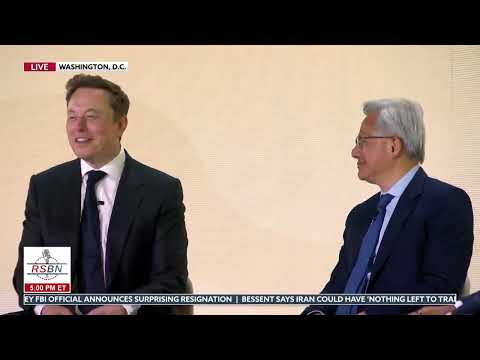
The interviewer turns to data centers and asks how governments should plan for AI computing and electricity. Musk says electricity is already becoming a serious constraint and recommends following AI discussions on X, where he says he gets his news.
Musk says analysts expect an AI power shortfall of at least 15 gigawatts in 2027. He attributes the forecast to AI chip production rising faster than available electricity outside China.
He says Google, Anthropic and others lease computing capacity from SpaceX and that SpaceX built power plants to bring its facilities online. He also points to restrictions on exporting advanced GPUs to China as a constraint on where the newest data centers can be built.
Musk argues that countries able to build more power could attract AI data centers, offering electricity in exchange for taxes and fees. He presents this as an economic opportunity for governments.
같은 채널의 다른 글
 26:37EN
 Right Side Broadcasting Network· 2026년 9월 29일Musk and Huang: AI’s Power Needs and the Case for Agent MonitoringElon Musk, Jensen Huang, Tom BrownMusk predicts a link between power and growth; Huang describes isolating and independently monitoring AI agents.
 28:08ENRight Side Broadcasting Network· 2025년 11월 19일Musk and Huang announce Saudi AI project and debate the future of workAbdullah Alswaha, Elon Musk, Jensen Huang · Saudi Ministry of Communications and Information TechnologyxAI and HUMAIN plan a 500 MW project; Musk predicts optional work, while Huang sees nearer-term productivity gains.
 35:50ENRight Side Broadcasting Network· 2025년 2월 20일Musk at CPAC: DOGE cuts, political change and a disputed fraud estimateElon Musk, Rob Schmitt, Javier MileiMusk and Rob Schmitt discuss government spending and immigration; Musk’s fraud estimate requires the scope of GAO’s data.