30초 요약
The 3Blue1Brown narrator explains why a continuous tangent vector field on a sphere must vanish somewhere. He constructs a field with exactly one zero, then outlines a proof using an antipodal deformation and signed flux, before considering the pattern in higher dimensions.
- 1An airplane orientation problemA continuous heading-only choice of wing direction would require a nonzero tangent field on the sphere.
- 2Exactly one zeroProjecting a constant planar field onto the sphere produces a field with one zero at the projection pole.
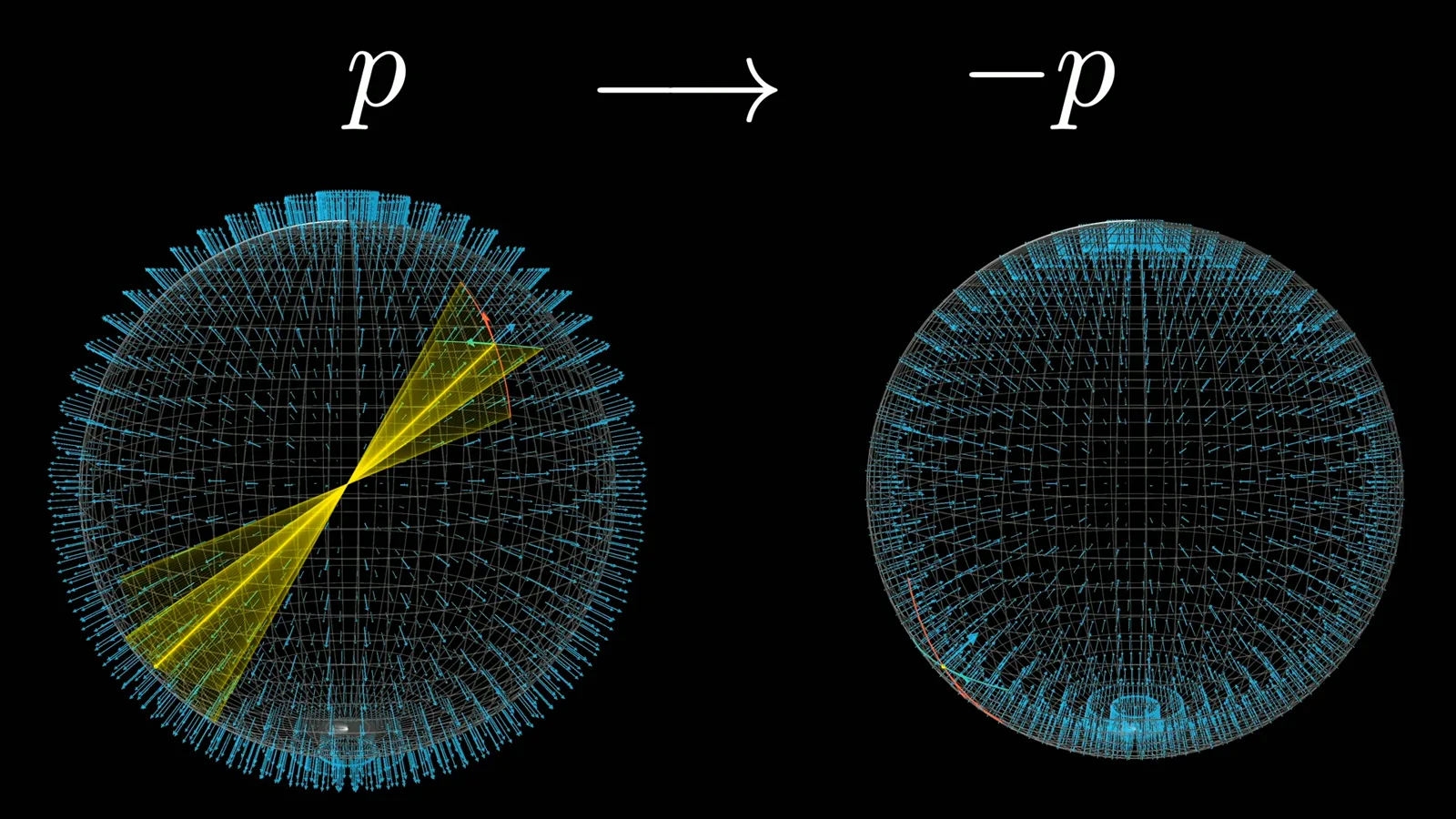
- 3A hypothetical deformationA nonzero field would define continuous half-circle paths from p to −p, avoiding the origin.
- 4Signed fluxFlux around the origin is preserved during a deformation that never crosses the source.
- 5Higher dimensionsThe answer depends on whether the dimension describes the sphere or its ambient space.
핵심 정리
- Every continuous tangent vector field on a two-dimensional sphere has at least one zero.
- A field with exactly one zero can be constructed through stereographic projection.
- A hypothetical nowhere-zero field would continuously move each point to its antipode without crossing the origin.
- The antipodal map reverses orientation on the ordinary sphere, contradicting preservation of signed flux around the origin.
- Odd-dimensional spheres admit nowhere-zero tangent fields; even-dimensional spheres do not.
챕터별로 다듬은 전문 읽기
The combing puzzle
The narrator introduces the theorem and asks whether exactly one problem point is possible.
A swirl in his baby’s hair reminds the 3Blue1Brown narrator of the hairy ball theorem. Informally, a ball covered in hair cannot be combed flat continuously without at least one point where the hair has nowhere to lie.
Combing around an axis produces swirls at both poles. The theorem guarantees at least one problematic point, but the narrator poses a puzzle: can a clever arrangement reduce the number to exactly one?
Tangent fields and applications
Airplane orientation, wind and electromagnetic fields motivate the formal statement. Each example depends on specific continuity and modeling assumptions.
The name is playful, but the mathematics has practical applications. The narrator first considers an animation problem: orient a 3D airplane as it follows an arbitrary path.
The direction of travel determines where the nose points but leaves a rotation around the nose-to-tail axis. Choosing a wing direction perpendicular to the heading fixes that remaining freedom.
All possible heading directions form a sphere. Assigning a perpendicular wing direction continuously to every heading amounts to assigning a nonzero tangent vector at every point of that sphere.
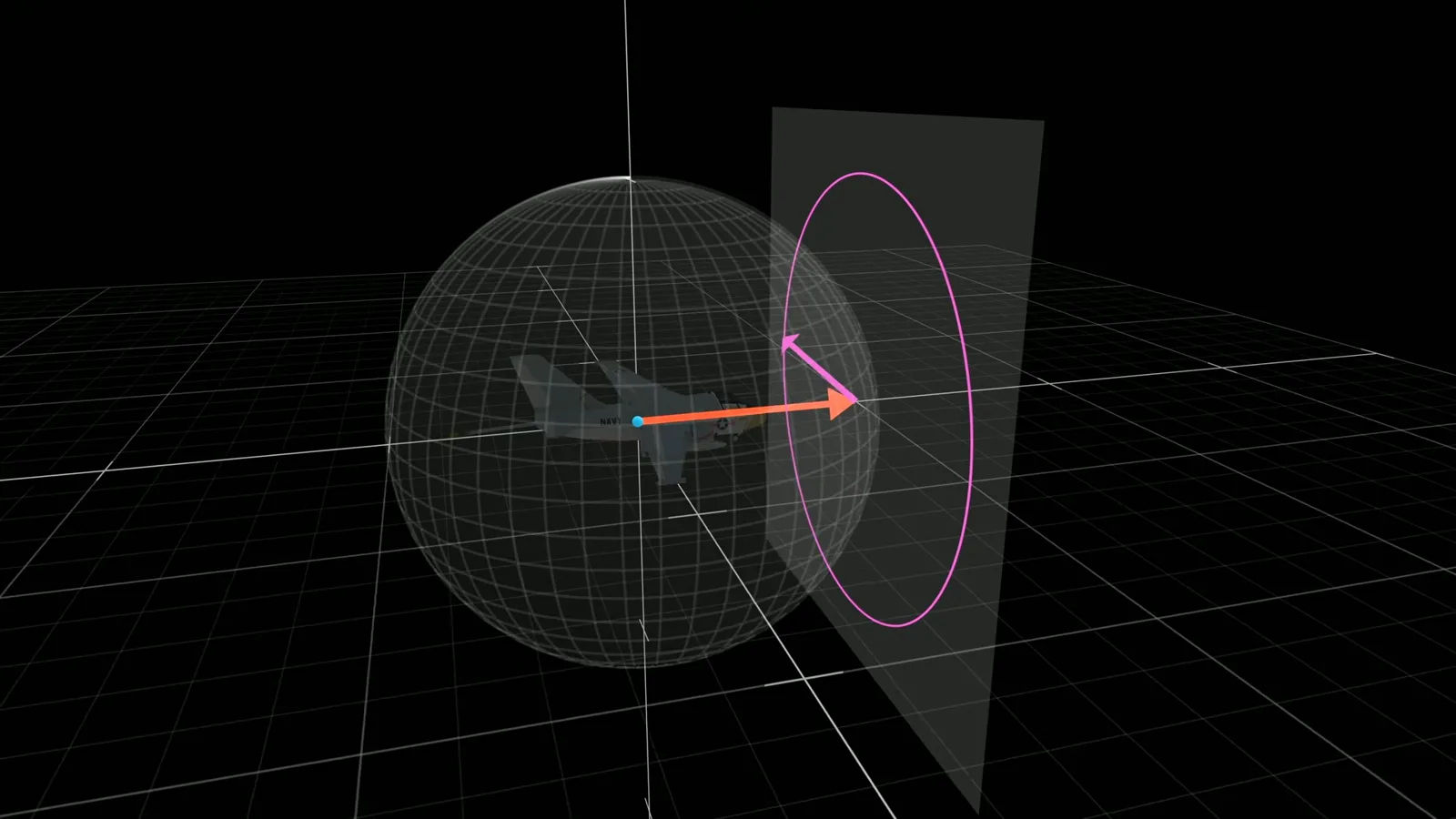
A tangent vector lies in the plane touching the sphere at its point. A tangent vector field assigns one to every point; even though diagrams show only a sample, the field covers the entire continuous surface.
The hairy ball theorem says every continuous tangent vector field on a two-dimensional sphere has at least one zero vector. In the plane animation, insisting on a nonzero wing direction everywhere therefore forces a discontinuity somewhere.
One simple choice keeps the plane’s roof as upright as possible, producing a field that fails at the vertical directions. To make a robust animation, the programmer needs more information than the instantaneous heading alone, such as features of the trajectory.
For a continuous wind field around Earth, the theorem implies a point where the component parallel to the surface is zero. The wind can still have a vertical component, and the example relies on the stated continuity and spherical idealization.
A similar argument applies to an idealized radio wave whose electric and magnetic fields are transverse to the direction of propagation. On a distant sphere, a continuous tangential field must vanish somewhere, so a nonzero signal cannot have the same field at every direction in the specified sense.
A field with one zero
Stereographic projection transfers a constant planar field onto the sphere. The north pole is its only zero.
The narrator returns to the puzzle. Swirls or source-and-sink examples often have two zeros, tempting one to guess that two are always required, but a field with exactly one zero is possible.
Stereographic projection maps the sphere minus its north pole onto a plane: rays from the north pole pass through the sphere and meet the plane. Every plane point corresponds to a unique sphere point away from that pole.
Start with a constant nonzero vector field pointing right on the plane, then project the motion back to the sphere. The resulting spherical field is nonzero away from the north pole and can be extended with a zero at that pole.
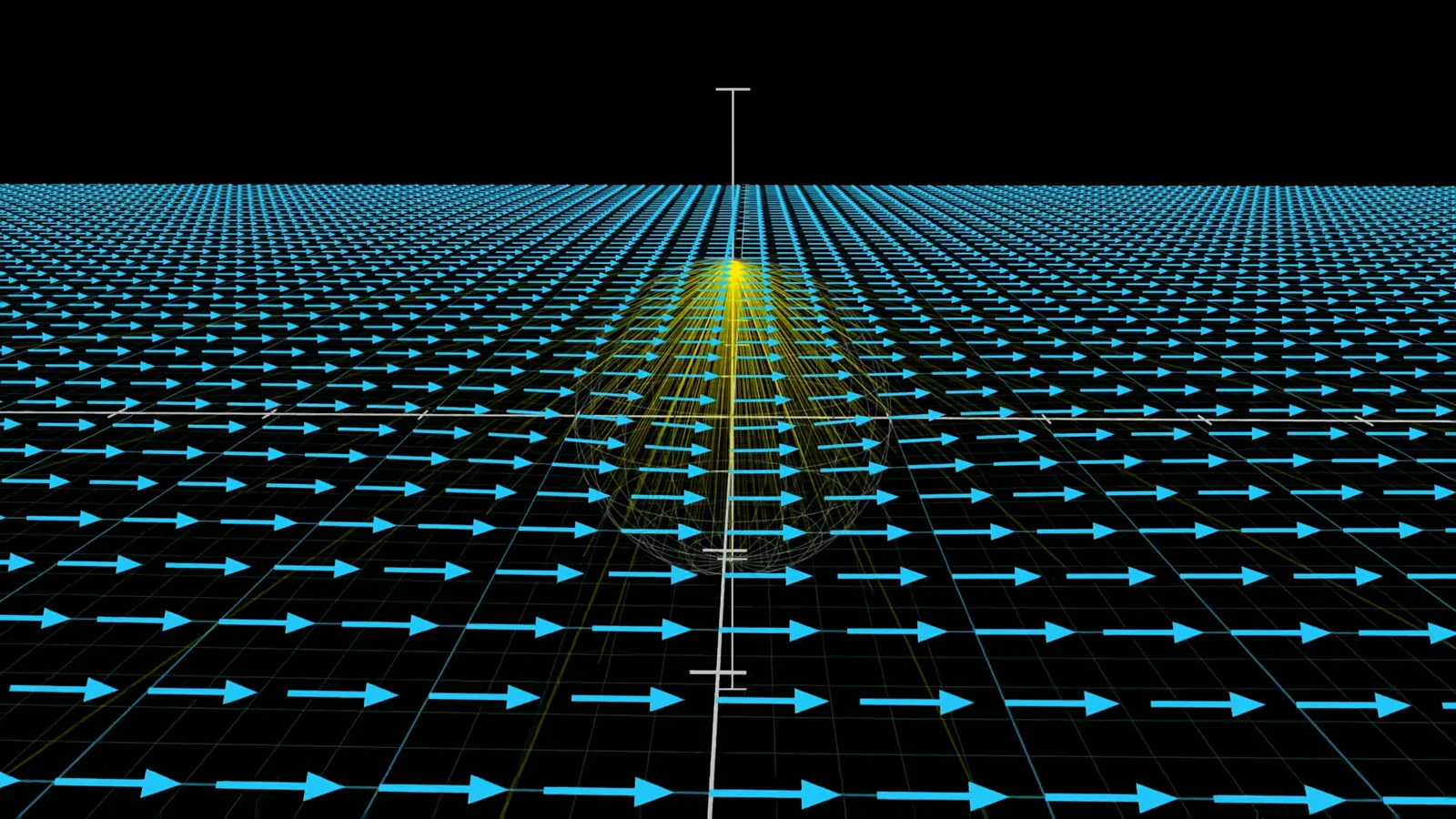
One way to understand the projected vectors is to follow particles moving uniformly to the right on the plane and take the velocities of their images on the sphere. Their paths form circles tangent at the north pole, where the velocity becomes zero.
The hypothetical deformation
A nowhere-zero field would send each point to its antipode along a continuously varying path. The animation omits a point because the assumed field cannot exist.
To show that even one zero is unavoidable, the narrator uses a proof by contradiction shared by mathematician Senia Sheydvasser. Assume there is a continuous tangent field that is nonzero everywhere.
At a point p, the assumed tangent vector and the radius define a plane through the origin and hence a great circle. Move p halfway along that circle in the vector’s initial direction; it arrives at the antipodal point −p.
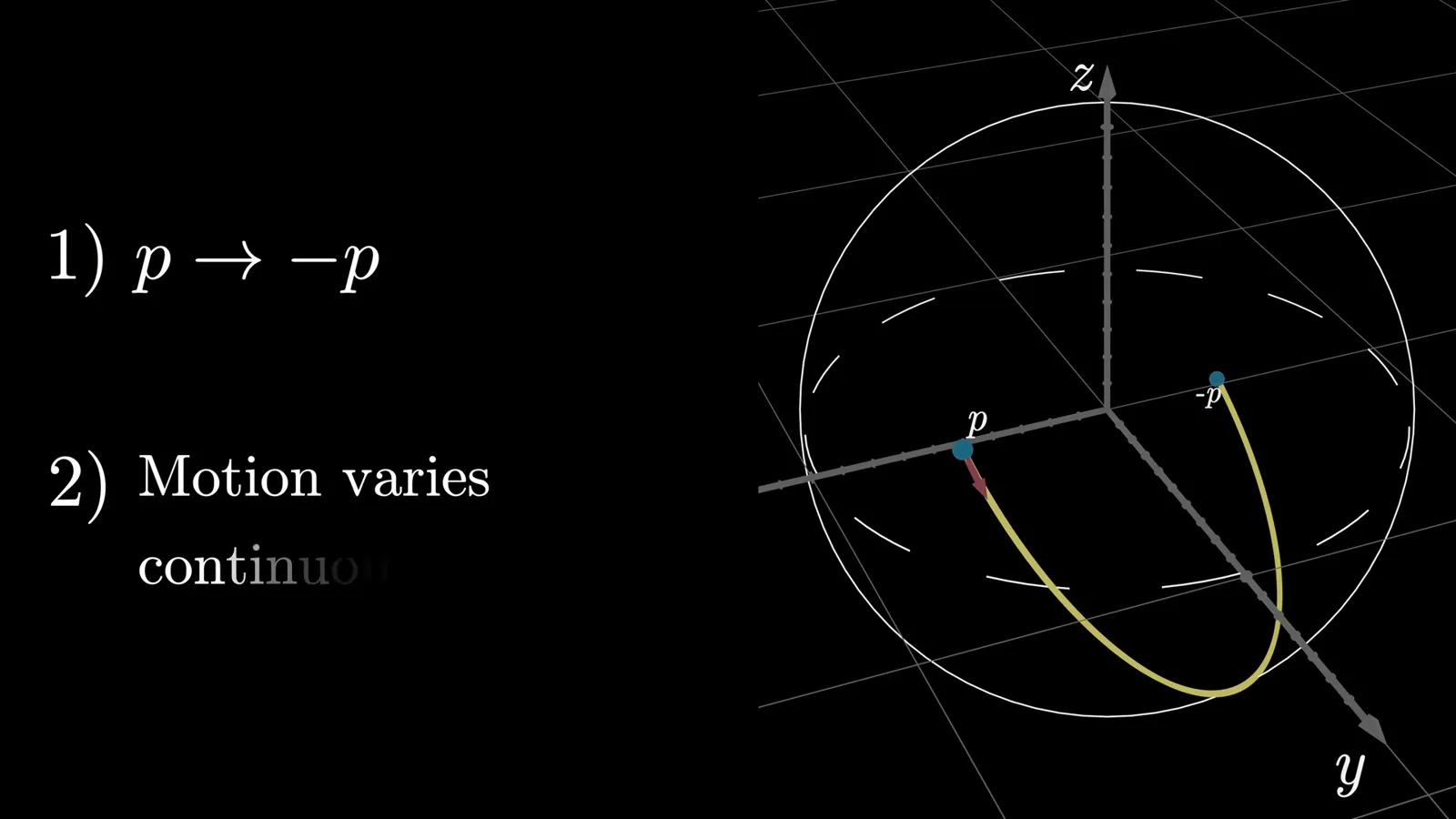
The point does not follow the vector field as it moves: its entire path is fixed by its starting vector. A continuous nonzero field would make these paths vary continuously across the sphere, and none of the paths would cross the origin.
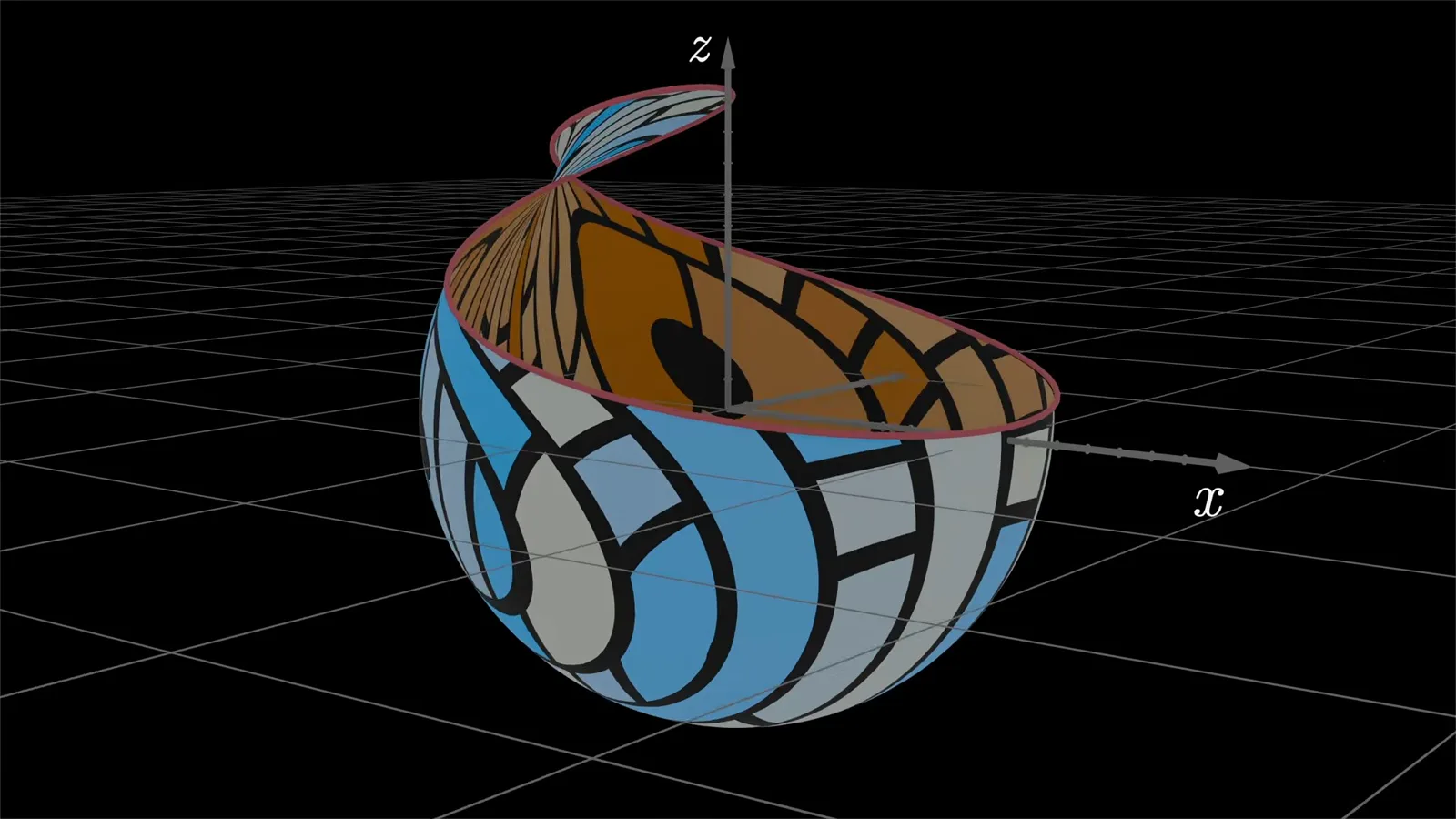
The animation cannot literally show the impossible field. Instead it uses the one-zero example and removes the north pole, illustrating the motion on the rest of the sphere while leaving the impossible point out.
As the points travel, the surface can cross itself. The animation adjusts radii and enlarges the missing patch to make the motion easier to see. The important proposed properties are orientation reversal and avoidance of the origin.
Orientation and flux
Coordinate directions track orientation, and the antipodal map reverses it. Signed flux shows why the deformation cannot avoid the origin.
To define inside and outside through a deformation, attach coordinate labels to the surface. At a point, use the ordered directions of increasing longitude and latitude and the right-hand rule to choose an oriented normal.
The coordinate labels travel with the surface. At regular points their ordered tangent directions determine a normal, providing a way to track orientation even when the surface is bent or folded.
The final map sends every p to −p. Under that map, both coordinate tangent directions reverse, but the oriented normal points toward the origin rather than outward: the antipodal map reverses the sphere’s orientation.
The narrator distinguishes this from the classic sphere eversion animation, which turns a sphere inside out without creases or cusps while allowing self-intersections. The contradiction here depends on a different restriction: no point of the surface may cross the origin.
Imagine an incompressible fountain at the origin emitting one liter per second uniformly in all directions. Flux measures the signed amount crossing an oriented surface per unit time: outward crossings count positive and inward crossings negative.
For the initial sphere, total flux is +1 liter per second. Bending or folding the surface without crossing the source does not change the net signed flux: crossings through overlapping folds cancel with the appropriate signs.
Move the surface completely away from the source and its net flux becomes zero, but that change requires the surface to pass across the origin during the deformation. Signed flux captures whether the source is enclosed with the surface’s orientation.
If the hypothetical motion reached the antipodal map, the final oriented normals would point inward and the flux would be −1 liter per second. Yet avoiding the origin would preserve the starting flux of +1.
Conclusion and dimensions
The contradictory flux values prove the theorem at an intuitive level. The narrator discusses rigor and the higher-dimensional pattern.
The contradiction rules out the assumed continuous nonzero tangent field. The narrator notes that making the flux argument rigorous requires additional details, and suggests exercises using multivariable calculus and the divergence theorem.
The final question concerns other dimensions. A circle can carry a continuous nonzero tangent field; the dimensional pattern depends on whether “dimension” means the sphere itself or the space containing it.
For spheres in an even-dimensional ambient Euclidean space, such a field exists; for spheres in an odd-dimensional ambient space, it does not. Equivalently, odd-dimensional spheres admit a nowhere-zero tangent field, while even-dimensional spheres do not.
The antipodal map preserves orientation in even ambient dimensions and reverses it in odd ambient dimensions, giving a clue to why this proof works in the latter case. The narrator leaves construction of a field in even ambient dimensions as a puzzle.
같은 채널의 다른 글
 40:44EN
 3Blue1Brown· 2026년 10월 16일Grant Sanderson: There's never been a better time to go into mathGrant Sanderson, Constantin Kogler · 3Blue1BrownStudents fear AI has solved mathematics. Grant Sanderson argues the opposite: even if machines prove theorems better than we do, the institution of math stays valuable—and this is a rare moment when newcomers can reshape it.
 51:55EN3Blue1Brown· 2026년 9월 18일The last IMO problem AI could not solveGrant Sanderson · 3Blue1BrownGrant Sanderson walks through IMO 2025 Problem 6 — a tiling puzzle that frontier models missed — and the visual patience it takes to prove a construction is optimal.
 0:55EN3Blue1Brown· 2026년 7월 24일The 64 Sugar Cubes Puzzle: Six Equal DistancesA 4×4×4 block has three colors; prove that six same-colored pairs share a distance.
 2:25EN3Blue1Brown· 2026년 6월 12일How Shannon Measured the Entropy of EnglishA guessing game helped Claude Shannon estimate how much information English text contains, and why prediction is central to compression.
 1:02EN3Blue1Brown· 2026년 6월 10일A Robot Walk and the Puzzle of Optimal Binary EncodingHow few bits does it take to send directions that occur with unequal frequencies?
 32:19EN3Blue1Brown· 2026년 6월 7일Reinventing Entropy: Why Prediction Helps Compress LanguageA robot’s movement code leads from prefix-free encoding to Shannon information and the entropy of language.