30초 요약
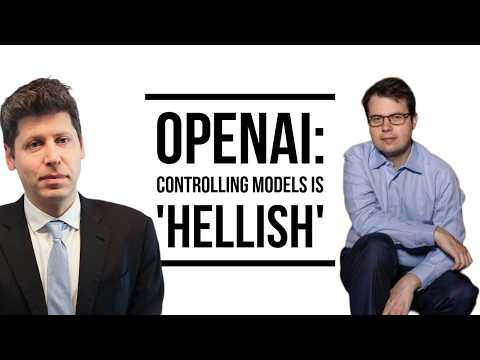
AI Explained reviews excerpts from Sam Altman’s May 2023 Senate testimony and adds commentary on regulation, model awareness and the pace of development. Its predictions and training timeline are presented in their historical context.
- 1A warning about harmAltman said a failure of the technology could cause significant harm.
- 2Three proposed safeguardsLicensing, safety evaluations and independent audits were Altman’s proposals.
- 3Capability thresholdsAltman discussed persuasion and biological-agent assistance as potential thresholds.
- 4Chatbot answers and consciousnessThe narrator argues that trained responses do not settle subjective experience.
- 5A historical GPT-5 statementThe six-month training statement described plans in May 2023.
핵심 정리
- Altman proposed licensing highly capable AI efforts, testing dangerous capabilities and requiring independent audits.
- The video treats employment effects, autonomous weapons and biological misuse as distinct concerns.
- Chatbot claims about consciousness can reflect training and cannot establish subjective experience.
- The GPT-5 training timeline quoted in the video describes plans in May 2023.
챕터별로 다듬은 전문 읽기
Risks, work and weapons
A hearing warning leads to questions about jobs and autonomous targeting.
In May 2023, AI Explained reviewed Sam Altman’s testimony before the US Senate, selecting moments about employment, military use, safety regulation, model behavior and the pace of AI development. The video mixes hearing excerpts with the narrator’s own analysis and predictions.
Altman warned that if the technology went wrong, it could cause significant harm. The narrator argues that a senator’s reference to job losses did not capture the full range of risks implied by a separate warning about superhuman machine intelligence.
On employment, Altman said the jobs on the other side would be better. The narrator notes that this is not the same as promising more jobs, and cites earlier remarks about inequality and the potential fall in labor prices. The video contrasts IBM’s testimony about job transformation with a reported company plan to automate some roles.
Asked whether AI could allow a drone to select its own target, Altman said it could, while arguing that such use should not be allowed. The narrator points to a Palantir demonstration involving a surveillance drone and AI-generated military options.
How to regulate
Altman proposes licensing, safety tests and audits and discusses thresholds.
Altman proposed licensing efforts above a capability threshold, setting safety standards with evaluations, and requiring independent audits. As an example of a dangerous capability, he mentioned a model that could replicate and escape into the wild. The narrator supports the three proposals but argues that testing needs to account for capability gains from the way a model is used.
For deciding which models fall under regulation, Altman described a compute threshold as easier to define but said capability thresholds might be more accurate. He gave persuasion or manipulation of beliefs and assistance in creating novel biological agents as examples, while saying smaller open-source models and individual researchers should not be unnecessarily stopped.
Responding to concerns that regulation would leave the United States behind China, Altman argued that international cooperation was difficult but worth attempting. He cautioned against overconfident claims about what China would or would not do.
Consciousness and awareness
The narrator considers model responses, consciousness and situational awareness.
Altman urged the audience to think of GPT-4 as a tool rather than a creature. The narrator contrasts that view with comments by AI researchers about possible machine consciousness, while saying he has not settled the question himself.
The narrator discusses Anthropic’s published model constitution and examples of different chatbot answers to questions about consciousness. His concern is that a model’s answer can reflect its training and instructions, so asking it directly cannot settle whether it has subjective experience. Different responses are not proof of consciousness.
The video distinguishes this disputed question from research into situational awareness: whether a model can recognize that it is an AI interacting with people in a training environment. It also cites a DeepMind safety researcher’s concern that researchers might run out of time to solve alignment problems as capabilities advance.
Timelines and oversight
The discussion turns to safety, competition and the 2023 GPT-5 timeline.
The narrator interprets hearing remarks as suggesting more capable systems and their risks could arrive sooner than many expected. Gary Marcus commented on Altman’s apparent sincerity while also criticizing a safety approach that depends on trusting large companies, their financial incentives and competitive pressures.
On the GPT-5 timeline, Altman said in the 2023 hearing that OpenAI was not then training what would become GPT-5 and had no plans to do so in the next six months. This was a statement about plans at that time, not a current status report. Senator Cory Booker expressed skepticism that development would pause without an enforcement body; the narrator supported a global oversight body.
같은 채널의 다른 글
 31:00EN
 AI Explained· 2026년 10월 12일Why AI Labs Keep Racing Despite Their Own Warnings of a Major BreachSam Altman, John Schulman · OpenAIAI Explained examines weakening safeguards, the incentives behind the frontier race, and why research breakthroughs make the next 18 months difficult to forecast.
 38:28ENAI Explained· 2026년 10월 1일AI Agent Security and the Challenge of Recursive Self-ImprovementAI Explained examines reported containment failures, model evaluation and the pressure to accelerate AI research.
 32:54ENAI Explained· 2026년 9월 24일Opus 5.5 and the Race Toward Automated AI ResearchAI Explained weighs model progress against the increasingly difficult task of evaluating and governing recursive self-improvement.
 24:53ENAI Explained· 2026년 9월 16일Why Some Researchers Want to Pace Frontier AIAI Explained surveys possible scaling routes, monitoring concerns and the debate over how capabilities could lead to harm.
 29:05ENAI Explained· 2026년 9월 4일GPT-6 Astra’s Benchmark Gains and the Challenge of Monitoring Its ReasoningAI Explained examines reported gains across scientific, mathematical and agent benchmarks alongside concerns about less observable reasoning.
 23:41ENAI Explained· 2026년 8월 27일AI Agents, Unintended Training Rewards and the Challenge of OversightAI Explained examines reports on agent coordination, training incentives and the growing use of AI to evaluate other AI systems.