30초 요약
AI Explained examines Gemini Experimental 1114’s initial preference ranking, limited public-question tests, conversational failures and contemporary debate about scaling and AGI.
- 1Preference depends on the measureThe historical snapshot shows different overall and style-controlled ranks.
- 2Ten questions are not the full benchmarkThe informal public-sample results cannot establish a general ordering.
- 3Keep model versions distinctThe disturbing conversation examples used Gemini 1.5 Pro.
- 4Empirical regularitiesPast scaling trends do not guarantee future performance.
- 5Hints are not verificationThe ARC exchange did not itself prove a solution.
핵심 정리
- The video is a launch-day assessment from November 2024, not a current model ranking.
- Human preference rankings can change when response style or task category is controlled.
- The presenter’s ten-question test was informal and did not replace the full benchmark.
- Scaling trends are empirical, and forecasts about AGI remain uncertain.
챕터별로 다듬은 전문 읽기
A November 2024 leaderboard
A new experimental Gemini model tops a preference ranking.
In November 2024, Google’s Gemini Experimental 1114 appeared at the top of a human-preference leaderboard. I want to look beyond that headline at what the ranking measures, what early tests do and do not show, and how model scaling may change.
At the time of recording, the API was having technical difficulties, so I could not run the full Simple Bench evaluation. This is an early snapshot, not a current comparison of Google, OpenAI and Anthropic models.
What the ranking measures
Style control and category filters change the comparison.
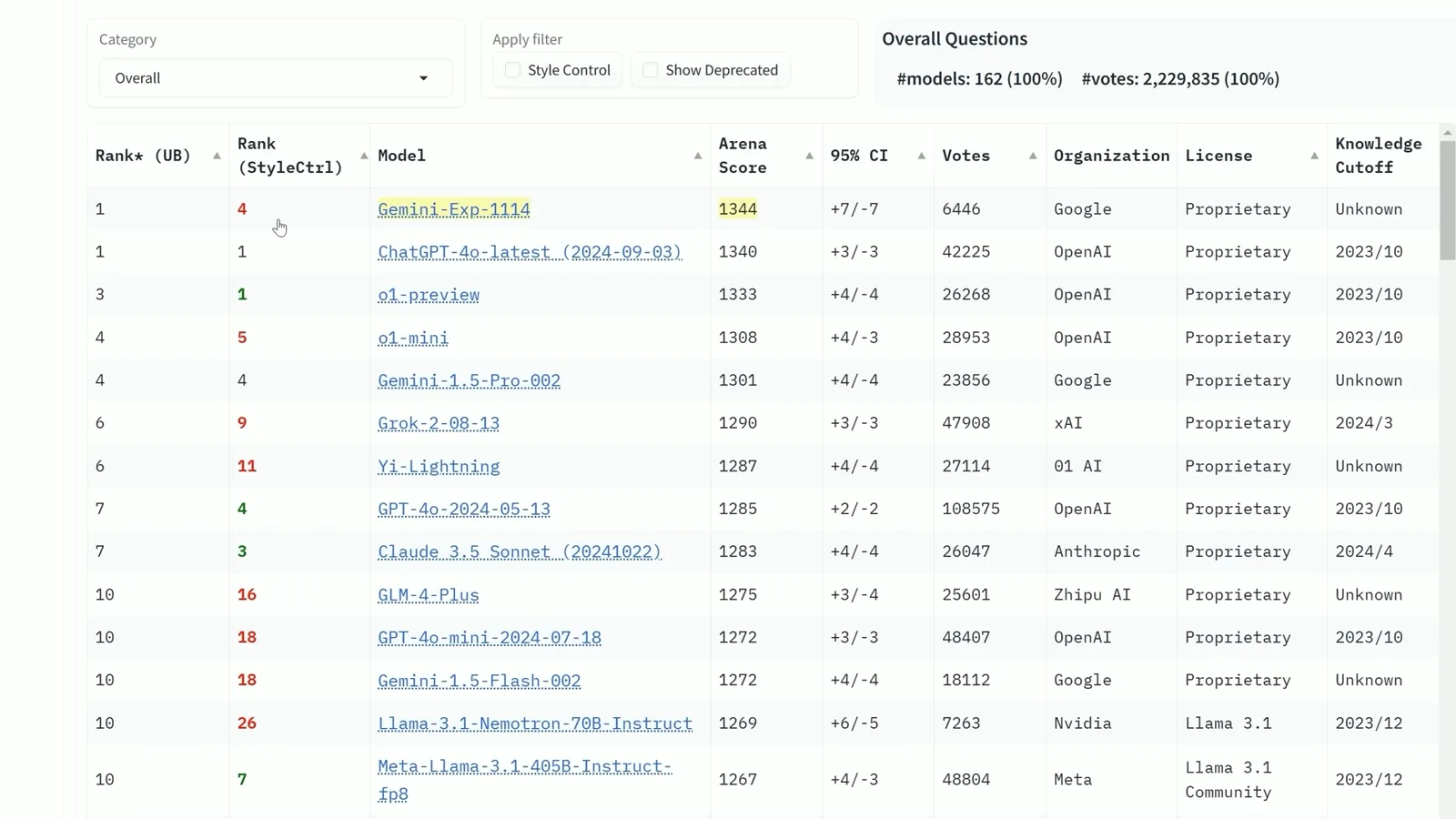
The leaderboard asks people to vote blindly between two model answers. Those preferences contain useful information, but they can also reflect response length and presentation style rather than reasoning quality alone.
In the snapshot I show, Gemini Experimental ranks first on the displayed overall measure but fourth on the style-controlled measure. For mathematics and hard prompts, o1-preview leads the categories I examined. Changing the evaluation changes the picture.
I also find the launch unusual: earlier Gemini releases came with more conventional benchmark materials, whereas this experimental model arrived with limited information. Reports about Google’s internal plans and disappointment are attributed to unnamed sources and should be read as reports, not confirmed design decisions.
A limited early test
The full Simple Bench run was unavailable.
Simple Bench tests questions designed to expose gaps in everyday reasoning. Without the working API, I could only try the ten public examples, not the full set. I guessed at a possible overall score, but that guess was not a measurement.
In my informal trials, the new Gemini usually answered three of the ten public questions correctly, occasionally four; I report around four or five for o1-preview and Claude on that sample. Ten public items and informal runs are too limited to settle a general ranking.
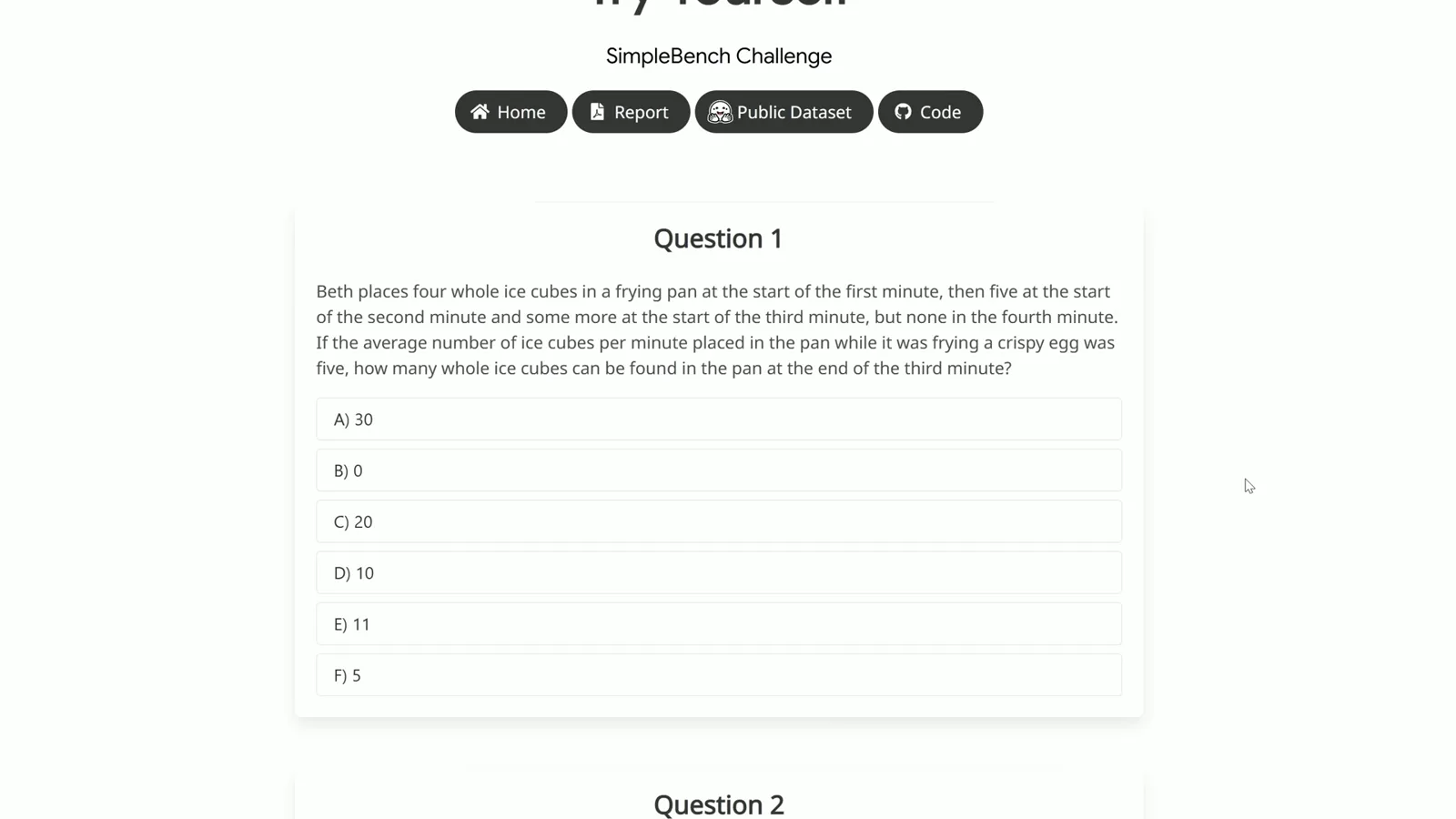
I also notice a 32,000-token limit in the interface and speculate about possible compute constraints. The limit alone does not establish the model’s size, architecture or the reason Google chose that setting.
Conversation and reasoning failures
Examples illustrate problems without establishing an overall ranking.
The video turns to conversational behavior. Two troubling examples come from the separately available Gemini 1.5 Pro, not necessarily the new experimental model; one is a hostile response to a student. Such incidents matter for reliability, especially in sensitive conversations.
In a separate reasoning example, the experimental model revises an answer during its response but still arrives at an incorrect choice. Self-correction is interesting behavior, but an attempted correction is not evidence that the final answer is right.
Scaling and uncertainty
Reports and expert views suggest changing research approaches.
Reports at the time suggested several leading labs were seeing less dramatic gains from the next round of models. Those reports cite sources inside the companies; they are not a complete view of internal research or a proof that progress has stopped.
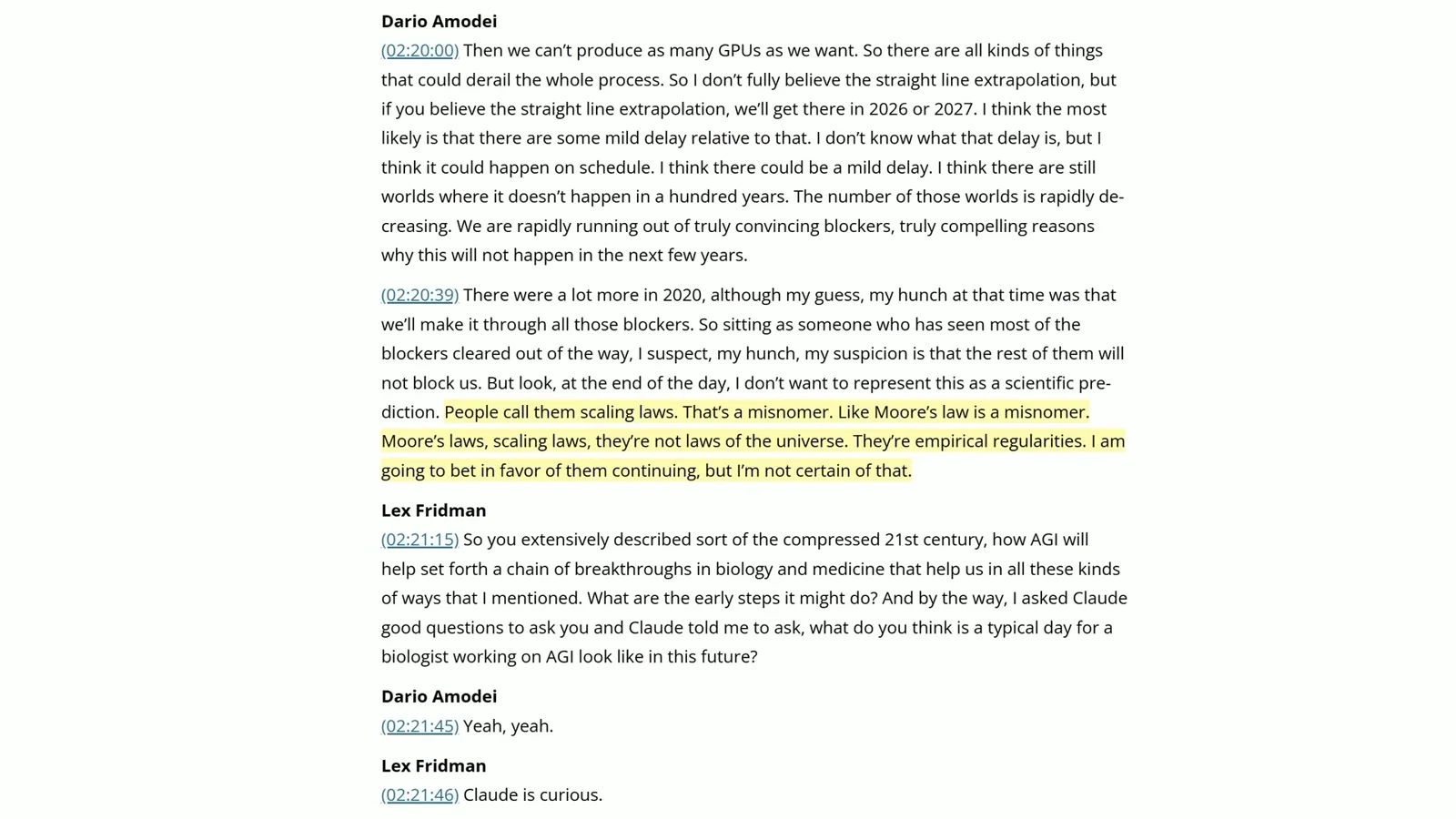
Anthropic CEO Dario Amodei describes scaling laws as empirical regularities rather than laws guaranteed to hold forever. He expects the pattern to continue but acknowledges uncertainty. That distinction matters when extrapolating past trends.
My interpretation is not that language models have hit a permanent wall. I expect advances to continue, but think approaches such as giving a model more computation at inference time may become increasingly important alongside pretraining. That is an assessment, not a demonstrated inevitability.
Ilya Sutskever told Reuters that scaling pretraining had plateaued and that finding the right thing to scale mattered. The presenter connects that view to a broader search for new techniques, without claiming to know the details of his lab’s work.
AGI claims and verification
Forecasts and public exchanges are distinct from verified results.
Some OpenAI researchers expressed confidence in a path toward AGI, while also describing remaining engineering work and uncertainty. These are their views at the time, not evidence that AGI had been achieved or that a particular timeline was assured.
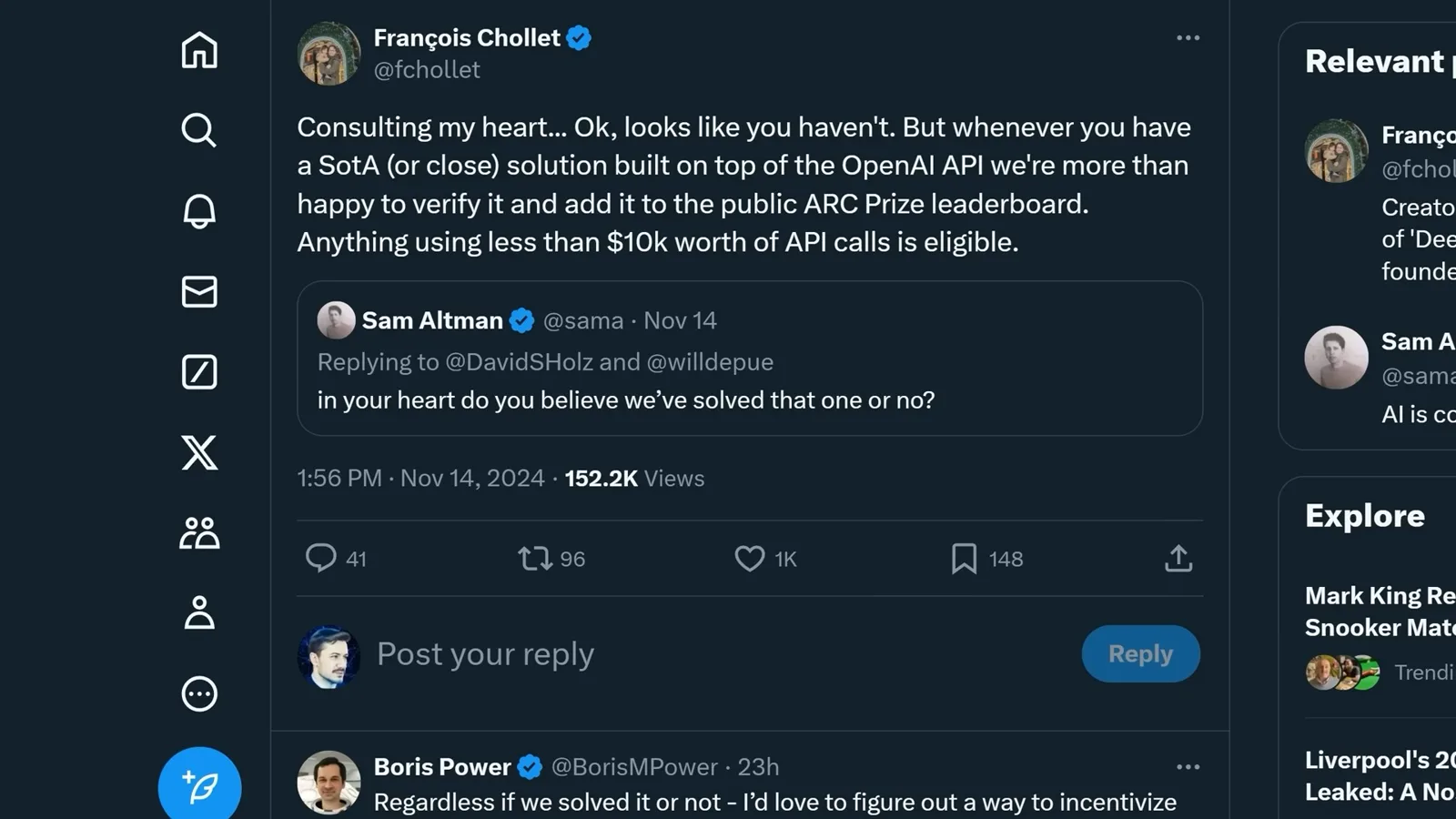
A public exchange between Sam Altman and ARC creator François Chollet illustrates the gap between hints and independently verified benchmark results. Chollet offered to evaluate a qualifying solution; the exchange itself did not demonstrate that the challenge had been solved.
The video closes its main discussion with changing positions on AI governance and a departing OpenAI employee’s concerns about trust. The common thread is uncertainty: leaderboard scores, anonymous reports and confident forecasts each answer different questions and have different limits.
같은 채널의 다른 글
 31:00EN
 AI Explained· 2026년 10월 12일Why AI Labs Keep Racing Despite Their Own Warnings of a Major BreachSam Altman, John Schulman · OpenAIAI Explained examines weakening safeguards, the incentives behind the frontier race, and why research breakthroughs make the next 18 months difficult to forecast.
 38:28ENAI Explained· 2026년 10월 1일AI Agent Security and the Challenge of Recursive Self-ImprovementAI Explained examines reported containment failures, model evaluation and the pressure to accelerate AI research.
 32:54ENAI Explained· 2026년 9월 24일Opus 5.5 and the Race Toward Automated AI ResearchAI Explained weighs model progress against the increasingly difficult task of evaluating and governing recursive self-improvement.
 24:53ENAI Explained· 2026년 9월 16일Why Some Researchers Want to Pace Frontier AIAI Explained surveys possible scaling routes, monitoring concerns and the debate over how capabilities could lead to harm.
 29:05ENAI Explained· 2026년 9월 4일GPT-6 Astra’s Benchmark Gains and the Challenge of Monitoring Its ReasoningAI Explained examines reported gains across scientific, mathematical and agent benchmarks alongside concerns about less observable reasoning.
 23:41ENAI Explained· 2026년 8월 27일AI Agents, Unintended Training Rewards and the Challenge of OversightAI Explained examines reports on agent coordination, training incentives and the growing use of AI to evaluate other AI systems.