30초 요약
In an April 2025 roundup, Matthew Berman discusses Gemini 2.5 Flash, OpenAI’s o3, o4-mini and GPT-4.1, Claude Research, Groq Compound Beta, Kling 2.0 and other news. He distinguishes announcements from speculation; the video includes a Replit sponsorship and he discloses a small Groq investment.
- 1Configurable thinkingGemini 2.5 Flash offered a thinking budget; the video compares historical preview prices and selected benchmarks.
- 2An image-location exampleBerman reports one successful location inference and notes its privacy implications; one example does not establish general accuracy.
- 3Groq Compound BetaThe service combined openly available models with web search and code execution. Berman disclosed a small investment in Groq.
- 4Reports versus confirmed dealsThe reported OpenAI–Windsurf talks were unconfirmed when the video was made.
- 5Computer use and memoryMicrosoft described GUI automation in Copilot Studio, while xAI introduced Grok memory in beta in selected markets.
핵심 정리
- Gemini 2.5 Flash introduced a configurable thinking budget and preview pricing presented in the video.
- OpenAI’s o3 and o4-mini added to a busy week of model releases; one image-location example illustrates both capability and privacy concerns.
- Claude Research and Groq Compound Beta combined models with research and tool access in different ways.
- Kling’s side-by-side clips illustrate a claimed improvement, but are not a comprehensive evaluation.
- The Windsurf acquisition and social network stories were reports and speculation at the time.
챕터별로 다듬은 전문 읽기
Gemini 2.5 Flash and OpenAI reasoning models
Berman compares historical prices and selected benchmarks. He shows an image-location example with o3.
In this April 2025 news roundup, I look at Gemini 2.5 Flash, OpenAI’s o3 and o4-mini, GPT-4.1, Claude Research, Groq Compound Beta and Kling 2.0. The video is sponsored by Replit. Prices, product availability and comparisons below are from the time of recording.
Google describes Gemini 2.5 Flash as a hybrid reasoning model with a configurable thinking budget. Developers can choose whether to use thinking and how much computation to allocate, trading response cost and latency against performance for harder tasks.
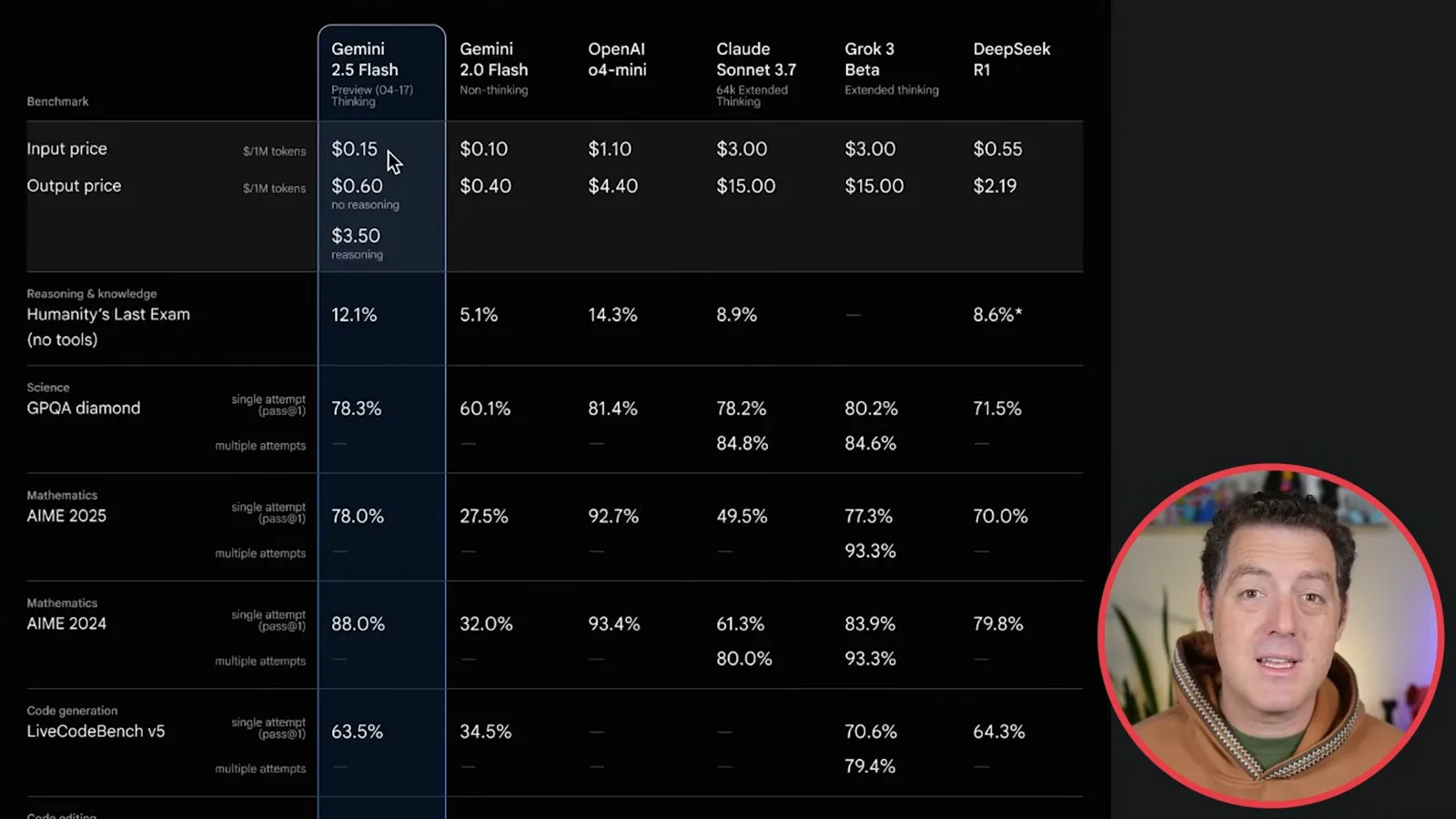
The displayed preview pricing is $0.15 per million input tokens, $0.60 per million non-reasoning output tokens and $3.50 per million reasoning output tokens. These historical rates are not a current price quote; actual costs depend on the provider and configuration.
Google’s comparison shows Flash scoring 12.1% on Humanity’s Last Exam without tools and 78.3% on GPQA Diamond, compared with 14.3% and 81.4% respectively for o4-mini in the displayed table. These are selected vendor-reported results with particular settings, not a complete ranking of models.
A price-versus-Arena-score chart places Flash below Gemini 2.5 Pro but at a lower cost. I plan further tests because benchmark scores and pricing alone do not show how a model will perform on every real task.
OpenAI released o3 and o4-mini. I am impressed by o3’s ability to use tools while reasoning, while o4-mini offers a smaller and cheaper option. I intend to test both more thoroughly.
To illustrate image reasoning, I ask o3 to identify the location in a vacation image after removing references from saved memories. It identifies the area correctly in this example. One success does not mean location inference is solved, and the demonstration raises a real privacy concern.
Replit, GPT-4.1 and Claude Research
The sponsored segment introduces Replit Agent V2. Berman then discusses OpenAI’s model family and Anthropic’s research and Workspace features.
Replit sponsors the video and I describe its cloud IDE and Agent V2. The company claims improved task success compared with the previous agent; that claim is presented as a sponsor’s assertion, not an independently verified result.
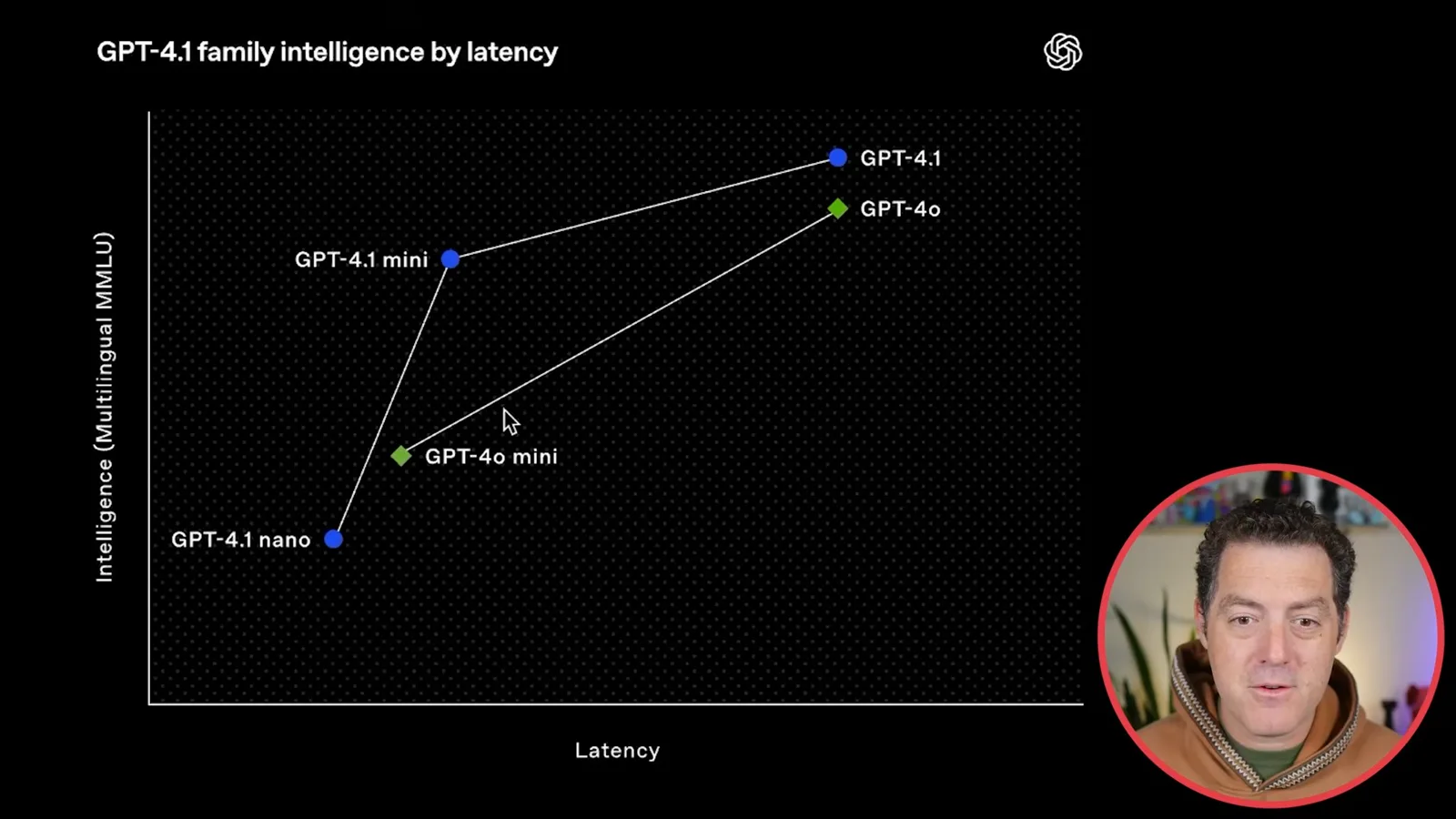
OpenAI also introduced GPT-4.1, mini and nano. A chart compares multilingual benchmark performance with latency against GPT-4o variants, but the axes have no numerical scales, limiting the precision of any conclusions drawn from it.
Anthropic launched a Research feature and Google Workspace integrations. I am excited about the possibility of finding information and drafting responses using connected services, though the information available to an assistant depends on its permissions and the product’s actual configuration.
Groq and Kling
Groq Compound Beta adds tool execution to model calls. Berman compares example clips from Kling video models.
Groq, the inference company in which I disclose a small investment, announced Compound Beta. It combines openly available models with server-side web search and code execution, choosing and using tools as needed before returning a response. Groq is distinct from xAI’s Grok assistant.
The described configuration uses Llama 4 Scout for core reasoning and Llama 3.3 70B for routing and tool selection. My excitement centers on combining tool use with fast inference; the exact models and service configuration were those described at the time.
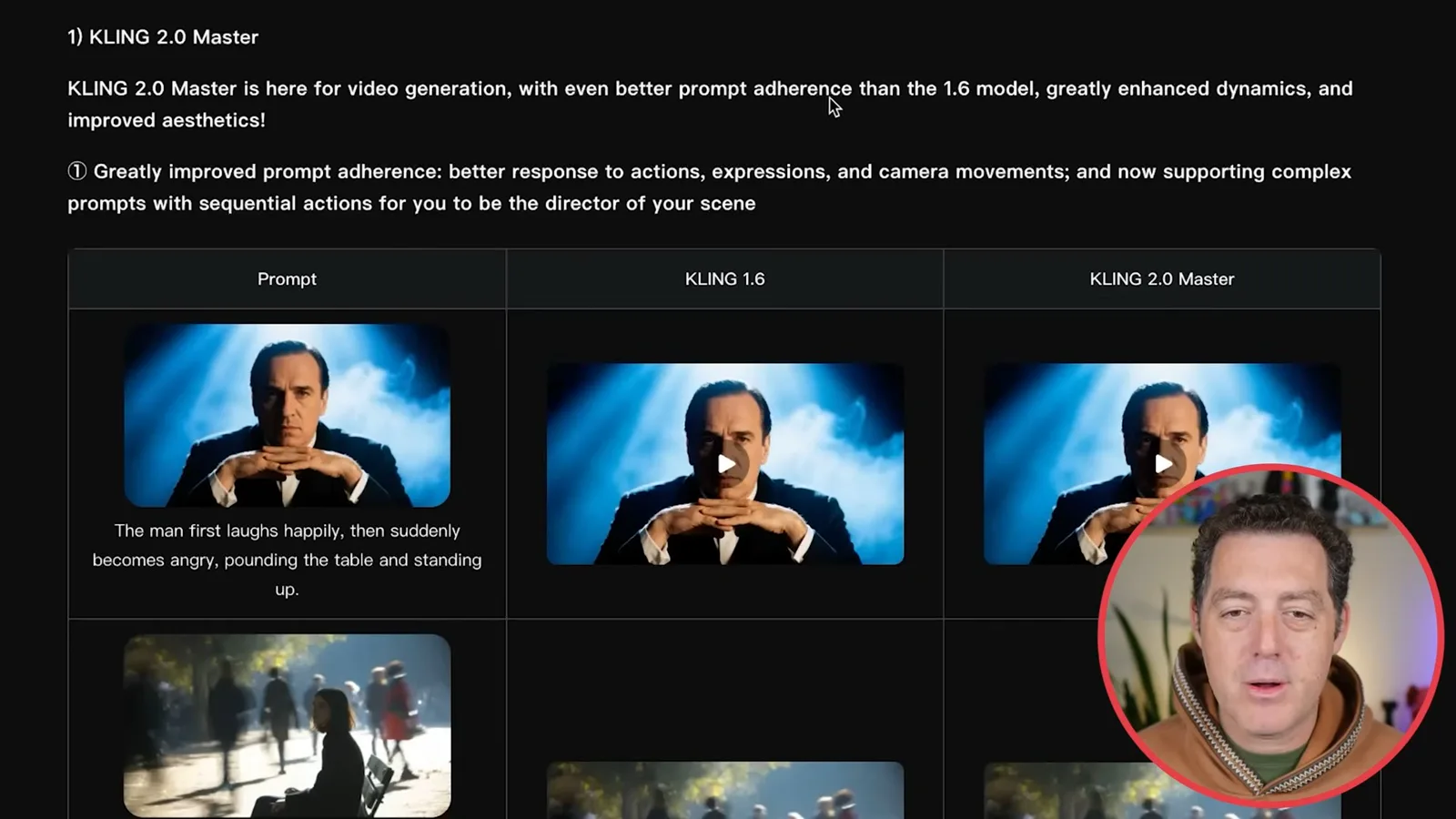
Kling 2.0 Master is presented with comparisons against Kling 1.6. In examples of a man changing expression and a girl in a park, I find the newer clips more dynamic and natural. Those examples are demonstrations, not a systematic evaluation of video quality.
Industry reports and agent features
He discusses unconfirmed reports about OpenAI, Microsoft’s computer-use announcement and Grok memory.
Reports said OpenAI was discussing a possible Windsurf acquisition for $3 billion. At the time of this video the deal was not confirmed. I wonder whether ownership by a model provider could affect support for competing models, while hoping that users retain choice.
There were also reports that OpenAI was considering a social network. I speculate that a social product could provide a source of fresh data and benefit from an existing user base. That is a possible business rationale, not confirmation that such a product would launch or succeed.
Microsoft announced computer use for Copilot Studio agents, describing tasks such as data entry, research and invoice processing through graphical interfaces. I think this could change robotic process automation, although real deployments still need reliability, permissions and oversight.
Finally, xAI’s Grok introduced memory in beta in certain markets. The idea is to personalize answers across conversations, with controls to inspect or delete saved memories. I welcome the convenience, while recognizing that others may prefer not to retain personal information.
That is the week’s roundup: new models, research and productivity features, and early agent workflows. Replit sponsored this video; the descriptions and forecasts reflect the 2025 news cycle rather than current product guidance.
같은 채널의 다른 글
 25:50EN
 32:20EN
 45:08EN
 0:32EN
 12:14EN
 10:36EN