30초 요약
In January 2025, Matthew Berman describes the announced beta of ChatGPT Tasks, which lets users schedule one-time or recurring requests. He had not yet received access, so his account relies on launch reporting rather than a hands-on test. Availability, interface, and limits described in the video are historical and may have changed.
- 1Scheduling a requestBerman describes asking ChatGPT to follow up at a specified future time or on a recurring schedule.
- 2A launch report, not a testHe says the beta was rolling out to paid subscribers and that he did not yet have access.
- 3Suggested tasksThe contemporary report he cites says users must approve suggested tasks before creation.
핵심 정리
- Tasks were introduced as a way to schedule a request or reminder for a future time.
- The initial beta was described as supporting recurring requests and user-approved suggestions.
- Berman sees scheduling as a step toward assistants that act over time, while noting that scheduling itself is a familiar software capability.
챕터별로 다듬은 전문 읽기
What Tasks was designed to do
The beta introduced scheduled reminders and requests in ChatGPT.
In January 2025, Matthew Berman reports that OpenAI is introducing Tasks in ChatGPT. The feature is intended to let a user describe something to do or remember and specify when to follow up. He sees it as a useful step toward a digital assistant, while noting that scheduling is a straightforward capability in conventional software.
Berman says the initial beta was rolling out to Plus, Team, and Pro subscribers, but he had not yet received access. His description is therefore based on launch reporting rather than his own test. The interface, eligible plans, limits, and product capabilities may have changed since this video.
One-time and recurring requests
Berman gives a daily weather report as an example and describes the launch interface.
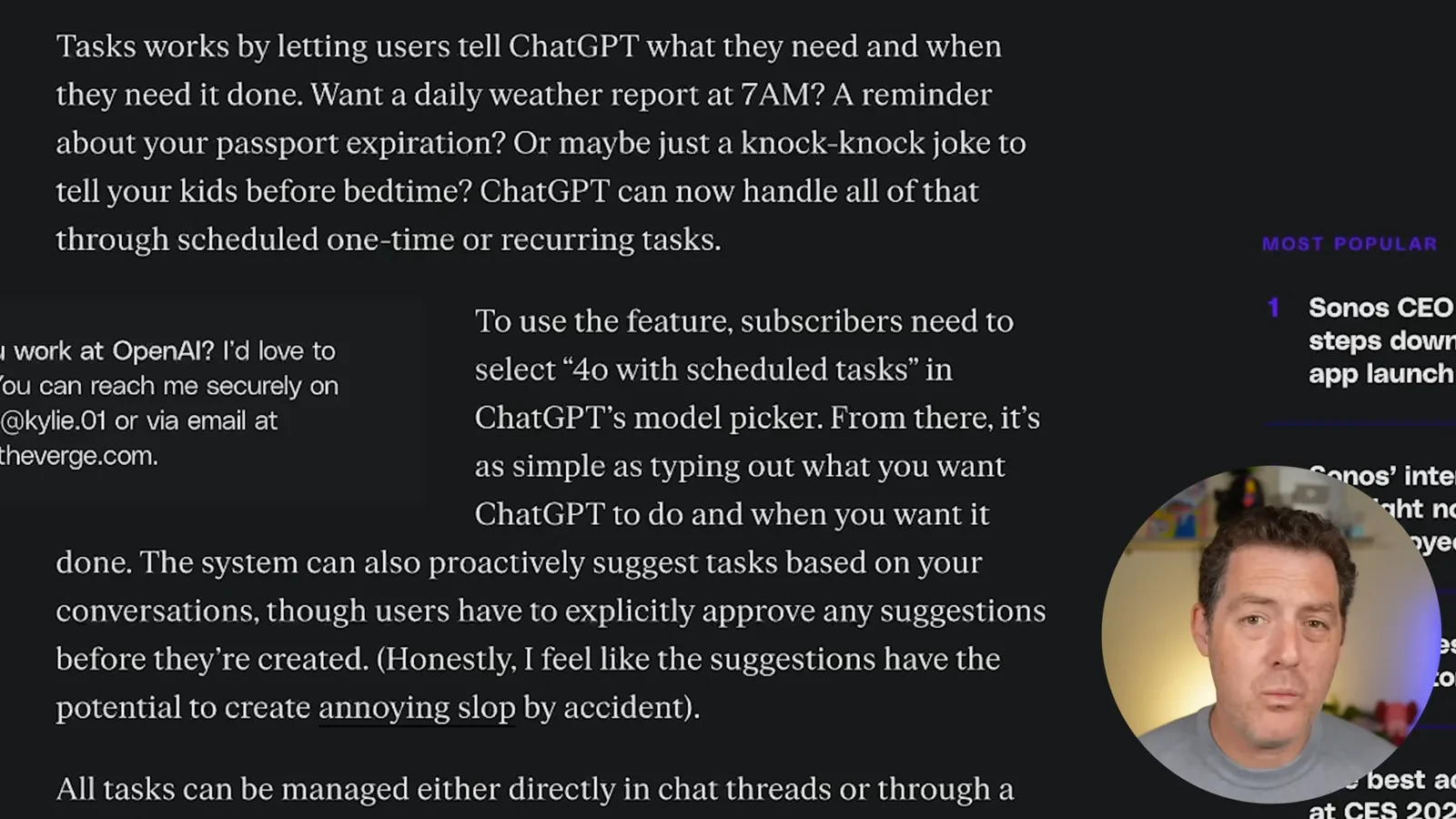
A request could be scheduled once or repeatedly: for example, a daily weather report at 7 a.m. Berman also describes an interface for viewing saved reminders and the model selector used at launch. Those specific navigation instructions are a snapshot of the original beta, not necessarily current instructions.
Suggestions and future assistants
He discusses approval for suggested tasks and the potential for more agent-like features.
The report he reads says ChatGPT could suggest tasks based on a conversation, with user approval required before creating them. Berman finds that useful for recurring information or future follow-ups. He reports an initial limit of ten active tasks and no announcement at the time about a free-tier rollout.
Berman connects scheduled tasks to the broader idea of agents that carry out work on a user's behalf, and looks ahead to browser-controlling systems. He stresses that a simple scheduled request can also be built with traditional scripting; his interest is in bringing the experience into a conversational assistant.
같은 채널의 다른 글
 25:50EN
 32:20EN
 45:08EN
 0:32EN
 12:14EN
 10:36EN