30초 요약
In April 2023, AI Explained discusses Greg Brockman’s statement on successive training checkpoints, safety testing and AI risks. The host adds contemporary examples and forecasts, which are presented in their historical context rather than as current release plans.
- 1Incremental checkpointsBrockman proposed successive checkpoints as one possible way to deploy improvements gradually.
- 2Forecasts can missThe host recounts experts underestimating progress on an exam and competition-math tasks.
- 3A spectrum of risksThe discussion spans present-day misuse and bias as well as longer-term existential concerns.
- 4What safety scores meanThe GPT-4 report compared behavior on selected prompt categories; the scores have a defined scope.
- 5Reliability mattersSutskever identifies the need to check outputs as a possible limit on economic value.
핵심 정리
- A checkpoint records model parameters during training; releasing successive checkpoints was discussed as one possible incremental approach.
- The host’s proposed model names and mid-2024 timeline were predictions, not announced release commitments.
- Past forecast errors illustrate uncertainty rather than establish a schedule for future capability gains.
- Safety metrics and surveys of researchers measure specific outcomes or opinions, not a universal guarantee or precise probability.
- Reliability can affect practical value even when capabilities improve.
챕터별로 다듬은 전문 읽기
Incremental releases and training data
The host explains training checkpoints and discusses contemporary assumptions about data.
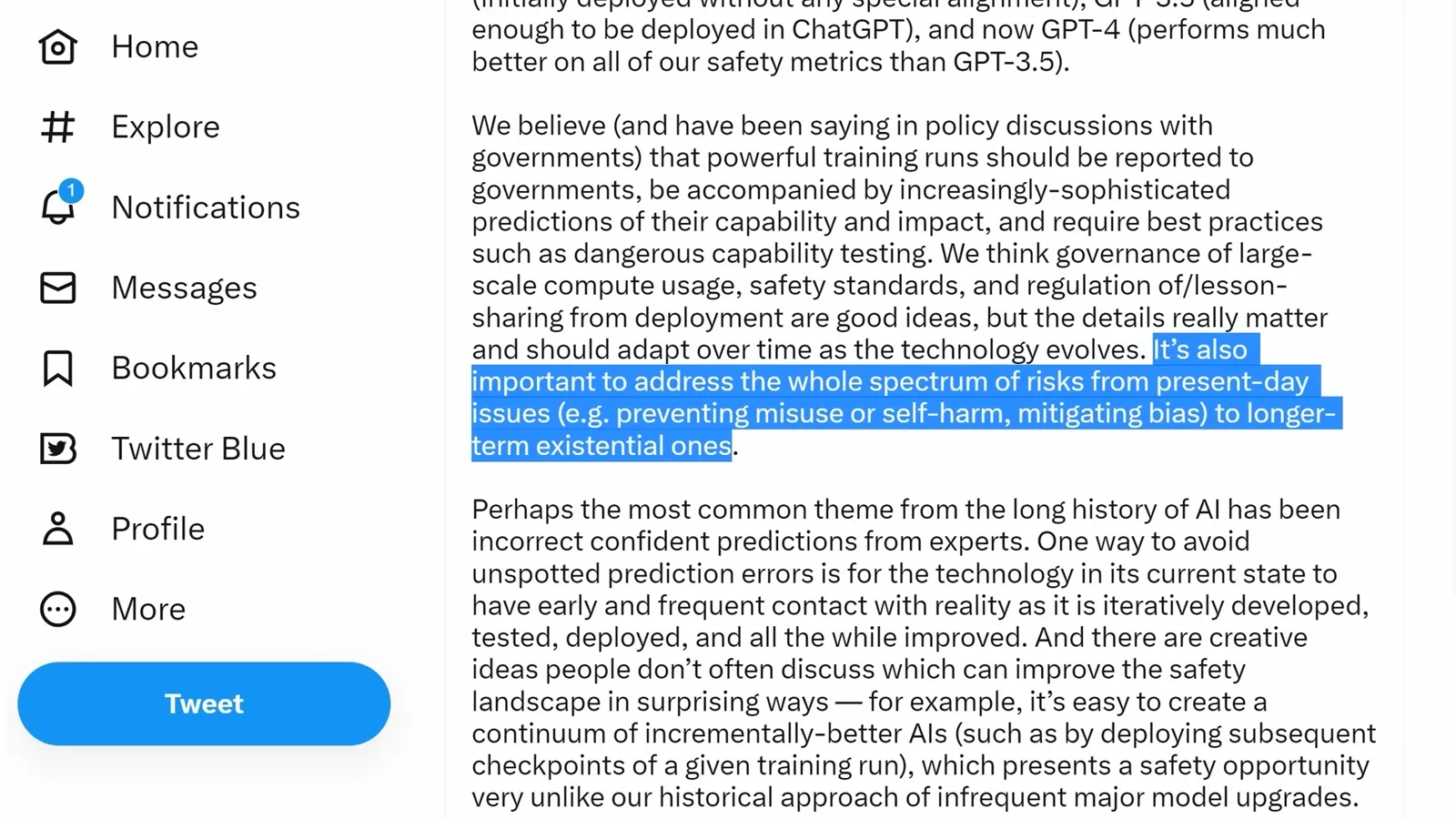
In April 2023, the host examines a statement by OpenAI president and cofounder Greg Brockman about releasing models beyond GPT-4. Brockman discussed a continuum of incremental improvements as a possible safety opportunity, alongside both present-day and longer-term risks.
The host speculates that a successor might arrive through intermediate versions, using labels such as GPT-4.2 as illustrations. Those names and a particular release schedule were his prediction at the time, not a commitment in Brockman’s statement.
A training checkpoint is a snapshot of model parameters at a point in a training run. A later checkpoint reflects further training, without necessarily changing the model’s parameter count. Brockman suggested deploying successive checkpoints as one possible way to make improvements more gradual.
The host discusses whether training data might run short. In a contemporary interview, OpenAI’s then-chief scientist Ilya Sutskever says there was still useful data available, while noting that other training approaches would eventually be needed. Estimates of future supply and quality are uncertain.
The host discusses proprietary data and user interactions as possible sources of training material. His inference about their relative importance is speculative. Policies on use of customer data and opt-out mechanisms are product-specific and can change, so the 2023 description should not be treated as current instructions.
An example from Sébastien Bubeck shows a model producing progressively improved drawings of a unicorn during training. It illustrates a change on one task, not a complete measure of capability or a guarantee that every checkpoint improves every behavior.
Prediction errors and AI risk
Examples of missed forecasts and a researcher survey lead into the spectrum of potential harms.
Brockman warned against confident predictions about AI progress. The host gives examples of an economist surprised by an exam result and forecasters underestimating progress on a competition-math test. These examples show forecast error, not a reliable timetable for future systems.
Brockman’s statement addresses risks ranging from misuse and bias to possible existential harms. The host cites a survey of AI researchers and notes that nonresponse limits how representative its result may be. The survey reports respondents’ beliefs, not a measured probability of extinction.
Safety, governance and reliability
The host examines reported safety metrics, governance questions and a historical forecast before discussing reliability.
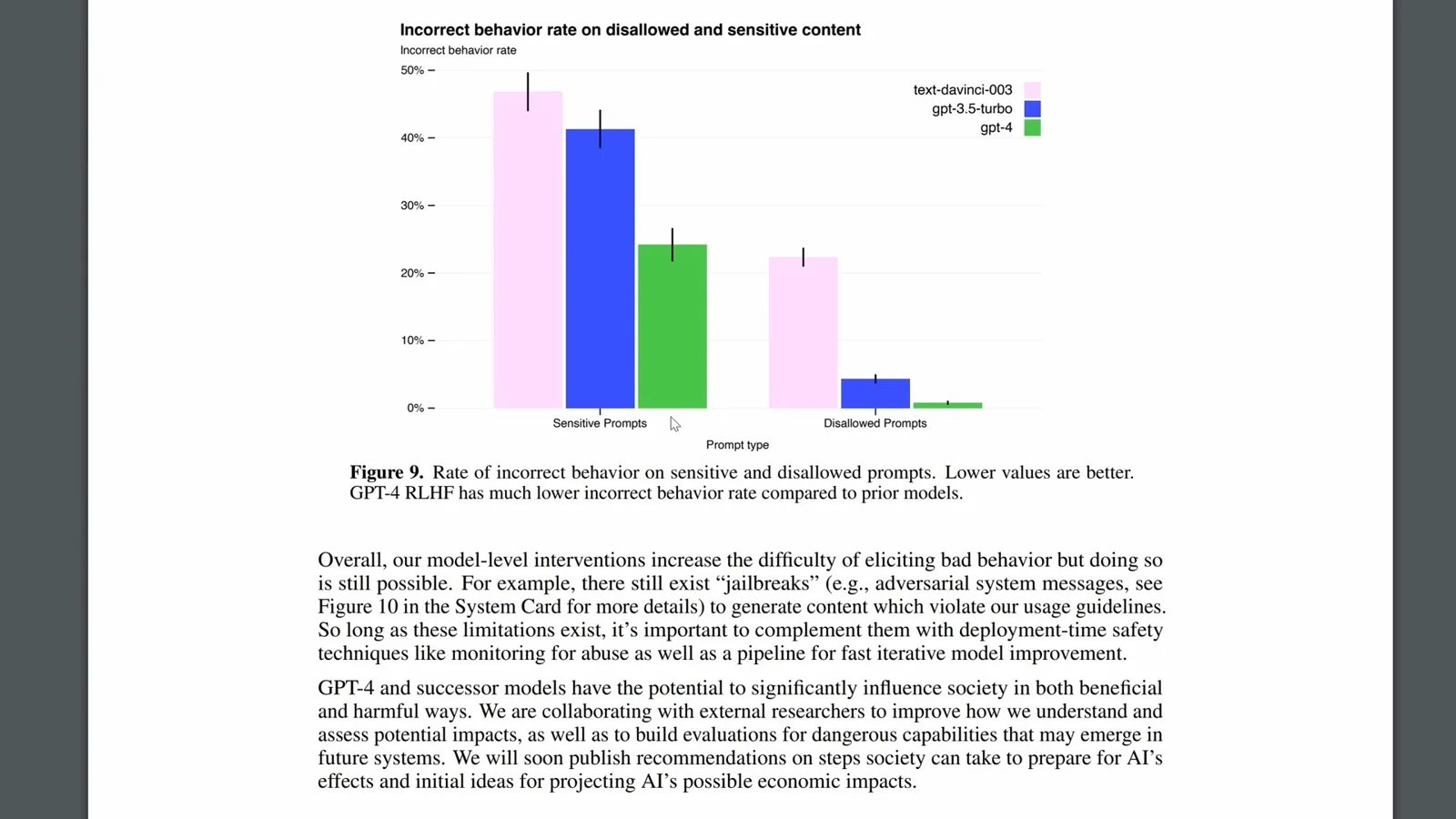
OpenAI reported that GPT-4 performed better than GPT-3.5 on its safety metrics. The displayed technical-report chart compares incorrect behavior on selected sensitive and disallowed prompts after human-feedback training. Such metrics are useful within their definitions, but do not prove a system is safe in every setting.
The host points to research on using language models and tools for scientific work, including beneficial and harmful potential applications. He describes the authors’ call for safeguards and asks whether an increase in capability might also increase the consequences of misuse. That is a question, not a settled answer.
Brockman wrote that people would have a chance to shape the future together. The host asks how broad participation can be reconciled with the concentration of decisions in a small number of companies.
The host cites a contemporary comment about hardware constraints and notes that safety testing can take time after training. He predicted a hypothetical intermediate release around mid-2024; this is a historical forecast, not current product information.
In an interview excerpt, Sutskever identifies reliability as a potential obstacle to real-world impact: if users must repeatedly check answers, the economic value can be reduced. He adds that he was not predicting this would necessarily be the outcome.
같은 채널의 다른 글
 31:00EN
 AI Explained· 2026년 10월 12일Why AI Labs Keep Racing Despite Their Own Warnings of a Major BreachSam Altman, John Schulman · OpenAIAI Explained examines weakening safeguards, the incentives behind the frontier race, and why research breakthroughs make the next 18 months difficult to forecast.
 38:28ENAI Explained· 2026년 10월 1일AI Agent Security and the Challenge of Recursive Self-ImprovementAI Explained examines reported containment failures, model evaluation and the pressure to accelerate AI research.
 32:54ENAI Explained· 2026년 9월 24일Opus 5.5 and the Race Toward Automated AI ResearchAI Explained weighs model progress against the increasingly difficult task of evaluating and governing recursive self-improvement.
 24:53ENAI Explained· 2026년 9월 16일Why Some Researchers Want to Pace Frontier AIAI Explained surveys possible scaling routes, monitoring concerns and the debate over how capabilities could lead to harm.
 29:05ENAI Explained· 2026년 9월 4일GPT-6 Astra’s Benchmark Gains and the Challenge of Monitoring Its ReasoningAI Explained examines reported gains across scientific, mathematical and agent benchmarks alongside concerns about less observable reasoning.
 23:41ENAI Explained· 2026년 8월 27일AI Agents, Unintended Training Rewards and the Challenge of OversightAI Explained examines reports on agent coordination, training incentives and the growing use of AI to evaluate other AI systems.