30초 요약
3Blue1Brown explains why polarized white light passing through concentrated sugar water produces colored diagonal bands when viewed from the side. The explanation combines optical rotation, polarization-dependent scattering and refraction through the tube.
- 1Polarization rotatesThe interaction of polarized light with sugar molecules rotates its polarization direction along the tube.
- 2Colors rotate at different ratesHigher-frequency violet light rotates faster than red in the example.
- 3Scattering reveals colorThe amount scattered toward the observer depends on each color’s polarization direction.
- 4Why the bands are diagonalThe circular tube and refraction make the appearance vary vertically as well as along the tube.
핵심 정리
- Sugar water rotates the direction of polarization as light travels through it.
- Different colors rotate at different rates, separating their polarization directions.
- Scattering sends different amounts of each polarized color toward a side observer.
- The tube’s curved surface and refraction help turn the color variation into diagonal stripes.
챕터별로 다듬은 전문 읽기
Rotating polarized light
A sugar-water solution rotates the polarization of light by different amounts for different colors.
A tube filled with a concentrated sugar-water solution shows colored diagonal stripes when white light passes through a polarizing filter into it. The complete explanation is subtle, but the main ingredients can be understood one at a time.
Polarized light has an electric field oscillating in a particular direction. As it passes through the sugar solution, interactions with the molecules rotate that direction. Light that starts vertically polarized may end up horizontal or at another angle by the far end of the tube.
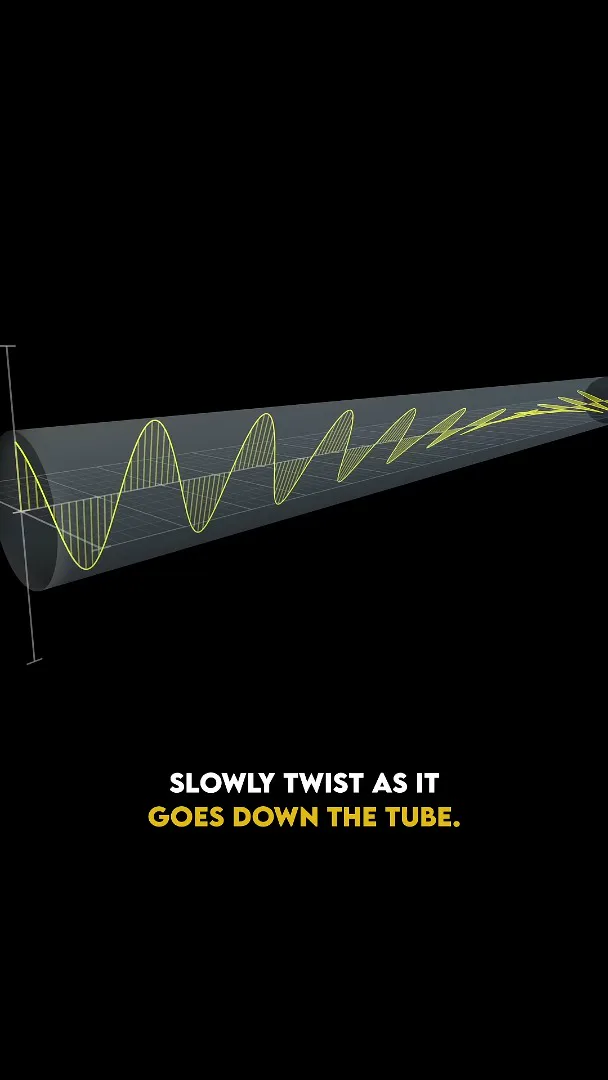
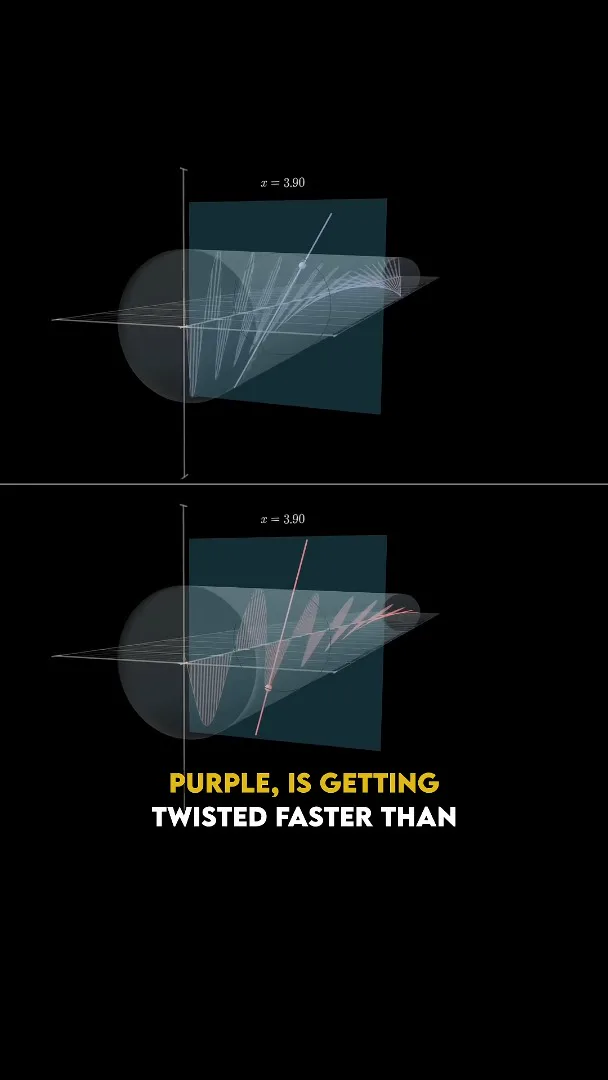
The rotation rate depends on frequency: in this example violet rotates faster than red. White light contains many frequencies, so their polarization directions separate as the light travels. Looking straight down the tube, however, the mixture still appears white because the colors are still present together.
Scattering and diagonal stripes
Polarization-dependent scattering reveals the colors from the side, while tube geometry and refraction explain their diagonal form.
From the side, scattered light reveals the separation. A molecule does not scatter polarized light equally in every direction: more light travels perpendicular to the polarization direction, and in the idealized picture none travels along it. At a given position, red might scatter toward your eye more strongly than violet, or vice versa.
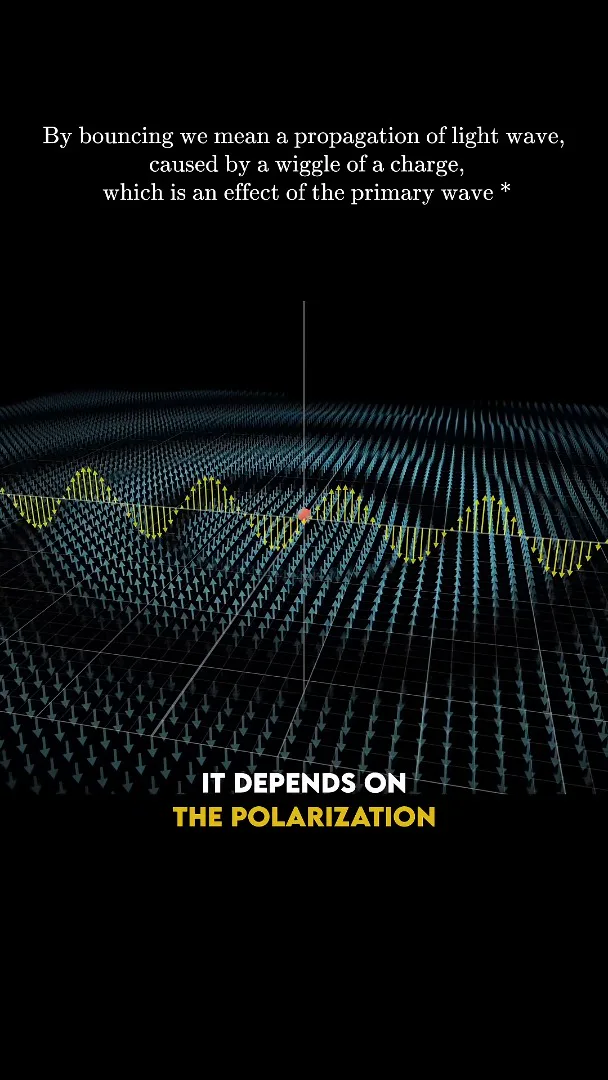
This explains why color changes along the tube, but not yet why the bands are diagonal rather than vertical. The tube is circular, and light bends as it passes from the solution through the glass and into the air. That geometry also changes what you see as you look up and down, producing the diagonal pattern.
The speaker describes following this small optical mystery into a larger series about the origins of light and what it means for light to slow down in glass or water. A simple observation can lead to foundational ideas that help explain many other phenomena.
같은 채널의 다른 글
 40:44EN
 3Blue1Brown· 2026년 10월 16일Grant Sanderson: There's never been a better time to go into mathGrant Sanderson, Constantin Kogler · 3Blue1BrownStudents fear AI has solved mathematics. Grant Sanderson argues the opposite: even if machines prove theorems better than we do, the institution of math stays valuable—and this is a rare moment when newcomers can reshape it.
 51:55EN3Blue1Brown· 2026년 9월 18일The last IMO problem AI could not solveGrant Sanderson · 3Blue1BrownGrant Sanderson walks through IMO 2025 Problem 6 — a tiling puzzle that frontier models missed — and the visual patience it takes to prove a construction is optimal.
 0:55EN3Blue1Brown· 2026년 7월 24일The 64 Sugar Cubes Puzzle: Six Equal DistancesA 4×4×4 block has three colors; prove that six same-colored pairs share a distance.
 33:51EN3Blue1Brown· 2026년 7월 16일What Cross-Entropy Connects: Compression, Language Models and KL DivergenceGrant Sanderson · 3Blue1BrownGrant Sanderson builds cross-entropy from code lengths and uses it to explain next-token training and distillation.
 2:25EN3Blue1Brown· 2026년 6월 12일How Shannon Measured the Entropy of EnglishA guessing game helped Claude Shannon estimate how much information English text contains, and why prediction is central to compression.
 1:02EN3Blue1Brown· 2026년 6월 10일A Robot Walk and the Puzzle of Optimal Binary EncodingHow few bits does it take to send directions that occur with unequal frequencies?