





필터 결과
100개정렬
 1:08:02EN
 Sequoia Capital· 2026년 10월 13일팟캐스트AlphaGo Took Two Years. AlphaZero Took Hours. Silver Is Making the Same Bet on SuperintelligenceDavid Silver and Lasse Espeholt left DeepMind to build Ineffable Intelligence, a twenty-person lab that wants a superlearner to discover science, math, and language from experience rather than from a pre-training run.
 1:04:26ENSequoia Capital· 2026년 10월 6일팟캐스트At 100,000 Accelerators, Something Fails Every HourGoogle AI infrastructure chief Amin Vahdat tells Sequoia's Sonya Huang why FLOPS is a vanity metric, why the TPU line split in two, and why he would rather wait on a utility than build his own gigawatt.
 1:05:21ENSequoia Capital· 2026년 9월 15일팟캐스트The Bridge From Model to Workflow Is a Trillion-Dollar BusinessBox CEO Aaron Levie argues that the money in this cycle sits in the messy gap between frontier models and real enterprise work — and that coding's overnight diffusion will not repeat for everyone else.
 52:27ENSequoia Capital· 2026년 9월 1일팟캐스트After Two Dozen Police Departments Said No, They Built an Anti-Network-Effect AI CompanyA Wisconsin county had 300 gigabytes sitting on a cold case—and Peregrine's founders still refuse to take the credit.
 55:19ENSequoia Capital· 2026년 8월 25일팟캐스트Human Click Data Is a Bug: Rebuilding Search for a Web of AgentsParag Agrawal, former Twitter CEO and founder of Parallel Web Systems, argues that agents will query the web a thousand times more than people, and that both search infrastructure and the ad-supported internet have to be rebuilt for that customer.
 53:44ENSequoia Capital· 2026년 8월 18일팟캐스트The Biggest Bug in Today’s Models Is That the Weights Never ChangeTuring Award winner Rich Sutton and Khurram Javed founded Oak Lab to build agents that keep learning after they ship — and they call synthetic data a big mistake.
 47:22ENSequoia Capital· 2026년 8월 4일팟캐스트From One in a Thousand to 15 Percent: Chai Discovery Treats Drug Design as a Scaling ProblemJoshua Meier and Matthew McPartlon tell Sequoia’s Training Data why antibody design is an engineering problem, not a bespoke science, and why they sell a molecular CAD suite instead of their own drugs.
 49:12ENSequoia Capital· 2026년 7월 29일팟캐스트The People Writing the Transformer’s Eulogy Want a Lab That Can Take Vacation Without Themo1’s reasoning lead and a Gemini pre-training lead argue the architecture, not more scale, is now the bottleneck — and that replacing it starts with automating kernel generation.
 51:31ENSequoia Capital· 2026년 7월 21일팟캐스트They Refunded Nearly $2 Million. Then Factory’s CEO Explained the Dark FactoryMatan Grinberg on being two years early, why a model-agnostic harness beats lab co-design, and why 90 percent of coding tokens will soon run with the lights off.
 48:55ENSequoia Capital· 2026년 7월 14일팟캐스트Anthropic's Platform Grew Three Layers in a Year — and Tokens Now Have JobsKatelyn Lesse and Angela Jiang tell Sequoia's Training Data how Anthropic went from a stateless Messages API to knowledge, execution, and coordination — without trying to own the servers.
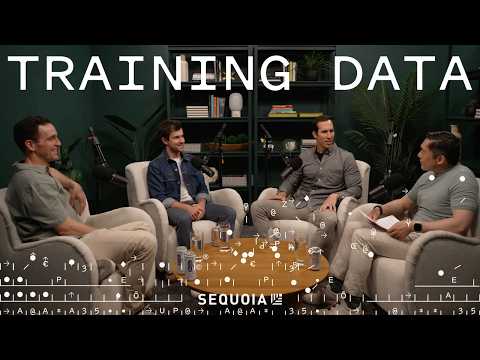 55:19ENSequoia Capital· 2026년 7월 7일팟캐스트The drone is 15% of Zipline: 140 million miles, zero incidentsKeller Rinaudo Cliffton and Eric Watson explain why the aircraft is the small part of an automated logistics system now cheaper than a car.
 1:10:15ENSequoia Capital· 2026년 6월 30일팟캐스트The 100x lives between the layers: Dylan Patel on co-design and a 60x yearSemiAnalysis’s founder argues that matching models, kernels, and silicon is what turns a 2x here and a 2x there into 100x, while equivalent-quality inference has gotten about 60 times cheaper in a year.
 44:52ENSequoia Capital· 2026년 6월 24일팟캐스트An 80GB Wikipedia Cache Versus a 100GB Model That Holds the InternetEngram’s founders argue that stuffing a company into the context window is the expensive kind of memory—and that baking it into the weights can cut token use by two orders of magnitude.
 38:45ENSequoia Capital· 2026년 6월 16일팟캐스트The 25-agent town that became a Fortune 500 decision sandboxOn the day before Valentine's Day in a Stanford simulation, cafe owner Isabella decided to throw a party — no human wrote the plot.
 51:09ENSequoia Capital· 2026년 6월 11일팟캐스트Build like the model will eat your harness in a yearLogan Kilpatrick, who leads Google AI Studio and the Gemini API, tells Sequoia's Sonya Huang why agent scaffolding is a 12-month asset, why coding already feels like narrow superintelligence, and why Google is optimizing for outcomes instead of eyeballs.
 41:20ENSequoia Capital· 2026년 6월 10일팟캐스트A $4 Million Cabinet and a Trillion-Dollar Year: Jensen Huang Turns the AI Factory Into a Manufacturing StoryOn Sequoia's Training Data stage, NVIDIA's CEO walks a sixty-country audience from ChatGPT's parlor tricks to agentic work, a five-layer industrial cake, and why radiology hiring went up.
 40:22ENSequoia Capital· 2026년 6월 2일팟캐스트Building Gets Easier Near AGI. Knowing What to Build Does Not.Listen Labs CEO Alfred Wahlforss on AI interview agents, a 30-million-person audience, and why transcripts beat credit-card data when you need to predict customers.
 45:33ENSequoia Capital· 2026년 5월 26일팟캐스트Cursor Ships 1TB of Composer Weights Across Oceans in Under a MinuteFederico Cassano and Fireworks' Dima walk through the globally split RL stack that trained Composer 2 on a sparse trillion-parameter MoE.
 38:24ENSequoia Capital· 2026년 5월 19일팟캐스트Serval's Bet: Keep ServiceNow's Primitives, Take Humans Out of the BuildJake Stauch tells Sequoia's Pat Grady how a two-year-old ITSM startup uses codegen agents, boring enterprise controls, and "fewer, better" hiring to rebuild employee support for the AI era.
 34:56ENSequoia Capital· 2026년 5월 13일팟캐스트On Suno, 90% of Daily Users Make a SongCEO Mikey Shulman on modeling raw sound instead of music theory, why music is not an LLM-style scale problem, and treating creation itself as the entertainment.
 31:26ENSequoia Capital· 2026년 4월 14일팟캐스트ChatGPT Opened 65 Pages to Buy a Shower HeadProfound CEO James Cadwallader argues that the internet's front door is the same, but an agent now walks through it, and marketing has to be rewritten for that visitor.
 58:27ENSequoia Capital· 2026년 3월 24일팟캐스트Even a dumber AI can win science if it never leaves the labGinkgo Bioworks CEO Jason Kelly tells Sequoia why autonomous labs, not smarter models, will change how experimental science gets done.
 44:19ENSequoia Capital· 2026년 3월 17일팟캐스트The $500-per-Kilogram Line: Why Starcloud Thinks Data Centers Belong in SpaceStarcloud founder Philip Johnston walks through the physics, launch economics, and business model of putting AI compute in orbit.
 40:56ENSequoia Capital· 2026년 3월 10일팟캐스트Four of the Top Five Defense Primes Still Run Hardware Tests on PowerPointNominal’s cofounders argue that hardware never got the last twenty years of software infrastructure, and that physical AI will stall until test data lives in one place.
더 보기100개 중 24개 표시