30 秒でわかる
Theo Browne argues that AI at a roughly fixed capability level has become cheaper even as his own spending has risen. He compares token prices, benchmark task costs and historical intelligence-index price bands, then explains how longer and more ambitious agent workflows increase usage. His examples depend on benchmark comparability and, in one case, an assumed token-efficiency ratio. The historical chart shown tracks a blended token price, not a direct measurement of every task’s cost.
- 1Three dimensions of costCompare price per token, tokens per task and the capability required to solve the task. A high token price can still result in competitive task cost.
- 2The workload changes the economicsInput-heavy classification and long-running development agents have different cost drivers, including caching and reliability.
- 3Comparing a fixed capability levelTheo compares DeepSeek V4 Flash and GPT-5 Codex high on overlapping benchmarks, then uses an assumed efficiency ratio to illustrate potential savings.
- 4Historical price bandsThe displayed Artificial Analysis chart tracks blended token prices by intelligence-index band, not direct costs of individual tasks.
- 5More use can mean bigger billsCheaper, more capable models make longer and more ambitious workflows possible, increasing consumption even as a fixed capability becomes cheaper.
ポイント
- A token price alone does not reveal the cost of a completed task or the quality of its result.
- Task-specific token use, input and output mix, caching and reliability all affect real spending.
- Benchmark comparisons suggest some earlier capability levels have become much cheaper, though matching scores do not make models identical.
- Lower unit costs can coexist with higher bills when users run longer agents and tackle more work.
- Theo’s estimated 20-fold saving for one comparison assumes a token-efficiency ratio that he did not measure.
チャプターごとに整えた全文を読む
The apparent contradiction
Theo contrasts rising personal bills with the promise that AI would become cheaper. He argues that the answer depends on what is being compared.
In July 2025, Sam Altman talked about intelligence becoming too cheap to measure. Yet I might have spent $800 to $1,000 on AI in all of 2025, while in 2026 I can use $1,000 worth of tokens in a single day. Frontier models can be more expensive per token and produce far more tokens, so the bill feels as if it is going in the wrong direction.
Primagen raised the apparent contradiction: Altman had also talked about AI becoming ten times cheaper year over year, but Astra is expensive. My short answer is that a given level of capability really has become cheaper. The problem is that we often compare different levels of capability and different amounts of work.
Token price is only the beginning
The cost of useful work also depends on token consumption and the capability needed. Different tasks have different cost drivers.
Start with token prices. The chart shows GPT-5 medium at $1.25 per million input tokens and $10 per million output tokens, versus $10 and $50 for GPT-6 Astra. The most capable options can cost several times more per token. But token price by itself is a poor measure of what it costs to get useful work done.
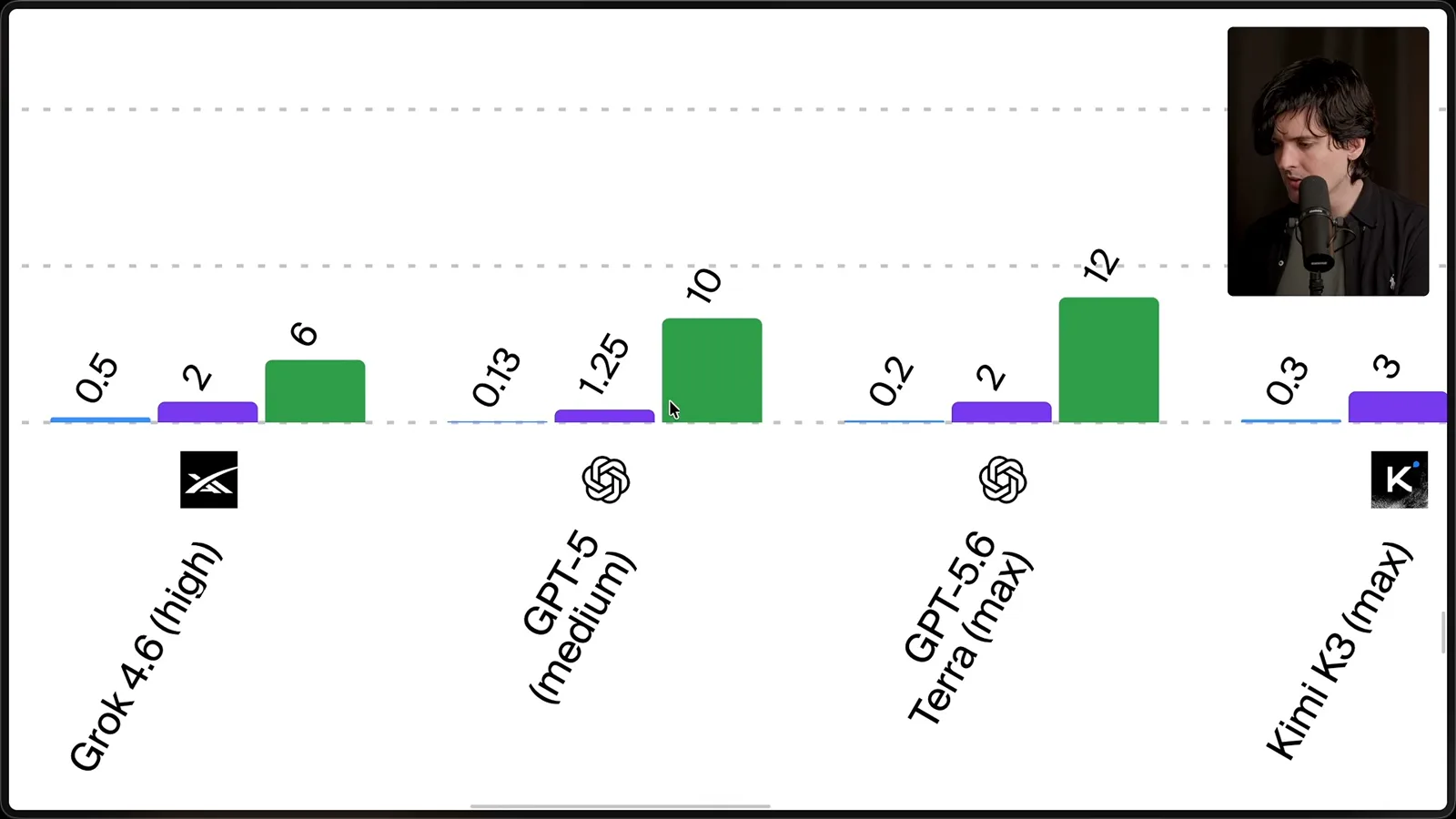
I want to separate three things: the price of a token, the number of tokens required for a task, and the capability needed to solve it. The useful question is how much it costs to obtain an adequate solution, not simply which model has the cheapest output token.
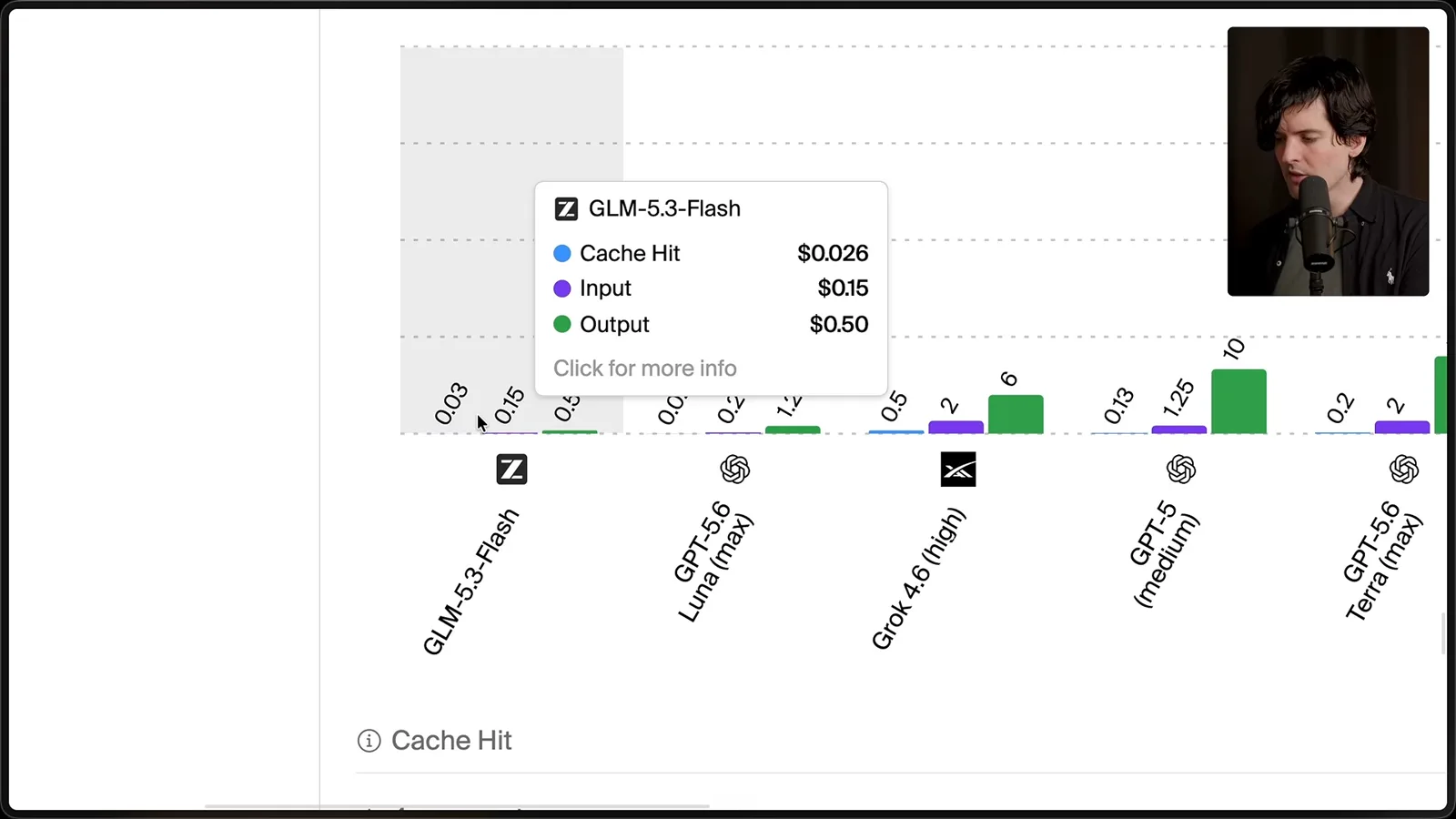
There are also very cheap models. The GLM-5.3-Flash example on the chart is $0.15 per million input tokens and $0.50 per million output tokens; I mention some providers offering a discount. In my experience it is highly capable on many agentic tasks despite costing a small fraction of GPT-5's token price.
Now consider tokens per task. Gemini 3.8 Flash looks inexpensive at $3.75 per million output tokens, but in the benchmark shown it uses enough tokens that its cost per task is much closer to more expensive models. Gemini 3.5 Flash is another example of a low token price not guaranteeing an equally low task cost.
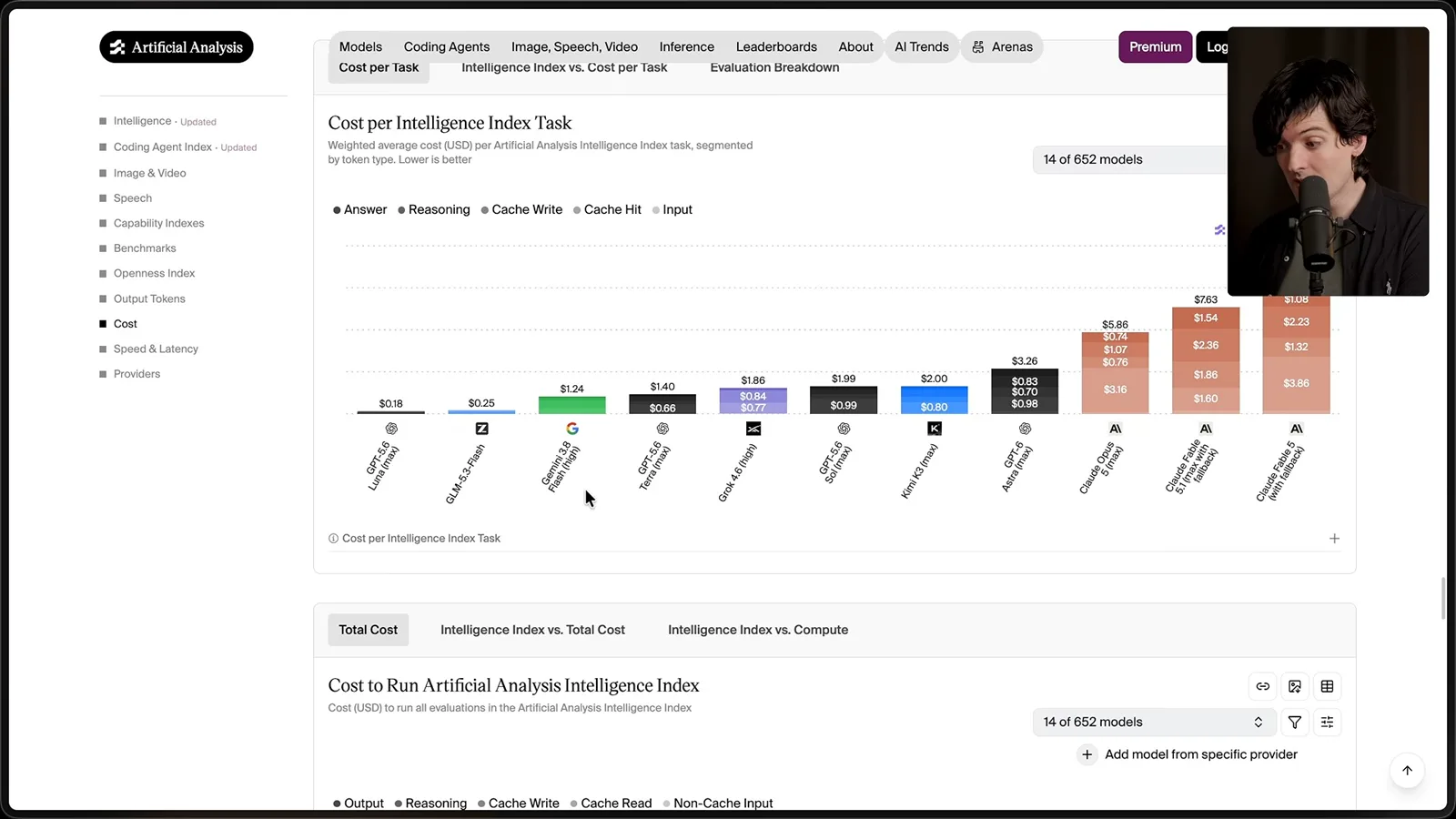
Task shape matters. To categorize 800,000 input tokens with a short answer, input pricing may dominate the bill. For agentic development, caching, reliability and how efficiently the model proceeds through the work can matter much more. There is no single cheapest model for every workload.
Comparing capability and cost
Benchmark charts show a tradeoff between price and performance. Theo compares models at approximately the same index score and explains an illustrative efficiency assumption.
Artificial Analysis plots benchmark performance against cost per task and draws a Pareto frontier: the best measured score available at a given cost. In the examples I discuss, moving from a score around 45–46 at $0.82 to the 50s at $3.26 costs several times more for a modest score increase. This is a benchmark comparison, not a guarantee for every application.
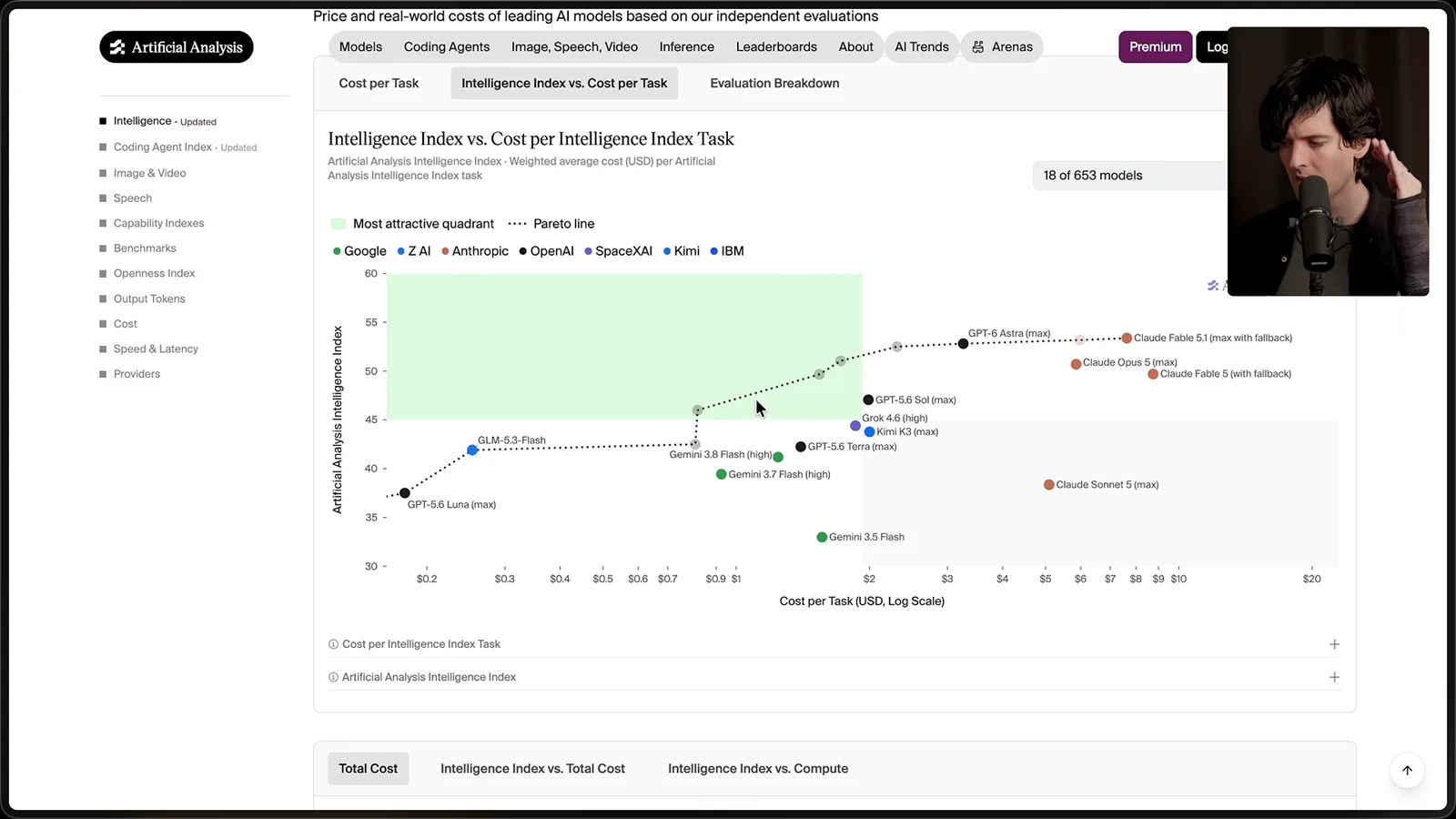
I would also flip the question: hold the capability level roughly constant and ask what it costs over time. Comparing models across generations is difficult because benchmarks saturate and are replaced, so the available overlapping tests may not capture every difference between the models.
I found DeepSeek V4 Flash and GPT-5 Codex high had a similar overall intelligence-index score on the comparison available to me, though their individual benchmark results differed. The prices I showed put DeepSeek input tokens about 21 times cheaper and output tokens about 55 times cheaper. Similar benchmark scores are a proxy for comparable capability, not proof that the models behave identically.
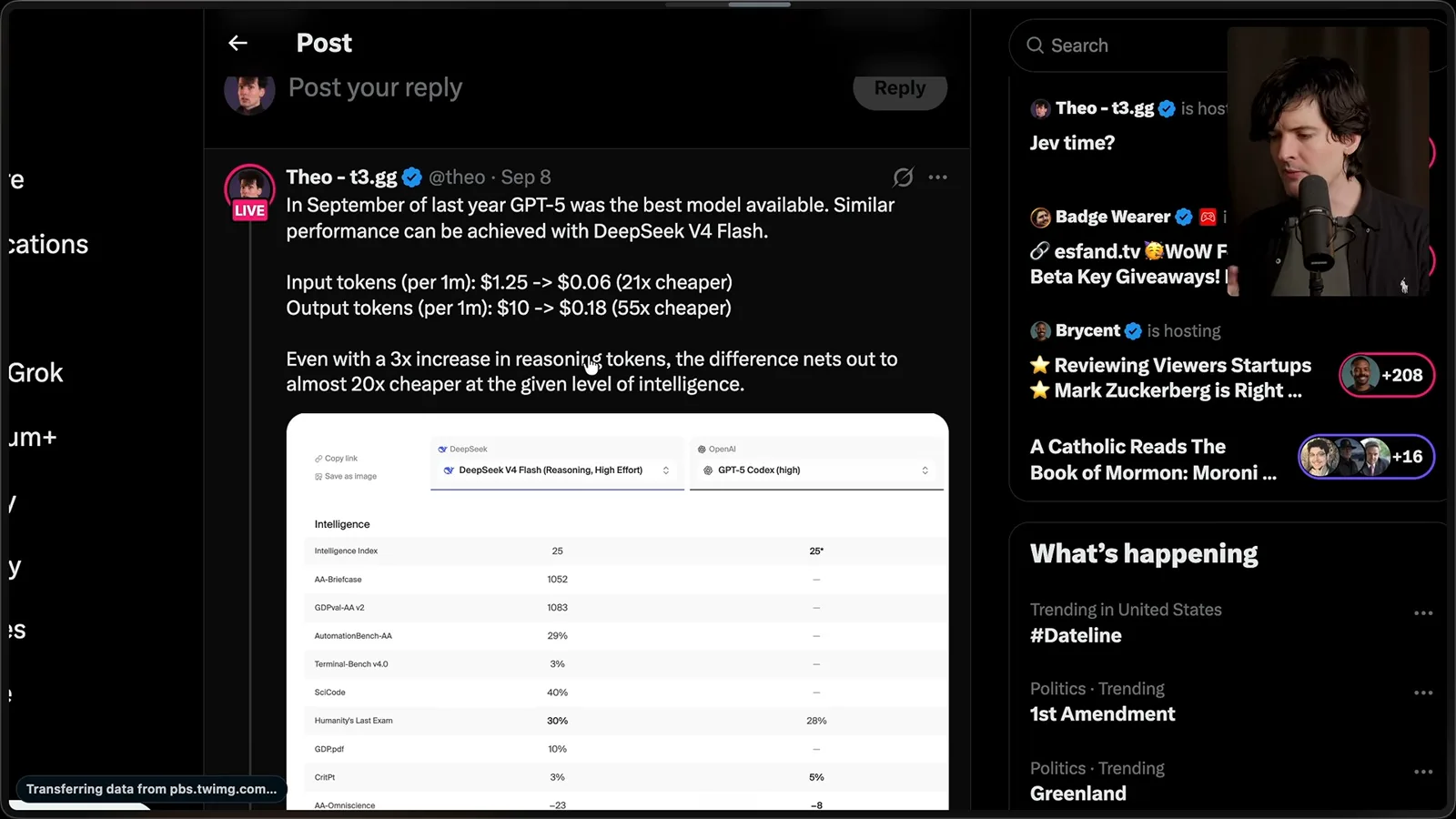
I could not find reliable figures for their relative token efficiency. My roughly 20-fold improvement estimate assumes DeepSeek uses three times as many reasoning tokens; it is an illustration based on that assumption, not a measured cost per completed task. On that basis, the decline can exceed the tenfold figure that prompted this discussion.
Historical prices by capability band
Theo reviews declines in the displayed blended token prices for successive index bands. The graph uses a logarithmic cost axis.
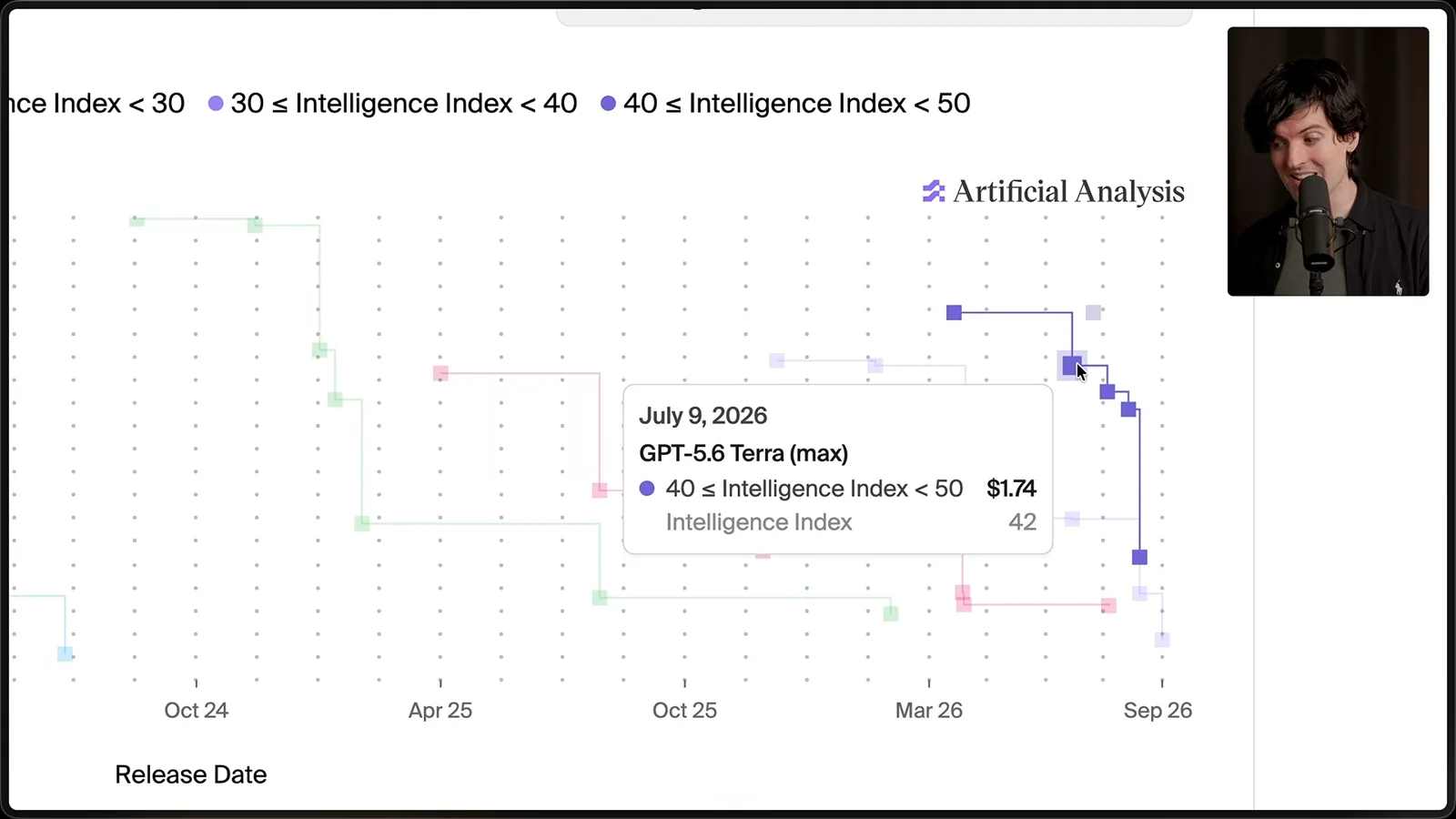
Artificial Analysis also tracks prices over time in intelligence-index bands. The historical chart shown is labeled as a blended per-million-token inference price, using a mix of cache, input and output prices; it should not be read as a measured price for a particular task. It shows substantial declines within earlier capability bands.
For the 10–20 index band, the chart moves from the expensive o1-preview era toward Grok 3 mini at about $0.16 on the displayed blended-price measure by February 2025. That is roughly one hundredth of the earlier approximately $15 figure. I think the initially high price of o1 models also contributed to the dramatic drop.
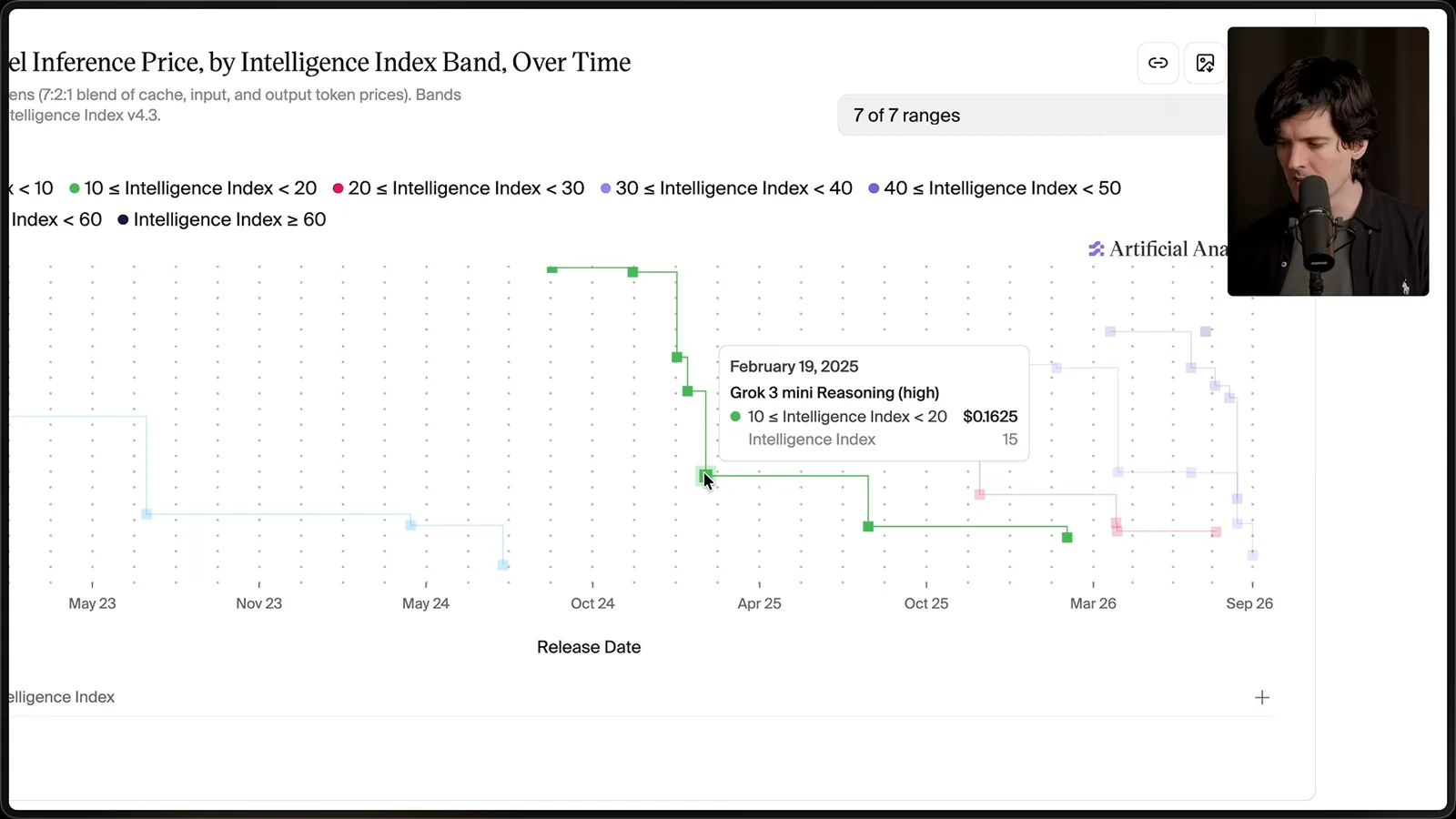
At higher bands, the same pattern appears in the figures I cite: models at roughly the 20-point level became much cheaper, and later entrants reduced the price of 30- and 40-point performance as well. The chart uses a logarithmic cost axis, so equal vertical distances represent multiplicative changes rather than equal dollar changes.
For the 40–50 band, I point to Opus 4.7, then GPT-5.6 Terra, GLM-5.3 and GLM-5.3-Flash as examples of comparable index levels arriving at lower displayed prices. A new frontier can feel expensive right after a jump, even while older capability levels become dramatically cheaper.
Why total spending still rises
More capable agents can do longer, more ambitious jobs. Theo connects increased usage to lower unit costs and discusses practical tool use.
There is one more factor: our usage has changed. We once asked a model to autocomplete one function; now we can give an agent a screenshot of a bug and ask it to investigate and land a change. It runs longer, uses more tokens, and can complete larger pieces of work with less intervention.
That helps explain why a lower price for a fixed capability can coexist with a higher total bill. I compare it to the Jevons paradox: when something becomes cheaper and useful in more places, people may consume much more of it. This is my explanation of the trend, not a calculation proving the cause of every customer's bill.
I expect frontier-level capability to get cheaper too. More than the price has changed: I prefer GLM-5.3-Flash to the older GPT-5 for my work because, in my experience, its vision, tool use and long-running agent workflows benefit from a year's worth of improvements. That preference is about practical workflows, not an assertion that it knows more without tools.
A model with less memorized knowledge can still solve a knowledge task better if it knows how to search and use tools effectively. Small models with good tools can outperform older, larger models on the workflows that matter to me. Those practical differences may not be captured by one intelligence score.
A correction and a conclusion
Theo revisits his earlier incorrect prediction that progress had peaked. He argues that cheaper comparable work and higher real bills can coexist.
I have been wrong about progress before. Two years ago I argued that AI might have peaked after looking at benchmarks that seemed to flatten. We needed new benchmarks, and I underestimated both the speed and the extent of later improvements. That experience is a reason to be humble about any single measurement.
My point is not that anyone's bill is imaginary. Spending $1,500 in a day is real and can be alarming. My argument is that tasks comparable to last year's can be much cheaper, while we now choose to spend on larger and harder work that previous models could not complete in the same way.
AI spending is connected to how much work we ask the models to do and how useful the results are. I expect capability to improve and the cost of a given level to continue falling, even when our total spending does not look cheaper. The relevant comparison is the work and quality we receive for the money.
同じチャンネルの記事
 36:07EN
 Theo - t3․gg· 2026年10月27日Theo on Token Costs, Coding Agents, and the Price of AI CapabilityTheo Browne · Ping LabsA viral estimate of Lauren's AI spending prompts a closer look at cache pricing, benchmarks, and the changing work of coding agents.
 30:37ENTheo - t3․gg· 2026年10月26日Theo’s Three Skills for Reviewing and Shipping with Coding AgentsTheo Browne · Ping LabsHow sol-loop, full-send and full-stop encode review, verification and different levels of merge authority.
 0:43ENTheo - t3․gg· 2026年10月23日Theo Distinguishes Security Vulnerabilities from Active AttacksTheo Browne · Ping LabsA short explanation of why disclosed software flaws and reported attacks are different kinds of security news.
 29:22ENTheo - t3․gg· 2026年10月22日Theo on Security Vulnerabilities, Stolen API Keys and AITheo Browne · Ping LabsA look at the gap between vulnerability disclosure and patching, and a speculative account of why stolen inference keys may be valuable.
 31:13ENTheo - t3․gg· 2026年10月20日Theo on Why Smarter Models Help More Than DevelopersTheo Browne · Ping LabsFrom game modifications to compiler experiments, Theo revisits his assumptions about who benefits from more capable AI.
 31:47ENTheo - t3․gg· 2026年10月18日Theo on Asking Agents for Outcomes and Building the Tools They NeedTheo Browne · Ping LabsA tool-call report, a troubleshooting playbook and connected data show how prompting can reshape product engineering.