30 秒でわかる
Fully reusable rockets need more than a returning booster: the ship must withstand reentry and missions beyond Earth need orbital propellant transfer. At a 2022 Starbase update, Elon Musk described those challenges, a redesigned Raptor engine and the launch tower. In the questions, he discussed engine cooling, crew safety and his then-forecast timelines for flight and refilling.
- 1Both Starship stages were designed for rapid reuseMusk contrasts the goal with Falcon 9’s reusable booster and fairings.
- 2Mars missions require refilling in orbitMusk describes launching the payload first, then transferring mostly oxygen along with fuel.
- 3Raptor 2 combines more thrust with fewer partsThe 2022 presentation compares the engine with Raptor 1.
- 4Keeping the engine chamber cool was a remaining challengeMusk describes balancing cooling flows while production ramps up.
ポイント
- Rapid reuse requires recovery of both the booster and the ship.
- Musk described orbital propellant transfer as necessary for Mars and Moon missions.
- Raptor 2 was designed to simplify the engine while increasing thrust.
- The 2022 flight and cost figures were goals and forecasts.
チャプターごとに整えた全文を読む
Why Musk wants a reusable rocket
He connects rapid reuse to lower launch costs and a long-term Mars goal.
At Starbase in 2022, Elon Musk welcomes the audience and says SpaceX has made substantial progress since its earlier Starship prototype. He thanks the team and surrounding communities.
He gives two reasons for developing a reusable rocket and extending life beyond Earth: reducing the risk of a catastrophe on one planet and inspiring people to explore.
Musk compares the inspiration of exploration with the Apollo program, arguing that people can participate in discovery even without traveling themselves.
He says most resources should still go toward problems on Earth and argues that a small share devoted to space can support a long-term goal.
The enabling technology, he argues, is a fully and rapidly reusable rocket. Falcon 9 had demonstrated reuse of boosters and fairings, but Starship aimed to reuse both major stages.
The proposed booster would return to the launch tower to be caught by its arms. Musk acknowledges that the system still has to be demonstrated.
Musk cites SpaceX launch and landing experience and says the company was targeting roughly fifty Falcon launches in 2022.
The proposed scale of Starship operations
Musk describes hypothetical flight rates and the material needed for a Mars settlement.
He uses a chart to compare historical mass delivered to orbit with a hypothetical frequently reused Starship. His spoken description says three launches a day, while the displayed chart says three a week.
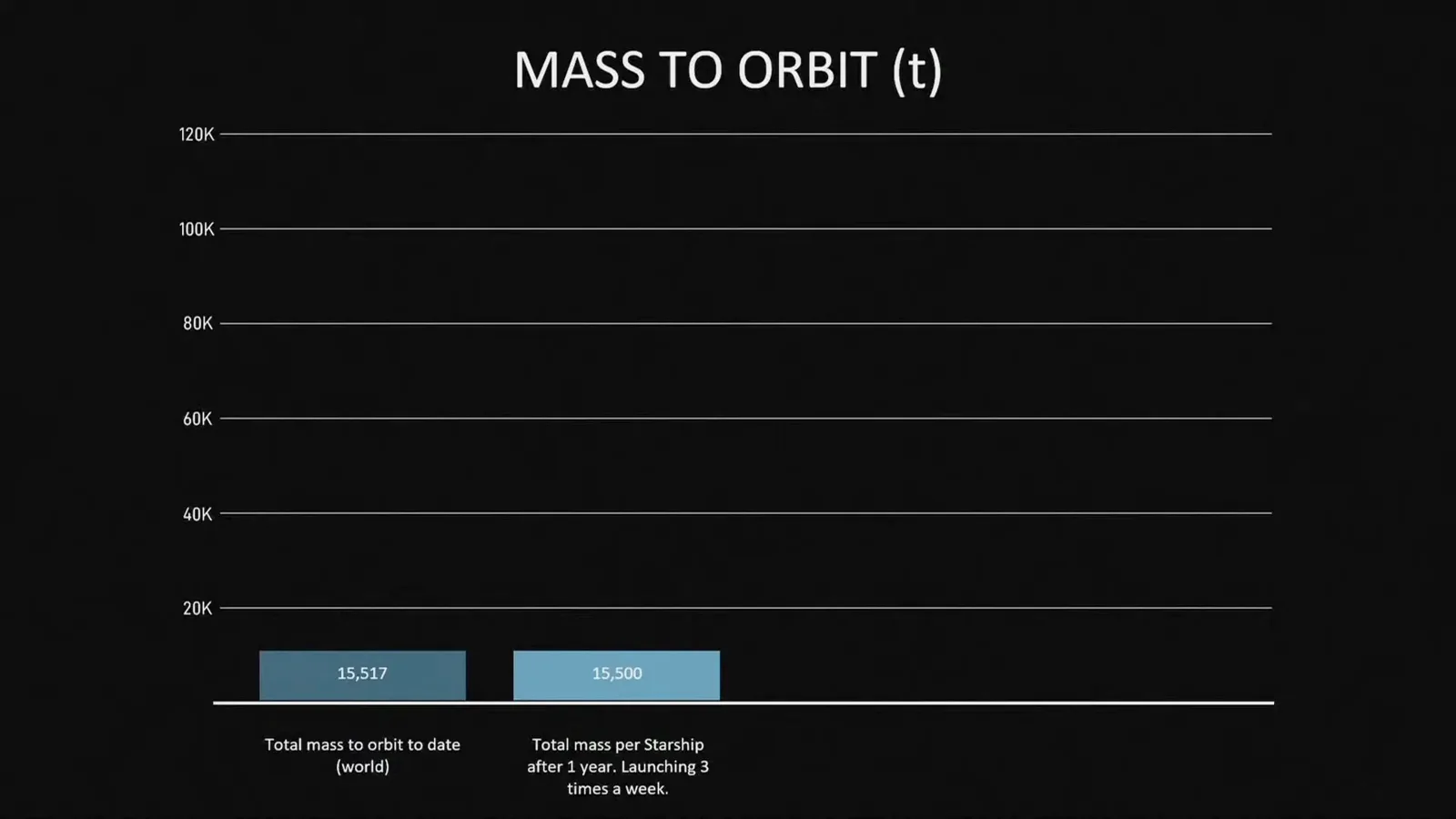
Musk describes an aspirational production system with many ships and boosters, and says the booster could return much sooner than a ship completing an orbit.
He estimates that a self-sustaining Mars settlement might require roughly a million tonnes of material. He says the key threshold is surviving without continued shipments from Earth.
He describes a Mars expedition as cramped, dangerous and demanding, and says making the planet easier to inhabit would require substantial work.
Heat shields and orbital refilling
He explains the 2022 vehicle design and why missions beyond Earth need propellant transfer.
Musk describes the 2022 Starship design: approximately nine meters in diameter, with a target payload of roughly 100–150 tonnes depending on orbit. He says dimensions and performance can evolve.
He says missions to Mars need orbital propellant transfer: a ship would reach orbit with its payload and then replenish its tanks. Most of the transferred mass would be oxygen rather than fuel.
The heat shield must withstand reentry while being reusable and affordable. Musk says the team makes the tiles in Florida using techniques also found in roofing-tile production.
He compares the planned orbital docking with SpaceX’s experience docking Dragon to the International Space Station, while noting that transfer between Starships remains to be demonstrated.
Musk describes the Super Heavy booster’s propellant and thrust targets, comparing the combined vehicle’s planned thrust with Saturn V.
Engines and launch infrastructure
The update covers the booster, launch tower and redesigned Raptor engine.
The booster on display has 29 engines; he says the next design moves to 33. Fitting engines beneath the vehicle constrains the arrangement.
He calls the tower and ground launch equipment “stage zero” and says designing and building them is as demanding as either rocket stage.
The presentation compares Raptor 1 and Raptor 2. Musk says the newer engine was simplified while increasing thrust from about 185 to 230 tonnes and reducing production cost.
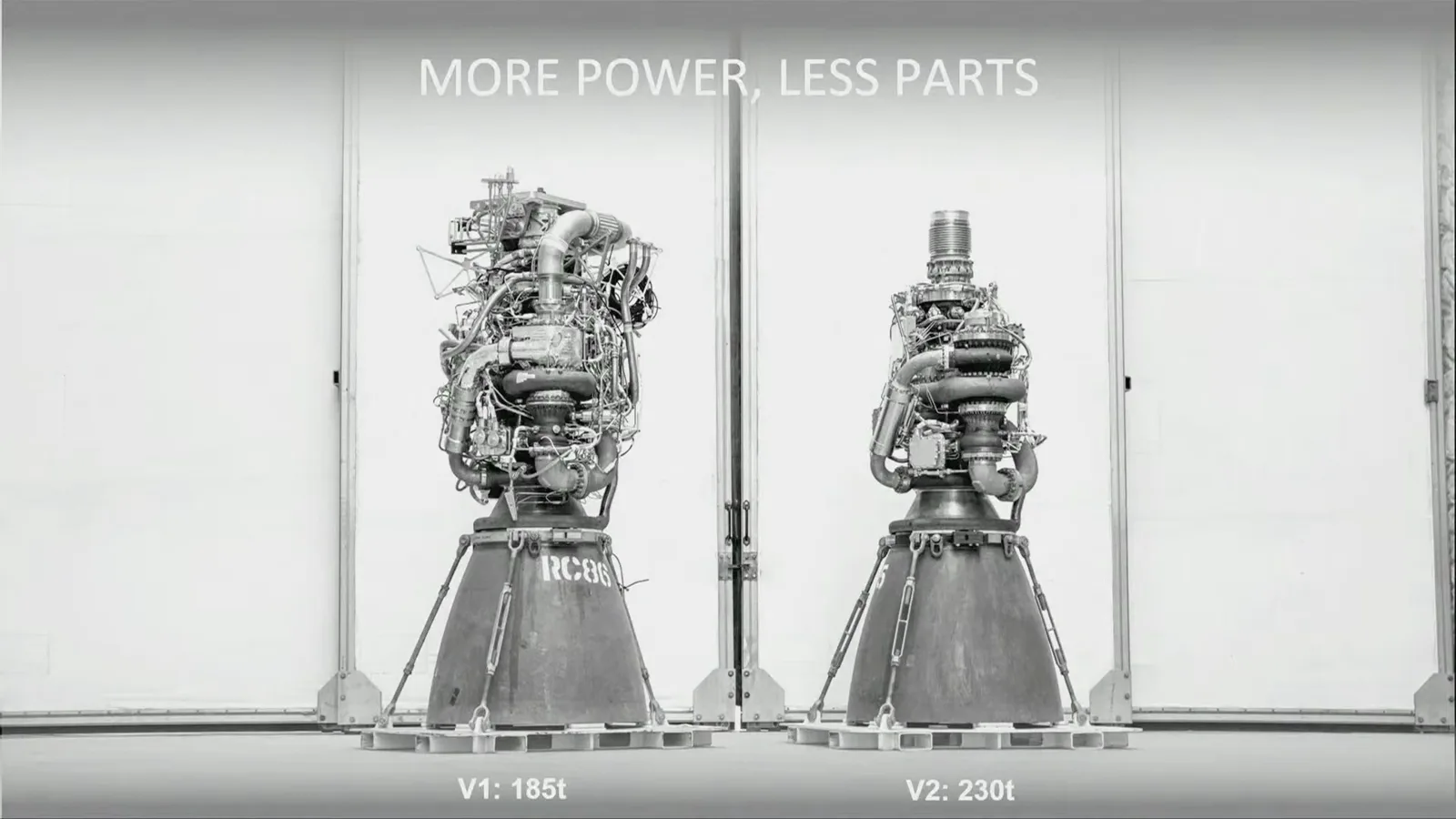
He says Raptor 2 had reached a higher peak thrust in testing and expects further improvements, while emphasizing the difficulty of developing the engine.
Musk discusses why the team chose Starbase, including launching eastward to benefit from Earth’s rotation, the coastal location and local support.
Planned missions and audience questions
Musk describes proposed missions and answers questions about readiness and costs.
He lists proposed early missions: Starlink satellites, NASA’s lunar landing program and the then-planned dearMoon mission. He says uncrewed tests should help improve reliability before human flights.
An animated presentation plays before the questions begin.
In the first questions, Musk says the ship then had three sea-level and three vacuum engines and considers adding more vacuum engines in a future version.
He says SpaceX is building Starship launch and production capacity at Cape Canaveral as well as in Texas, giving the program another location.
Asked about Federal Aviation Administration review, Musk says in February 2022 that SpaceX has limited visibility and had heard an approval might come in March.
A question about point-to-point travel prompts Musk to imagine long-distance cargo or passenger flights by rocket. He says the economics would depend on frequent reuse and propellant costs.
Asked about SpaceX’s spending, he argues that Starship’s development could be efficient compared with historical large-rocket programs, while saying the system still needed to work.
In 2022, Musk says he is confident of reaching orbit that year and sets goals for engine and vehicle production.
On a possible longer environmental review, he says a launch site in Florida could be an alternative, although building the tower there would delay the program.
Musk says early attempts could lose vehicles and distinguishes marginal launch cost from fixed costs. He forecasts that frequent reuse could eventually reduce total cost per flight.
Refilling and launch sites
He gives a 2022 forecast for orbital refilling and discusses alternatives to Starbase.
Asked when orbital refilling might be tested, he gives an optimistic estimate of late 2023 and says he would be surprised if it took more than two years.
A local reporter asks what would happen if a more extensive environmental review were required. Musk says it could delay Starbase launches and shift attention toward Florida.
He envisions Starbase as a research and development site and discusses a possible future role for ocean platforms, including long-distance travel away from populated areas.
Raptor design and crew safety
Questions turn to engine simplification, abort capability and life support.
Asked how Raptor 2 became simpler, Musk says the redesign removed or combined components, strengthened pump machinery and replaced some flanges with welded joints.
He says fewer seals and more integrated controls could reduce complexity. He also discusses improving the pressure path through the pumps and combustion system.
On crew safety, Musk says Starship would not have a separate abort system and considers whether the ship’s own engines could provide an escape capability from a failing booster.
For short missions, he suggests adapting Dragon’s life-support technology; a Mars trip would need more extensive recycling of air and other materials.
Asked about hardware readiness, Musk says in 2022 that regulatory review and hardware could be ready on roughly similar timelines, subject to uncertainty.
He says work on offshore platforms had been lower priority than the Texas launch site, but discusses a goal of developing launch capability on a platform.
A local reporter invites him to Brownsville community festivities; Musk says he hopes to attend.
Cooling and lunar missions
Musk identifies chamber cooling as a major engine challenge and discusses lunar operations.
Asked about Raptor production and testing, he identifies keeping the combustion chamber from melting as a central problem. The team is balancing different cooling approaches.
Musk says some engines had accumulated hundreds of seconds of operation and that the production team was working toward a higher output rate.
On NASA’s lunar lander, he says high production rates could support both the lunar mission and work toward reuse. He discusses adding landing legs for the Moon.
Asked how quickly tanker flights would launch for orbital refilling, he says the aim is to minimize evaporation of cold propellants and imagines flights a few hours apart.
He says the team is focusing first on reaching orbit and recovering both stages, rather than on designing a crew interior.
A local resident asks about operating in Texas. Musk thanks the community and gives his view that the state’s regulatory environment is suitable for the work.
Musk thanks the audience and invites attendees to view the rocket more closely. The remaining portion of the broadcast contains music.
同じチャンネルの記事
 40:00EN
 Reuters· 2025年5月20日Musk faces questions on Tesla, DOGE savings and foreign aidElon Musk, Mishal HusainAt the Qatar Economic Forum, Mishal Husain presses Musk on Tesla demand, possible conflicts of interest and the effects of aid cuts.
 35:14ENReuters· 2025年2月13日Musk proposes deleting US agencies and predicts an AI robot economyElon Musk, Omar Sultan Al OlamaAt the 2025 Dubai summit, Musk argues for deep federal cuts, previews Grok 3 and announces plans for a Dubai Loop.
 8:58ENReuters· 2021年6月29日Musk outlines Starship reusability and long-term goals at MWC 2021Elon Musk · SpaceXIn a conference interview excerpt, Musk discusses methane fuel, orbital refilling and the role of SpaceX, Tesla and Neuralink in his view of the future.