30 秒でわかる
At an April 2025 cabinet meeting, President Trump defended his tariff strategy as officials described negotiations with trading partners. Elon Musk projected $150 billion in fiscal 2026 savings from reducing waste and fraud, a forecast rather than realized savings. Cabinet members also discussed immigration, energy and health; several claims require context, including unusual unemployment records and speculation about autism. In questions, Trump said higher tariffs might return after the 90-day pause if deals did not materialize, while leaving room to reassess.
- 1Trump defends tariffs as officials report trade talksTrump acknowledges transition costs and predicts favorable trade deals. The March 2025 CPI report showed a monthly decline but a 2.4% rise over the previous year.
- 2Labor secretary cites unusual unemployment recordsChavez-DeRemer describes the records as fraudulent. A prior inspector-general report noted that some states used altered birth dates to protect identity-theft victims, underscoring the need to investigate individual records.
- 3Musk forecasts $150 billion in fiscal 2026 savingsHe attributes the projection to work with cabinet departments on waste and fraud. He presents anticipated savings rather than a completed accounting.
- 4Kennedy predicts a fast answer on autism’s causesKennedy says a research effort will identify a cause by September, and Trump speculates about possible exposures. A later WHO review found no causal link between vaccines and autism.
- 5Trump leaves room to reassess tariffs after the pauseAsked about failed negotiations, he says higher tariffs would return, then says the administration would have to see what happens.
ポイント
- Musk projected $150 billion in fiscal 2026 savings; the figure was not a report of savings already achieved.
- Trump said higher tariffs could return after a 90-day pause if negotiations failed, while also saying the administration would reassess at the time.
- Unusual birth dates in unemployment records require investigation; some earlier records used altered dates to protect identity-theft victims.
- Kennedy predicted an autism-cause finding by September 2025; later evidence reviews found no causal link between vaccines and autism.
チャプターごとに整えた全文を読む
Trump opens with inflation and tariff negotiations
Trump says trade terms need to change and officials are talking with other countries. The latest price report showed a monthly decline and a year-over-year increase.
President Donald Trump opens by saying consumer prices and energy costs have fallen and predicting that the economy will do well despite a period of transition. The Labor Department's [March 2025 report](https://www.bls.gov/news.release/archives/cpi_04102025.pdf), released that day, showed prices down 0.1% for the month but up 2.4% over the previous year.
Trump says his tariff strategy is intended to make trade fairer. He argues that earlier presidents allowed unfavorable arrangements to continue and says trade revenue is making the country stronger.
He says Treasury Secretary Scott Bessent and Commerce Secretary Howard Lutnick are talking with many countries seeking deals. Trump acknowledges possible transition costs but predicts the outcome will be favorable.
Trump thanks the officials around the table and says he has invited the press into the meeting to show transparency. He asks Defense Secretary Pete Hegseth for a report on his Panama trip.
Cabinet reports on Panama, trade and universities
Hegseth discusses cooperation with Panama, Lutnick describes negotiations, and McMahon discusses university funding.
Hegseth says the United States and Panama signed a framework concerning U.S. vessels' passage through the Panama Canal and an understanding about a joint military presence at several facilities.
Hegseth presents the Panama arrangements as a way to counter Chinese influence. Trump says U.S. troops have moved into areas previously used by the United States.
Lutnick says many countries want to negotiate trade arrangements and predicts historic deals. He also expects a proposed 'gold card' immigration program to begin soon.
Education Secretary Linda McMahon says her department has reviewed, suspended or canceled some university grants and contracts as it addresses antisemitism on campuses. She says she is also speaking with state education leaders about returning education responsibilities to states.
Trump asks about funding held back from universities including Columbia and Harvard and criticizes some of their hiring choices. McMahon says officials are investigating several institutions and that university presidents have called seeking discussions.
Budget, shipbuilding and agency plans
Officials report on legislation, shipbuilding, environmental rules, transport and agriculture. Their claims and projections are attributed to them.
An official welcomes House approval of a budget resolution and says lawmakers can now write a package implementing the president's agenda. Trump says he wants tax and regulatory cuts and funding for the border in one bill.
An official describes executive actions on shipbuilding, ports and foreign military sales, contrasting Chinese ship orders with U.S. orders. Trump says he wants to rebuild domestic shipbuilding and may seek congressional approval to purchase ships from allied countries in the meantime.
White House chief of staff Susie Wiles praises cooperation across the cabinet.
Environmental Protection Agency administrator Lee Zeldin says the agency has canceled $22 billion in grants and is pursuing deregulation. He argues these changes can support economic growth while protecting the environment.
Trump and Zeldin discuss allowing facilities to build their own power plants, including for AI-related projects. Trump says the existing grid is vulnerable and promises faster approvals.
Transportation Secretary Sean Duffy says shipbuilding requires trained mariners and calls for investment in the U.S. Merchant Marine Academy.
Duffy says the department is working through thousands of previously announced infrastructure projects that still need grant agreements. He says the department is removing requirements he describes as ideological.
Agriculture Secretary Brooke Rollins says farmers face high costs and that the administration's trade strategy will benefit them.
Rollins says she is working with health officials on changes to the food-stamp program. She and Trump also say wholesale egg prices have fallen, while she cautions that retail prices can fluctuate around Easter.
Treasury, Justice and Labor discuss their priorities
Bessent describes trade talks and a budget package; Bondi and Chavez-DeRemer discuss enforcement and unemployment records.
Bessent says more than 75 countries want trade discussions, with Treasury, Commerce and the U.S. Trade Representative organizing the process.
Bessent says the administration wants a debt-ceiling increase in the budget package. He praises a bond auction and the latest inflation report, and argues that deregulation can help smaller banks and communities.
Attorney General Pam Bondi discusses court cases involving federal spending, agency personnel and immigration.
Bondi says the Justice Department is pursuing alleged drug traffickers and people accused of attacks on Tesla property, and says further arrests are expected.
Labor Secretary Lori Chavez-DeRemer says her department is recovering unused pandemic funds.
Chavez-DeRemer cites unemployment-insurance records with implausible birth dates, describing the associated payments as fraudulent. She says investigators will seek to recover funds and also points to new job creation.
Trump calls the age-related figures evidence of fraud and asks how money can be recovered. Chavez-DeRemer says her department is working with inspectors general. A [2023 Labor Department inspector-general report](https://oig.dol.gov/public/reports/oa/2023/19-23-012-03-315.pdf) noted that some older-claimant records had altered birth dates to protect identity-theft victims; the agency and inspector general disputed the extent. It does not establish the explanation for every record cited here.
Immigration, trade and Musk’s savings projection
Noem outlines border and self-departure plans. Greer describes trade negotiations, and Musk forecasts fiscal 2026 savings.
Homeland Security Secretary Kristi Noem says border encounters have fallen and discusses registration and a proposed self-departure program for people without legal status.
Noem says the administration is exploring travel assistance and reintegration arrangements with other countries for those who leave voluntarily.
Noem says she is working with governors on emergency management and secure communications and reminds them of the upcoming REAL ID requirement for air travel. She also discusses state driver's license systems and election integrity.
Trump says he wants a process that would allow some departing workers to seek legal return, mentioning farms and hotels that rely on them. He says the administration would work with farmers who recommend individual workers.
U.S. Trade Representative Jamieson Greer describes Trump's tariffs as an effort to protect domestic manufacturing and open export markets. He says many countries have approached the administration about trade negotiations.
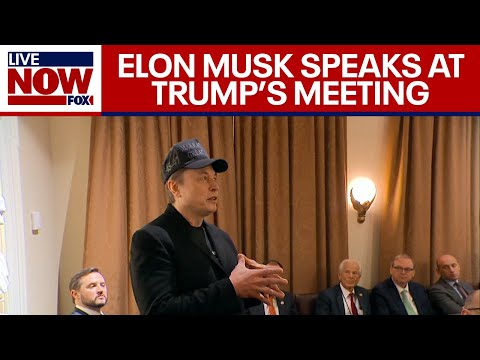
Musk says DOGE and cabinet departments anticipate $150 billion in fiscal 2026 savings from reducing waste and fraud. He cites unemployment records with implausible birth dates and argues that better spending controls can improve services. This is a forecast of savings, not an account of savings already realized.
Musk says his team is working with the administration to get the proposed gold card operational. Trump describes it as a pathway to citizenship; both speak of it as a forthcoming program.
Intelligence and health officials describe their plans
Gabbard discusses intelligence and records, and Kennedy describes health-policy proposals and a planned autism research effort.
Director of National Intelligence Tulsi Gabbard says she wants timely intelligence for the cabinet and greater information sharing among federal agencies and local law enforcement about cartels.
Gabbard also describes reviewing alleged politicization in intelligence work. She says agencies are cooperating to share information on cartels with state and local law enforcement.
Gabbard raises election-system security and says teams are preparing records concerning the assassinations of Robert F. Kennedy and Martin Luther King Jr. for release. Trump and Robert F. Kennedy Jr. welcome making the materials public.
Small Business Administration head Kelly Loeffler describes a manufacturing tour and says the agency has changed loan applications to add citizenship and birth-date checks. She credits DOGE with assisting anti-fraud efforts.
Health and Human Services Secretary Robert F. Kennedy Jr. says the administration is reassessing fluoride policy. The [National Toxicology Program](https://ntp.niehs.nih.gov/research/assessments/noncancer/completed/fluoride) said evidence was insufficient to determine whether the recommended U.S. community-water level of 0.7 mg/L affects children's IQ.
Kennedy says he is working with states on changes to food assistance and school meals, including efforts to address food dyes and other chemicals.
Kennedy discusses restricting school phone use and reducing animal testing, and says his department is working with Musk's team on health-agency operations. He also describes the measles outbreak and argues for more attention to chronic disease.
Kennedy cites autism prevalence figures and predicts his department will identify a cause by September. Trump speculates about possible exposures, including a vaccine. Later, a [WHO expert review](https://www.who.int/news/item/11-12-2025-who-expert-group-s-new-analysis-reaffirms-there-is-no-link-between-vaccines-and-autism) found no causal link between vaccines and autism; Kennedy's timetable was a prediction.
Energy and diplomatic updates
Burgum discusses energy development. Rubio describes trade, Iran and immigration policy.
Interior Secretary Doug Burgum argues that expanding domestic energy production can lower costs and support manufacturing and allies. He describes the administration's energy council and plans to open more federal land and offshore areas to development.
Burgum discusses coal, offshore oil and Alaska energy development, arguing that a larger energy supply will attract investment. His figures for resource values and potential production are estimates, and his claims about the effect of the policies are forecasts.
Secretary of State Marco Rubio supports the administration's trade approach and discusses planned talks with Iran.
Rubio says other countries are cooperating on receiving deportees. He defends revoking student visas in cases involving campus misconduct.
Reporters ask about tariffs, China and global conflicts
Trump and Bessent discuss the tariff pause, market moves and negotiations. Trump also addresses Ukraine and hostages in Gaza.
A reporter asks about the stock market's decline and the administration's next steps with China. Bessent says he expects trade negotiations to produce greater certainty during the 90-day pause; Trump says he hopes to make a deal with China.
Asked about China reducing the number of U.S. films shown there, Trump says he has heard of worse responses. Asked about reports of Chinese nationals fighting for Russia, he says the administration will look into it and focuses on ending the war in Ukraine.
Trump says he appreciates the release of an American ballerina from Russia and hopes for a Russia-Ukraine agreement. He says he wants negotiations to move faster and describes the human cost of the fighting.
Trump discusses hostages held in Gaza, relaying figures he says families gave him and describing their wish to have both living and dead relatives returned.
Trump says the United States is working with Israel and Hamas on the hostages' return. He says some of those released had endured severe conditions and hopes an agreement can bring others home.
Asked how soon a tariff deal might be reached, Trump says one could be close but insists the terms must be acceptable.
Trump says the administration may use legal work pledged by law firms to help with the volume of trade negotiations. He says the government wants agreements on terms it considers proper for the United States.
Tariff exceptions, trade partners and U.S. Steel
Trump discusses possible tariff decisions after the pause, planned uses of tariff revenue and his preference for investment in U.S. Steel.
Asked whether higher tariffs would return if no deal is reached after 90 days, Trump initially says they would, then says the administration will have to see what happens. He says he is not currently considering company-specific exceptions but wants flexibility.
Trump says tariff revenue could help pay down debt, reduce taxes, support budgets and fund border enforcement.
Trump praises immigration officials and describes what he says was a sharp reduction in people waiting at a border crossing. He says enforcement will require resources.
Asked whether countries can negotiate below a 10% baseline tariff, Trump says it depends on the country and the terms offered.
Trump says the administration is treating the European Union as a single negotiating bloc. He criticizes earlier trade arrangements and says other governments have taken advantage of the United States.
Trump argues that U.S. agreements with Japan and others are one-sided, including defense arrangements. He says he wants to change trade terms and argues earlier administrations failed to press partners for better ones.
A reporter asks about Trump's vision for U.S. Steel. Trump predicts tariffs will revive American steelmaking and says companies will build new plants.
Trump makes similar predictions about auto production and says some planned Mexican factories will instead be built in the United States. He says tariffs will encourage companies to manufacture domestically.
Trump argues that many factories and manufacturing jobs left the United States after NAFTA. He contends that earlier presidents could have kept them by threatening tariffs on goods imported from factories that moved abroad.
Returning to U.S. Steel, Trump says he is reluctant to see a historic American company acquired by a foreign buyer. He describes Japan's Nippon Steel as capable but says he prefers an investment arrangement to an outright purchase.
Trump says an investment could eventually lead to full ownership under another president. He repeats his view that foreign countries secured advantageous deals because earlier U.S. leaders did not negotiate effectively.
Questions return to unemployment records and immigration
Trump praises Musk and discusses alleged unemployment fraud, China and border enforcement before closing the public session.
A reporter asks about the unemployment-insurance figures raised earlier. Trump calls the alleged payments terrible and praises Musk's work. He says he bought a Tesla as a gesture of support and lets staff use it.
Asked whether he has communicated with China's president, Trump declines to say who initiated contact and says he hopes relations will work out. He argues the United States can rebuild its economic base.
Trump criticizes the Biden administration's border policy and alleges that other countries sent criminals and people from institutions to the United States.
Trump says the administration will pursue deportations and encourage voluntary departure. He also says the country needs people to enter legally for jobs.
Trump closes by saying the country needs workers but wants them to enter legally. He thanks the participants and ends the public portion of the meeting.
同じチャンネルの記事
 8:23EN
 LiveNOW from FOX· 2026年8月5日SpaceX Revenue Grows as Investors Weigh Heavy SpendingMike Pache, Lauren Simonetti · LiveNOW from FOXA Fox Business discussion examines the first public earnings report, Starlink growth and the cost of SpaceX’s AI and rocket plans.
 45:47ENLiveNOW from FOX· 2026年1月13日Musk Welcomes Hegseth as Pentagon Outlines AI and Innovation PlanElon Musk, Pete Hegseth · SpaceXAt SpaceX’s Starbase, Musk describes his spaceflight ambitions before Hegseth announces military AI and procurement plans.
 2:02:46ENLiveNOW from FOX· 2025年4月30日Trump cabinet reviews its first 100 days and defends DOGE cutsDonald Trump, Elon Musk, Pete Hegseth, Howard Lutnick, Sean Duffy, Doug Collins, Jamieson Greer, Mike Waltz, John Ratcliffe, Russell Vought, Susie Wiles, Scott Turner, Brooke Rollins, Scott Bessent, JD Vance, Pam Bondi, Lori Chavez-DeRemer, Chris Wright, Kristi Noem, Kelly Loeffler, Tulsi Gabbard, Lee Zeldin, Linda McMahon, Robert F. Kennedy Jr., Doug Burgum, Marco RubioCabinet members report on tariffs, agency changes and immigration, while Musk and Trump cite a contested savings figure.
 31:26ENLiveNOW from FOX· 2025年3月28日Musk’s DOGE Team Explains Its Cuts and Computer-System PlansBret Baier, Elon Musk · Fox NewsIn a March 2025 Fox News interview, DOGE members describe proposed savings, retirement processing and Social Security changes.
 47:00ENLiveNOW from FOX· 2025年3月24日Trump’s March 2025 Cabinet Meeting: Cuts, Tariffs and Foreign PolicyDonald Trump, Elon MuskCabinet officials discuss federal spending, trade and agency changes as reporters ask about Greenland, Ukraine and the economy.
 9:50ENLiveNOW from FOX· 2025年2月26日Musk Defends DOGE Savings Target and Federal Worker EmailsDonald Trump, Elon MuskAt a February 2025 cabinet meeting, Musk discusses a $1 trillion savings goal and a disputed request for federal employees to report their work.