30 秒でわかる
Theo explains how he began coordinating coding agents in loops that implement, review and revise work. He recounts a Lakebed performance project, emphasizes that his autonomous experiment is not a recommendation for major production systems, and discusses the substantial token costs these workflows can generate.
- 1From manual prompts to loopsTheo describes early error-prone loops and his later review-and-revision workflows.
- 2Break down a larger changeA Lakebed performance investigation led to a plan for multiple dependent PRs.
- 3Coordinate implementation and reviewA periodic coordinator watched PR state, initiated reviews, routed findings and checked approvals.
- 4An autonomous experiment with limitsFour PRs were merged overnight, but Theo says this level of autonomy is not yet appropriate for a major production codebase.
- 5Token cost can escalateOne workflow consumed over three million tokens over eight hours in response to three small review comments.
ポイント
- Agent loops can automate handoffs, but Theo’s early experiments also increased error rates.
- A coordinator can split a large plan into dependent implementation and review steps.
- Theo does not recommend his overnight autonomous merging experiment for large production systems yet.
- Loops can amplify both useful work and wasted time or token usage.
- Review the manual steps surrounding an agent task to find opportunities for delegation.
チャプターごとに整えた全文を読む
From prompting to agent loops
Theo describes moving from manual handoffs to loops. He also explains why early attempts concerned him.
Pete says developers should design loops that prompt coding agents. Early experiments such as the Ralph loop helped me imagine agents working longer, but they also greatly increased the error rate of my changes. I returned to prompting an agent, reading its plan, directing each step and manually passing review feedback back.
I have long admired how Pete experiments with agents, even when the results are rough. More recently I began using loops to review and revise code, monitor pull requests and issues, and bring context to me through Hermes Agent. I still write prompts, but I now think many individual agent runs need not start with one I wrote.
Orchestrating work and review
A post about coordinating threads gives him a new mental model. He experiments with PR monitoring and review feedback.
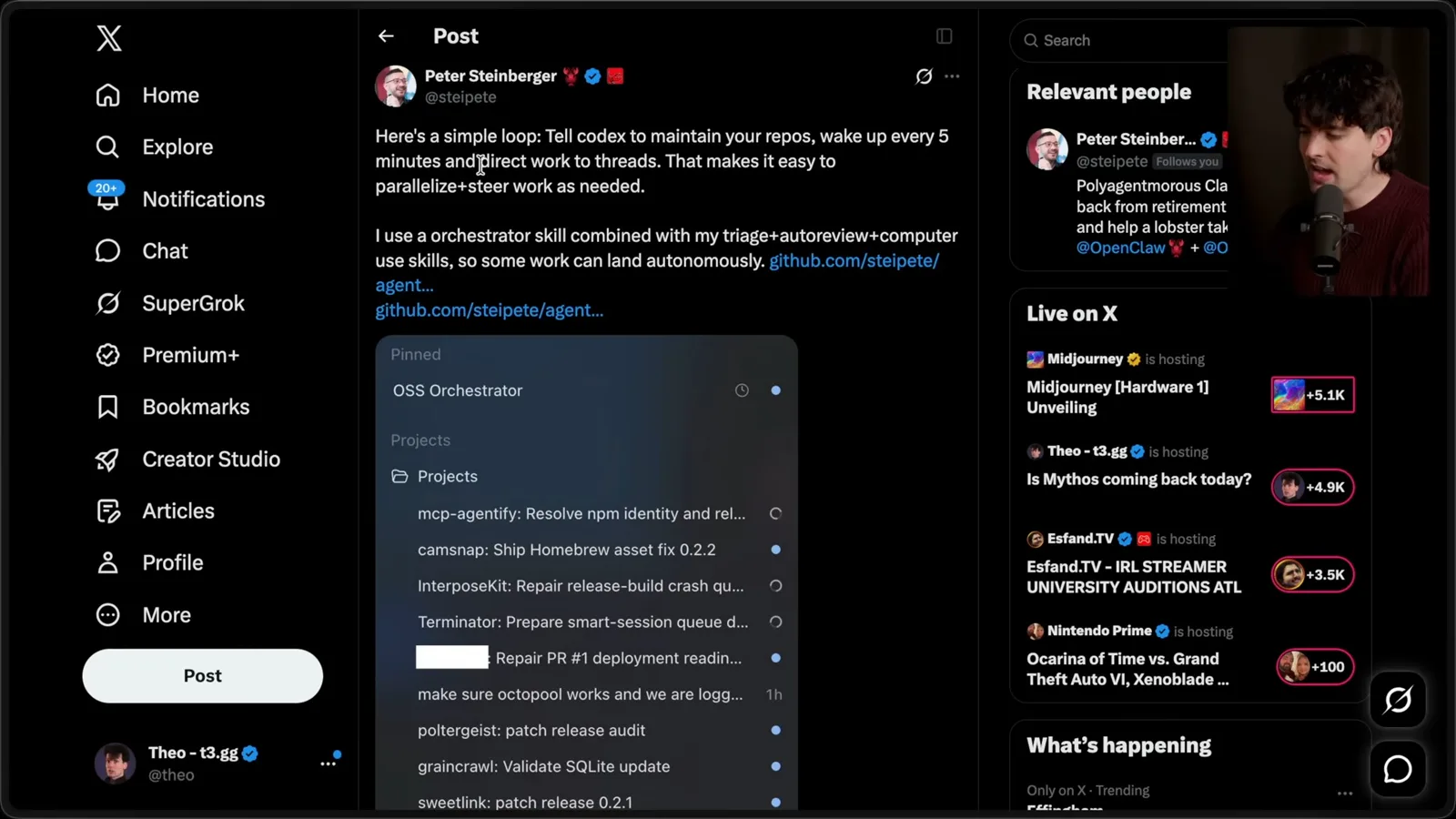
The post that made this click was Peter Steinberger describing an orchestrator that periodically wakes, checks repositories and directs work to threads. I had not realized one Codex thread could create another. The idea gave me a new way to think about parallel work and supervision.
We moved from asking a chatbot for code and copying the answer into a project to letting agents edit the code directly. Workflows and subagents add another step. I was skeptical of predefined personas for every worker because I value agents’ ability to construct the context and method a particular task needs.
Closing the loop goes further: the model can select work, audit the result, pass feedback back and repeat. I am not claiming that all code should be produced without oversight. I wanted to experiment with a limited version and see where it helped.
For a large refactor, I let the agent divide the work among subagents and asked it to monitor the pull request. Previously I had been copying comments from review tools into the agent myself. With a separate worktree for the PR, I could ask it to watch for comments and address them without blocking my main working directory.
The monitoring ran for more than six hours and made improvements, so I pushed further. I also tried asking one agent to run another reviewer and address its feedback. But a single PR is only one shape of work; some problems need several dependent changes.
A multi-PR Lakebed workflow
An agent breaks down performance work into dependent changes. A coordinator then manages implementation and review loops.
While investigating Lakebed’s isolate layer, an analysis suggested that the data architecture might become a bottleneck first. Each mutation could cause many subscriptions to rerun. The proposed improvements included dependency-aware invalidation, batching, shared results and limits on refresh frequency.
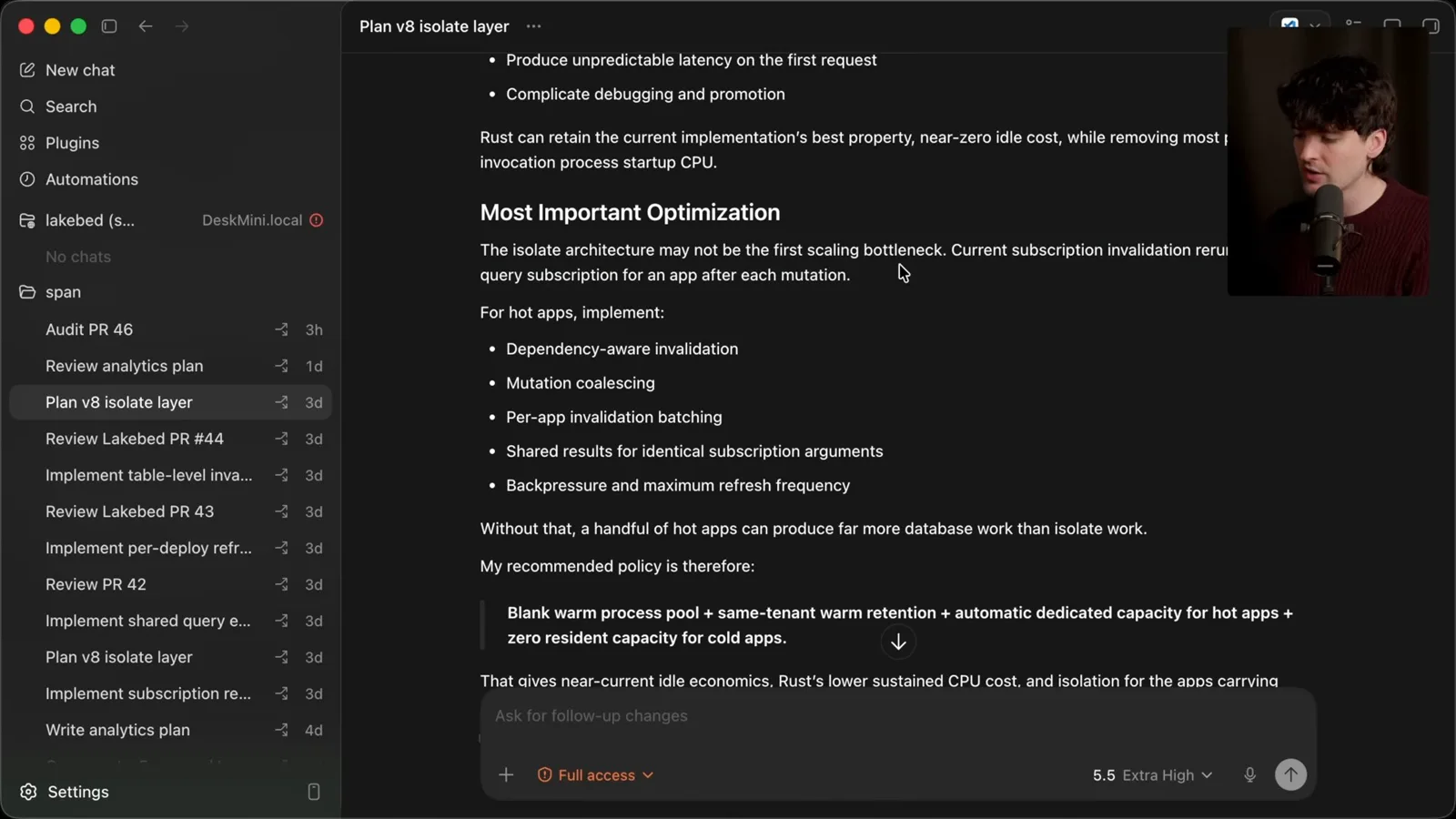
I asked whether these changes belonged in one PR or several, and whether they should be parallel or stacked. The agent recommended multiple PRs, mostly stacked with some parallel opportunities. I asked for HTML plans, then had it start a new thread for the first change.
After the first PR went through review and I merged it, I asked for a new thread for the next part. Then I wondered if the process itself could be automated: one thread implements, another reviews, the implementation responds to comments, and the coordinator moves on after the PR is ready.
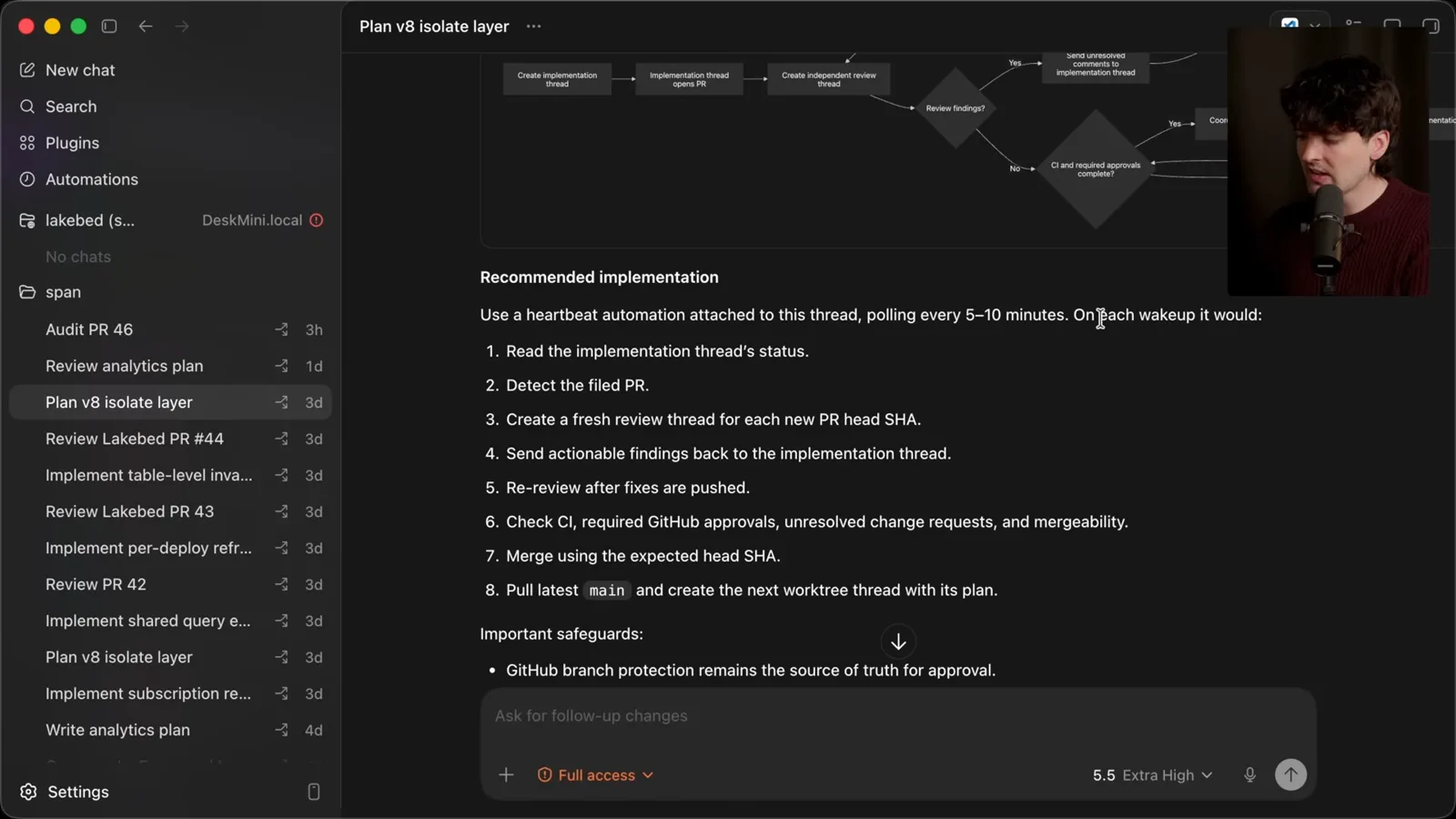
The proposed workflow used a periodic heartbeat to inspect implementation status, detect a PR, start a fresh review for a new head revision, return actionable findings and review fixes. It would check CI and required approvals before merging, then update the base before starting the next worktree.
I started it before bed and woke up to four stacked PRs that had been reviewed and merged. It also disrupted my editor. The result was exciting, but I would not recommend handing this level of autonomy to a production codebase serving millions of users yet.
What stood out was that the workflow created smaller loops suited to this particular problem, instead of applying one fixed reviewer pattern to every change. I see a contrast with static sprint structures: a process can be shaped around the work rather than forcing every task into the same shape.
The same thinking can be used to monitor PRs or surface useful updates on a schedule. I used a loop to watch for 5G hotspot options and it brought a new plan to my attention. In my development example, I still wrote the initial prompts, read the responses and decided to try the proposed process.
Finding the next step to delegate
Theo maps his manual workflow and suggests where agents may help. He keeps human attention on harder questions.
Look at what you do after an agent finishes. I used to run the app, check the result, commit, push, open a PR, collect review feedback, ask my team and then merge. Some of those steps can be delegated: ask the agent to run and check the app, or gather and address review comments.
I also suggest considering whether an automated review can catch obvious issues before a person spends time reading the code. The goal is to leave the human more attention for harder questions. This is my preferred workflow, not evidence that an agent review guarantees correctness.
Costs and limits
Loops can burn large numbers of tokens, particularly when they run in the wrong direction. Theo discusses his own subscription usage and long-running experiments.
A major catch is cost. Loops consume more tokens, and a wrong direction can run for longer before anyone notices. In one case, fewer than ten minutes of review produced a workflow that ran for eight hours and used over three million tokens to address three small comments.
My subscription usage happened to remain below its limit despite several loops, but that is a snapshot of my own accounts and plans at the time. Limits, prices and eligible use can differ. I cautioned that paying per API token could make this style of experimentation expensive.
A persistent goal in one thread is different from a dynamic workflow that creates separate pieces of work. I was also trying a long-running Rust rewrite of Hermes Agent to reduce resource use. It was an experiment; I did not expect it to be production-ready just because the loop ran for a long time.
I showed estimates of substantial inference use across several machines and subscriptions, and saw that as room to experiment. Those estimates are not the same as a cash saving or a prediction of anyone else’s costs. My practical takeaway is to examine your next manual step and ask whether an agent can help, then inspect what it actually does.
The value of loops is letting agents take on more of a process. Try asking for the next step and see how well it works in your own situation. My own experiments surprised me, but the result still needs to be evaluated.
同じチャンネルの記事
 38:47EN
 Theo - t3․gg· 2026年10月28日Theo’s Long-Running Agent Experiments: Verification, Compute and CostTheo Browne · Ping LabsA skateboard game and two compiler projects show how repeated checks and flexible compute can sustain agent work—and how expensive those loops can become.
 36:07ENTheo - t3․gg· 2026年10月27日Theo on Token Costs, Coding Agents, and the Price of AI CapabilityTheo Browne · Ping LabsA viral estimate of Lauren's AI spending prompts a closer look at cache pricing, benchmarks, and the changing work of coding agents.
 30:37ENTheo - t3․gg· 2026年10月26日Theo’s Three Skills for Reviewing and Shipping with Coding AgentsTheo Browne · Ping LabsHow sol-loop, full-send and full-stop encode review, verification and different levels of merge authority.
 0:43ENTheo - t3․gg· 2026年10月23日Theo Distinguishes Security Vulnerabilities from Active AttacksTheo Browne · Ping LabsA short explanation of why disclosed software flaws and reported attacks are different kinds of security news.
 29:22ENTheo - t3․gg· 2026年10月22日Theo on Security Vulnerabilities, Stolen API Keys and AITheo Browne · Ping LabsA look at the gap between vulnerability disclosure and patching, and a speculative account of why stolen inference keys may be valuable.
 31:13ENTheo - t3․gg· 2026年10月20日Theo on Why Smarter Models Help More Than DevelopersTheo Browne · Ping LabsFrom game modifications to compiler experiments, Theo revisits his assumptions about who benefits from more capable AI.