30 秒でわかる
Resend co-founder Zeno Rocha says making email easy for developers requires handling difficult delivery, abuse and DNS problems behind the scenes. He describes expanding an API-first product to MCP and command-line clients, and rewriting pricing information as text after a model misread an interactive calculator. Rocha also explains how design and family shape his decisions as a founder.
- 1Large email sends must be paced and monitoredRocha describes provider throttling, engagement signals and reputation.
- 2Remote agent access required revisiting permissionsResend built OAuth and observability before distributing its remote MCP integration.
- 3Text made a pricing example easier for an agent to readA later test corrected numbers that had been misread from an interactive widget.
- 4Rocha sets family time alongside company growthHe describes choosing a close relationship with his daughter as a priority.
ポイント
- Email delivery requires pacing, reputation management and abuse detection.
- An API-first product can support both human interfaces and agent tools.
- Machine-readable pages can make information easier for agents to retrieve, though the effect on recommendations is hard to isolate.
- Rocha treats product craft and family time as deliberate priorities.
チャプターごとに整えた全文を読む
From developer tools to email delivery
Rocha explains Resend’s origins and the hidden complexity of sending email.
Resend co-founder Zeno Rocha says his email platform began with a developer-experience problem and now serves millions of users. He also describes building a company while prioritizing time with his family.
Host swyx introduces Rocha, whose previous projects included the Dracula editor theme. Rocha says people once recognized that project more readily than Resend.
Rocha came from frontend development, not email infrastructure. He had used existing services and felt developers deserved a more thoughtful experience.
He reports 4.3 million users and 120,000 paying customers at the time of recording, ranging from individual developers to large companies.
swyx discloses that he is an angel investor in Resend. He recalls a coding model recommending Resend even when his project already had another email service configured.
Rocha says he has spent considerable effort making the product discoverable in a new distribution environment where people ask models which tools to use.
Sending high volumes of email is not merely a scaling problem, Rocha says. Different mailbox providers apply different rules and monitor the behavior of recipients.
The company initially removed a lengthy approval step to reduce friction, then learned why incumbents had imposed it: fraud, phishing and abuse are significant operational problems.
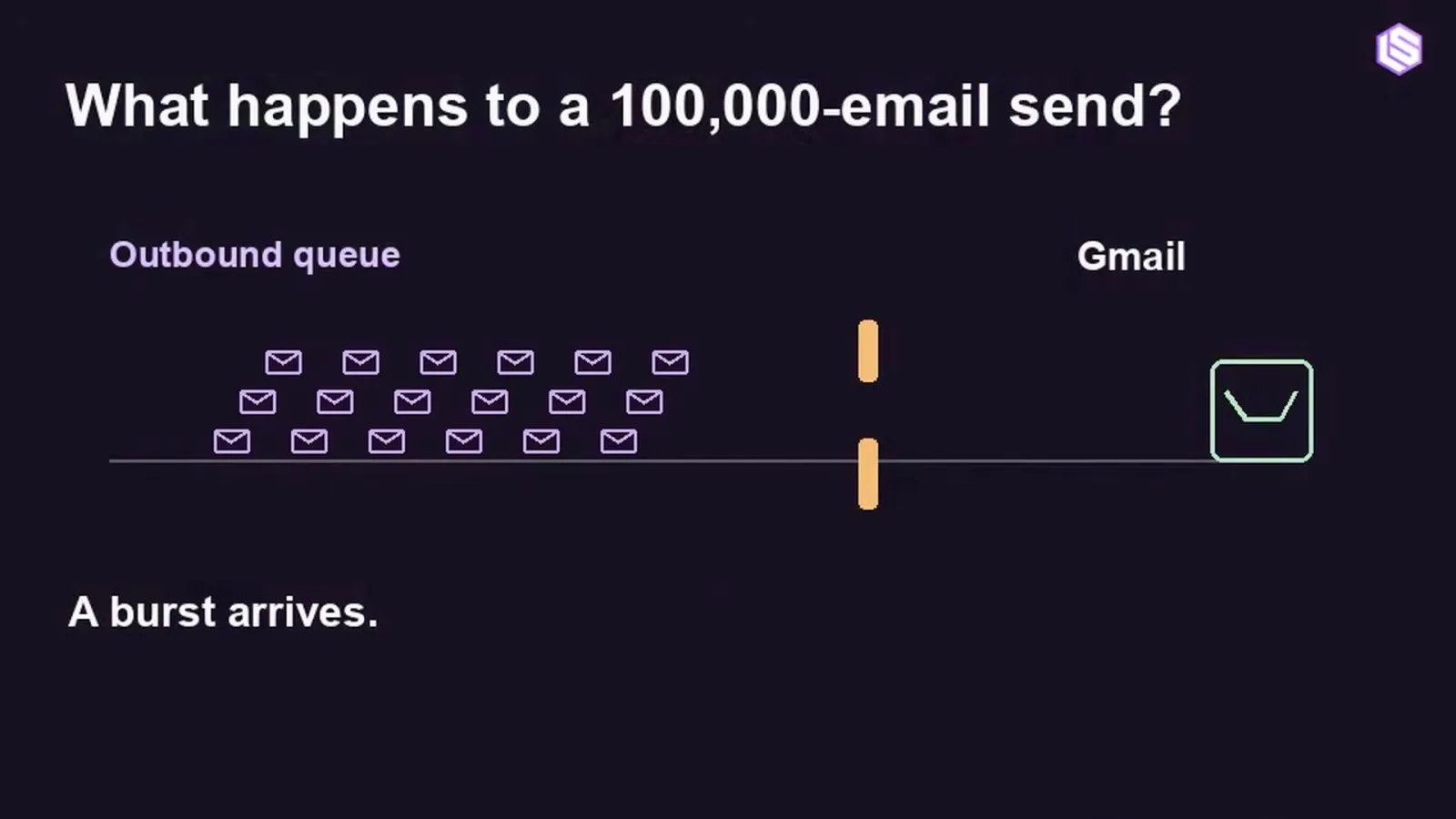
A large send must be queued and paced. Rocha says providers may observe early recipient engagement before deciding how to treat later messages.
The platform also manages IP pools and sending rates. Rocha says consistent sending patterns can look healthier than sudden bursts followed by long silence.
He describes looking at domain age, website signals and sending behavior to identify suspicious accounts, while distinguishing abuse from ordinary user mistakes.
Rocha says users should not have to become email specialists to avoid basic mistakes. The product adds insights and checks so best practices appear in the workflow.
The service began generating a plain-text version from HTML email. Rocha says this can help filters inspect content, though plain text also changes how open tracking works.
An invisible image can record an open, but privacy features and automated scanning can load it without a person reading the message. Rocha says open rates are therefore less reliable.
He also discusses link-tracking domains: if an abusive customer damages the reputation of a shared tracking domain, other senders can be affected.
His team chose to let people start quickly and intervene when warning signals appear. Rocha says it then talks with the user to determine whether the problem was misuse or deliberate abuse.
Support, DNS and open-source templates
The conversation covers documentation, domain setup and React Email.
The conversation turns to support. Early hires answered tickets, but Rocha says the team also needed to prevent recurring questions by improving documentation.
One policy required support answers to include a documentation link. Writing the article took longer initially but made the answer reusable for later customers.
DNS setup remains a common source of friction, especially for people using AI building tools who may not know how to diagnose a CNAME or TXT record.
Rocha describes Domain Connect, a protocol that lets a service coordinate DNS changes with participating providers through an authorization flow. Adoption required work with providers.
Email infrastructure also depends on industry relationships. Rocha says the company hired people with deliverability experience and used their existing networks.
React Email became an open-source route into the product. Rocha says it addressed the difficulty of building email templates before users needed a service to send them.
He says the team began Resend first and built React Email after user research exposed the pain of turning designs into email-compatible HTML.
The framework uses React-style components to produce email markup. The speakers note that email clients do not execute ordinary page JavaScript, so templating is the main benefit.
Rocha recalls being warned that email providers can spend enormous effort fighting abusers. He concluded that automation would be essential rather than treating support and safety as an endlessly growing manual operation.
He says Resend’s SDK downloads passed SendGrid’s, while acknowledging that SendGrid still sends far more email and serves large enterprise customers.
The two discuss the economics of email and adjacent channels such as SMS and messaging. Rocha says his broader goal is to help customers connect with their audiences.
Owning the infrastructure and serving agents
Rocha discusses sending infrastructure, API design and MCP.
Resend started on Amazon SES and concentrated on developer-facing tools. Rocha says low sending costs still require surrounding infrastructure for events, queues, logs and webhooks.
The company is now building more of its own sending infrastructure. Rocha expects greater control over throughput, deliverability and information shown to customers.
He describes managing IP blocks, traffic to mailbox providers and the relationships needed to operate that infrastructure. He wants users to see more of what happens after a message is sent.
For performance, the company has moved parts of the sending path from its JavaScript stack to Go. Rocha says the team is willing to use different languages where they fit.
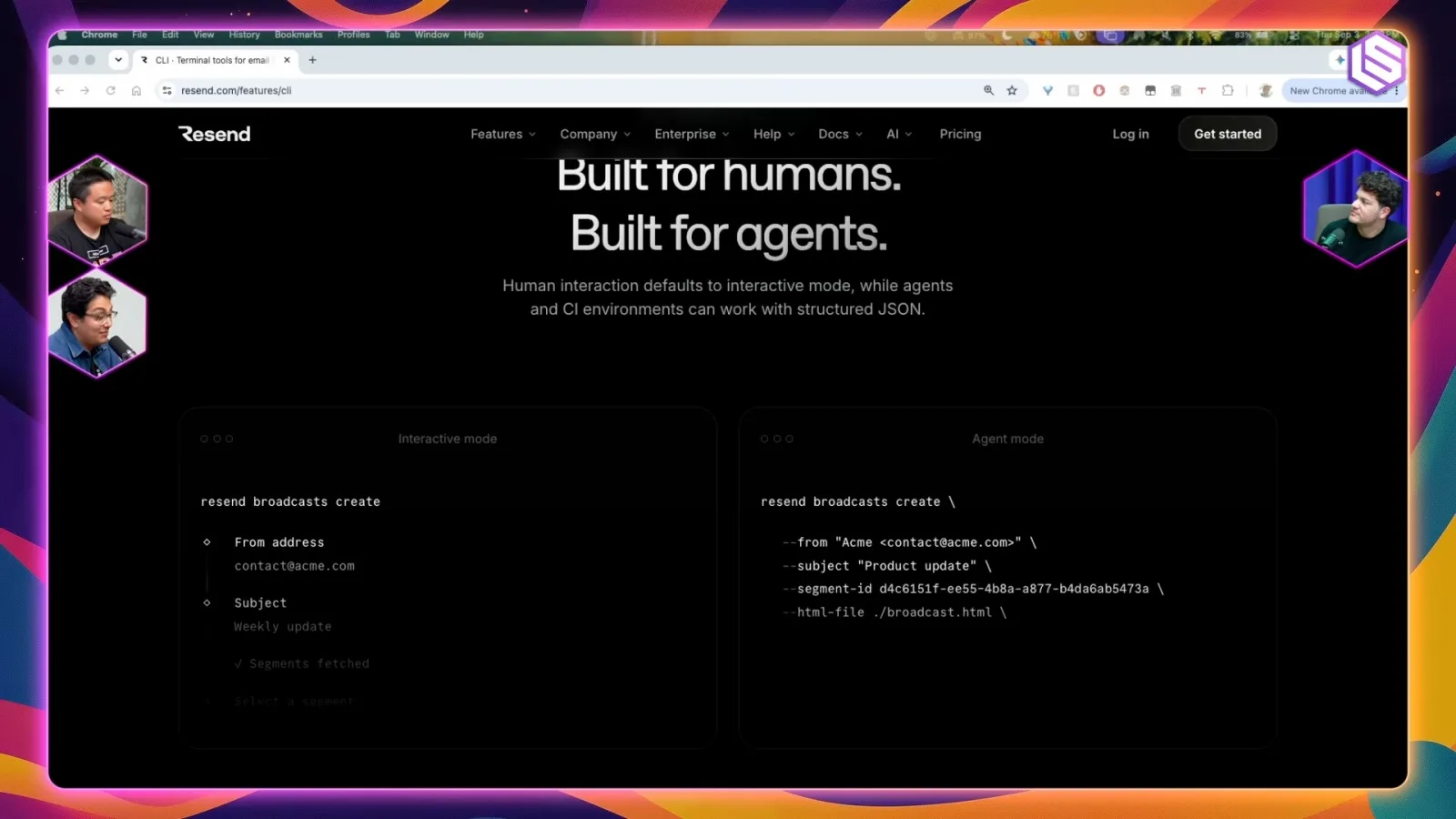
Rocha wants Resend to be usable through whatever interface a customer needs. He says its API-first approach later made it easier to expose functionality to agents.
He reports growing MCP usage and says the first implementation came from an investor’s open-source project, which was later transferred to the company.
To offer a remote MCP integration, the team revisited permissions and built OAuth support. After that came observability and work to distribute the integration through official directories.
Rocha says he personally prefers official integrations maintained by the software vendor. For him, their availability can influence which products he chooses.
He watches tool calls and the amount of data returned. The MCP surface has grown to more than 80 tools, and he says he has not recently seen tool count cause the confusion he once expected.
Covering everything the dashboard can do is difficult, especially for billing, invitations, provisioning and deletion. The team must decide what belongs in an API.
The speakers discuss keeping a public API independent of the user interface. Rocha says maintaining separate public and private paths created duplication for the team.
Interfaces, inboxes and deliverability
The speakers explore CLI access, collaboration and incoming email.
Resend also offers a CLI and SDKs. Rocha shows that applicants can use the CLI or API to apply for jobs, alongside the usual interface.
He says the team supports many languages and a free tier partly because he remembers building software in Brazil with limited resources and connectivity.
The product also offers a collaborative editor. Rocha says some teams want marketers to edit templates visually, while others prefer to keep templates in source control.
On incoming email, he describes plans for programmatically creating multiple inboxes and exposing operations such as reading, marking and labeling messages.
Rocha says mailbox providers differ in their acceptance rules. Reputation increasingly attaches to domains as well as IP addresses, so senders may separate transactional and marketing traffic.
Making product information discoverable
Rocha shares experiments with documentation and machine-readable pages.
Rocha turns to discoverability. The company wrote short documentation for specific combinations of language and framework, then added question-and-answer sections across pages.
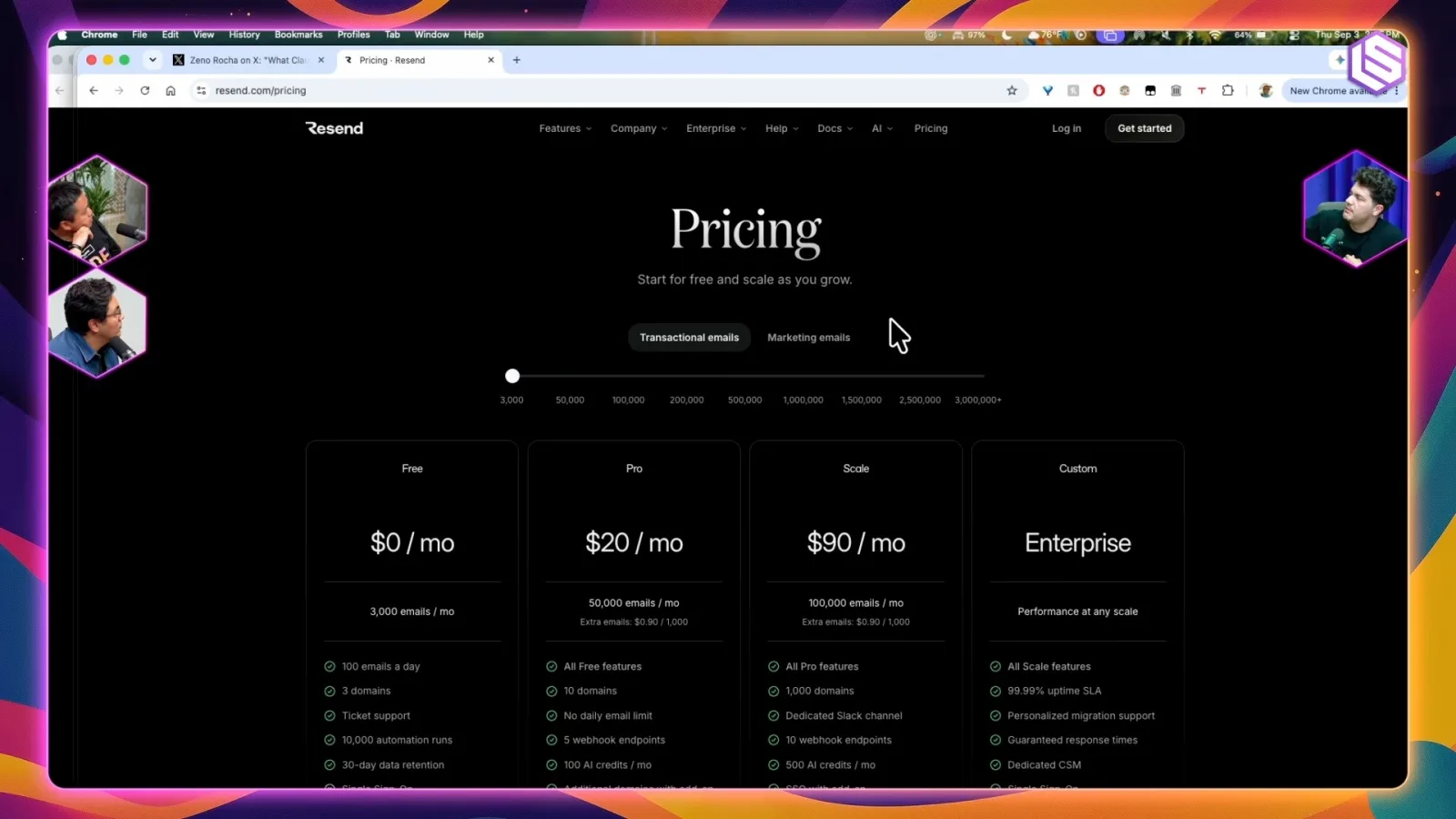
The team also publishes machine-readable Markdown versions of pages. Rocha says a model once misread pricing from an interactive widget; after he added a textual version, a later test returned the numbers correctly.
Maintaining HTML and Markdown separately can create multiple sources to update. The speakers discuss the possibility of generating both from a common source.
Rocha says comparison and migration pages are another experiment. He places important chart data in text because a text-fetching agent may not execute a JavaScript widget.
He suspects recent tools and independent discussion can influence recommendations, but the speakers acknowledge that it is hard to isolate which discoverability tactics cause a result.
They describe tracking recommendations and running experiments. Rocha says existing analytics products report visibility but do not always tell him which action will improve it.
Enterprise growth and family
The discussion closes with sales, product positioning and personal priorities.
On enterprise sales, Rocha says the company is adding the function cautiously to preserve its culture. Enterprise buyers may need a meaningfully different product, not just a longer checklist.
Marketing and transactional email have different cost structures. Rocha describes batching, observing engagement and adjusting sending rates during a large campaign.
Rocha discusses joining Y Combinator as a parent and the difficulty of comparing himself with founders who had different family circumstances.
An adviser told him he spent too much time on design. Rocha ultimately decided the product’s identity and the experience of using it were priorities worth preserving.
He says he would choose a smaller business and a close relationship with his daughter over a much larger company at the expense of that relationship.
Both speakers acknowledge that being present with family while ambitious work occupies their attention is difficult. Rocha says he tries to improve a little each day.
swyx closes by distinguishing a company leading an existing category from creating a new category. The speakers discuss how hard it is to explain a new category succinctly.
They wrap up the conversation after reflecting on product positioning, building the company and family.
同じチャンネルの記事
 23:15EN
 Latent Space· 2026年11月8日ポッドキャスト · 2 人Jay Parikh: GitHub must adapt as coding agents change developmentゲスト Jay Parikh · ホスト Shawn WangGitHub's scale, model choices and security are changing as agents join developers, says Microsoft CoreAI's Jay Parikh.
 1:42:28ENLatent Space· 2026年11月7日ポッドキャスト · 2 人Jamin Ball on Anthropic's S-1, Compute Economics and the Frontier Model Raceゲスト Jamin Ball · ホスト swyxAn investor examines Anthropic's filing, from cash flow and convertible notes to the financing and competitive pressures facing frontier AI labs.
 50:37ENLatent Space· 2026年11月6日ポッドキャスト · 2 人Adit Abraham on Why Document Parsing Still Breaks AIゲスト Adit Abraham · ホスト Allen ParkThe Reducto co-founder discusses missing table rows, production evaluation, document editing and growing a company while making a steak sandwich.
 50:50ENLatent Space· 2026年11月6日ポッドキャスト · 3 人Fabian Theis on Virtual Cells, Organoids and Closing the Lab Loopゲスト Fabian Theis · ホスト RJ Honicky, Brandon AndersonThe Helmholtz Munich researcher explains perturbation models, biological benchmarks and the work required to connect prediction with experiments.
 1:12:24ENLatent Space· 2026年11月4日ポッドキャスト · 2 人Behind Latent Space: swyx and Galen Gao on AI Engineers, SaaS, and Shanghaiゲスト Shawn Wang (swyx) · ホスト Galen GaoShawn Wang and Galen Gao trace the growth of the AI Engineer community and discuss what coding agents mean for small businesses.
 34:48ENLatent Space· 2026年11月3日ポッドキャスト · 2 人Zach Lloyd on the Infrastructure Behind a Software Factoryゲスト Zach Lloyd · ホスト Shawn Wang (swyx)Warp’s founder explains how teams can define, observe and improve agentic development workflows—and when the additional infrastructure may be excessive.