30 秒でわかる
ArtCraft built a functional first approximation of Photoshop in about 24 hours by giving coding agents detailed plans for the interface, tools and file formats, founder Brandon Thomas says. It has not reached full feature parity: he estimates it has passed 60%. Thomas wants artists to own and adapt their tools, and says users are already coding their own workflows. As the community expands the project into office, CAD and collaborative software, it must also manage build infrastructure and decide where human review remains necessary.
- 1Artists are already building custom workflows on top of open toolsThomas says creative studios used coding agents and APIs to build interfaces for work that general-purpose products did not fit. That experience pushed ArtCraft toward open infrastructure and customizable applications.
- 2The first Photoshop-like app took about 24 hours, but remains incompleteThe team described the editor’s interface, tools, data structures and importers in extensive prompts. Thomas estimates the project has passed 60% parity and says the team is still working toward broader coverage.
- 3The community is extending the approach beyond photo editingThomas describes open alternatives across office applications, collaborative design and CAD. He says the team is also releasing the underlying infrastructure and data models.
- 4Linux access and programmable interfaces are central to the projectThomas says around a quarter of users are on Linux, and describes MCP and command-line support as first-class features for automating creative work.
- 5Keep human review for high-impact backend changesThomas recommends human involvement for schema migrations and API design while giving agents more freedom on desktop applications and games. He also describes Autocraft, a planned open-source development system.
ポイント
- A detailed plan for tools, interfaces and file formats helped ArtCraft build its first Photoshop-like editor quickly, Thomas says.
- The initial application is an approximation; Thomas estimates it has passed 60% feature parity.
- Open applications can let creative teams customize interfaces and workflows around specific jobs.
- Thomas recommends keeping people closely involved in backend work such as schema migrations and API design.
- The team plans to open-source Autocraft, a system for issue triage, agentic development and evaluation.
チャプターごとに整えた全文を読む
A viral project and the case for owning software
Thomas says a set of Photoshop-like and other open applications spread quickly. He connects the project to a desire for applications and infrastructure users can own.
Our project went viral after I built approximations of Photoshop and other applications. Since then, I have been talking with open-source developers, investors and other people interested in the work. I want to use AI to help make applications and infrastructure that people can own and change.
Open source already powers much of technology, but users are often pulled into platforms they do not control. I think AI gives developers a chance to rebuild more of the applications people use and give that control back.
I have spent about 15 years as an engineer, including eight at Square working on infrastructure such as online payments and authentication. I also spent seven years building startups, with creative people, artists and filmmakers among the customers I wanted to serve.
From open protocols to closed platforms
He contrasts an early web of customizable pages, third-party tools and APIs with later platforms and subscription products. He argues that the change reduced user control.
The early web felt different. Internet Relay Chat let people run their own servers and automate clients, while many messaging services tolerated third-party software. Websites exposed APIs and data exports, so developers could combine services to make new applications.
People could buy files such as MP3s and customize their web spaces. Communities built animations, forums and projects such as Wikipedia. I remember an environment shaped by technical early adopters and a great deal of experimentation.
Web 2.0, broadband and smartphones brought many more people online. Making products easier to use was necessary, but platforms replaced protocols, APIs disappeared and distribution became controlled by a smaller number of providers.
As services gained market power, subscriptions accumulated and some companies introduced cancellation charges and other conditions. Adobe’s early cancellation fees are an example of a cost that can surprise someone using an application only briefly.
Artists customize their own tools
ArtCraft began as a desktop tool for professional creatives. Thomas says customers used coding agents to adapt workflows, inspiring a broader open-source effort.
ArtCraft began by building open-source software for professional creatives, including desktop tools whose files sit on the user’s machine. Some advisers doubted that artists would care about open source, but we observed customers using coding agents to adapt their workflows.
Some micro-drama studios handle tens of thousands of dollars of work each month. Their delivery processes were too specialized for a standard product, yet people on their teams could use APIs and AI coding tools to assemble interfaces suited to their needs.
That suggested a wider ambition: if the infrastructure and applications were open, an artist could remove features they do not use and shape a tool around a particular workflow. Different members of a team might each adapt the same application for their own part of a job.
Building a Photoshop approximation with agents
A detailed plan produced a working first version within a day, Thomas says. The team is pursuing familiar interfaces and broader coverage rather than claiming full parity.
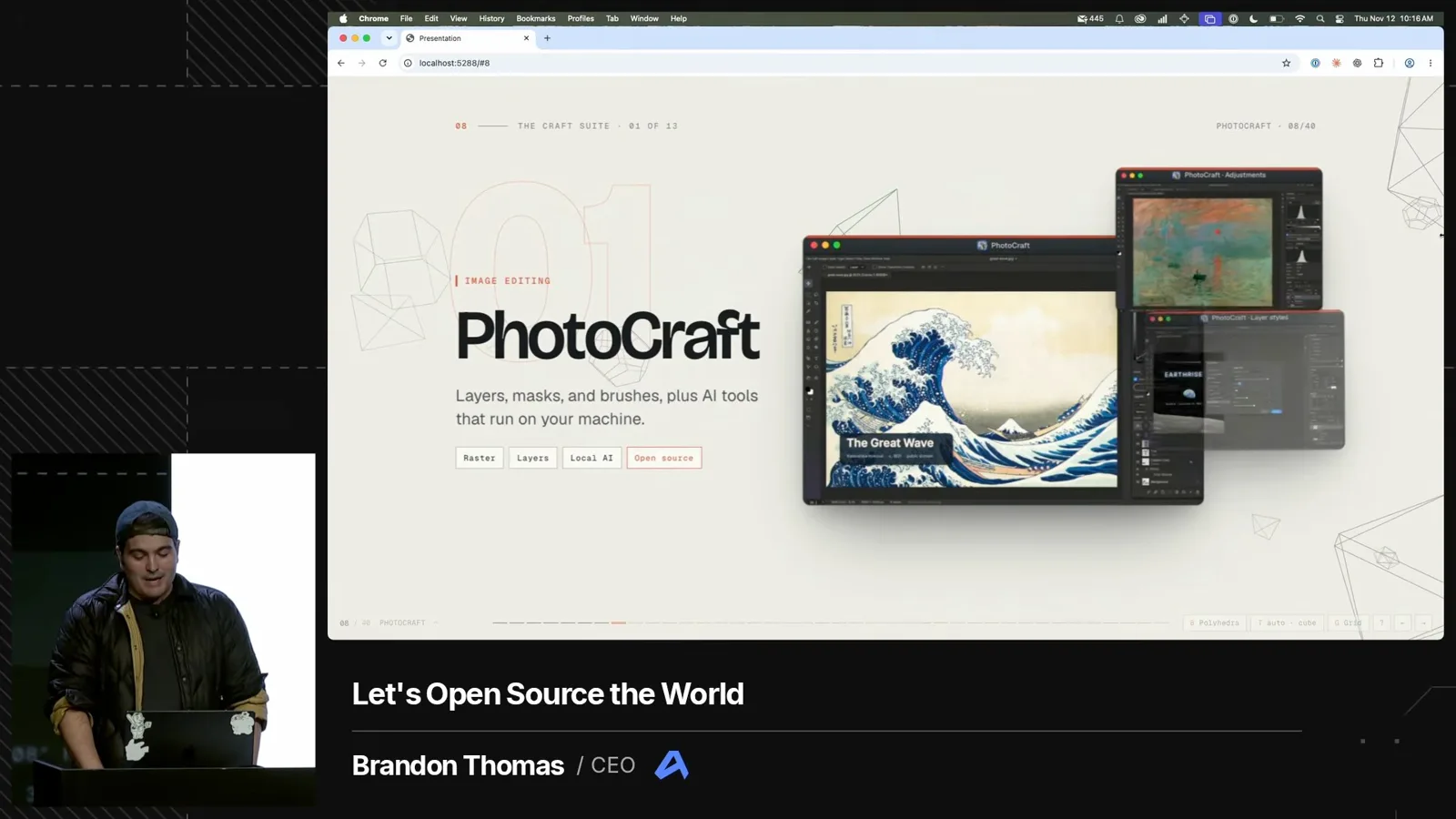
The team started with a Photoshop-like editor. They wrote extensive prompts describing the application, separating interface from functionality and planning tools, data structures and file importers. They also wanted command-line and MCP interfaces so agents could control the application.
Within 24 hours we had a functional and familiar approximation that started much faster than Photoshop. It did not cover the whole product: we measure feature parity and, at the time of the talk, had moved past our own estimate of 60%.
We debated inventing new interfaces immediately versus matching established ones. For now, we are pursuing familiar Adobe-like workflows so artists can use existing muscle memory. I expect more agent-oriented interfaces later and treat the existing applications as a demonstration of what agentic development can build.
The project expanded to other creative applications, including page layout and video editing. I had not expected the response: after the work spread on Reddit, journalists contacted me and the project’s Discord grew rapidly.
Some artists who had opposed AI began using the tools, filing bug reports and requesting features. My hope is that they can learn to use interfaces such as MCP while getting faster, more focused applications for their work.
Expanding into office, design and CAD
The project and its community are building many kinds of applications. Thomas reports strong uptake, Linux use and a large contributor base.
Our team and its community have also worked on CAD, animation, audio and office tools. Universities and companies have approached us about using the applications, including on Linux, where some commercial alternatives have not been available.
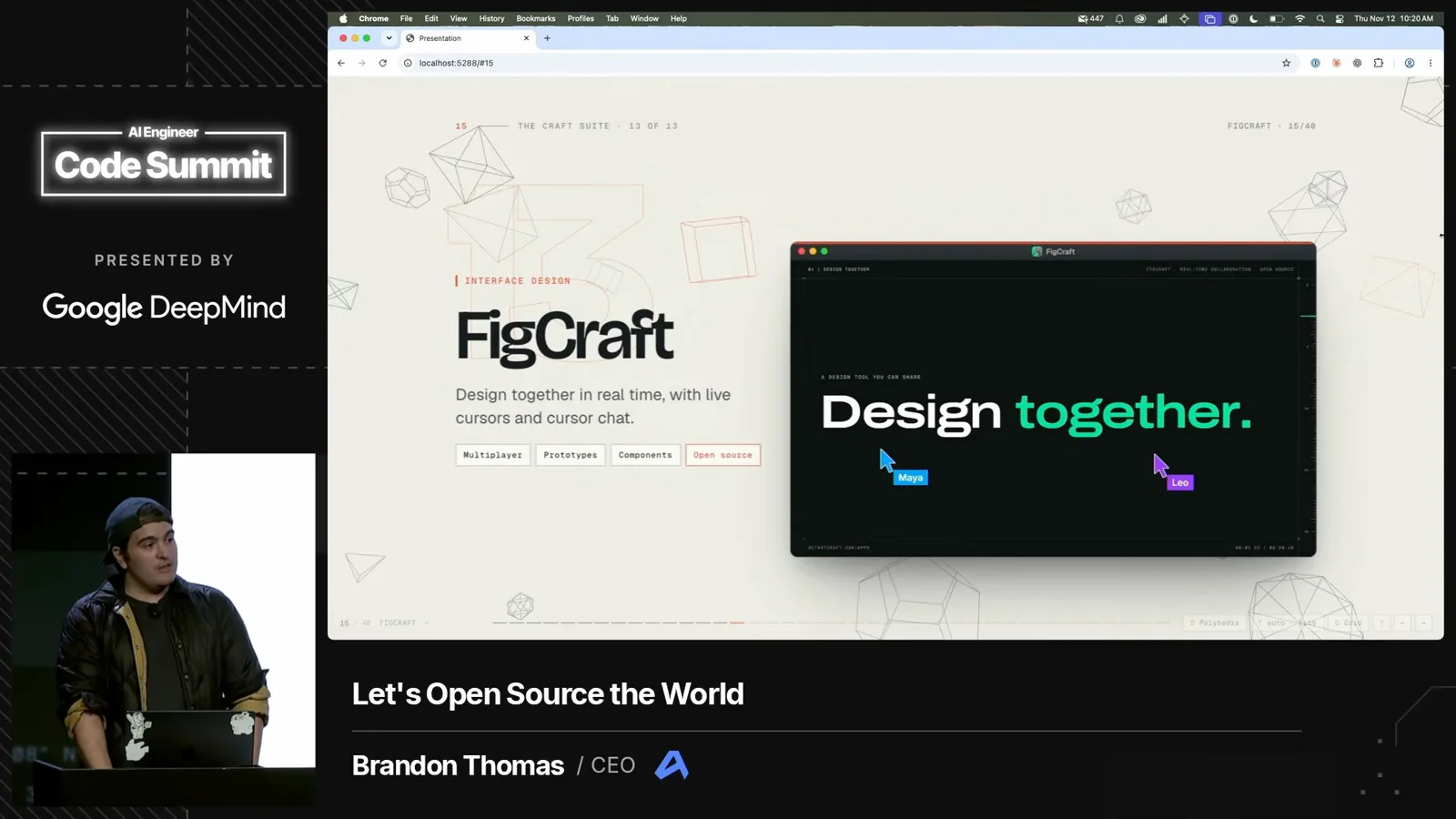
PDF Craft is a fast PDF application that works across systems including Linux and NetBSD. We have also developed a collaborative design tool with a server component; the underlying infrastructure and data model are open source.
A community-led Solid Craft project is developing engineering software and a kernel for 3D work. It can be controlled through MCP, including for projects intended for 3D printing.
The projects have more than 300,000 GitHub stars and around 4,000 contributors, with roughly 1.7 million downloads per day. This effort is much bigger than me: the community is contributing across development and continuous integration as well as individual applications.
A desktop launcher helps users manage the applications, and about a quarter of our users are on Linux. MCP and command-line interfaces are first-class features, so a user can ask an agent to assemble a creative project and watch it work.
The applications have also been localized into additional languages and are being developed for workflows affected by product retirement. Animation studios asked us to support a tool they depended on for their jobs.
Roughly 300 community applications are in development, alongside tools intended to let less technical people contribute. We are extracting reusable interface components and 2D and 3D libraries so that new projects can build on common pieces.
Rust, human review and an autonomous factory
Thomas describes native Rust applications, compilation and CI challenges. He outlines where he wants human review and his planned open-source Autocraft system.
Rust has been essential to delivering native, cross-platform creative applications. The code can also reach the web through WebAssembly, though compile times are a significant practical cost.
In my experience, developers need not already know Rust to start using it with coding agents. We have also run into practical problems with permissions, GitHub and scaling continuous integration; the team has begun adding its own infrastructure to cope.
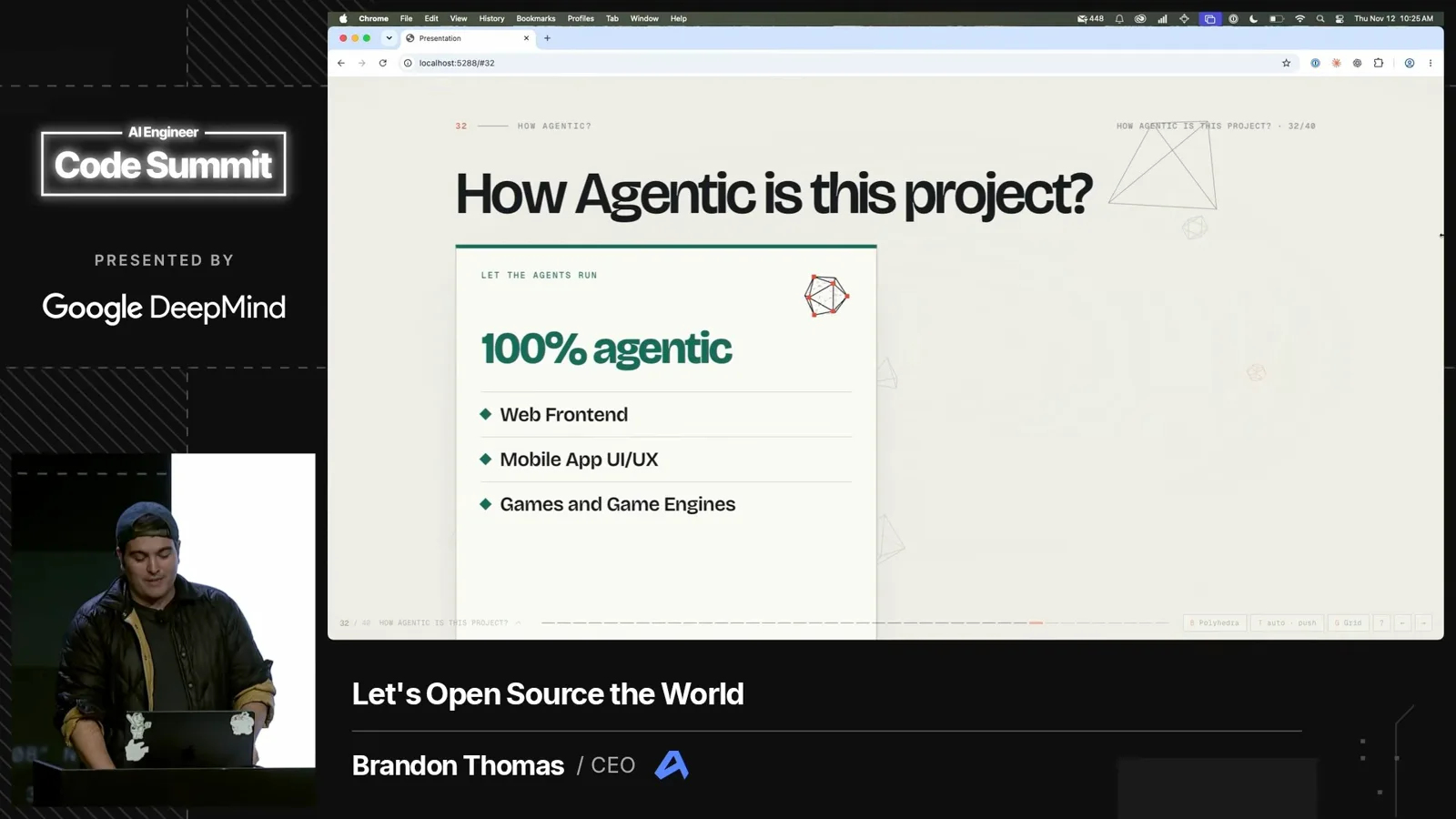
For work with important backend consequences, such as schema migrations and API design, I recommend keeping humans involved. For desktop apps, games and work that is basically immutable, I am more willing to let agents build with less direct oversight.
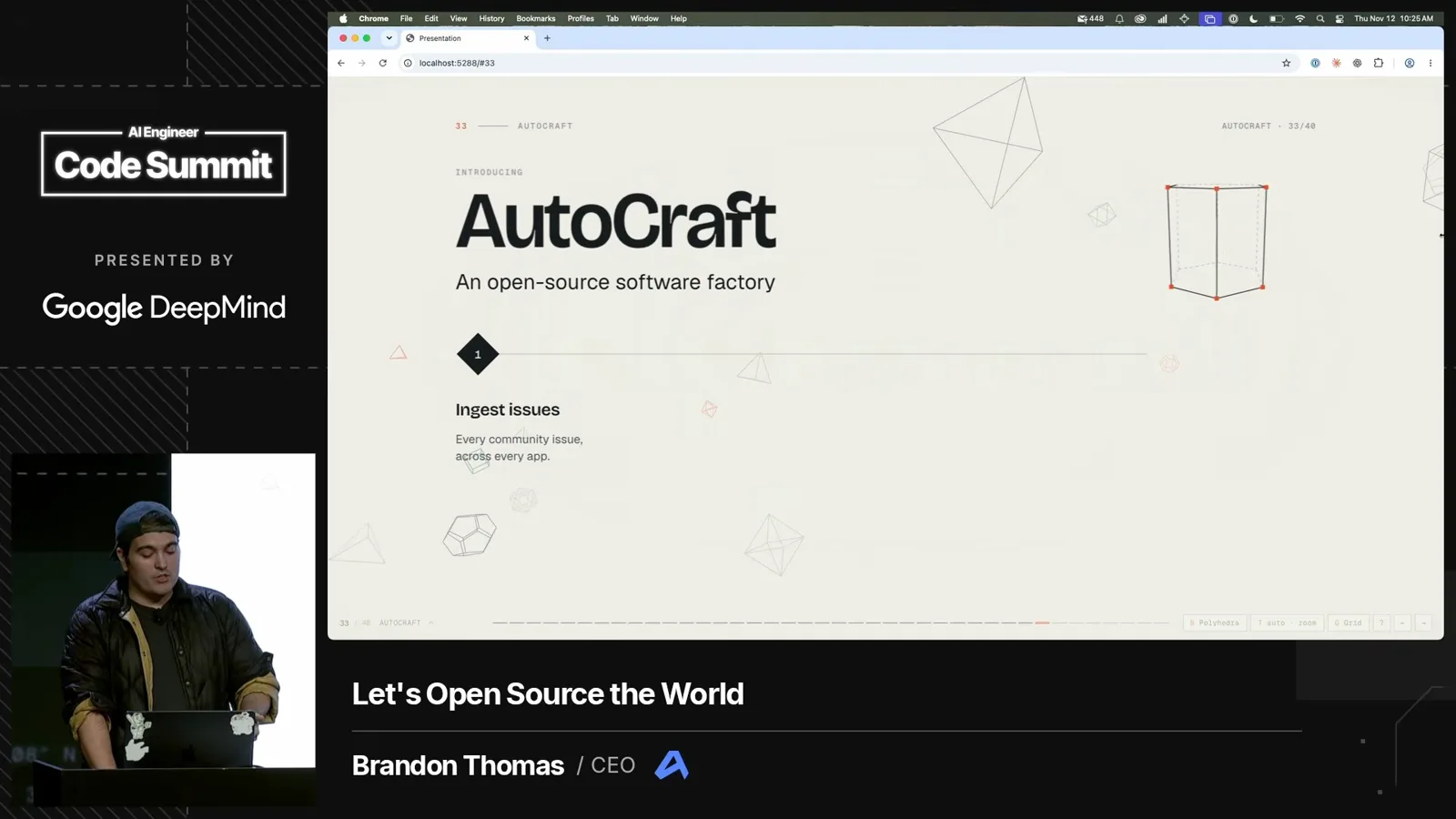
Autocraft is a forthcoming open-source software factory that will ingest and triage issues, perform agentic development and use recorded decisions for evaluation and post-training. The aim is to express more of the development process in code while keeping the system open.
Let us build applications, infrastructure, protocols and models that users and communities can own. Our company’s code is open, and I invite others to participate in building it.
同じチャンネルの記事
 23:19EN
 AI Engineer· 2026年11月15日Diogo Almeida: Reliable AI Needs a Different Training GoalDiogo Almeida · TypeSafe AIAlmeida argues that models trained to assist people are poorly suited to unattended automation, and calls for software built around reliable intelligence.
 17:31ENAI Engineer· 2026年11月14日Lauren Tan: Make AI-generated code trustworthy with enforceable checksLauren Tan · SpaceXSIThe Grok Bot engineer describes the architecture, verification and review changes behind her team’s high-volume agent workflow.
 17:31ENAI Engineer· 2026年11月12日Claude Code needs less steering, but unattended work needs stronger checksLydia Hallie · AnthropicLydia Hallie describes how permissions, isolated environments and verification can take over tasks people once handled during every session.
 14:00ENAI Engineer· 2026年11月11日Test what a skill teaches before cutting its instructionsNikolay Petrov · IntelNikolay Petrov compares model answers with and without a skill to find known, useful and harmful instructions—then checks changes on real tasks.
 18:03ENAI Engineer· 2026年11月11日Dmitry Buykin: How to Maintain Code When Agents Outrun ReviewDmitry Buykin · MaerskAt Maersk, weekly pruning, real-task replays and expert feedback help keep an agent-built system understandable.
 26:49ENAI Engineer· 2026年11月11日Ara Khan: Choose work that improves with AI without being replaced by itAra Khan · ClineCline’s Ara Khan explains an automated evaluation loop and urges engineers to pick problems that benefit from model progress.