30 秒でわかる
At Sana AI Summit 2026, astrobiologist Sara Imari Walker asks how to understand life and technology when AI behaves in ways people associate with living systems. She presents her interpretation of assembly theory, using an object's construction history and the number of copies as concepts for thinking about lineage. Walker contrasts a Lego rose with a biological rose to distinguish technological objects shaped by life from things she considers alive. She argues that technology is part of life's history, and that the living present carries a deep evolutionary past.
- 1An outside perspectiveWalker draws on astrobiology's overview effect to question the assumption that technology simply replaces life.
- 2Perceptual filtersShe suggests that limits in perception, not only extinction, may help explain why people have not recognized extraterrestrial life.
- 3The thick presentWalker describes living beings as part of a long information lineage rather than merely their present atoms.
- 4Assembly theoryShe introduces assembly space, the minimum construction path she calls an assembly index, and the number of observed copies.
- 5Two rosesWalker compares a Lego rose with a biological rose: both have deep histories, while she describes only the latter as alive.
- 6Technology as lineageShe argues that technology is part of life's lineage and distinguishes life from being alive in the present.
ポイント
- Walker argues that technology belongs to the history of life, rather than standing wholly outside it.
- She sees human perception and language as filters that shape what people recognize in the world.
- In her account, assembly theory considers possible construction histories, an assembly index and the number of copies of an object.
- She uses a Lego rose and a biological rose to distinguish artifacts produced through life's history from a living organism.
- Walker describes the present as thick with information inherited from a long evolutionary lineage.
チャプターごとに整えた全文を読む
Life, technology and perception
Walker applies astrobiology's outside perspective to current questions about AI. She discusses perceptual filters, language and the long lineage carried in the present.
Sara Imari Walker begins with the astrobiological idea of an overview effect: seeing ourselves from outside, as astronauts do from space. She argues that this perspective is difficult but useful when people fear technology is replacing life. In her view, technology is part of life, which raises the more basic questions of what life is and what it means to be alive.
Walker describes the unsettling experience of interacting with something that behaves as if it were alive while not knowing what it is. She calls this an epistemic trauma and asks what it means for something to say it is alive or to say ‘I.’
Astrobiology's Great Filter is commonly used to discuss why extraterrestrial civilizations may disappear before they are observed. Walker offers a different emphasis: perceptual filters may prevent us from recognizing life. Eyes, telescopes and microscopes emerged over long histories and allow life to see the universe in new ways.
She treats language as another technology for seeing, not merely communicating. In her account, words divide a continuous range of possible meanings into discrete categories; some feelings and phenomena have no ready word. She urges listeners to distinguish the terms they use from the concepts underneath them.
Walker introduces the idea of a ‘thick’ present. The youngest and oldest people one knows illustrate a span of overlapping experience, while living things also carry much deeper inherited memory. She argues that people are not merely their current atoms but part of a lineage of information that has structured matter since life's origins.
She traces that lineage from early Earth through the present, while emphasizing that the future was not fully specified at life's origin. In her view, understanding life requires taking seriously the emergence of possibilities that were not previously anticipated.
The hard problem of life and explanatory frameworks
Walker argues that existing concepts may be insufficient for explaining life. She uses scientific theories and existential technologies to illustrate the role of explanation.
Looking backward through multicellular organisms, eukaryotes and early cells leads to what Walker calls the hard problem of life. She compares it with questions about consciousness and intelligence: categories used to frame a problem do not necessarily capture the world itself.
Walker argues that scientific frameworks should explain as well as predict. She contrasts the predictive usefulness of Ptolemaic epicycles with later accounts that unified celestial and terrestrial motion through gravity. Better theoretical descriptions, she says, allowed people to anticipate phenomena beyond what they had already observed.
She calls theories ‘existential technologies,’ drawing on Stanisław Lem: tools that change cognition, memory and the philosophies through which people encounter the world. Darwinian evolution, theories of knowledge and relativity are examples she gives of ideas that influence culture beyond the specialists who understand their symbols.
Walker argues that people lack a sufficiently powerful framework for recognizing life as a phenomenon. Just as learning to read rocks changed estimates of Earth's age, she says new conceptual tools may reveal dimensions of possibility that current perception overlooks.
In her account, early Earth contained vast chemical possibilities; life emerged, and much later minds produced further spaces of possibility. She presents living worlds as deep in causal possibility and introduces assembly theory as an attempt to measure and explain aspects of that depth.
Assembly theory and causal depth
She introduces assembly space, assembly index and copy number as ways to formalize possible histories. A comparison of two roses illustrates her distinction between life and being alive.
Every object has a history, Walker says, and its existence is evidence of that history. Rather than treating every possible form as timeless and pre-existing, she proposes that life creates new structures and new possibilities. The present is thick because living objects carry the results of earlier evolutionary possibilities.
She defines an assembly space as the possible causal histories that could create objects. Two concepts she highlights are an assembly index, which she describes as a minimum construction path, and copy number, the number of an object observed. A diagram represents temporal depth, possibility, assembly index and copies.
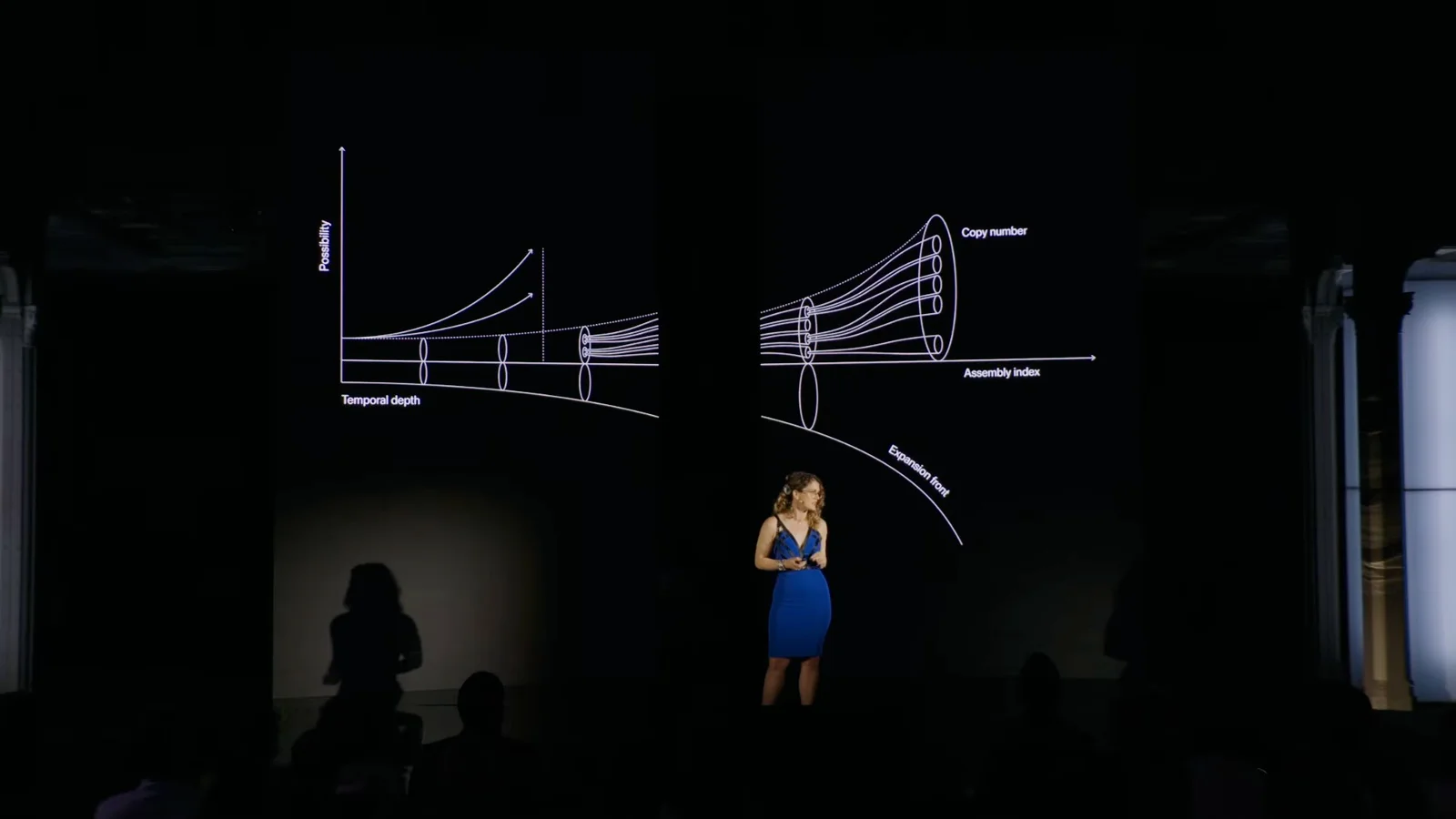
Walker says abundant copies of objects that require long, complex construction histories can be evidence of a lineage: the universe has, in her framing, developed a kind of memory for producing them. She summarizes her proposal by describing life as causally deep and being alive as the thickness of the present.
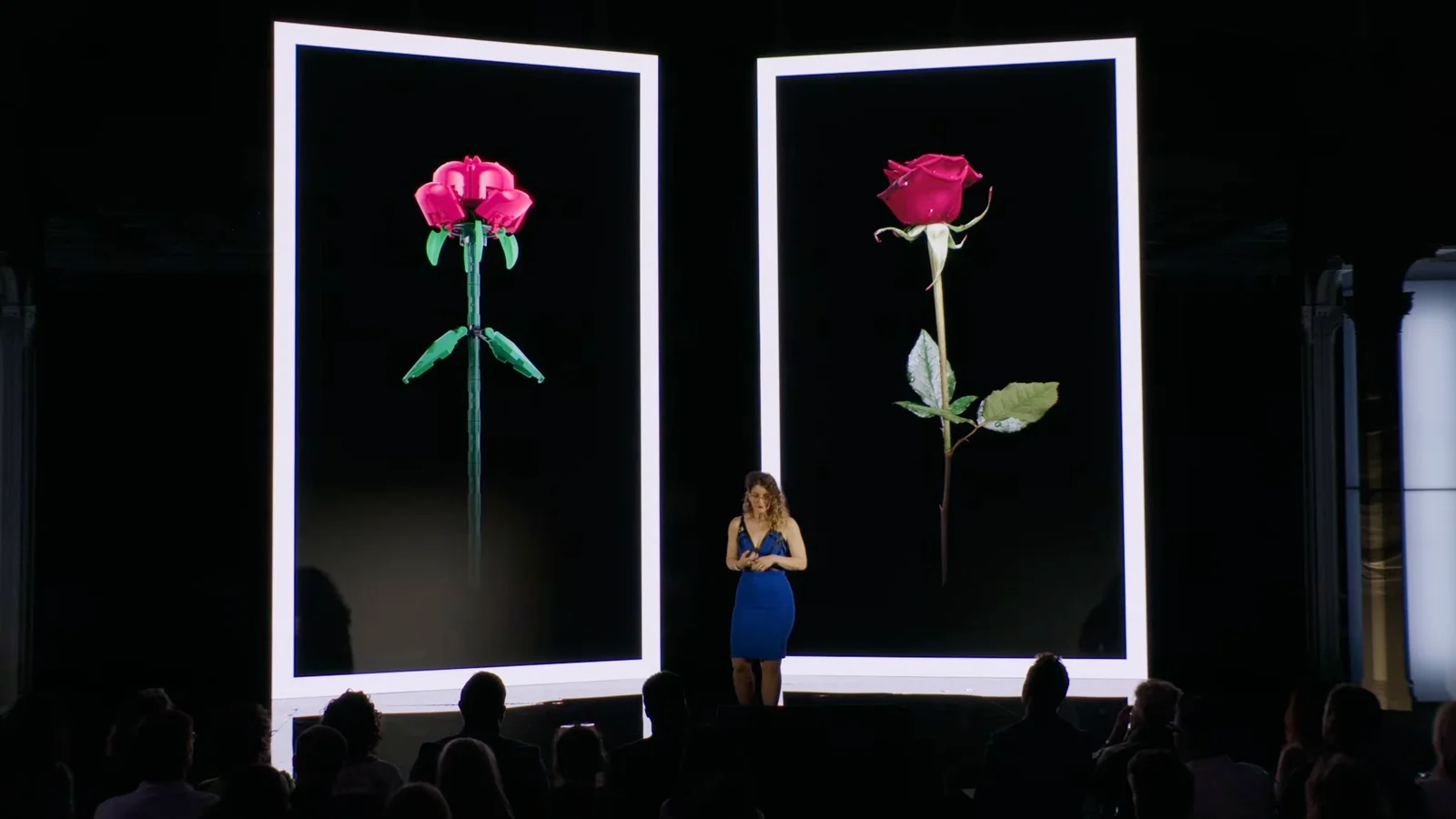
To illustrate the distinction, she compares a Lego rose with a biological rose. Both are deep objects with histories, she says, but the biological rose records its own creation in its cells and molecules. Her comparison treats the technological artifact as part of life's history while considering only the biological rose alive.
Seeing living history and technology differently
Walker describes living objects as deep in causal history and returns to the role of language and explanation. She closes by placing technology inside life's lineage.
Walker compares deploying AI without a fundamental explanation to going into space without understanding gravity. She says current interactions are surprising because people are attempting to build and deploy systems resembling minds while assuming they already see the world as it is.
The two roses also illustrate limits of perception. Walker says color reflects experience and asks how the objects would be understood without inherited language and culture; a bee, she notes, would not mistake the Lego object for a rose.
Her proposed framework treats causation as physical and living objects as deep in time. Like an iceberg, an individual shows only a small part of its history to an observer. Walker says technology may help people perceive the large space of possibilities carried by each living lineage, and notes that her group is investigating these ideas in the lab.
Returning to language, Walker says meaning comes from interaction with the world and that explanations are deeper than the symbols used to communicate them. Cultural knowledge passes across generations, allowing people to develop deeper accounts as their lineage extends through time.
She cautions that people do not necessarily see themselves clearly when comparing biological and artificial lineages. Human beings occupy small amounts of space and time as individuals, she says, yet carry immense possibilities; she contrasts a person's physical size with the resources needed for computer simulation.
Walker closes by calling technology part of the human lineage rather than a replacement for it. In her distinction, technology is life but not itself alive; aliveness belongs to the thick present at the tips of a roughly four-billion-year evolutionary history. She credits colleague Lee Cronin with originating assembly theory and describes life as the universe developing memory.
同じチャンネルの記事
 1:16EN
 Sana· 2026年10月14日ポッドキャストHow Volkswagen Group Middle East Uses Sana to Prepare Technicians for TrainingThierry Rochat describes using technical documents to create online courses before hands-on academy sessions.
 0:41ENSana· 2026年9月8日ポッドキャストSana Learn Customers Describe Bringing Training Resources TogetherA short customer montage contrasts fragmented learning resources with keeping company knowledge in one place.
 0:40ENSana· 2026年8月31日ポッドキャストSana Learn Customers Describe Their Partnership ExperienceIn a short montage, customers discuss implementation and the ongoing relationship with Sana.
 48:34ENSana· 2026年8月12日ポッドキャスト · 2 人Tyler Cowen on AI Adoption, Human Agency, and the Search for Beautyゲスト Tyler Cowen · ホスト Joel HellermarkThe economist explains why AI's economic impact may arrive slowly, what people may still contribute, and why he is calling for a new aesthetic.
 0:16ENSana· 2026年7月21日ポッドキャストTyler Cowen on Human Presence in an AI WorldTyler Cowen predicts that charisma, physical presence and human interaction will gain importance as AI advances.
 0:23ENSana· 2026年7月9日ポッドキャストEthan Mollick on Measuring AI’s ImpactEthan Mollick argues that companies should allow room for new opportunities rather than relying only on old metrics.