30 秒でわかる
At Tesla’s March 2023 Investor Day, executives presented a scenario for a sustainable energy system requiring roughly 30 terawatts of renewable power, 240 terawatt-hours of storage and $10 trillion in manufacturing investment. They described plans to lower next-generation vehicle costs through parallel assembly, simpler electronics and battery production, and said they would build a Gigafactory near Monterrey, Mexico. These numbers and timelines are company estimates and plans. The presentation also covered supervised driving software, charging, energy storage, supply chains and capital allocation.
- 1Tesla’s energy scenario calls for 240 TWh of storageMusk and Baglino estimate 30 TW of renewable power, $10 trillion in manufacturing investment and roughly half the primary energy use of a combustion-based economy.
- 2Tesla proposes building vehicle sections in parallelMoravy and von Holzhausen describe a future “unboxed” assembly process and target a smaller factory footprint and lower cost.
- 3FSD relies on fleet data, labeling and computingElluswamy describes training and validation for the supervised beta; the event’s comparison to national crash averages does not establish a causal safety benefit.
- 4Tesla connects charging expansion with site utilizationTinucci describes prefabricated Supercharger units, route planning and the first U.S. sites opening to other EVs.
- 5Kirkhorn links lower vehicle costs to affordabilityHe says Model 3 cost fell about 30% after the 2018 production ramp and reiterates a future target of cutting next-platform costs by half.
- 6Tesla announces a planned factory near MonterreyMusk says the proposed Mexico plant would add capacity rather than move production away from existing factories.
ポイント
- Tesla’s global energy scenario estimated 30 terawatts of renewable power, 240 terawatt-hours of storage and $10 trillion in manufacturing investment.
- The next-generation vehicle team targeted up to a 50% cost reduction through changes across design, batteries, powertrain and manufacturing; it was a target rather than a demonstrated result.
- Tesla described an assembly approach that builds major sections in parallel before joining them, aiming to reduce factory footprint and handling.
- The FSD beta described at the event required driver supervision; company safety comparisons with national averages did not control for driving conditions.
- Executives announced a planned factory near Monterrey and emphasized that production, refining and supplier capacity must scale together.
- Kirkhorn characterized the long-term investment figures as internal estimates, not formal capital-spending guidance.
チャプターごとに整えた全文を読む
The sustainable-energy scenario
Musk and Baglino outline their assumptions for renewable generation, storage, transport and industrial heat. They present the figures as a plan and estimate.
Tesla finance chief Zach Kirkhorn opens the 2023 Investor Day at the company's Austin headquarters. He says the presentation will examine the global transition to sustainable energy, Tesla's contribution and what that means for the company, rather than focusing on the next quarter.
Elon Musk introduces Master Plan 3 with Drew Baglino. They argue that a sustainable energy economy could support a large population without requiring people to abandon electricity or accept deprivation; they say a detailed paper will set out their calculations.
Baglino says more than 80% of global primary energy came from fossil fuels and only about a third delivered useful work or heat. Musk explains that combustion wastes heat and that extraction, refining and transportation also consume energy.
Baglino and Musk estimate that an electrified economy would need roughly half as much primary energy as a combustion-based economy because electric end uses and supply chains can be more efficient. This is a scenario estimate, dependent on their assumptions.
Their proposed system includes approximately 240 terawatt-hours of battery storage and 30 terawatts of renewable generation. Musk says their manufacturing investment estimate is rounded up to $10 trillion, covering mining, refining, batteries, recycling and vehicle factories. Tesla later published its [Master Plan Part 3 paper](https://www.tesla.com/ns_videos/Tesla-Master-Plan-Part-3.pdf) with the underlying scenario.
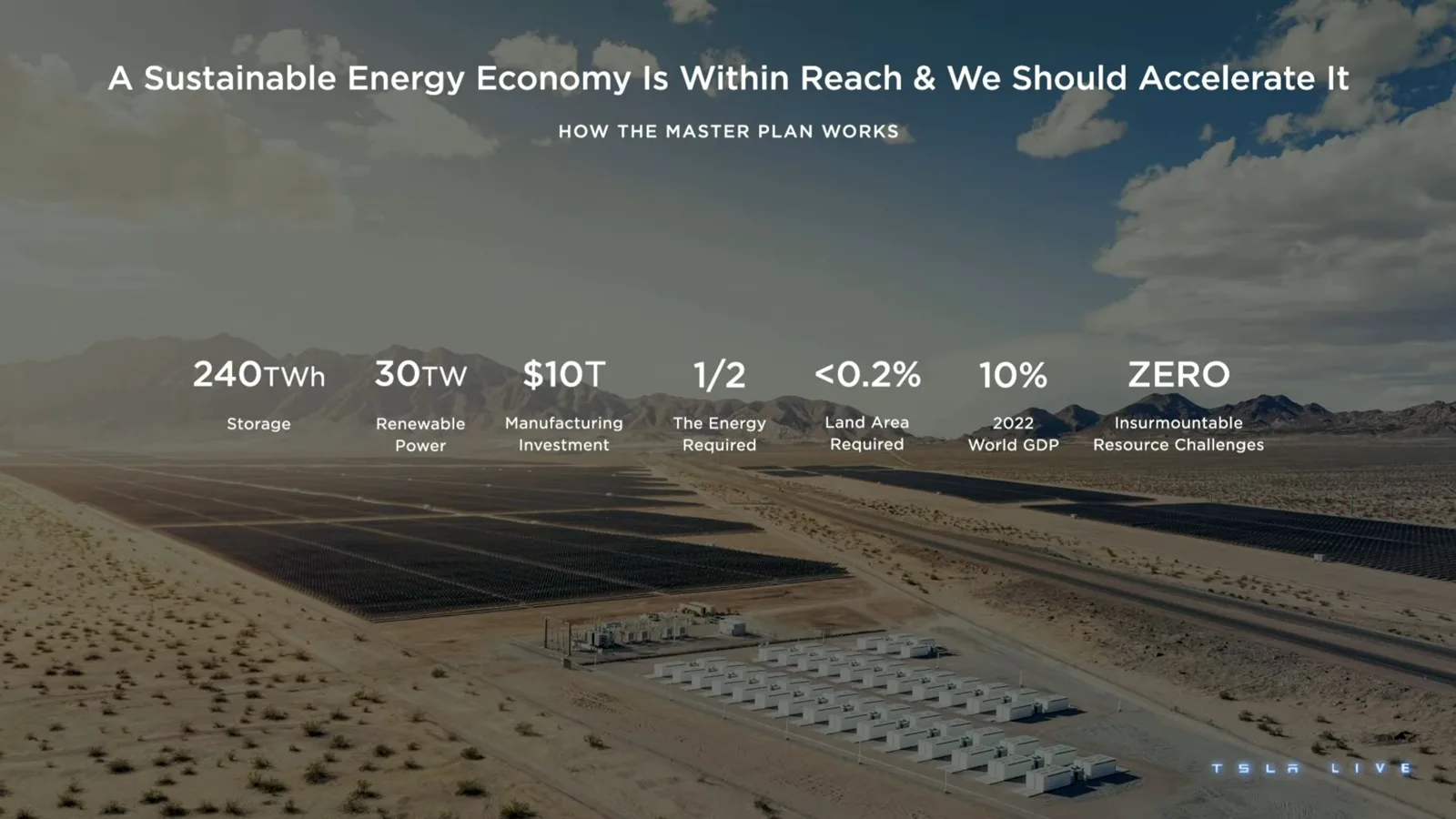
Musk compares $10 trillion with one year's global economic output, noting that spreading the investment over years reduces the annual share. He and Baglino estimate that wind and solar would require less than 0.2% of Earth's land area in their scenario.
Baglino says the team sees no insurmountable raw-material constraint and expects less extraction once fossil fuels are replaced. He outlines five areas: renewable electricity, electric vehicles, heat pumps, industrial heat and hydrogen, and sustainable aviation and shipping.
Musk expects most transportation eventually to become electric, while rockets will still need propellant. He says methane and oxygen could be made from water and carbon dioxide using electricity, including potentially on Mars.
Baglino says renewable generation is already being added to the grid and cites rapid growth in solar deployment. For vehicles, he points to growth in electric-car sales and the emissions reduction Tesla expects from replacing combustion engines.
The presentation models a smaller future vehicle fleet partly because of an assumption about autonomous use. Musk says Tesla's goal is 20 million vehicles a year; the speakers acknowledge their fleet estimates could be wrong.
Baglino compares the energy needed to move a Model 3 with a gasoline Toyota Corolla, counting energy from source to wheels. He uses cooking pasta as an everyday comparison for the electricity required to move the car a mile.
For buildings and some industry, Baglino advocates replacing fossil-fuel heating with heat pumps. Musk explains that a heat pump moves heat rather than creating it directly, much like an air conditioner or refrigerator working in reverse.
Industrial processes such as steel, cement and chemicals often require very high temperatures. Baglino describes producing and storing heat when renewable electricity is available and using it continuously, along with green hydrogen for certain chemical and metal processes.
Musk says some hydrogen will be needed in industry but gives his opinion that it will not play a major role in transport. Baglino says aviation and shipping also need alternatives, including batteries where suitable and sustainable fuels where energy density remains challenging.
The team returns to its 30-terawatt, 240-terawatt-hour and $10-trillion scenario. Baglino says solar, wind, vehicles and storage would need substantial further growth and compares the proposed annual investment with continuing investment in fossil-fuel infrastructure.
The speakers estimate that renewable generation could fit within a small share of land and point to co-location and offshore wind as options. Their land-use and ecological-impact statements are projections, not a site-specific environmental assessment.
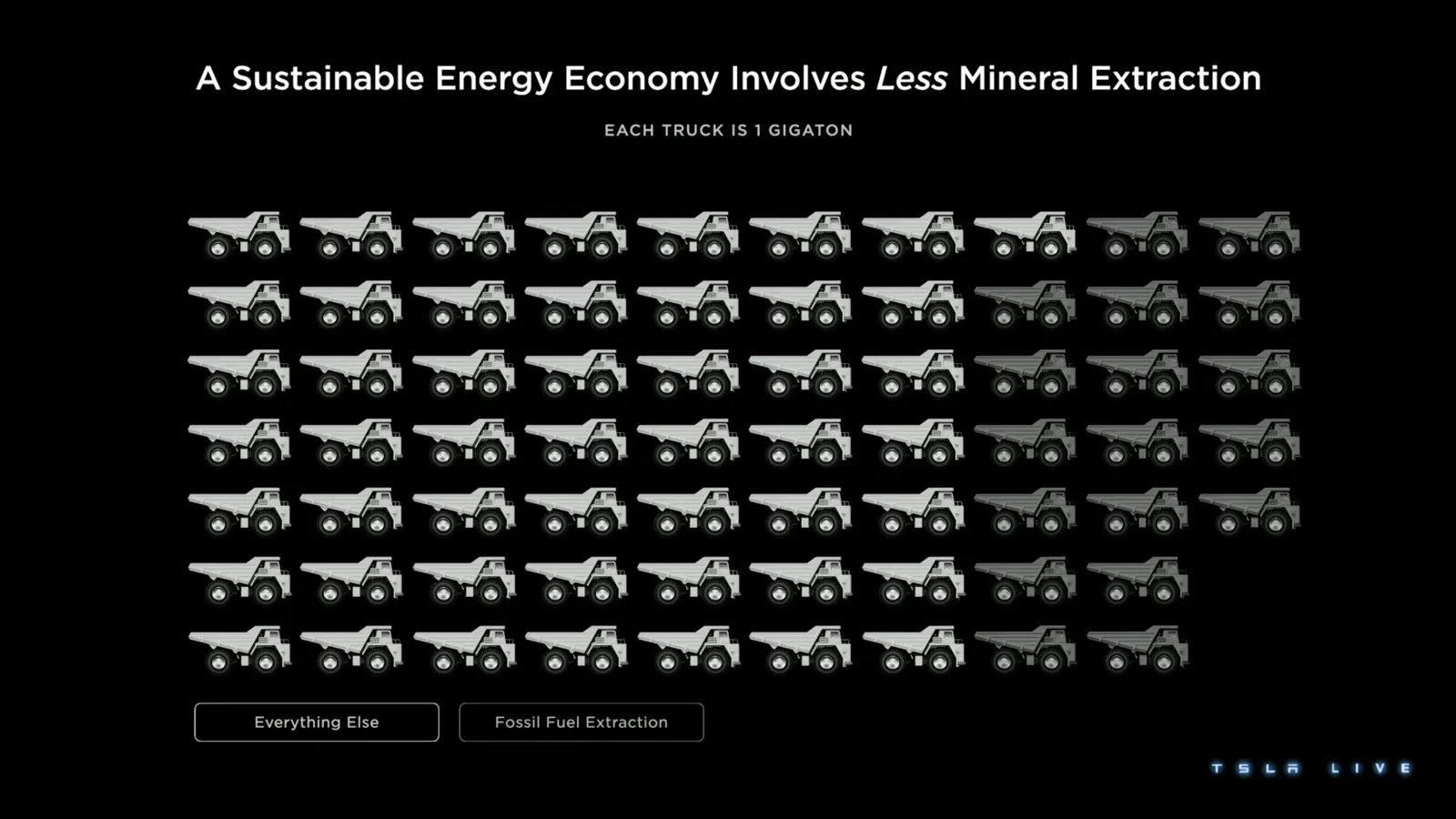
Baglino shows an illustration of global material extraction and argues that eliminating fossil-fuel extraction could reduce total mass extracted after the transition. He adds that new mining and refining for batteries and other equipment would still be required.
Musk argues that lithium is plentiful but that battery-grade refining is a bottleneck. The speakers discuss nickel, iron-based cells and recycling, and say their resource estimates do not reveal an insurmountable shortage.
Baglino says battery recycling could eventually reduce the amount of new ore needed for maintenance. Musk closes the first section by presenting the plan as a hopeful scenario based on the team's calculations, then invites the vehicle-design leaders onstage.
Redesigning cars and assembly together
Von Holzhausen and Moravy explain lessons from Model 3, Cybertruck and a proposed parallel assembly process for future vehicles.
Design leader Franz von Holzhausen and vehicle engineering leader Lars Moravy describe how Tesla's product-development process changed. For Model S, design came first, engineering followed, and the team only later determined how to manufacture the car.
For Model 3, design, engineering and manufacturing teams worked together earlier, but a late attempt to automate a car initially designed for manual assembly contributed to what the presenters call 'production hell'. They say the experience showed why product and manufacturing decisions must be made together.
The Cybertruck's stainless-steel material shaped its design and manufacturing: the team describes bending panels instead of conventional stamping and says the vehicle does not need a paint shop. In March 2023, they say production is planned for that year.
Moravy argues that conventional assembly repeatedly moves a whole vehicle, including fitting and removing doors before the interior is complete. He says production can be redesigned by assembling more subcomponents in parallel before joining them once.
The team cites Model Y's large castings and structural battery pack as steps toward that approach. The battery forms part of the floor, allowing seats and other interior parts to be installed before the assembly is joined to the body.
Moravy calls the proposed next-generation approach 'unboxed' manufacturing: build and test separate sections, improve access for people and robots, and combine them later. He presents targets for higher operator density and better use of factory space and time.
Using a Model Y illustration rather than revealing the new vehicle, the presenters forecast more than 40% less factory footprint and potentially up to 50% lower cost through the combined design and production changes. These are targets for a future platform, not results demonstrated for it.
Powertrain and electronics
Campbell, Bannon and Lau discuss drive units, rare-earth materials, wiring, controllers and a move to 48-volt low-voltage systems.
Powertrain engineering leader Colin Campbell says the Model 3 and Y drive unit became 20% lighter for the same power and uses 25% less heavy rare earth material than at launch. He says its powertrain factory also became smaller and cheaper without reducing output.
Campbell attributes the improvements to teams designing the vehicle, components and factory together. He describes an in-house power-electronics package that removes heat more effectively, allowing less silicon carbide, and a custom processor that replaces four earlier processors.
He says Tesla uses internal simulation to test many motor designs and places product and manufacturing-equipment engineers together. The aim is to make a high-performance part that can also be assembled at scale.
For the next powertrain, Campbell says Tesla has identified a way to use 75% less silicon carbide, support different battery chemistries and reduce the drive-unit cost to around $1,000. He also says a planned powertrain factory would have the same capacity in about half the space.
Campbell says the next permanent-magnet drive unit was designed without rare-earth materials, citing supply, environmental and health concerns associated with mining. He presents these changes as part of the next platform's plan.
Pete Bannon and David Lau turn to vehicle electronics. They describe the 2012 Model S's many low-voltage devices and individually assembled wiring harness, which made development and fault diagnosis complicated.
Bannon says Tesla consolidated controllers and reduced the Model 3 harness by 17 kilograms compared with Model S, then shared improved controller designs across models. He says Tesla designed 85% of Cybertruck controllers and planned to design all controllers for the next platform.
The speakers describe replacing mechanical relays and fuses with software-controlled electronic fuses. Lau says this allows monitoring, retries after transient faults and different behavior under different conditions.
Bannon says Tesla moved from lead-acid to lithium-ion low-voltage batteries and used a tool-free connector that software can check after service. He also describes successive improvements to the Model 3 display in cost, weight, power use and brightness.
Bannon says Cybertruck and future platforms will move low-voltage systems from 12 to 48 volts. For the same power, higher voltage reduces current; under equal resistance, resistive losses fall with the square of the current, enabling smaller wiring and components.
For Cybertruck, Bannon says components connect to nearby controllers, which communicate over Ethernet, reducing wires that span the car. He expects a simpler harness to help automation and make vehicle-wide diagnostics easier.
Software, fleet data and service
Tesla describes over-the-air updates, real-world feedback and software used in vehicle production and service.
Lau says over-the-air updates and anonymized fleet data help Tesla iterate on hardware and software. As examples, the speakers cite little-used sunroofs and real-world collision data used to update restraint systems.
Lau describes using fleet data to map road roughness so equipped cars can adjust their suspension ahead of a rough section. Before release, Tesla ran the software passively to observe when it would have activated without affecting the car.
In manufacturing, Lau says Tesla applies 'test early and often' to each assembly step: the vehicle computer checks connected parts, software and configuration, and flags anomalies before more components are built over them.
For service, Tesla says onboard diagnostics, customer descriptions and internal tools help diagnose problems, schedule work and order parts for more than a third of concerns. The company also tests subassemblies before they reach the car.
Lau describes shared phone keys, synchronized vehicle profiles and internal fleet tools as components that could also support a future autonomous fleet. He says permissions, encryption and signed commands are intended to protect access and customer data.
Supervised driving and Optimus
Elluswamy explains the data and computing pipeline for FSD beta. Musk shows robot progress and discusses longer-term ambitions.
Autopilot leader Ashok Elluswamy says a truly autonomous fleet could increase vehicle utilization and reduce the number of cars needed. He describes the development challenge as three connected pieces: the AI architecture, training data and computing capacity.
Elluswamy describes moving from separate single-camera, single-frame networks toward multi-camera video networks that produce a unified three-dimensional representation. The outputs include obstacles, motion, lanes and traffic signals for the planning system.
He demonstrates an occupancy network identifying moving obstacles and says the team also borrows techniques used in language models and reinforcement learning for complex road layouts. A planner must then choose a safe and smooth path through interactions such as an unprotected left turn.
To create training data at scale, Elluswamy says Tesla collects clips from its fleet and uses a data-center pipeline to label them. Reconstructed road scenes can also seed simulations with different weather, lighting and moving objects.
He gives an example of unnecessary braking near a parked car. Tesla added 14,000 similar videos to the training set, he says, so the updated network could better distinguish a parked vehicle from one entering the road. The team calls this repeated collection, labeling, training and deployment its data engine.
Elluswamy reports a 14,000-GPU cluster, with about 30% used for automatic labeling and 70% for training, and describes plans to expand storage and add Dojo computing. He says about 400,000 customers in the U.S. and Canada could use the supervised FSD beta at that time.
He cites a comparison between FSD users and the U.S. average to argue for a safety benefit, but the groups and driving conditions are not matched in the presentation, so the comparison does not establish a causal safety improvement. The beta he describes required driver supervision. Tesla’s [FSD (Supervised) manual](https://www.tesla.com/ownersmanual/models/en_us/GUID-2CB60804-9CEA-4F4B-8B04-09B991368DC5.html) requires an attentive driver ready to take over.
Musk returns to show progress on the Optimus humanoid robot. He says the prototype had gone from not walking at the prior AI Day to walking in the new video, while acknowledging it was not performing advanced athletic movements.
Musk argues that Tesla can reuse elements of its vehicle AI and computing in a robot, but says a useful robot must carry out tasks without a person programming every individual action. He describes custom actuators, motors, gears and electronics as necessary parts of the design.
Musk speculates that humanoid robots might eventually outnumber people and that the business could become more valuable than Tesla's car business. These are long-term predictions, not results demonstrated at the event.
Charging and supply chains
Tinucci describes the charging network, followed by Budhiraj and Thomas on suppliers, disruptions and automation.
Charging infrastructure leader Rebecca Tinucci says Tesla supplied 9 terawatt-hours of charging in 2022, over half through AC charging at home. She reports 80,000 charging points, including 40,000 Superchargers, across the network at the time.
Tinucci says Tesla reduces deployment costs by engineering its charging equipment and preassembling four-post Supercharger units in a factory before transporting them to sites. She reports a 15% deployment-cost saving from that method.
The team lowered cost per kilowatt-hour partly by increasing utilization, Tinucci says, but high utilization can create queues. Tesla's Trip Planner combines vehicle and site information to route drivers toward less congested locations.
She says improvements in hardware and software shortened average Supercharger visits, and that the company aims to predict occupancy using cars already routing to a station. She frames this as a way to raise utilization while managing waiting time.
Tinucci says some Supercharger sites were being opened to non-Tesla vehicles, including the first ten U.S. locations just opened at the time. She explains that Magic Dock adapters and longer fourth-generation cables help support other charging-port standards and locations.
She says Tesla had procured renewable energy to offset charging provided over the preceding two years, but distinguishes that from the future goal of shifting charging to times when renewable generation is available. More convenient daytime AC charging is part of that plan.
Supply-chain leaders Karn Budhiraj and Roshan Thomas describe a team that works directly with suppliers to turn Tesla designs into production lines. Engineers may spend weeks or months at a supplier helping establish equipment, quality and output.
The presenters say their visibility into multiple supplier tiers helped identify potential disruptions. They distinguish direct suppliers from the suppliers behind them and say battery materials may require attention down to mines and refining.
Tesla says it narrowed the supplier base from Model S and X to the higher-volume Model 3 and Y as it learned which partners could scale. Budhiraj says the team's work extends beyond the direct part to many smaller electronic components behind it.
Budhiraj uses the vehicle computer as an example: two densely populated boards, a heat sink and thousands of components are combined into one delivered assembly. He says Tesla worked with suppliers to automate the line after stabilizing quality and yield.
Thomas says Tesla moved approximately 16 million pallets from suppliers to factories in the prior year and more than a billion electronic components a week. He says service locations also require timely parts and that dual or triple sourcing helps reduce disruption risk.
The team recalls pandemic shutdowns, port congestion and semiconductor shortages. Budhiraj says direct relationships with lower-tier suppliers, capacity planning and communication helped Tesla respond as different regions faced disruptions at different times.
Budhiraj estimates wafer demand for a hypothetical 20-million-vehicle annual output and argues that the semiconductor industry could supply it with sufficient advance investment. His estimate depends on future industry capacity and Tesla's product architecture.
Thomas describes a compact integrated thermal-management assembly containing around 100 components. Launched during the pandemic, it initially faced quality and throughput problems on manual and semi-automated lines.
He says the team simulated the factory and worked with a supplier to implement a fully automated line in less than eight months. Tesla reports substantially lower labor requirements and a defect rate below 0.005% for the example.
The supply-chain team summarizes its plan as simplifying designs, gaining visibility into supplier tiers, working with long-term partners and automating complex assemblies. Budhiraj says the company learned through difficult scaling from zero to around 40,000 vehicles a week.
Factories, batteries and energy storage
Zhu and Baglino describe vehicle and cell factories. Snyder discusses Megapack, grid controls and energy trading.
Tom Zhu, then responsible for global production, sales and delivery service, says Tesla had four vehicle factories on three continents with installed capacity of about two million cars annually. He describes the Shanghai factory's construction and says in-house construction and simpler layouts helped speed the project.
Zhu says Tesla had produced its four-millionth vehicle that morning. He contrasts the time taken for each successive million and says the company wants to improve factory uptime, quality and cycle time as it scales.
Zhu describes a manufacturing sequence of questioning requirements, deleting and simplifying steps, speeding up the line and only then automating. At Shanghai, combining two paint-shop heating steps reduced cycle time, energy use and emissions, according to Tesla's measurements.
He says a global organization connecting production with sales and service helps feed customer issues back into factory improvements. More factories and lines would be needed to pursue the 20-million-vehicle annual goal, he says.
Drew Baglino gives an update on battery manufacturing. He shows a dry-electrode line that takes powder and foil into coated electrode without the earlier demonstration's manual steps, and says per-tool productivity had increased substantially.
Baglino says successive cell-factory designs reduced building volume and capital needs per unit of output by combining cell, process, equipment and facility design. He frames the work around future vehicle and stationary-storage targets.
He describes a planned lithium refinery near Corpus Christi, Texas, targeting 50 gigawatt-hours of annual capacity, and a cathode facility near Tesla's Austin factory. The commissioning and production dates he gives are targets as of March 2023.
Megapack leader Mike Snyder says Tesla had deployed over 16 gigawatt-hours of industrial and residential storage in 50 countries. He describes the Lathrop-made Megapack XL as a system combining batteries, power electronics and controls for projects of different sizes.
Snyder says integrating cable routes into the enclosure and power conversion into the product can reduce installation work. He presents the battery system as a way to store energy and deliver power when the grid needs it.
Snyder and Baglino explain a virtual-machine mode that uses power electronics to emulate some stabilizing behavior of a rotating machine. They say a grid operator uses the feature to help maintain stability with a high share of renewables.
Snyder introduces Autobidder, software that helps battery operators make frequent decisions about buying and selling electricity. He says it had been deployed in markets including Australia, Texas and the United Kingdom.
Snyder says Tesla converted a distribution center into the Lathrop Megapack factory in less than a year. He reports faster installation and lower labor per project, and says reducing the time from factory shipment to grid operation is important for scaling.
Baglino discusses distributed storage and Tesla Electric using a South Australian virtual power plant as an example. He says coordinated solar and home batteries can reduce the cost of serving customers and, in some cases, pay customers for grid services; results depend on local market conditions.
He says Tesla planned a Texas electricity offer for vehicle owners with overnight charging for a monthly fee, intended to align charging with plentiful nighttime wind. He also sets an eventual aspiration of one terawatt-hour a year of stationary-storage production.
People, sustainability and financials
Shelby presents Tesla’s impact metrics; Kirkhorn discusses cost reduction, internal software and capital allocation.
Laurie Shelby, who leads environmental, health, safety and sustainability work, says Tesla had about 129,000 employees and that more than half worked in vehicle manufacturing. She describes a system for employees to submit improvement and safety ideas.
Shelby cites Tesla's estimates of emissions avoided by customers, operational water and waste improvements, and the energy generated by its products. These are company calculations with underlying assumptions about comparison cases and accounting boundaries.
Kirkhorn returns to financials and says Tesla reduced Model 3 cost by about 30% after reaching 5,000 cars a week in 2018. He attributes this to higher volume, productivity, localization, product changes and supplier improvements while saying product quality must also improve.
For the next-generation platform, he reiterates a target of roughly halving cost relative to the prior platform. He says this would require improvements across the vehicle, battery, powertrain and manufacturing rather than a single breakthrough.
Kirkhorn says buyers should consider total cost over the life of a vehicle, including financing, insurance, electricity and maintenance. He presents Tesla's comparison with a Toyota Corolla and predicts lower cost per mile for the next platform and robotaxi variants; actual results depend on assumptions and use.
He says non-GAAP operating expense fell as a share of revenue and per vehicle since 2018. He attributes research efficiency to focusing on fewer programs and reusing technology across products, and says Tesla's direct sales and service model affects its cost structure.
Kirkhorn describes the operational strain when Model 3 production ramped and says Tesla built internal software to manage many back-office processes. Teams delete unnecessary steps, simplify the remainder and automate where appropriate, he says.
He says internal tools also support customer self-service, insurance and detailed operational reporting. The feedback loop lets business teams request changes to the software and use fresh data to adjust processes.
Kirkhorn says Tesla had invested roughly $28 billion over its history toward its larger manufacturing ambitions and presents future investment as achievable from forecast cash flow. Those future volumes, spending needs and cash flows are estimates, not guarantees.
He reviews capital allocation: first fund operations and downside protection, then invest in growth, and only then consider other uses of excess cash. He says the board assesses buybacks or dividends against expected cash needs.
He closes the prepared presentation by linking cost reduction, affordability, volume and cash generation. The webcast then pauses before the investor Q&A.
Mexico announcement and investor questions
Musk announces a planned plant near Monterrey. The panel answers questions about manufacturing, refining, charging, demand and AI.
After the break, Musk announces a planned Gigafactory near Monterrey, Mexico. He says it would add global capacity rather than replace production at Tesla's existing factories; the announcement is a plan made in 2023.
Asked when next-generation manufacturing will reach existing products, Musk says the biggest architectural changes will first appear in future vehicles because retooling an operating factory can interrupt production. Moravy says the planned platform would also be made at plants beyond Mexico.
An analyst asks about lithium mining and refining. Musk says Tesla would prefer others to supply the materials but will enter bottlenecks when necessary; he identifies refining capacity as the main constraint. Baglino says Tesla intends to share lessons from its refinery work with suppliers.
On speeding renewable deployment, Musk encourages investment in battery-material refining. Baglino says cheaper storage and flexible charging can make renewable generation more valuable by shifting consumption to times when power is plentiful.
Asked how many models Tesla needs and whether vehicles will provide power back to the grid, Baglino says the company was redesigning power electronics to add bidirectional capability over the following two years. Musk says a home battery could make that capability more convenient when the car is unplugged.
Asked about China and geopolitical risk, Tom Zhu says local supply chains, local employment and affordable products are central to Tesla's approach. He says the company will do its best in an uncertain geopolitical environment.
Musk argues that affordability is a major constraint on vehicle demand, and says the company observed demand respond strongly to price changes. He speculates that autonomous use could substantially increase a car's utilization and value; that depends on achieving autonomous operation.
An analyst asks which segments the next platform will address and whether cheaper models would displace demand for existing ones. Musk emphasizes the difficulty of scaling production and supply chains; Moravy says the next platform is intended for multiple vehicle segments rather than a single model.
Executives describe dual sourcing and redundancy for supply disruptions, while Musk notes that extra capacity has costs. He says Tesla tries to secure more battery-cell supply than vehicle production needs and can direct excess cells into stationary storage.
Asked whether cost strategy differs by region, Zhu says Tesla aims to localize suppliers and labor, citing Shanghai. Kirkhorn adds that the company wants more standardized factory designs for the next platform so expansion can be repeated more quickly.
An analyst asks about long-term margins and the capital required for the 20-million-vehicle and storage goals. Kirkhorn says the investment figure shown was an internal rough estimate, not formal capital-spending guidance, and could change as the company learns.
Elluswamy says Tesla's multi-trip reconstruction is intended mainly to generate labels for training, not to require high-definition maps in every vehicle. Musk and colleagues say they expect substantial growth in neural-network training capacity using a combination of Nvidia hardware and Dojo.
Asked about dry battery electrodes, Baglino says the team is comparing alternative production processes and improving speed and yield. Musk says scaling from a laboratory process to reliable volume manufacturing is difficult; in March 2023 he says volume scaling that year appears likely.
An investor asks when Tesla will reveal the next vehicle and whether it might launch at an existing factory before the Mexico plant is finished. Musk declines to provide details, saying the company plans a separate product event.
A final question asks how a larger Tesla could be managed and whether generative AI will make cars easier to build. Musk says he does not expect AI to help manufacture cars in the near term, expresses concern about the technology and calls for public-interest oversight.
Musk distinguishes the neural networks used for driving from general AI and says Tesla's vehicle system has become hard to visualize because of its complexity. The event closes after the panel thanks attendees.
同じチャンネルの記事
 24:44EN
 Tesla· 2026年11月6日Elon Musk Unveils the Cybertruck: Steel Body, Cracked Glass and a New Pickup DesignElon Musk · TeslaAt Tesla’s 2019 event, Musk introduced the electric pickup and demonstrated its body, glass, suspension and cargo bed.
 59:56ENTesla· 2026年10月21日Tesla Q3 2026: Cash Flow, FSD Demand and the Cost of Scaling RobotsElon Musk, Vaibhav Taneja, Travis Axelrod · TeslaExecutives discuss quarterly margins, capital spending and plans for Cybercab, Optimus and chip production.
 23:21ENTesla· 2026年10月16日Tesla’s Roadster Event: A Ramp Stunt, Aerodynamics and a 2028 Production TargetElon Musk, Franz von Holzhausen, Lars Moravy · TeslaElon Musk, Franz von Holzhausen and Lars Moravy demonstrate a prototype developed with SpaceX engineering.
 1:09:55ENTesla· 2026年7月22日Tesla’s Q2: Margins Narrow as Spending on Robots and AI RisesTravis Axelrod, Elon Musk, Vaibhav Taneja, Ashok Elluswamy, Lars Moravy · TeslaTesla reported higher energy deployment and negative free cash flow while executives outlined Robotaxi and Optimus plans.
 27:27ENTesla· 2026年5月21日Tesla’s Final Model S and X Deliveries: How the Cars EvolvedElon Musk, Franz von Holzhausen, Lars Moravy · TeslaElon Musk and Tesla’s team recall a tent-based design studio, years of changes, and plans for the former production line.
 1:05:20ENTesla· 2026年4月22日Tesla Plans a $25 Billion Investment Year as It Prepares OptimusTravis Axelrod, Elon Musk, Vaibhav Taneja, Lars Moravy · TeslaOn Tesla’s Q1 2026 call, executives detail one-time margin gains, battery constraints and plans for robots and driving software.