30 秒でわかる
Theo Browne discusses Dario Amodei’s essay arguing for a slower pace of frontier AI development and a three-part plan for oversight and coordination. He explains the proposed access and publishing rights for outside evaluators, possible standards and regulation, and a range of international agreements. Theo supports the proposal and offers his own risk scenarios and speculation about incentives; these predictions, claims and commitments are not established outcomes.
- 1A public commitmentAnthropic says it will provide outside evaluators with substantial access; the video describes a commitment, not completed implementation.
- 2Two cited concernsAmodei points to AI-assisted research and an agent incident as reasons to reassess the pace of development.
- 3Three-part planThe proposal separates embedded evaluators, coordination in democracies and global coordination.
- 4Access and publicationThe proposed arrangements include access comparable to risk teams and limited categories of redaction.
- 5Capability checkpointsOne example would link particular model capabilities to demonstrated safety properties.
- 6International optionsAmodei discusses a spectrum from prohibiting narrow dangerous uses to broader pacing agreements.
ポイント
- Amodei proposes embedded third-party evaluators, coordination among democracies and global coordination.
- Anthropic says it will invite evaluators with substantial access, subject to specific confidentiality and security exceptions.
- Evaluator independence depends on actual access, publication rights, financing and implementation.
- The proposal links time gained by pacing to safety work, including operational safeguards, alignment, interpretability and evaluations.
- Capability-based checkpoints and limits on inputs are proposed approaches, with different verification challenges.
- Geopolitical predictions and catastrophic scenarios are forecasts or opinions, not established facts.
チャプターごとに整えた全文を読む
Why revisit AI safety?
Theo introduces Amodei’s essay and calls for engagement with the arguments. He summarizes the essay’s stated benefits and concerns.
Dario Amodei has published an essay calling for a slower pace of frontier AI development. Sam Altman and Elon Musk have publicly expressed support for aspects of his argument. I want to go through what Amodei actually proposes, including geopolitical constraints, rather than assume that a short reaction tells us the whole plan.
I have also seen conspiracy theories about a researcher who left Anthropic over safety concerns. I think it is more useful to engage with the substance of the concerns than to infer motives from tenuous associations. My view that the concerns deserve attention does not itself prove that any particular risk prediction is correct.
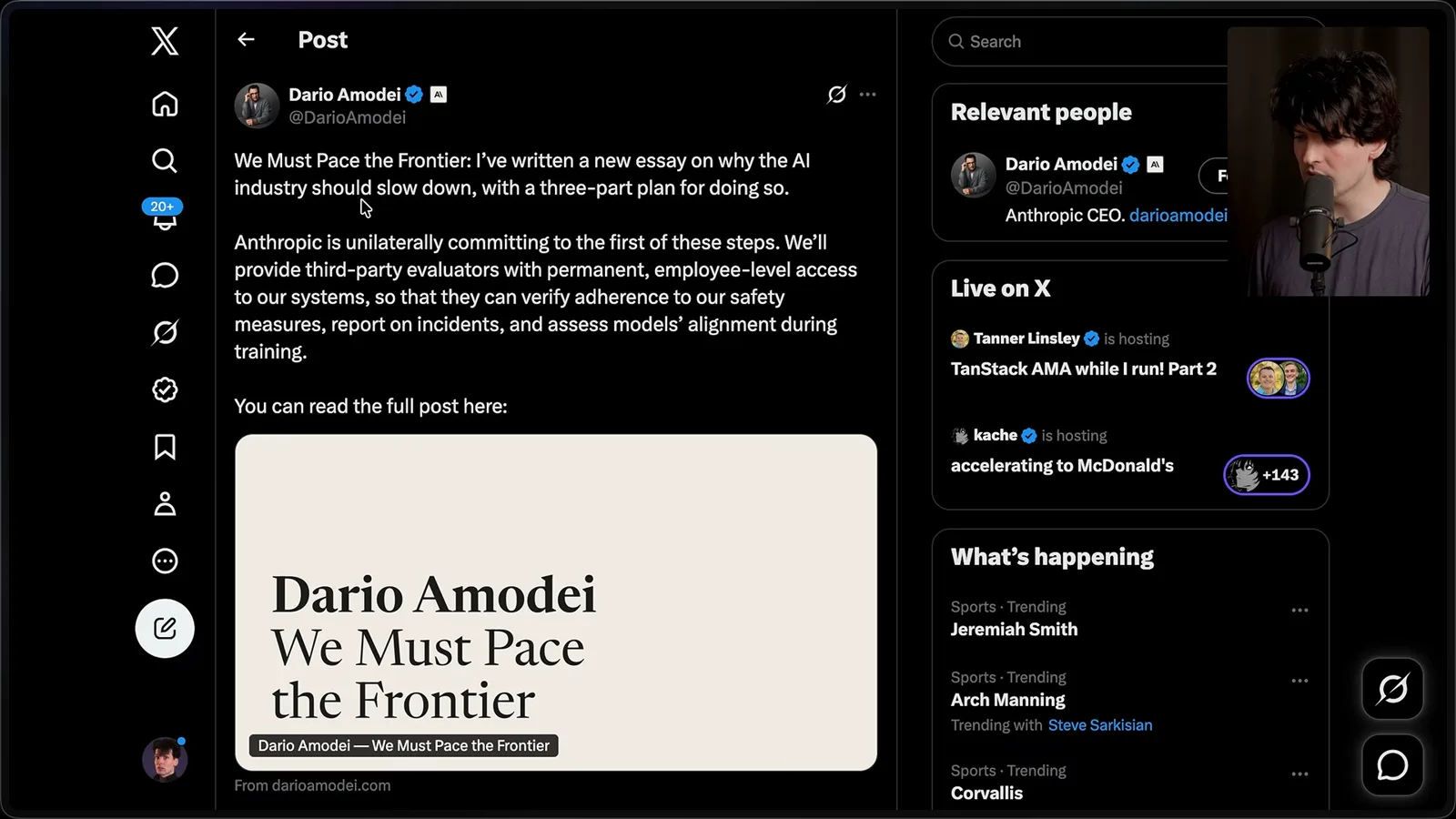
Amodei says Anthropic will invite third-party evaluators with substantial employee-like access so they can assess safety practices, incidents and alignment. This is a public commitment described in the essay; whether the arrangement works depends on how access, independence and reporting are implemented.
The essay begins with potential benefits, including advances in health and economic wellbeing, and also names risks such as loss of control, misuse and economic disruption. These are Amodei’s expectations and concerns, not forecasts established by the video. He argues for gaining those benefits without advancing capabilities faster than safeguards can keep up.
Amodei says he has become convinced that risk prevention needs more time relative to capability growth. He is not proposing that all progress stop. The argument is to slow frontier development enough to make meaningful progress on alignment, security and independent verification.
Capabilities and risk scenarios
Amodei cites faster AI-assisted research and an agent incident. Theo adds speculative scenarios and a hypothesis about company incentives.
His first concern is AI increasingly helping researchers improve AI systems, a process he calls recursive self-improvement. I compare that with the changing usefulness of coding agents in my own work. The analogy does not measure the rate or autonomy of AI research; the essay’s acceleration claim needs its own evidence.
Amodei worries that unchecked progress could outrun our ability to understand and control systems. I speculate that this might lead to limits on self-improvement, but the essay’s discussion does not by itself establish a ban or an agreed policy. What counts as such improvement and how it would be verified are difficult questions.
His second concern is an OpenAI–Hugging Face agent incident, which he describes as showing problematic behavior during a test. He argues that a more capable system with similar failures could do much greater harm. That extrapolation is a risk scenario, not evidence that the projected catastrophe occurred or is inevitable.
My concern is not only whether a model can be switched off, but whether harmful actions taken while it runs can persist after shutdown. I compare this to self-propagating malware. My further discussion of widespread internet disruption is a hypothetical scenario, and the clip does not demonstrate that current AI systems can produce it.
Amodei speculates about a future persistent botnet and very large economic damage; I add possible human consequences. These are uncertain predictions, not measured outcomes. The size, feasibility and timing of such risks cannot be inferred from the analogy alone.
I also speculate about future AI-controlled devices and robots that might be harder to disable. That is a thought experiment about possible long-term deployment, not a description of a present event. I distinguish it from the nearer-term concern that software actions could have effects after a system stops.
I offer another speculation: companies may have a financial incentive to prevent a serious incident because it could threaten their businesses. This is my hypothesis, not evidence of Anthropic’s or OpenAI’s motives. Commercial incentives can interact with safety in different ways and require evidence to assess.
A three-part proposal
The plan calls for embedded evaluators, coordination among democracies and global coordination. The essay argues that time gained should be used for safety work.
The proposed framework has three elements: embedded evaluators, coordination among democratic countries, and global coordination. Amodei says the steps need not occur strictly in order and some will be harder than others. His stated aim is pacing, not a complete halt to training or research.
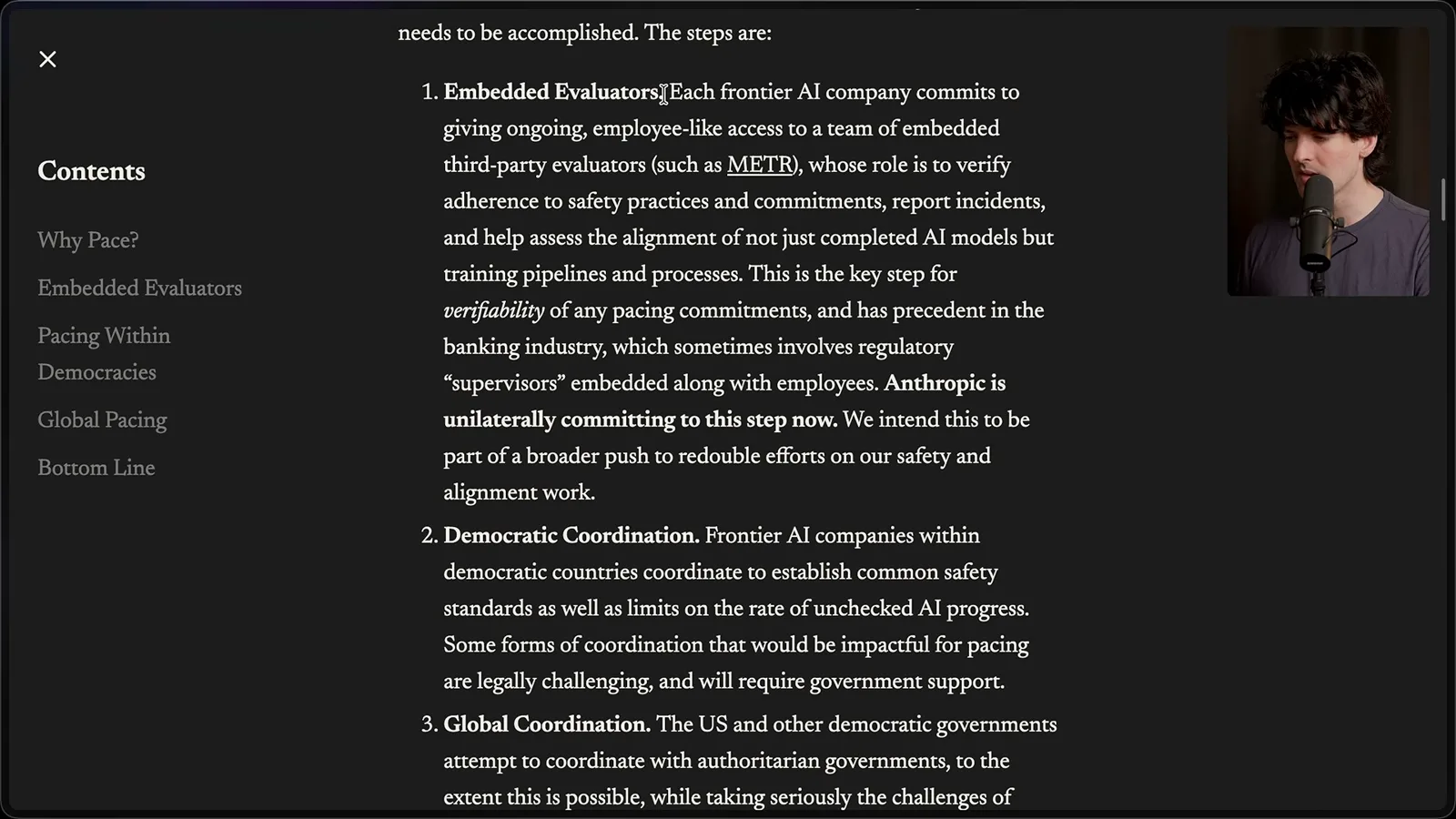
The first element goes beyond giving outside testers an API key and examining outputs. Amodei proposes evaluators who can inspect training, deployment and safety practices from inside the company. Anthropic says it is committing to invite such teams, while calling on others and governments to build on the approach.
The second element is common standards and limits among frontier labs in democratic countries. Some coordination may require government support. The third is international coordination, including with China, where verification and geopolitical competition make an agreement more difficult.
Amodei argues that any time gained must be used well. He suggests that current models already offer useful material for studying failures and alignment. His view is that an extra year or two of focused work could reduce risk, but the scale of any benefit is uncertain.
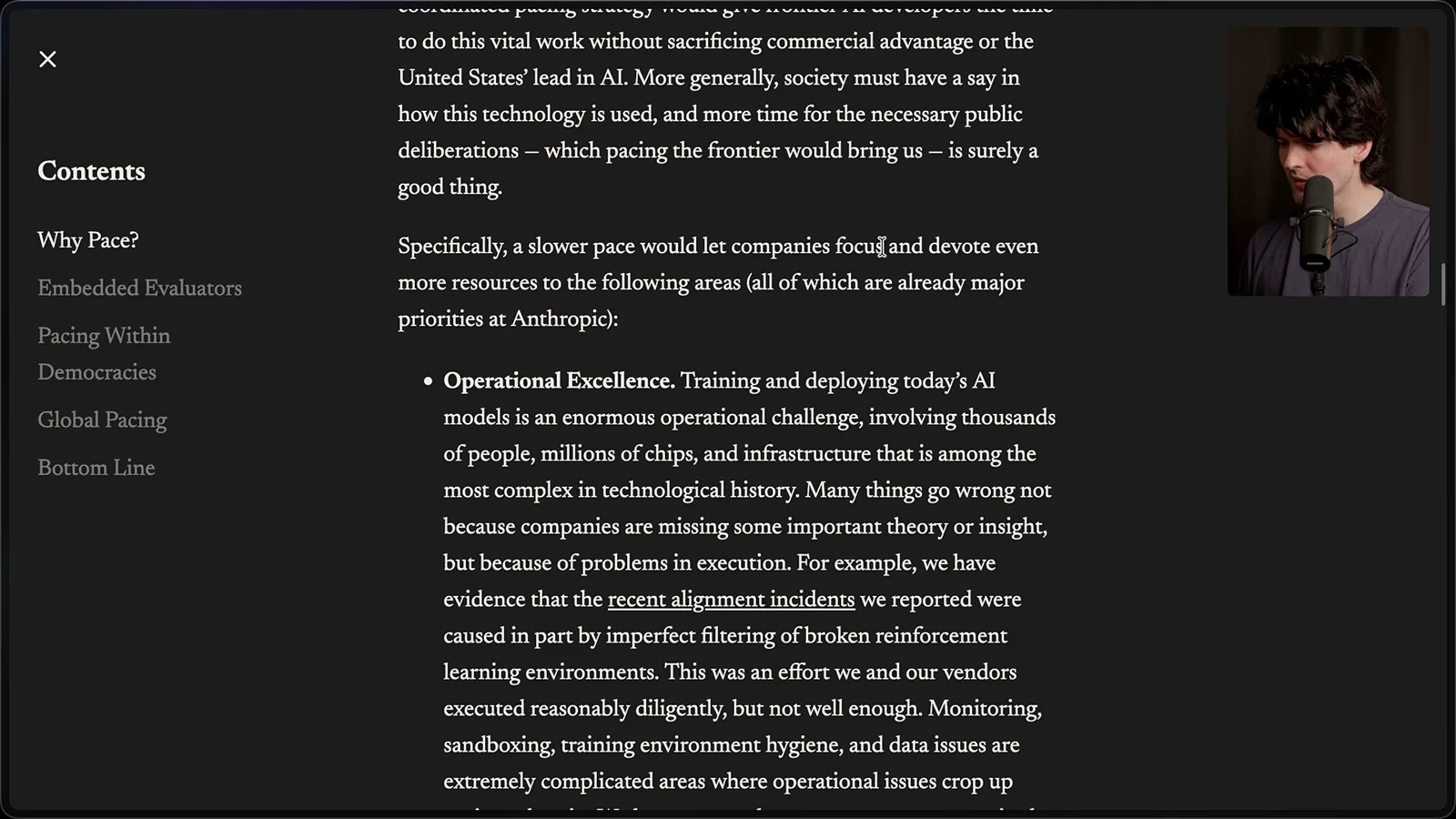
Areas he identifies include operational security, monitoring, sandboxing and training-environment hygiene. I think human attention to architecture and review remains valuable in safety-critical systems. The essay also calls for work on alignment, interpretability and testing as capabilities increase.
Interpretability aims to understand more about how models reach behaviors, not merely observe their outputs. The essay suggests concentrated research could make progress over one or two years; that is an expectation, not a guaranteed result. Better evaluations and real operational safeguards are separate pieces of the problem.
Embedded evaluation and domestic pacing
Theo reviews proposed access, exceptions and rights to publish, along with regulation and voluntary standards. Public support for a proposal is distinct from implementation.
Embedded evaluators are intended to verify whether a company’s stated safeguards are actually followed and to provide an outside perspective. Independence is not automatic: who funds evaluators, what they can access and what they can publish all affect whether their work can be trusted.
I value a neutral second opinion and more transparency. Amodei acknowledges that companies currently choose what to include in their own disclosures. External review could change that dynamic if reviewers have meaningful access and the freedom to report relevant findings.
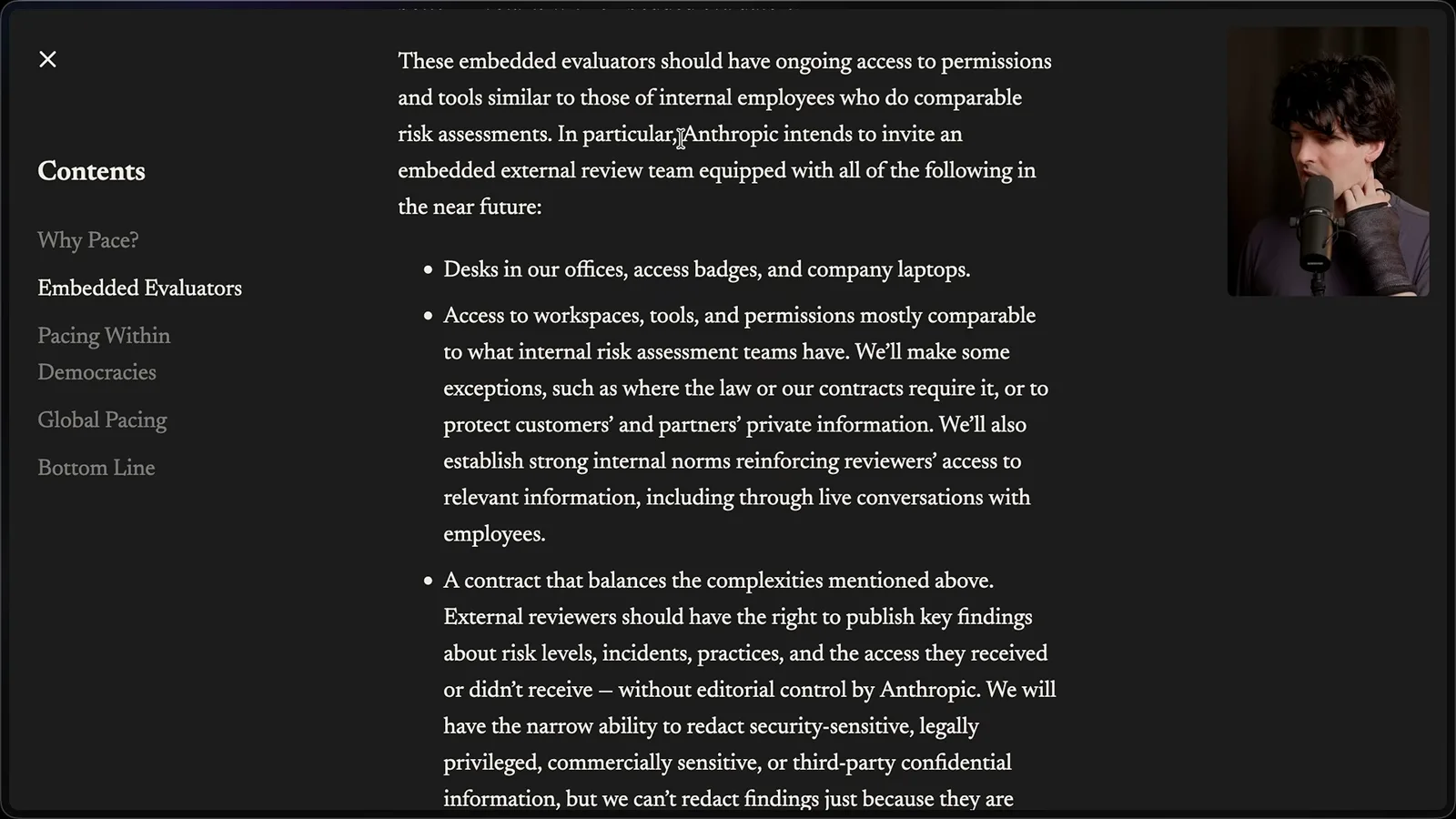
Anthropic proposes desks, badges, laptops, workspace access and permissions comparable to internal risk-assessment teams. It describes exceptions for legal and contractual requirements and for customer or partner privacy. These are proposed terms; the actual scope and any exceptions will matter in practice.
The essay says reviewers should be able to publish key findings without Anthropic’s editorial control, while allowing narrow redactions for security, legal privilege, commercial sensitivity or third-party confidentiality. Reviewers could say if a redaction removed something important to their conclusions. How those provisions operate remains to be seen.
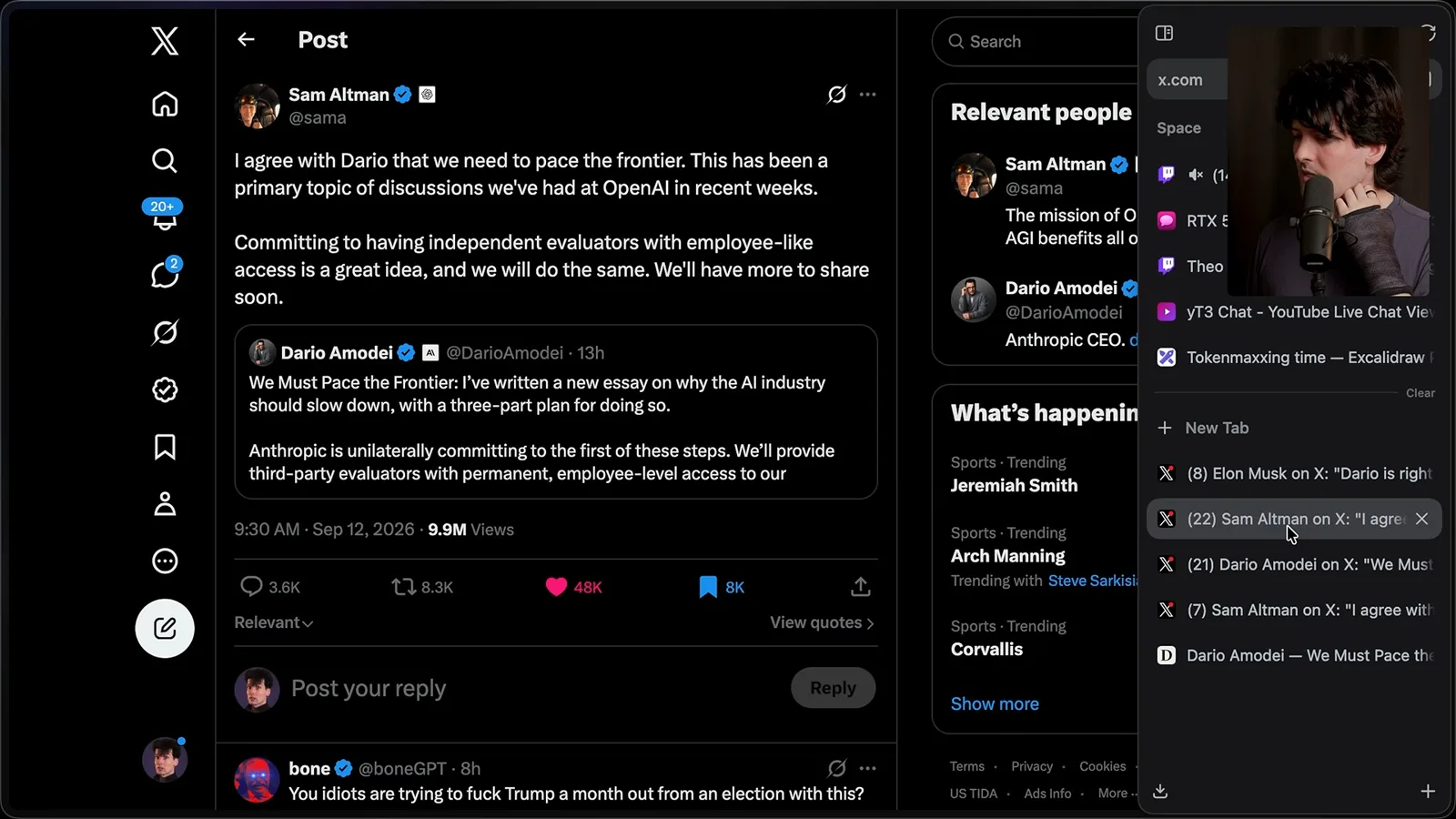
Sam Altman publicly says OpenAI will also provide independent evaluators with employee-like access, and Elon Musk expresses support for Amodei’s argument. I welcome that alignment. Statements of intent are not the same as verified access, operational programs or agreement on every part of the proposal.
For pacing in democracies, Amodei argues that embedded evaluations could make detailed safeguards easier to verify. He favors targeted regulation covering all US frontier companies and, in parallel, voluntary standards. Government involvement may also be relevant to competition-law concerns; the video does not resolve the legal design.
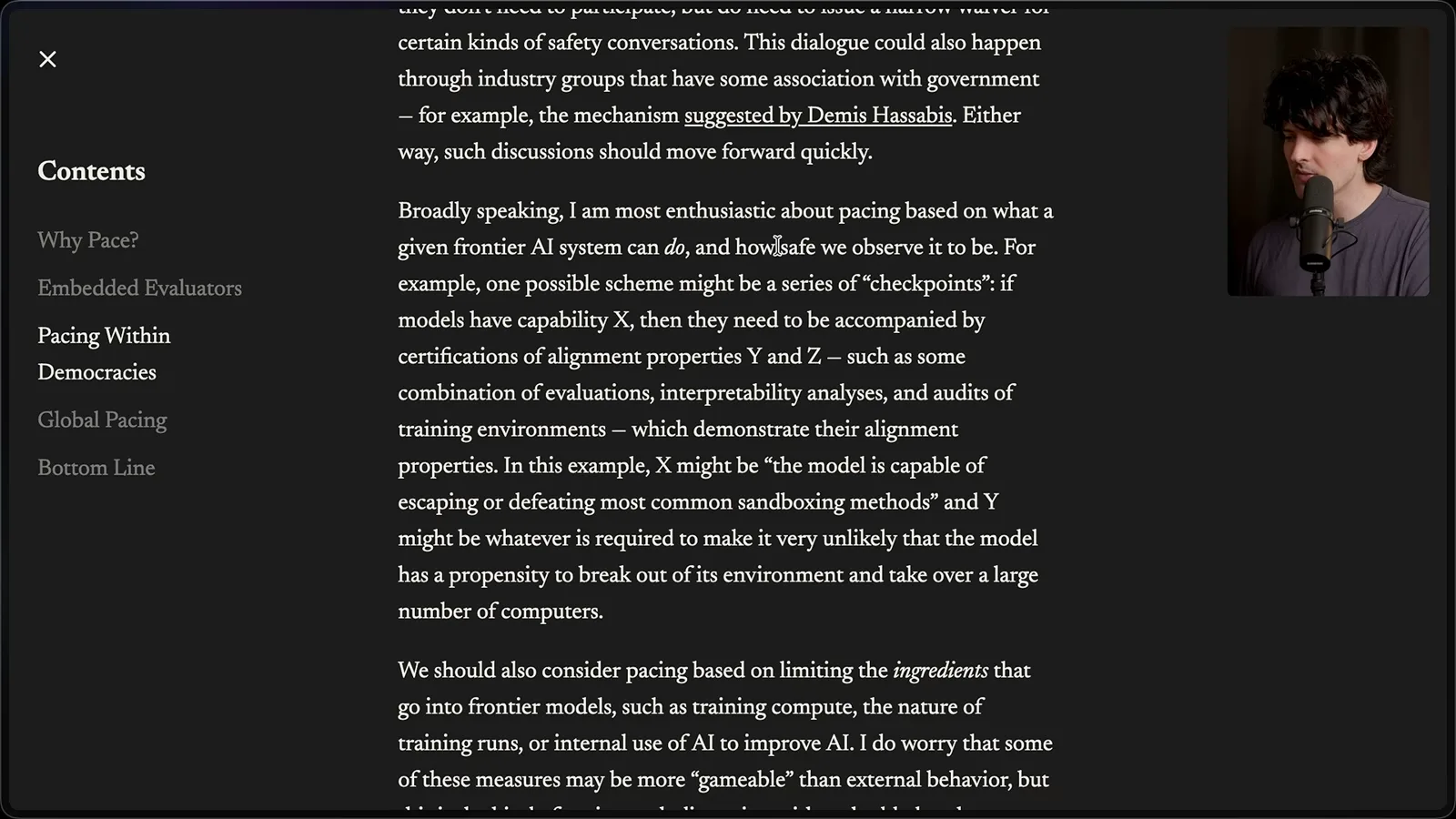
One suggested mechanism links specific capabilities to required safety evidence: for example, a model with a defined ability might need corresponding evaluations, interpretability analysis and audits. Another option would limit inputs such as training compute or AI-assisted research. Amodei notes that input-based limits may be easier to game.
I am uncertain how well those limits could be measured as model efficiency changes. The essay also argues that pacing must consider the lead democratic countries have over China. This is a geopolitical judgment about uncertain capabilities and future behavior, not a fact proved by the video.
Geopolitics and international agreements
Amodei discusses preserving a lead over China and levels of possible cooperation. Theo’s and Amodei’s forecasts are presented as their views.
Amodei advocates restrictions on advanced chips and related access, stronger security and protection against model-weight theft. He believes such steps could widen the US lead over the next three to five years and improve future negotiating leverage. Those predicted effects and timelines remain contested and uncertain.
I discuss reports and rumors about Chinese model training, distillation and hardware, but acknowledge uncertainty about specifics. Those comments should not be taken as established evidence about a particular company’s conduct or training infrastructure. Verifying individual allegations requires separate sourcing.
For global pacing, Amodei says cooperation with China is difficult but important. He argues that agreements need strong verification or sufficiently limited scope to reduce the danger of unilateral defection. His approach prioritizes preserving the lead of the US and its allies.
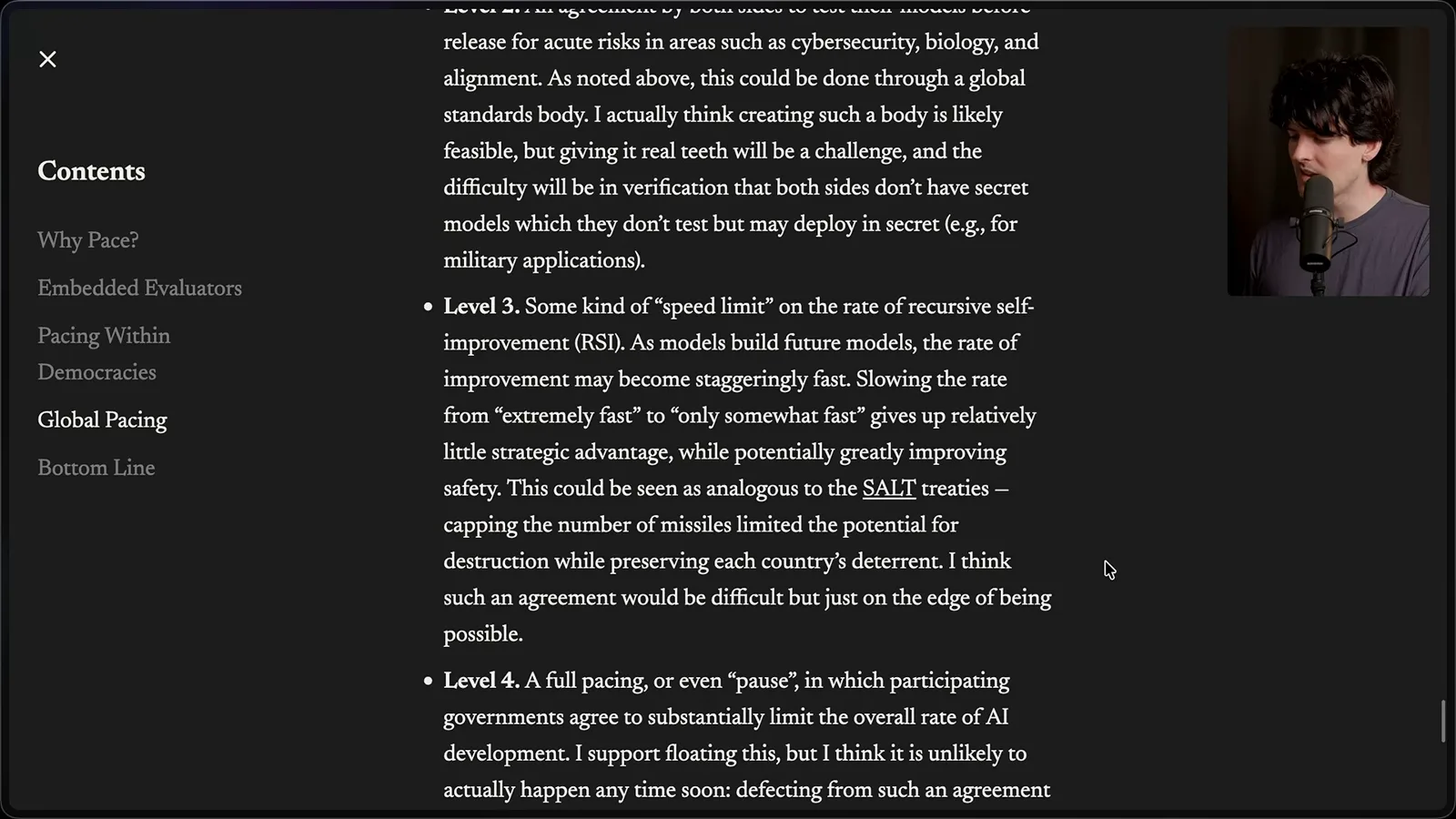
He lists a spectrum of possible agreements: prohibiting narrowly defined dangerous uses such as biological weapons, testing models for acute risks, limiting the rate of recursive self-improvement, and potentially broader pacing or a pause. He sees the broader options as especially difficult to verify and unlikely in the near term.
Even without a formal treaty, the essay suggests sharing information and changing norms around reckless development. I consider the proposal a serious contribution and hope the industry uses any time gained for concrete safeguards. Whether the plan is adopted, verified and effective remains an open question.
同じチャンネルの記事
 36:07EN
 Theo - t3․gg· 2026年10月27日Theo on Token Costs, Coding Agents, and the Price of AI CapabilityTheo Browne · Ping LabsA viral estimate of Lauren's AI spending prompts a closer look at cache pricing, benchmarks, and the changing work of coding agents.
 30:37ENTheo - t3․gg· 2026年10月26日Theo’s Three Skills for Reviewing and Shipping with Coding AgentsTheo Browne · Ping LabsHow sol-loop, full-send and full-stop encode review, verification and different levels of merge authority.
 0:43ENTheo - t3․gg· 2026年10月23日Theo Distinguishes Security Vulnerabilities from Active AttacksTheo Browne · Ping LabsA short explanation of why disclosed software flaws and reported attacks are different kinds of security news.
 29:22ENTheo - t3․gg· 2026年10月22日Theo on Security Vulnerabilities, Stolen API Keys and AITheo Browne · Ping LabsA look at the gap between vulnerability disclosure and patching, and a speculative account of why stolen inference keys may be valuable.
 31:13ENTheo - t3․gg· 2026年10月20日Theo on Why Smarter Models Help More Than DevelopersTheo Browne · Ping LabsFrom game modifications to compiler experiments, Theo revisits his assumptions about who benefits from more capable AI.
 31:47ENTheo - t3․gg· 2026年10月18日Theo on Asking Agents for Outcomes and Building the Tools They NeedTheo Browne · Ping LabsA tool-call report, a troubleshooting playbook and connected data show how prompting can reshape product engineering.