30 秒でわかる
In this short video, Matthew Berman complains about recurring features of AI writing and describes a prompt based on a Wikipedia list of writing patterns. The video links to the Humanizer project and suggests placing instructions in a prompt or personalization settings; it does not test how reliably the approach works.
- 1Patterns the presenter dislikesBerman lists em dashes, generic wording, sycophancy and excessive emoji.
- 2A list of writing patternsHe points to a Wikipedia page cataloguing patterns associated with AI writing.
- 3Using the promptHe describes a prompt based on that list and suggests adding it to personalization or a system message.
ポイント
- Berman dislikes recurring AI writing patterns such as generic phrases, excessive emoji and sycophantic tone.
- He points to a prompt derived from a Wikipedia list of AI-writing patterns.
- He suggests using the instructions in a prompt, personalization settings or a system message.
- The short presents the method as useful but does not establish a guaranteed result.
チャプターごとに整えた全文を読む
Recognizing repeated patterns
Berman describes features of AI prose that he finds repetitive. He points to a Wikipedia list of such patterns.
I’m tired of familiar AI writing habits: em dashes, generic phrases, sycophantic tones and too many emoji. Wikipedia maintains a detailed list of patterns that can signal this kind of generated writing.
Turning the list into instructions
He describes a prompt based on the list. He suggests using it directly or adding it to personalization settings.
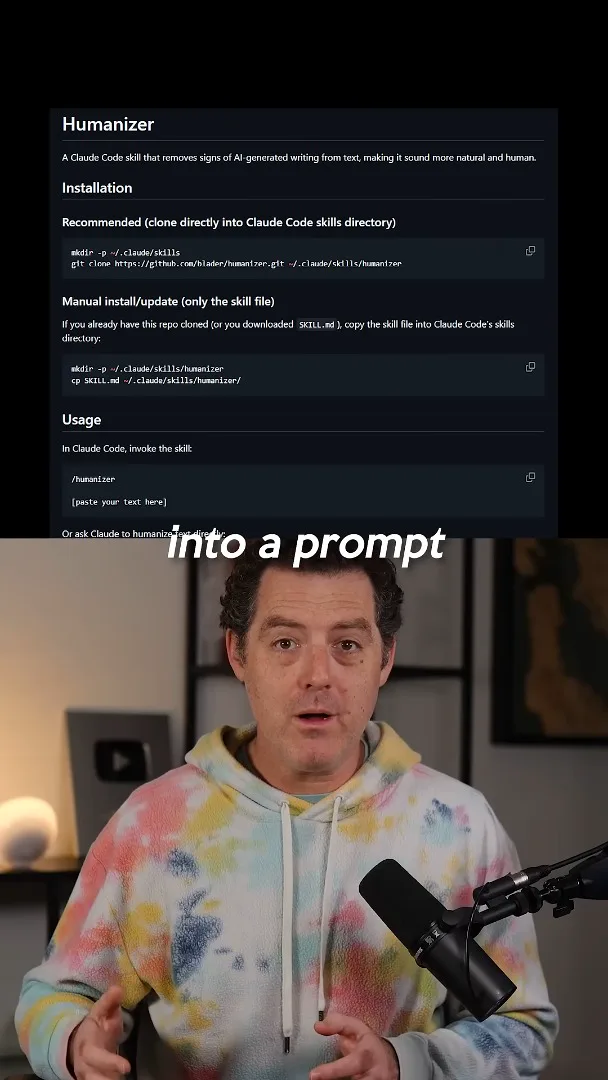
Someone turned that page into a prompt you can give an AI to reduce those patterns. You can use the list in a prompt, or add instructions to your favorite AI’s personalization or system message. The video description links to the Humanizer project; the short does not provide a controlled test of its effectiveness.
同じチャンネルの記事
 34:21EN
 Matthew Berman· 2026年10月27日Matthew Berman Examines Anthropic’s IPO Filing, AI Growth and GovernanceMatthew Berman, Sam Altman · Forward FutureThe presenter reviews the S-1’s financial metrics, compute strategy and voting structure while questioning the tension between rapid AI development and safety.
 0:26ENMatthew Berman· 2026年10月25日Sam Altman on Human Values and Problem-Solving in an AI WorldSam Altman · OpenAIIn a short interview excerpt, Altman considers the enjoyment of solving hard problems and the human role in interpreting results.
 0:36ENMatthew Berman· 2026年10月25日Kimi K3.1 and a Rubik’s Cube Solver DemonstrationMatthew Berman · Forward FutureMatthew Berman shows a scrambled virtual cube being solved and gives the Kimi K3.1 test a favorable assessment.
 0:21ENMatthew Berman· 2026年10月24日An AI-Generated Kimi Benchmark Chart Used Invented ScoresMatthew Berman · Forward FutureMatthew Berman asks for a graph of Kimi K3.1 Pro benchmarks, then discovers that the displayed figures are illustrative placeholders.
 25:50ENMatthew Berman· 2026年10月24日Kimi K3.1 Pro Tested: Strong 3D Demos, Uneven Results and Competitive PricingMatthew Berman · Forward FutureMatthew Berman tests the open-weight model on coding, 3D rendering and visual explanations, then compares benchmark results and prices.
 32:20ENMatthew Berman· 2026年10月23日Who Is Local AI For? The Costs, Trade-offs and a Hybrid FutureMatthew Berman · Forward FutureMatthew Berman weighs data control and independence against hardware cost, setup complexity and inference speed.