30 秒でわかる
Theo Browne describes changing his approach after an AI model failed to identify or fix a problem. He used the agent to locate relevant code and build a browser-console tool, while bringing his own observations and hypotheses to the investigation.
- 1Change the questionWhen the model could not find or fix the problem, Theo shifted to testing multiple hypotheses.
- 2Build a testing toolHe asked for changes that could be tried in production through console commands and observed immediately.
- 3Divide the workThe agent found code and built tools quickly; Theo contributed the information and theories that guided the work.
ポイント
- An AI model may help investigate a problem even when it cannot identify the cause itself.
- Theo asked the agent to build a console-accessible tool for testing changes quickly.
- The agent accelerated code discovery and experimentation while Theo supplied the observations and theories.
チャプターごとに整えた全文を読む
Using the model to investigate
Theo describes moving from asking a model to solve a problem to using it to test theories. A custom browser tool lets him change options and observe the effects.
At this point I realized the model was not going to solve the problem for me, or even find it. So I changed my mindset: instead of waiting for an answer, I thought about how to use the model to test as many different debugging theories as efficiently as possible.
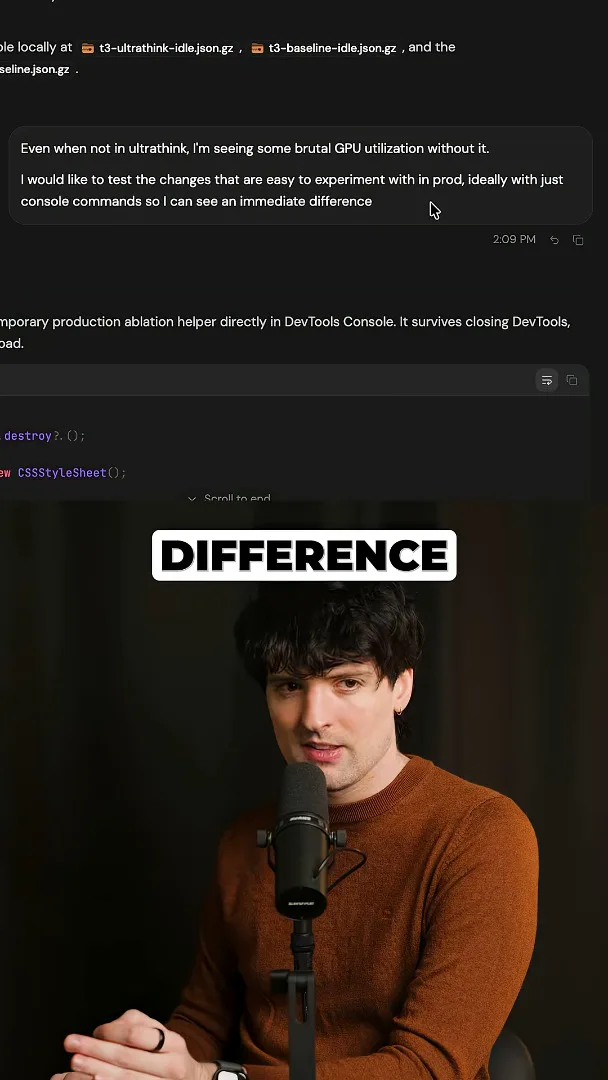
I asked it to make changes easy to experiment with in production, ideally through console commands so I could see an immediate difference. It wrote a window binding that created __T3GPU, giving us a custom tool for switching options back and forth while investigating.
The agent could find things in the codebase faster than I could and build custom tools to test my theories better than I could. But I was still the one bringing the actual information to the investigation.
同じチャンネルの記事
 38:47EN
 Theo - t3․gg· 2026年10月28日Theo’s Long-Running Agent Experiments: Verification, Compute and CostTheo Browne · Ping LabsA skateboard game and two compiler projects show how repeated checks and flexible compute can sustain agent work—and how expensive those loops can become.
 36:07ENTheo - t3․gg· 2026年10月27日Theo on Token Costs, Coding Agents, and the Price of AI CapabilityTheo Browne · Ping LabsA viral estimate of Lauren's AI spending prompts a closer look at cache pricing, benchmarks, and the changing work of coding agents.
 30:37ENTheo - t3․gg· 2026年10月26日Theo’s Three Skills for Reviewing and Shipping with Coding AgentsTheo Browne · Ping LabsHow sol-loop, full-send and full-stop encode review, verification and different levels of merge authority.
 0:43ENTheo - t3․gg· 2026年10月23日Theo Distinguishes Security Vulnerabilities from Active AttacksTheo Browne · Ping LabsA short explanation of why disclosed software flaws and reported attacks are different kinds of security news.
 29:22ENTheo - t3․gg· 2026年10月22日Theo on Security Vulnerabilities, Stolen API Keys and AITheo Browne · Ping LabsA look at the gap between vulnerability disclosure and patching, and a speculative account of why stolen inference keys may be valuable.
 31:13ENTheo - t3․gg· 2026年10月20日Theo on Why Smarter Models Help More Than DevelopersTheo Browne · Ping LabsFrom game modifications to compiler experiments, Theo revisits his assumptions about who benefits from more capable AI.