30 秒でわかる
Peter Yang walks through five ways he uses Claude Fable 5: identifying demanding work, stress-testing business plans, reviewing a project before launch, planning a feature, and auditing a collection of agent skills. He recommends preparing context with less expensive models, reviewing results, and watching usage. His access and performance claims describe his experience at the time of recording.
- 1Find work worth the model’s effortPeter asks the model to inspect his projects and suggest tasks needing deep analysis.
- 2Stress-test a business planA plan document and connected sources provide context for a three-month assessment; optional simulated perspectives challenge the proposal.
- 3Review an app before releaseA fitness-app audit identifies possible bugs and edge cases that passed existing tests. Peter reports his own comparison with other models.
- 4Plan a feature for another model to buildA nutrition-tracking plan lays out architecture, data sources, risks, decisions, and a proposed interface.
- 5Audit a collection of skillsThe model reviews Peter’s personal skill system for ambiguous instructions, redundant blocks, and other maintenance issues.
- 6Manage limited usagePeter recommends cheaper preparation, delegation of implementation, lower effort settings when suitable, and monitoring for unproductive loops.
ポイント
- Ask the model to suggest demanding tasks based on the projects and context it can access.
- Give business-advice requests a clear plan and relevant data, then evaluate the output yourself.
- A prelaunch review can expose bugs even when existing tests pass; findings still require verification.
- Use a detailed plan to hand implementation to another model, and review architectural decisions.
- Audit accumulated skills for duplication and stale instructions, while monitoring usage and effort settings.
チャプターごとに整えた全文を読む
Five uses for limited model access
Peter introduces the workflows and the access conditions he experienced.
Peter Yang demonstrates five tasks he considers worth spending limited access to Claude Fable 5 on. The video describes subscription limits and availability at the time of recording; those conditions can change. Its title and spoken description give different cutoff dates, so viewers should check current access directly.
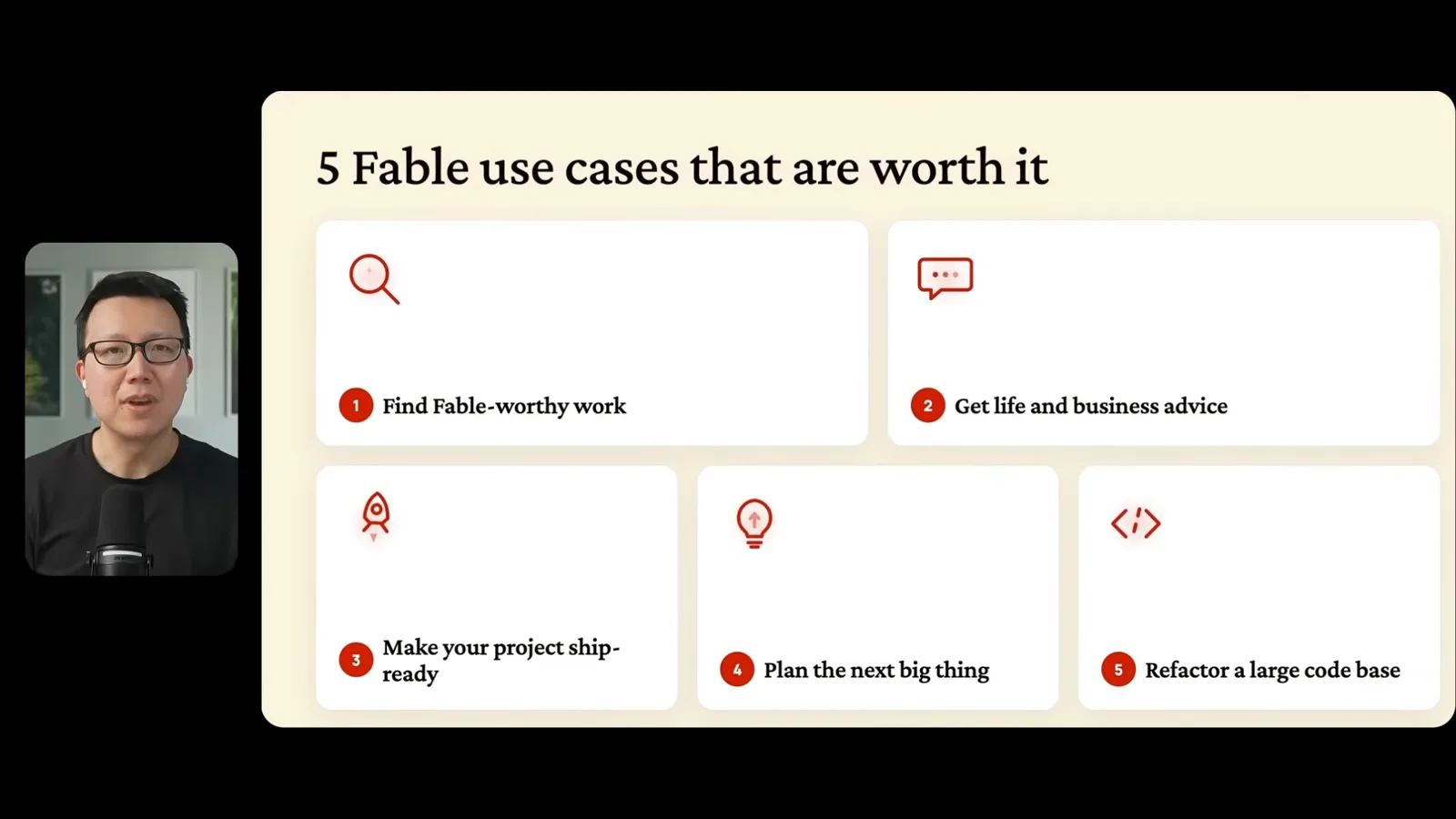
Find demanding work
Ask the model to identify valuable projects using available context.
First, he asks the model to examine his projects and memory and propose demanding tasks. Its suggestions include testing a business strategy, designing an offer, analyzing content performance, mining an archive, and cleaning up his skill system. The shared pattern is using context across a large body of work to find useful next steps.
Ask for strategic advice
Supply a plan and relevant information for an assessment.
For business advice, Peter starts with a plan describing goals, positioning, decision principles, energy, and relevant personal context. He connects information sources and asks for an assessment of the next three months. His optional advisor skill can simulate perspectives such as a customer, a skeptic, and an operator; those voices are prompts, not independent experts.
The model produces an assessment and suggested priorities. Peter recommends providing enough context to make advice specific, while retaining responsibility for checking the evidence, deciding what sensitive information to connect, and making the final call.
Audit an app before launch
Review a fitness app for bugs and edge cases.
For a prelaunch review, Peter asks the model to inspect a fitness app for real bugs and edge cases. He says it identified issues involving sign-out, account data, synchronization, and invalid inputs even though the existing unit tests passed. His comparison with other models is an individual experiment, not a controlled benchmark; proposed findings and fixes need human verification.
Plan the next feature
Draft a reviewable plan for nutrition tracking.
Peter then asks for a detailed plan for a nutrition-tracking feature, including phases, risks, open decisions, and information sources. The resulting HTML plan includes a proposed interface and architecture. He shows an editor that lets him comment on the plan before handing implementation to another model.
An explicit handoff can separate expensive planning from implementation. Peter also suggests acceptance criteria, but cautions that long autonomous loops may consume a limited allowance quickly. A plausible design or suggested food-data source still needs review before it is built.
Clean up a skill system
Find redundant, stale, or ambiguous instructions.
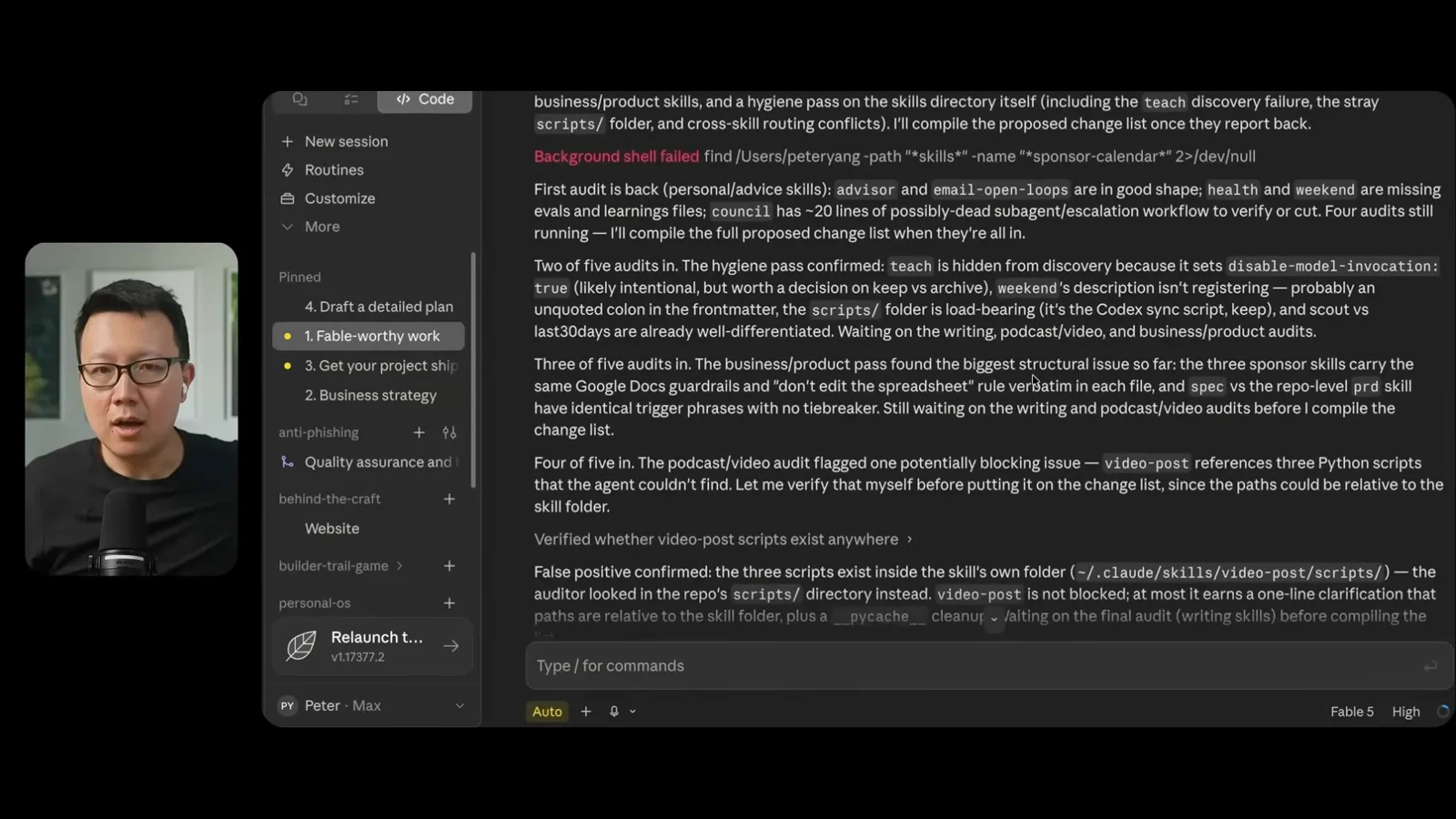
Finally, he audits the many skills in his personal system. The agent flags possible obsolete escalation logic, ambiguous instructions, and cleanup opportunities. Peter says he will review the recommendations more closely; the on-screen audit also shows a possible issue being checked and dismissed as a false positive.
Use the model efficiently
Prepare, delegate, and monitor consumption.
His closing advice is to prepare context and integrations with less expensive models, use the advanced model for difficult planning, delegate execution where appropriate, and monitor effort and usage. The goal is to spend the available budget on work that benefits from deeper reasoning, while checking the output.
同じチャンネルの記事
 46:40EN
 Peter Yang· 2026年11月8日ポッドキャスト · 2 人Ashley Alexander: How AI Helps Me Care for My Parents With Cancerゲスト Ashley Alexander · ホスト Peter YangA caregiver uses AI to prepare for appointments, organize records and ask better questions—while keeping doctors at the center of treatment.
 17:50ENPeter Yang· 2026年11月4日ポッドキャストPeter Yang’s Five Steps for Using AI to Help Care for His MotherYang uses a shared care brief and organized records to navigate appointments, while making time for family.
 15:03ENPeter Yang· 2026年11月3日ポッドキャストHow Peter Yang Used an AI Phone Agent to Negotiate His Internet BillAn AI call negotiated a lower price and faster service, but Yang still had to approve the change himself.
 33:09ENPeter Yang· 2026年11月1日ポッドキャスト · 2 人Jaclyn Konzelmann: When AI Can Build More, Choose What Deserves to Existゲスト Jaclyn Konzelmann · ホスト Peter YangGoogle Labs pairs short strategy documents with prototypes, user co-creation and lessons from experiments that end.
 13:05ENPeter Yang· 2026年10月28日ポッドキャストPeter Yang Tests Genie 4: Convincing Worlds, Unfinished GameplayFive live demonstrations show scenes that respond to prompts and sound, alongside inconsistent actions and limited game mechanics.
 1:06ENPeter Yang· 2026年10月26日ポッドキャストPeter Yang on Setting Up Payroll for a One-Person BusinessIn a paid partnership, Yang describes the paperwork he encountered and a payroll product integrated with a business account.