30 秒でわかる
Linear's Nan Yu and Jacob Shumway trace their agent from a small prototype to a product embedded in Slack and issue workflows. They explain why they load skills dynamically, start with capable models before optimizing cost, grow evaluations from real usage and focus release quality on core paths.
- 1Learn from real useA quiet Slack integration revealed workflows the team had not fully anticipated.
- 2Load skills on demandThe team moved away from supplying every possible action or the entire API schema at once.
- 3Optimize cost after defining successA strong model and an evaluation framework establish a baseline before smaller models are considered.
- 4Grow evals from actual behaviorThe team combines concrete checks with model judges and feedback, while guarding against misleading signals.
- 5Set a release bar for core pathsThe team prioritized reliability for the use cases it actively promoted while accepting variability elsewhere.
ポイント
- Start with a concrete workflow and learn from how people actually use the agent.
- Load relevant skills and tools as needed instead of supplying every instruction at once.
- Establish success with capable models and evaluations before optimizing model cost.
- Combine deterministic checks, carefully reviewed model judgments and feedback from real users.
- Design entry points into existing work and keep generated changes visible for human review.
チャプターごとに整えた全文を読む
From memo to prototype
The guests explain the agent loop and early product experiments.
Linear's Nan Yu and engineer Jacob Shumway discuss how they built a production AI agent with Peter Yang. Their examples cover a prototype, dynamic skills, evaluations and the places where an agent enters an existing workflow. The episode is sponsored by Oceans.
Shumway describes an agent as a model operating in a loop: it works toward a goal, calls tools, gathers context and eventually returns a result. Yu adds that an agent product contains more than the loop, including interfaces, scheduling and other cooperating subsystems.
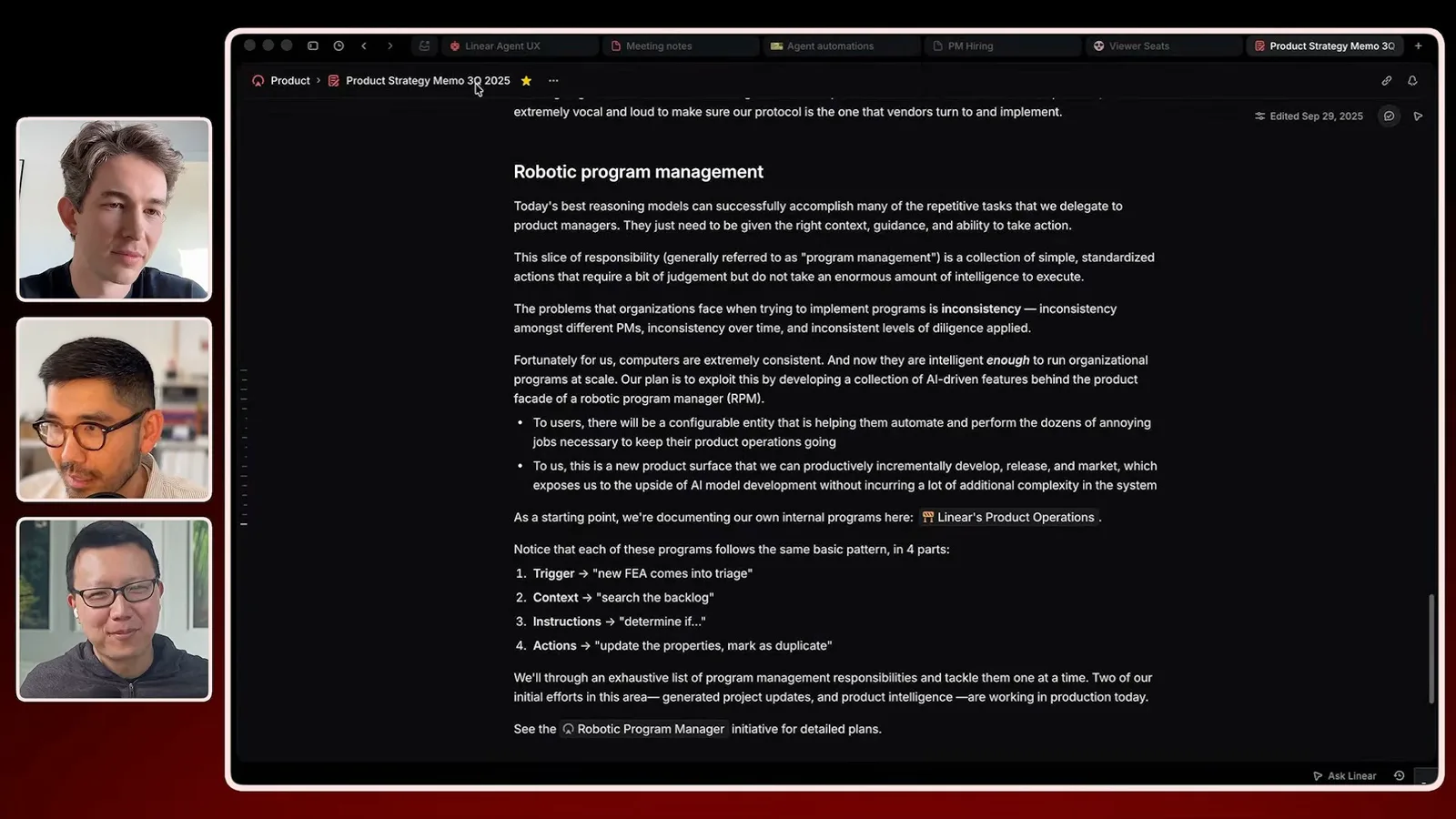
Yu shows an early 2025 memo about automating routine program-management work. The team's ambition later expanded to interactive and creative tasks. An early prototype called a model from the frontend and exposed existing command-menu actions as tools; creating issues from notes became an especially useful starting point.
Slack, skills and human review
Real use drives an on-demand architecture and an issue-to-pull-request workflow.
The first production version was quietly connected to Linear's existing Slack integration. People discovered they could mention the agent in a conversation and ask it to act on the surrounding discussion. The team learned from the unexpected ways people used it rather than assuming every use case in advance.
Giving the agent all possible actions or an entire GraphQL schema created context and hallucination problems, Shumway says. The team moved toward skills loaded on demand: a request determines which instructions and tools are brought into context, including product-specific guidance for writing and prioritizing issues.
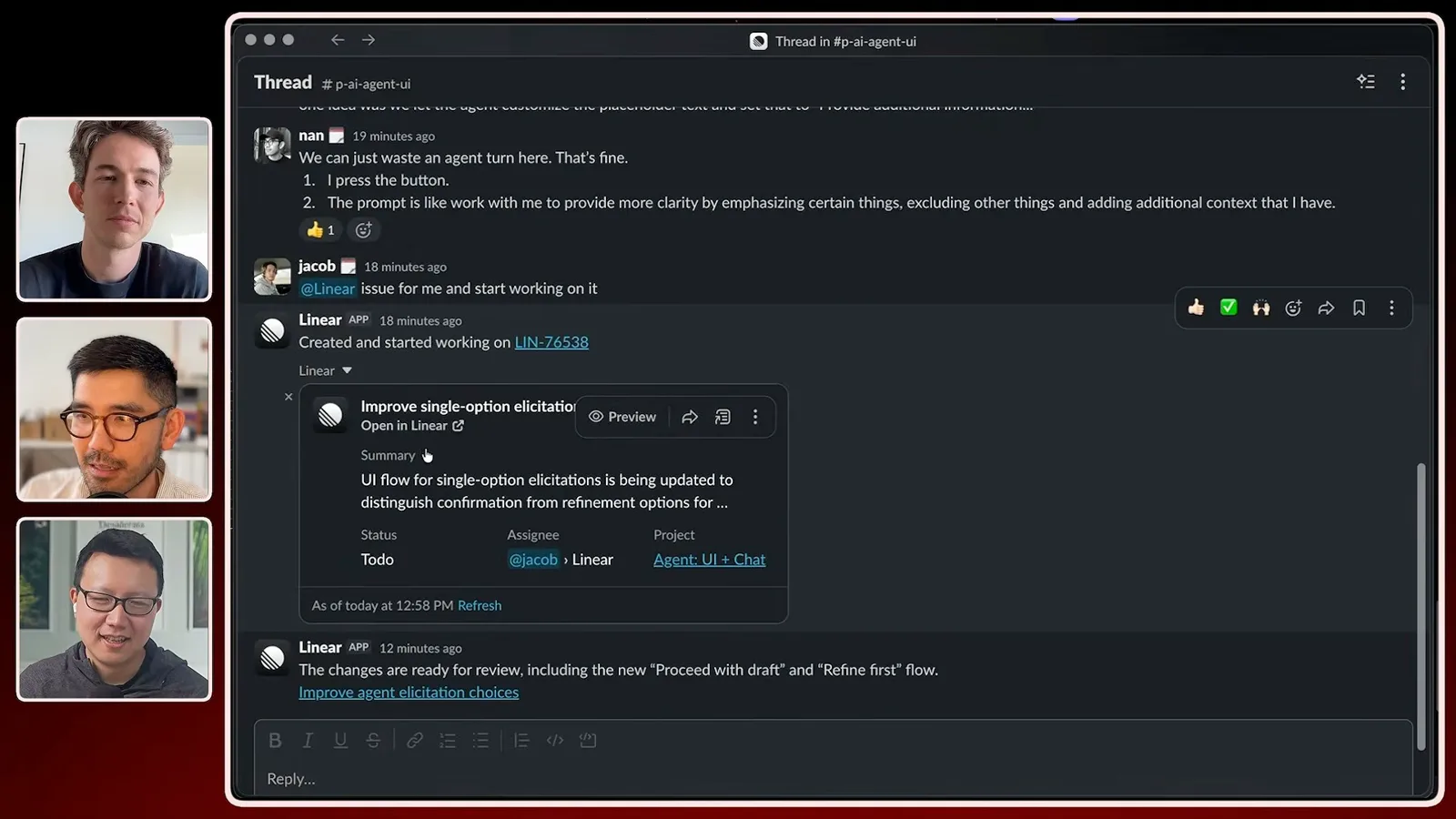
In one demonstration, a Slack discussion leads to an issue and then a pull request. The agent delegates work to itself, while the issue remains assigned to a person and tracked in a backlog. The guests describe the result as a starting point for a human to inspect, not a guarantee that the generated change is right.
Models, evaluations and feedback
The team describes routing, model cost, objective tests and reported capability gaps.
Early usage centered on creating issues, so the team used a small router and an optimized path for that common task. Shumway says they generally start with a strong model to establish that the workflow works, build evaluations and define success, then consider smaller models to reduce cost while checking quality.
Their evaluation dataset grows from real usage and unexpected behavior. Deterministic tests check concrete requirements such as a requested status; an LLM judge can assess more subjective questions such as title selection. Shumway says they use model judges less often because the judges themselves need checking, and unnecessary consistency checks can generate false signals.
The team also tests interaction quality: did the agent recognize an actual request, or act too eagerly? Feedback about awkward behavior becomes additional evaluation cases. Shumway recommends a clear goal and tools to retrieve relevant guidance instead of filling every prompt with potentially distracting instructions.
When an agent lacks a tool for a requested action, it can report that gap. The team routes the report to an existing issue or creates a new one. The guests say users also found unexpected applications, including translating customer feedback before filing an issue.
Product design and release
The guests discuss existing workflows, native agents, core reliability and future plans.
Yu says a native agent lets Linear apply its product-management opinions across the broader workflow, while external agents can also connect to individual tools. He argues that builders should map the user's real multi-step process and identify entry points such as Slack discussions and meeting debriefs, not assume a chat box is the whole product.
For release, Shumway says the team chose to ship once the agent was good enough to learn from more users. Yu describes the product bar as reliability on the core use cases they actively promote, while acknowledging that less common tasks can vary in reliability.
The guests identify proactive behavior and longer-running project memory as areas they were working toward. Those are plans discussed in the interview rather than a promise of current behavior. Their recurring lesson is to start with a useful workflow, observe real use and improve the agent with targeted context and feedback.
同じチャンネルの記事
 46:40EN
 Peter Yang· 2026年11月8日ポッドキャスト · 2 人Ashley Alexander: How AI Helps Me Care for My Parents With Cancerゲスト Ashley Alexander · ホスト Peter YangA caregiver uses AI to prepare for appointments, organize records and ask better questions—while keeping doctors at the center of treatment.
 17:50ENPeter Yang· 2026年11月4日ポッドキャストPeter Yang’s Five Steps for Using AI to Help Care for His MotherYang uses a shared care brief and organized records to navigate appointments, while making time for family.
 15:03ENPeter Yang· 2026年11月3日ポッドキャストHow Peter Yang Used an AI Phone Agent to Negotiate His Internet BillAn AI call negotiated a lower price and faster service, but Yang still had to approve the change himself.
 33:09ENPeter Yang· 2026年11月1日ポッドキャスト · 2 人Jaclyn Konzelmann: When AI Can Build More, Choose What Deserves to Existゲスト Jaclyn Konzelmann · ホスト Peter YangGoogle Labs pairs short strategy documents with prototypes, user co-creation and lessons from experiments that end.
 13:05ENPeter Yang· 2026年10月28日ポッドキャストPeter Yang Tests Genie 4: Convincing Worlds, Unfinished GameplayFive live demonstrations show scenes that respond to prompts and sound, alongside inconsistent actions and limited game mechanics.
 1:06ENPeter Yang· 2026年10月26日ポッドキャストPeter Yang on Setting Up Payroll for a One-Person BusinessIn a paid partnership, Yang describes the paperwork he encountered and a payroll product integrated with a business account.