30 秒でわかる
At Tesla’s August 2022 shareholder meeting, Elon Musk said the company had produced its three-millionth car and targeted a higher year-end production rate. He outlined manufacturing simplification and plans for charging, battery cells and Cybertruck, while declining to commit to a share buyback. His autonomy, output and economic forecasts were predictions made at the time; Tesla’s supervised driving system requires an attentive driver.
- 1Musk targeted a two-million vehicle annualized run rateHe distinguished the year-end production pace from vehicles produced during the year.
- 2Large castings simplified highlighted body partsA company slide compared 171 Model 3 pieces with two Model Y castings.
- 3A buyback was possible but not committedMusk tied any decision to cash flow and financial stability.
- 4Cybertruck pricing and specifications were expected to changeMusk cited inflation and targeted volume production in 2023.
- 5The recession prediction was explicitly speculativeMusk described his 2022 macroeconomic outlook as a guess.
ポイント
- Musk reported three million cars produced and targeted a higher annualized production rate.
- The company highlighted large castings and simpler factory flow.
- A buyback was discussed as possible, not promised.
- Cybertruck pricing and specifications were expected to change from the 2019 announcement.
- Autonomy and macroeconomic remarks were 2022 forecasts.
チャプターごとに整えた全文を読む
Production, cash flow and driving software
Musk reviews growth and discusses future autonomy.
At Tesla’s 2022 annual shareholder meeting in Texas, Elon Musk thanks the team and reviews production growth.
Musk says Tesla had reached a 1.5 million vehicle annualized production rate and aimed for a two-million rate by year-end. A run rate is a pace, not the number of vehicles already produced during a calendar year.
He says the company recently made its three-millionth car, compared with fewer than 3,000 vehicles produced a decade earlier.
Musk points to positive retained earnings and free cash flow, describing profitability as a difficult milestone after years of investment.
He predicts that autonomy could increase future cash flow and discusses improvements being developed for FSD beta, including complex left turns. His comments about timing and future capability are forecasts from 2022.
Musk describes driving as a real-world AI problem using cameras and neural networks. He argues that improved safety could eventually reduce injuries, but does not establish a comparative safety result at the meeting.
Electrification and factories
He describes scaling, energy, recycling and manufacturing.
He recalls skepticism about electric vehicles and says Tesla’s mission was to demonstrate that people would buy compelling electric cars. He welcomes other automakers’ shift toward electrification.
Musk describes Tesla as both a software and hardware company and portrays a factory as a coordinated system of people, machines and software.
He predicts Model Y could become the highest-selling vehicle by revenue in 2022 and by units in 2023. He adds that ramping Berlin and Texas still involves thousands of manufacturing and supply-chain problems.
Musk says a future factory location might be announced later in 2022 and speculates about eventually operating at least ten to twelve large factories. The numbers describe ambitions, not commitments or completed facilities.
He argues that electric vehicles generally have lower lifetime carbon emissions than gasoline cars and emphasizes the combined roles of clean generation, stationary storage and electric transport.
Musk claims that energy produced by Tesla solar installations over a decade exceeded energy used to manufacture and charge its cars. The figure is a company claim from the presentation, not an independently audited calculation in the video.
He says battery packs can be recycled and reports that Tesla was recycling more than 50 packs per week in Nevada. He expects the amount to grow as more vehicles and packs reach the end of useful life.
Musk says a future Master Plan Part 3 will examine the materials and infrastructure required for a sustainable global economy. At this meeting it was still a forthcoming plan.
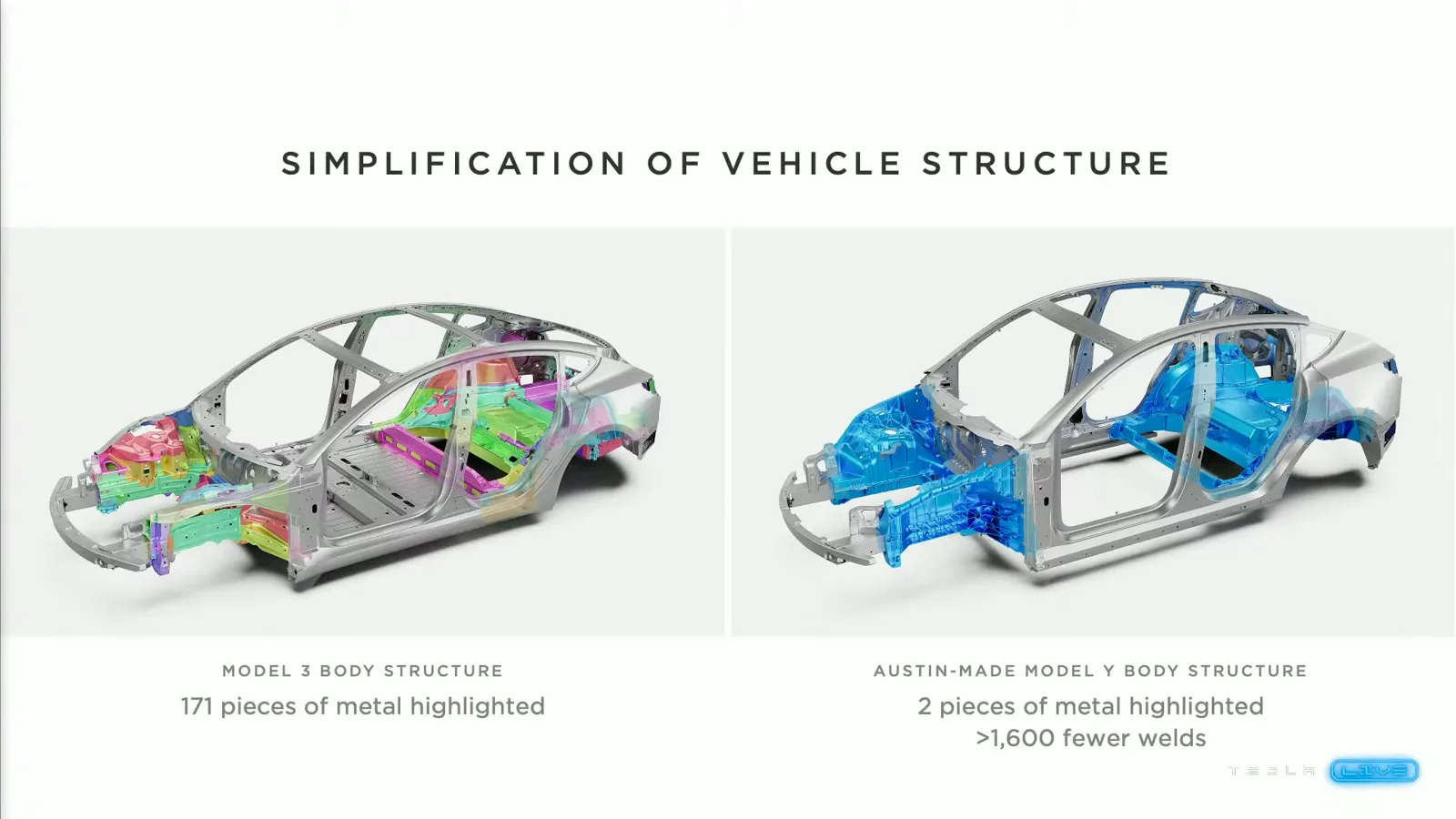
He presents a comparison between Model 3 body components and large castings in an Austin-made Model Y, saying the highlighted metal pieces were reduced from 171 to two.
Musk says simpler castings and a more direct factory flow can reduce manufacturing complexity. He identifies manufacturing capability as a potential long-term competitive advantage.
He discusses recruiting engineers and claims factory safety has improved, citing employee suggestions as part of the process. The meeting does not independently compare safety performance across manufacturers.
Charging, safety and FSD
Musk discusses charging and driver-assistance plans.
On Superchargers, Musk describes connected monitoring, continued network expansion and a possible next-generation rollout. He notes that permits can delay particular locations.
He discusses vehicle safety and says software updates can improve how systems respond to crashes. His broad comparative safety claims are presented as his statements at the time.
Musk reports more than 40 million FSD beta miles and forecasts wider North American availability. Tesla’s supervised driving features require an attentive driver; the name does not make the vehicle autonomous.
He previews AI Day and predicts that the Optimus robot could eventually be valuable. He thanks shareholders for voting before taking questions submitted online and from the audience.
Shareholder questions on cash and products
He discusses capital spending, Cybertruck and battery cells.
Asked about the use of cash, Musk says Tesla favors investing in capital expenditure and research and development. He says acquisitions are possible when they fit, but historically most growth has been organic.
A share buyback is possible, he says, but he declines to commit and conditions it on financial strength, future cash flow and broader stability.
Asked how many factories might support 20 million vehicles annually, Musk estimates roughly a dozen large sites. This is an illustrative production ambition, not a guarantee.
On Cybertruck, he says inflation and other changes mean specifications and pricing will differ from the 2019 announcement. He targets volume production around the middle of 2023.
Musk says charging locations are prioritized by demand and suggests a public poll on future sites. He describes an idea for a themed Los Angeles charging location with food and screens.
He says 4680 battery-cell production was increasing but its ramp remained difficult to predict. He says supplier cells were sufficient for the company’s stated 2022 vehicle output target.
Asked about inflation, Musk says some component prices appeared to be trending down in forward purchasing. He speculates about a mild recession and explicitly labels his macroeconomic view a guess.
Audience questions and long-term plans
The audience asks about autonomy, succession and infrastructure.
An audience member asks how autonomous vehicles might change ownership. Musk imagines owners deciding when to use their cars or make them available to a shared fleet, comparing the model to ride-hailing and short-term rentals.
He argues that a driverless vehicle might be used more hours per week than a conventional privately owned car. The utilization and financial benefits depend on future autonomous operation and are not demonstrated by the presentation.
Shareholders offer product suggestions, including steering controls and clearer information about skills needed for space exploration. Musk thanks them for the feedback.
Asked what people overlook, Musk praises engaged retail investors and argues that understanding a company’s products is important. He advises looking beyond short-term supply disruptions when considering a business.
An attendee asks whether factory waste heat could be reused. Musk agrees it could be a future improvement and describes how Tesla manages thermal energy among vehicle components.
Asked about a pilot city for a robotaxi network, Musk says the company was aiming for a general driving solution rather than one specific city, while acknowledging local regulatory differences.
An investor raises succession and Musk’s other commitments. Musk says he intends to remain at Tesla while useful, praises the team and acknowledges that he has no easy succession answer.
Discussing Twitter amid litigation over the acquisition, Musk says the service could accelerate a broader X product vision. He avoids detailing the legal dispute.
An audience question turns to the Boring Company. Musk describes a vision of tunnels, underground transport and high-speed intercity travel, while noting the existing Las Vegas tunnel.
Asked about cars communicating with one another and Dojo coordinating traffic, Musk says Dojo’s first goal was neural-network training. He sees possible value in sharing road closures and other traffic information.
Musk closes by encouraging support for sustainable energy and transport. He thanks customers, shareholders and the team for helping the company progress.
同じチャンネルの記事
 24:44EN
 Tesla· 2026年11月6日Elon Musk Unveils the Cybertruck: Steel Body, Cracked Glass and a New Pickup DesignElon Musk · TeslaAt Tesla’s 2019 event, Musk introduced the electric pickup and demonstrated its body, glass, suspension and cargo bed.
 59:56ENTesla· 2026年10月21日Tesla Q3 2026: Cash Flow, FSD Demand and the Cost of Scaling RobotsElon Musk, Vaibhav Taneja, Travis Axelrod · TeslaExecutives discuss quarterly margins, capital spending and plans for Cybercab, Optimus and chip production.
 23:21ENTesla· 2026年10月16日Tesla’s Roadster Event: A Ramp Stunt, Aerodynamics and a 2028 Production TargetElon Musk, Franz von Holzhausen, Lars Moravy · TeslaElon Musk, Franz von Holzhausen and Lars Moravy demonstrate a prototype developed with SpaceX engineering.
 1:09:55ENTesla· 2026年7月22日Tesla’s Q2: Margins Narrow as Spending on Robots and AI RisesTravis Axelrod, Elon Musk, Vaibhav Taneja, Ashok Elluswamy, Lars Moravy · TeslaTesla reported higher energy deployment and negative free cash flow while executives outlined Robotaxi and Optimus plans.
 27:27ENTesla· 2026年5月21日Tesla’s Final Model S and X Deliveries: How the Cars EvolvedElon Musk, Franz von Holzhausen, Lars Moravy · TeslaElon Musk and Tesla’s team recall a tent-based design studio, years of changes, and plans for the former production line.
 1:05:20ENTesla· 2026年4月22日Tesla Plans a $25 Billion Investment Year as It Prepares OptimusTravis Axelrod, Elon Musk, Vaibhav Taneja, Lars Moravy · TeslaOn Tesla’s Q1 2026 call, executives detail one-time margin gains, battery constraints and plans for robots and driving software.