30 秒でわかる
3Blue1Brown introduces symmetry groups using reflection, rotation and the identity action. A sixfold snowflake has 12 symmetries, while an idealized mirror-symmetric face has two.
- 1Symmetry as actionA reflection across a line can leave an idealized face unchanged.
- 2The snowflakeRotations and reflections preserve a sixfold snowflake.
- 3Include the identityDoing nothing counts, bringing the snowflake’s group to 12 actions.
ポイント
- A symmetry is an action that leaves an object looking unchanged.
- Rotations and reflections can be combined into a symmetry group.
- The identity action, doing nothing, is also a symmetry.
- The illustrated snowflake has 12 symmetries, conventionally called D6.
チャプターごとに整えた全文を読む
Reflection and symmetry
A symmetric face illustrates an action that preserves an object.
When I say a face is symmetric, I mean that I can reflect it across a line and leave it looking the same. Symmetry is a statement about an action I can perform, not just a visual impression.
The snowflake’s actions
Rotations and reflections form a larger collection.
A snowflake can have more symmetries. Rotating the illustrated sixfold snowflake by 60 or 120 degrees leaves it unchanged, as do reflections across several axes. Taken together, the symmetry actions form a group.
Counting group elements
The identity gives the snowflake 12 symmetries; a face can have two.
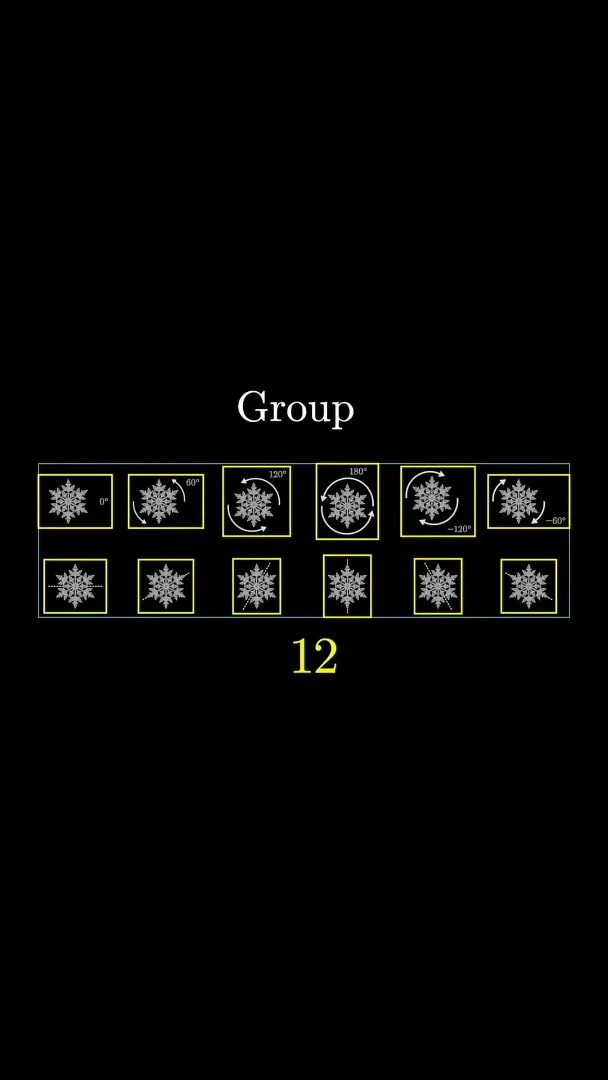
I also include the action of doing nothing, called the identity. For this snowflake there are 12 distinct symmetry actions: six rotations, including the identity, and six reflections. This group is commonly called D6.
The idealized face has a simpler group with two actions: doing nothing and reflection. It is called C2. These examples are a first glimpse of the many groups used to describe different kinds of symmetry.
同じチャンネルの記事
 40:44EN
 3Blue1Brown· 2026年10月16日Grant Sanderson: There's never been a better time to go into mathGrant Sanderson, Constantin Kogler · 3Blue1BrownStudents fear AI has solved mathematics. Grant Sanderson argues the opposite: even if machines prove theorems better than we do, the institution of math stays valuable—and this is a rare moment when newcomers can reshape it.
 51:55EN3Blue1Brown· 2026年9月18日The last IMO problem AI could not solveGrant Sanderson · 3Blue1BrownGrant Sanderson walks through IMO 2025 Problem 6 — a tiling puzzle that frontier models missed — and the visual patience it takes to prove a construction is optimal.
 0:55EN3Blue1Brown· 2026年7月24日The 64 Sugar Cubes Puzzle: Six Equal DistancesA 4×4×4 block has three colors; prove that six same-colored pairs share a distance.
 33:51EN3Blue1Brown· 2026年7月16日What Cross-Entropy Connects: Compression, Language Models and KL DivergenceGrant Sanderson · 3Blue1BrownGrant Sanderson builds cross-entropy from code lengths and uses it to explain next-token training and distillation.
 2:25EN3Blue1Brown· 2026年6月12日How Shannon Measured the Entropy of EnglishA guessing game helped Claude Shannon estimate how much information English text contains, and why prediction is central to compression.
 1:02EN3Blue1Brown· 2026年6月10日A Robot Walk and the Puzzle of Optimal Binary EncodingHow few bits does it take to send directions that occur with unequal frequencies?