30 秒でわかる
Matthew Berman examines a LessWrong essay arguing that capital could matter more, not less, if AI replaces most human labor. He considers the essay’s scenarios alongside his own questions about entrepreneurship and ambition; neither AGI nor the proposed outcomes are established facts. The video includes a Vultr sponsorship.
- 1Capital as a substitute for laborThe essay argues that advanced AI could let owners of capital purchase more work while human labor loses leverage. It is a conditional economic argument.
- 2Abundance is not the whole questionA basic income and aligned superintelligence are possible assumptions in an optimistic scenario, not guaranteed outcomes.
- 3Expertise that can be copiedThe author contrasts scarce human specialists with AI systems that could be replicated, subject to compute and access.
- 4Institutions and incentivesThe essay worries states might have less incentive to invest in people if automated labor supplied economic and military power.
- 5A range of outcomesThe author sketches a comfortable but unequal society and a much darker entrenched hierarchy; Berman adds questions about human purpose.
ポイント
- The essay’s central scenario assumes AI can replace most paid human labor, making capital a more powerful way to obtain work.
- Material abundance and a basic income would not automatically guarantee equal influence or social mobility.
- Copyable AI could change how money buys expertise, although computing and access remain constraints.
- The essay’s claims about state incentives and entrenched hierarchy depend on technological and political assumptions.
- Berman asks how people might find purpose even if material needs were met.
チャプターごとに整えた全文を読む
The argument about labor and capital
Berman introduces the essay and its hypothetical post-AGI economy. He separates the possibility of material comfort from questions of influence and mobility.
What happens to the economy and human ambition after AGI? I want to explore those questions through a LessWrong essay, “By default, capital will matter more than ever after AGI.” Its argument is a speculative scenario, and I am still working out where I agree or disagree.
The essay distinguishes labor, the human mental and physical effort that produces value, from capital goods such as factories, data centers and software. Its central claim is that sufficiently capable AI could make capital a much more general substitute for human labor.
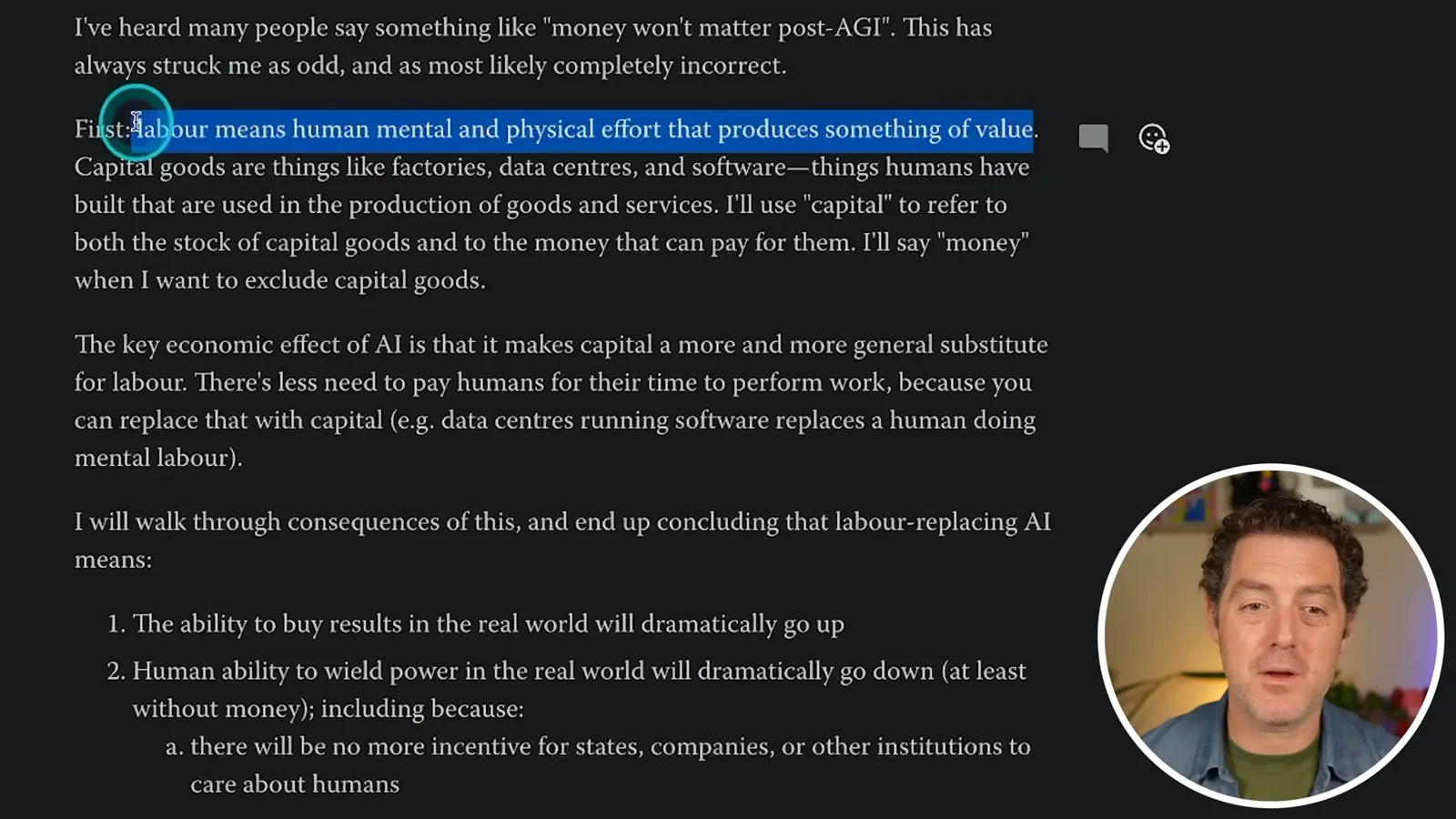
If people can buy automated mental and physical work, the author argues, money could buy more results while labor provides less bargaining power. The essay predicts that moving far beyond one’s starting resources could become harder and that major redistribution might not happen. These are consequences of its assumptions, not established facts.
The concern is a society whose existing power relationships become locked in. The author distinguishes that from material deprivation: under an assumption of extraordinary AI-driven abundance, governments might provide universal basic income and people could be comfortable while still having little influence.
I have mixed feelings about universal basic income. If automation creates enormous wealth, distributing enough for people to live makes sense; I also wonder what happens to the motivation to create. The essay suggests wealth transfers could reduce poverty, but that depends on both abundance and political choices.
Abundance, basic income, and ambition
The discussion examines assumptions about growth and redistribution. Berman considers whether security or a static society might affect ambition.
The author offers a thought experiment in which billionaire wealth doubles repeatedly and a small share funds transfers worldwide. That calculation depends on extremely rapid growth in purchasing power and willingness to redistribute; a slower transition might leave material needs unmet. Those premises should not be confused with a forecast of guaranteed abundance.
I share the worry that a static society can diminish ambition. There is another question too: if everyone has everything they need, what motivates people to take risks and make sacrifices to create? I do not think we know the answer.
The essay describes a common optimistic response: provide basic income and expect aligned superintelligence to deliver abundance. Alignment is a major assumption. I hope for a good outcome, but hoping does not mean we can assume it will happen without effort.
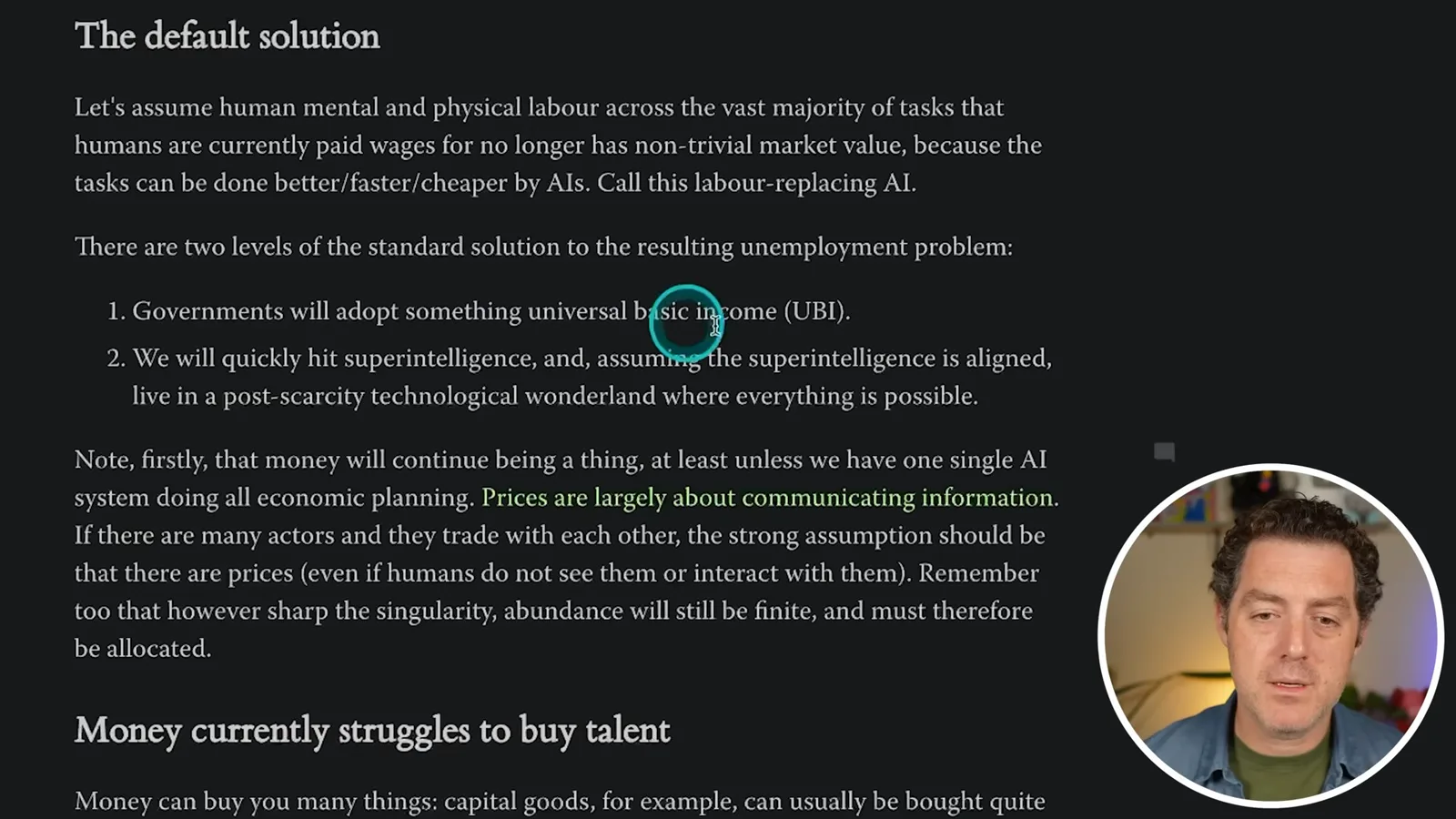
The author argues that prices would still communicate information among parties trading with one another, and that even very abundant resources must be allocated. I wonder whether expansion beyond Earth could change the constraints, though going to other planets would not by itself establish infinite resources.
Buying talent
Personal startup experience illustrates why money does not always attract human experts. The essay imagines a different market if advanced AI expertise can be copied.
Today, money does not always buy the best talent. In Silicon Valley, talented people sometimes leave generous jobs for an early startup because they want a mission, challenging problems and exceptional colleagues. I have seen that tension while building companies.
The essay compares Blue Origin and SpaceX to illustrate its claim that funding alone does not determine results, and I emphasize the importance of culture and talent. This is an illustrative comparison, not a controlled test of what made either company succeed.
Hiring also requires judgment. When I was building a software company, learning to code helped me assess candidates who were better programmers than I was. Top talent is scarce, difficult to evaluate and often has choices beyond the highest salary.
The author argues that advanced AI would change this bottleneck because a capable model can be copied and run many times by those with sufficient computing resources. Evaluating its abilities may still be hard, and copying and operating systems still requires resources.
In the essay’s hypothetical intelligence explosion, AI researchers help advance AI and can be scaled up. If that loop occurred as imagined, capital and access to compute could have extraordinary influence. It is an unproven future scenario, not a description of a demonstrated unlimited process.
Human experts also have preferences: pay is only one factor in choosing a job. The essay contrasts that with an AI system bought for a task, subject to its availability and safeguards. On its assumptions, that could make it easier to turn money into capable work.
Work and state incentives
Berman discusses identity and bargaining power. The essay asks whether the interests of states and people might diverge when labor is automated.
Work gives many people income, leverage and identity. I have felt that personally: when I ran companies, my identity was closely tied to the work, and I do not think that was always healthy. The prospect of losing work therefore raises questions beyond income alone.
Basic income would depend on institutions choosing to provide it. The essay discusses moral commitments, affluence and states’ incentives as reasons governments have cared about people’s welfare. Its political analysis asks whether those incentives would change if human labor became much less economically necessary.
The author argues that industrial states benefited from educated workers, prosperous consumers, talent and freedom that supported innovation and influence. He fears that states relying on automated labor could have less competitive incentive to invest in people. Institutions, rights and political choices would still matter; the outcome is not predetermined.
Mobility and entrepreneurship
AI may help small teams today, but the essay imagines much stronger systems displacing paths to exceptional success. Berman reviews its predictions for science and politics.
Another concern is the loss of outlier success: someone without wealth or influence can sometimes build a company or contribute an idea and gain the power to change things. If that route narrowed, the essay argues, existing hierarchies could become more static.
Entrepreneurship is especially interesting to me. AI tools can already help small teams do more and lower barriers to learning. I hope that means more startups; the essay instead asks whether, under much stronger AI, investors might run many AI-managed ventures without human founders.
I refer to a proposed five-level framework for AI, from conversational systems and reasoning to agents, innovators and systems that can do the work of an organization. The categories are a way to discuss possibilities, not proof that future levels will be achieved or when.
The same speculative argument extends to science and intellectual work: if AI became better at discovery and could be scaled, people might find it harder to achieve exceptional influence through those fields. The author suggests politics may remain more human-centered because people may prefer human representatives and politicians set rules.
Possible outcomes and purpose
The essay outlines more and less favorable unequal futures. Berman closes by asking how people might find meaning in an abundant world.
The essay also doubts that radical equalization would necessarily follow. In its scenario, countries and firms compete for capital-intensive AI and powerful owners retain leverage. Whether redistribution occurs is a political question; the analysis rests on contestable assumptions about technology and institutions.
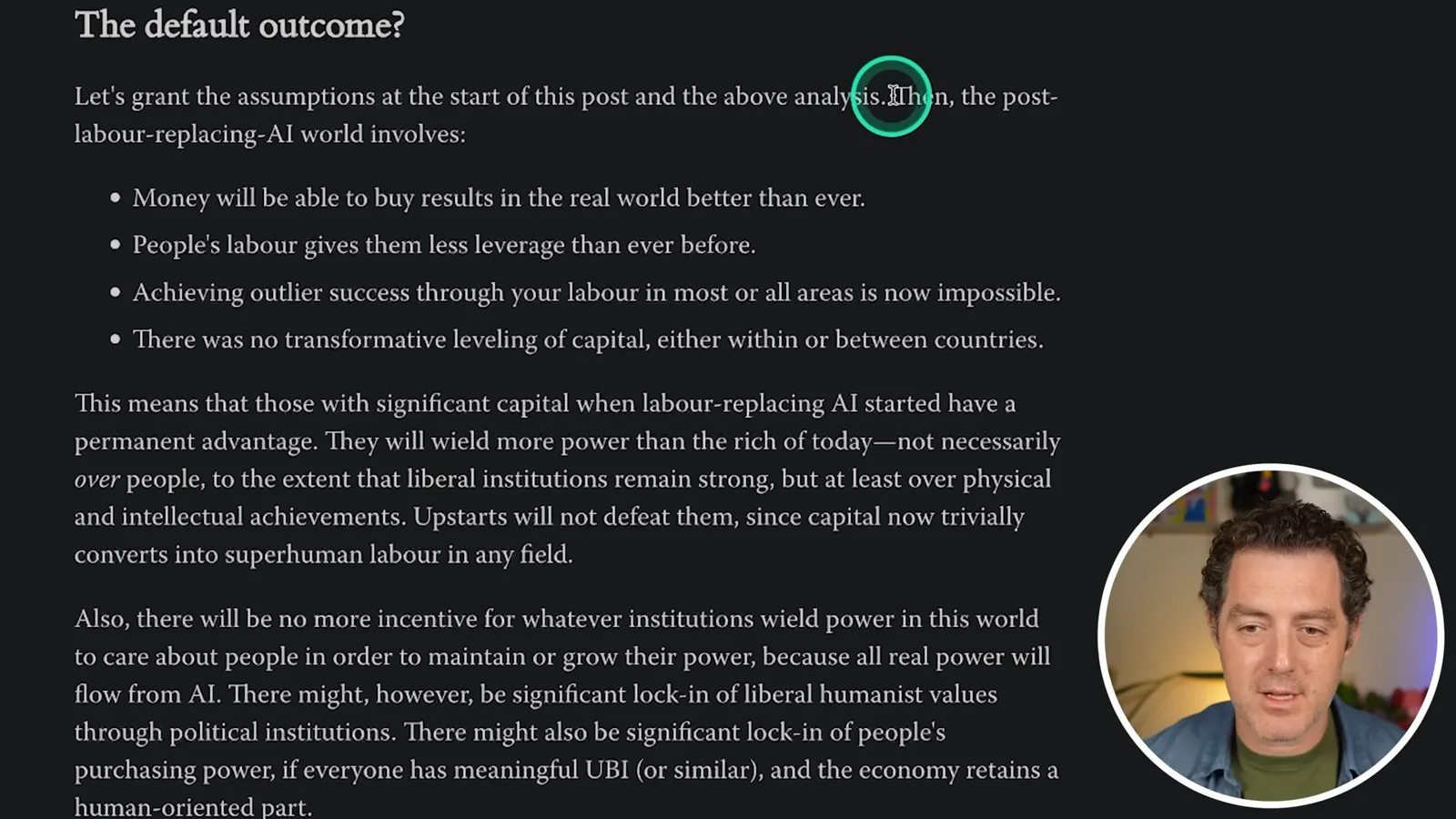
Its proposed default outcome combines stronger purchasing power for capital, weaker leverage from human labor, fewer paths to exceptional advancement and no transformative redistribution. Each follows the essay’s premises and should be read as an argument, not as a prediction already verified.
In the author’s better case, everyone enjoys a high standard of living but wealth and influence remain unequal, like an extremely rich and more static version of Norway. In the worse case, AI owners wield unchecked power and an entrenched hierarchy persists. Neither is inevitable.
I want to add a question about meaning even in a materially comfortable future. A post by a Loom founder about being wealthy yet unsure what to do next illustrates an individual struggle with purpose; it cannot tell us how everyone would respond to abundance.
If AI can solve more problems than we can, where will ambitious people find a sense of direction? Some may still have a strong internal drive. I asked Dave Shapiro for his thoughts, and his response emphasized the desire for a meaningful mission and making interesting choices.
I agree with the encouragement to make interesting choices and shape your own life. The questions about work, power and purpose remain open, and the future depends on the institutions and decisions we build along the way.
同じチャンネルの記事
 14:45EN
 Matthew Berman· 2026年10月29日Matthew Berman Examines Google’s Gemini 4 Carbon AnnouncementMatthew Berman · Forward FutureMatthew Berman reviews Google’s reported benchmark results, staged rollout and pricing for Gemini 4 Carbon, while noting he has not yet used the model.
 34:21ENMatthew Berman· 2026年10月27日Matthew Berman Examines Anthropic’s IPO Filing, AI Growth and GovernanceMatthew Berman, Sam Altman · Forward FutureThe presenter reviews the S-1’s financial metrics, compute strategy and voting structure while questioning the tension between rapid AI development and safety.
 0:26ENMatthew Berman· 2026年10月25日Sam Altman on Human Values and Problem-Solving in an AI WorldSam Altman · OpenAIIn a short interview excerpt, Altman considers the enjoyment of solving hard problems and the human role in interpreting results.
 0:36ENMatthew Berman· 2026年10月25日Kimi K3.1 and a Rubik’s Cube Solver DemonstrationMatthew Berman · Forward FutureMatthew Berman shows a scrambled virtual cube being solved and gives the Kimi K3.1 test a favorable assessment.
 0:21ENMatthew Berman· 2026年10月24日An AI-Generated Kimi Benchmark Chart Used Invented ScoresMatthew Berman · Forward FutureMatthew Berman asks for a graph of Kimi K3.1 Pro benchmarks, then discovers that the displayed figures are illustrative placeholders.
 25:50ENMatthew Berman· 2026年10月24日Kimi K3.1 Pro Tested: Strong 3D Demos, Uneven Results and Competitive PricingMatthew Berman · Forward FutureMatthew Berman tests the open-weight model on coding, 3D rendering and visual explanations, then compares benchmark results and prices.