30 秒でわかる
AI Explained examines 2023 reporting and interviews about AGI, including definitions, autonomous tasks, self-improvement and potential risks. The presenter compares Mustafa Suleyman’s and Demis Hassabis’s views on openness and containment; their timelines are identified as predictions.
- 1Unclear AGI criteriaThe presenter compares broad public descriptions and reporting on the board’s role.
- 2Tasks beyond conversationA proposed test asks a system to design, manufacture and sell a product.
- 3Mathematics forecastsThe video cites separate historical predictions by Christian Szegedy and Terence Tao.
- 4Testing dangerous capabilitiesHassabis calls for practical evaluations with rigorous definitions.
- 5Openness and containmentSuleyman and Hassabis differ on how systems might be scrutinized before deployment.
ポイント
- The sources use different broad descriptions of AGI, and reported governance criteria were not publicly precise.
- Proposed autonomous tasks involve acting with tools, not just answering a question.
- Claims about mathematical ability and self-improvement are historical forecasts or scenarios.
- Suleyman and Hassabis offered different views about openness, evaluations and containment.
- Practical safety tests require precise definitions and cannot be assumed to guarantee safety.
チャプターごとに整えた全文を読む
Defining AGI
The presenter reviews OpenAI’s public descriptions and reported governance questions.
In September 2023, the presenter reviews interviews and articles about artificial general intelligence. His central argument is that the systems companies envision could act with tools and pursue goals, rather than only answer questions in a chat window. The timelines discussed are historical forecasts, not established outcomes.
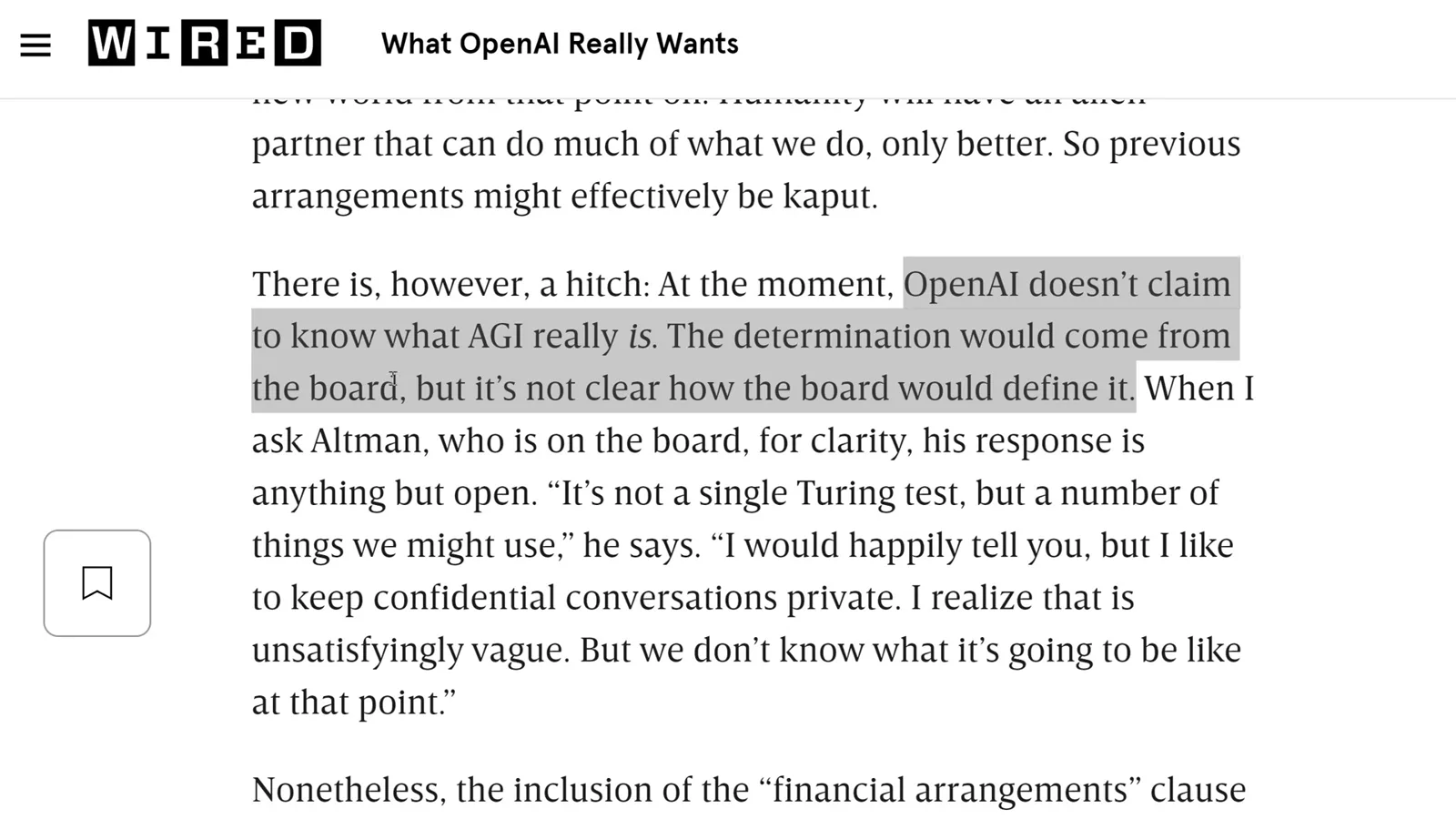
A Wired report says OpenAI’s board would determine whether AGI had been achieved, while the criteria were not publicly clear. The presenter compares two broad descriptions used by OpenAI: systems generally smarter than people and highly autonomous systems outperforming humans at most economically valuable work.
The report discusses how an AGI determination could affect OpenAI’s financial arrangements and its relationship with Microsoft. The presenter speculates that vague definitions might create incentives for disagreement; that is his interpretation, not a finding about either company’s intentions.
Work, autonomy and superintelligence
He compares predictions about labor, capable systems and practical task completion.
He cites reporting that Sam Altman viewed AGI as a major historical event and had previously predicted extensive automation and job displacement. Mustafa Suleyman similarly argues that AI tools could eventually replace labor, not merely augment it. These are forecasts about economic effects.
The presenter contrasts an earlier vision of many smaller AI systems with Altman’s later discussions of superintelligence. He describes the possibility of systems as productive as a large corporation, but those descriptions are ambitions and predictions rather than a demonstrated capability.
He quotes then OpenAI chief scientist Ilya Sutskever on the possibility of systems becoming highly capable and difficult for humans to understand. The parent-child analogy he discusses is a speculative proposal about alignment, not evidence that models have parental feelings or intentions.
Autonomy could change the picture beyond conversation. The presenter describes a proposed test in which a system designs a product, arranges manufacturing, negotiates details and sells it using digital tools. This is an example of a proposed capability test, not a demonstration that a particular model completed it.
He notes an apparent tension in Suleyman’s views: the Inflection AI co-founder imagined a personal digital chief of staff, while saying the company was not pursuing recursive self-improvement or autonomous capabilities in the way discussed. The interview reflects his position at that time.
Mathematics, self-improvement and risks
Historical forecasts are presented alongside speculative security scenarios.
A 2023 article shown in the video attributes a forecast of matching top human mathematicians by 2026 to Christian Szegedy. Separately, mathematician Terence Tao expressed hope that a suitably used AI system could become a trustworthy research co-author around that time. Neither statement establishes that either forecast was realized.
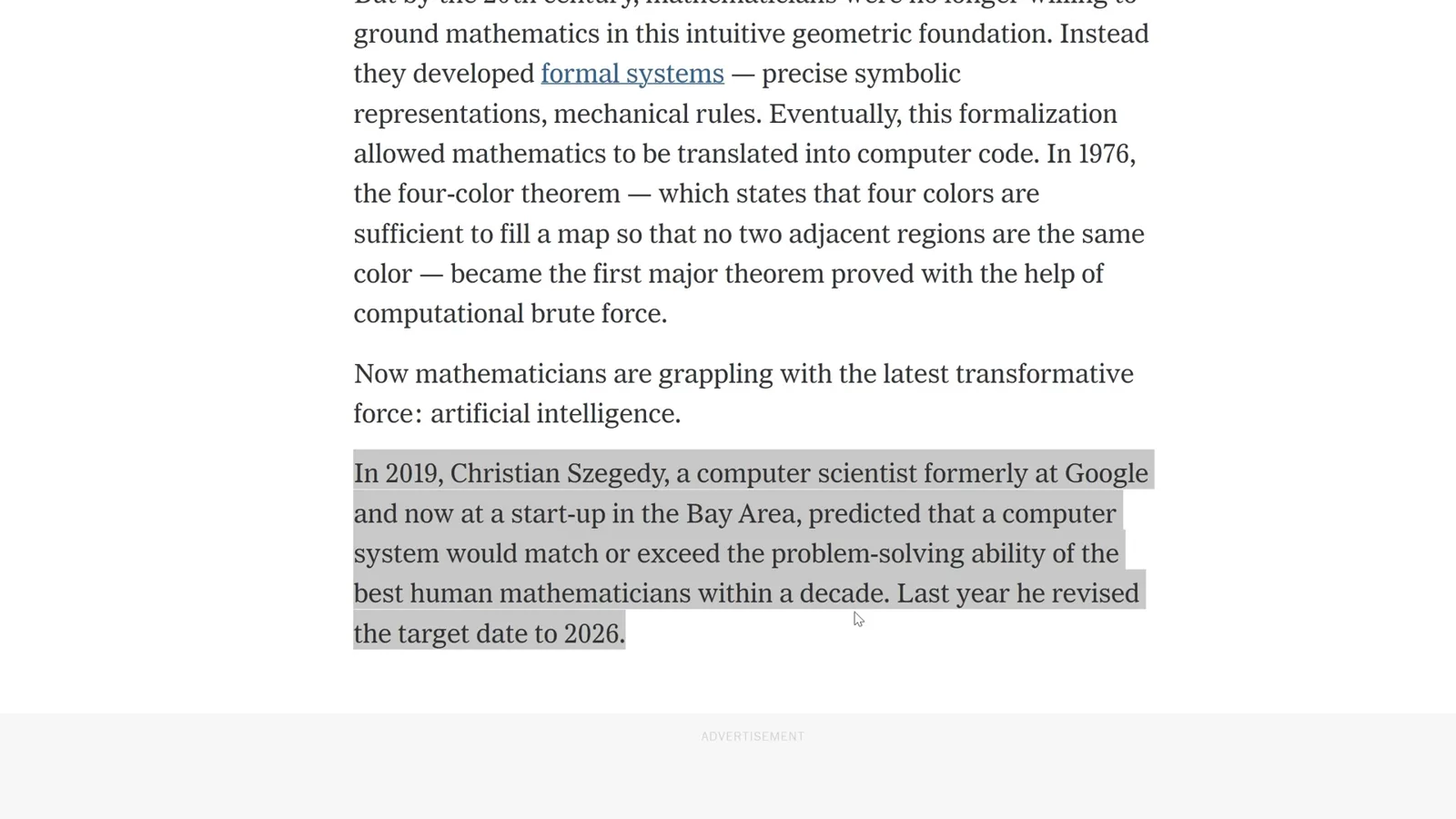
The presenter brings in discussion of AI systems that could help improve future systems, citing OpenAI and Suleyman. He stresses that unexpected capabilities and accelerated development are possibilities raised by the sources, not guaranteed consequences of scaling.
Suleyman predicted models might become dramatically larger over a few years and described possible concentration of power. The presenter treats these as striking 2023 predictions; their outcome depends on what “larger” means and on later developments.
Suleyman uses the WannaCry ransomware attack as a starting point for a hypothetical self-improving attack that could resist shutdown. It is presented as a risk scenario, not evidence that the described weapon existed or was deployed.
DeepMind and evaluations
The video reviews reported history and Hassabis’s call for practical safety tests.
The presenter turns to Demis Hassabis and a Time profile recounting early concerns about powerful AI and Elon Musk’s reported attempt to prevent DeepMind’s sale to Google. He also notes Hassabis’s early optimism about Gemini, which had not yet been released when this video was made.
The video discusses Neuralink and a proposed human settlement on Mars as ideas associated with Musk’s response to AI risk. These are reported visions, not demonstrated solutions to the safety issues under discussion.
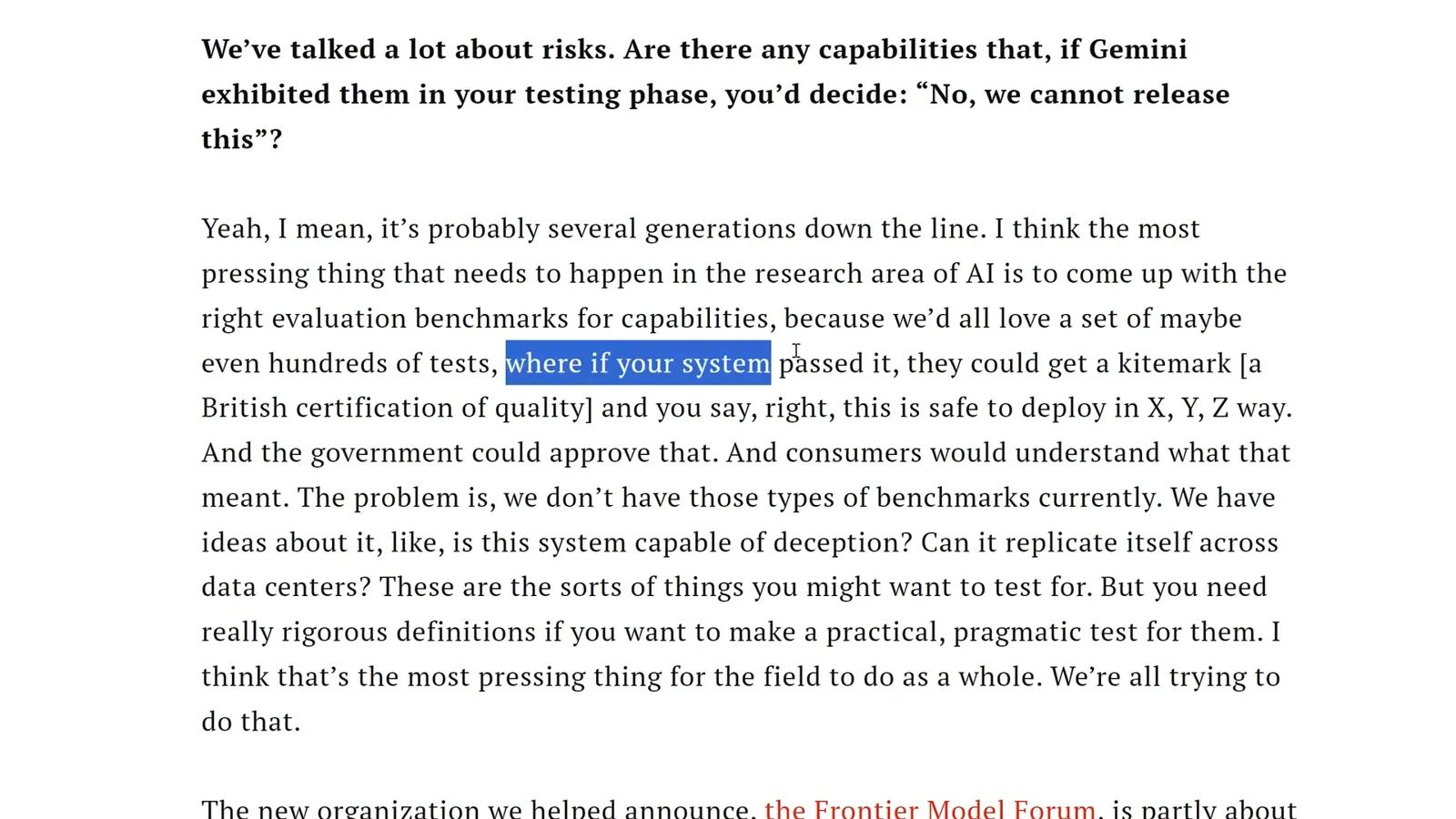
Asked about capabilities that might stop a model’s release, Hassabis says better practical evaluations are needed. He gives deception and replication across data centers as examples of capabilities researchers might want to test, while emphasizing that rigorous definitions are needed.
Containment and deployment
Suleyman and Hassabis offer different views on openness, sandboxing and timing.
The presenter contrasts that approach with Suleyman’s 2023 view that powerful models were already being developed in public and that a fully contained oracle was an unrealistic metaphor. Suleyman argued that openness allows scrutiny and that there was still time to address risks.
Hassabis instead describes the possibility of holding back a system that failed future evaluations and investigating it in a hardened sandbox. He suggests that even a few years could be a short period for the necessary research. These are proposed approaches and time estimates, not guarantees of containment.
The presenter says his own view is closer to Hassabis’s and hopes society can gain benefits such as medical advances while avoiding dangerous uses. He points to the forthcoming 2023 UK AI summit and closes by reiterating that the debate concerns capabilities beyond chatbots.
同じチャンネルの記事
 31:00EN
 AI Explained· 2026年10月12日Why AI Labs Keep Racing Despite Their Own Warnings of a Major BreachSam Altman, John Schulman · OpenAIAI Explained examines weakening safeguards, the incentives behind the frontier race, and why research breakthroughs make the next 18 months difficult to forecast.
 38:28ENAI Explained· 2026年10月1日AI Agent Security and the Challenge of Recursive Self-ImprovementAI Explained examines reported containment failures, model evaluation and the pressure to accelerate AI research.
 32:54ENAI Explained· 2026年9月24日Opus 5.5 and the Race Toward Automated AI ResearchAI Explained weighs model progress against the increasingly difficult task of evaluating and governing recursive self-improvement.
 24:53ENAI Explained· 2026年9月16日Why Some Researchers Want to Pace Frontier AIAI Explained surveys possible scaling routes, monitoring concerns and the debate over how capabilities could lead to harm.
 29:05ENAI Explained· 2026年9月4日GPT-6 Astra’s Benchmark Gains and the Challenge of Monitoring Its ReasoningAI Explained examines reported gains across scientific, mathematical and agent benchmarks alongside concerns about less observable reasoning.
 23:41ENAI Explained· 2026年8月27日AI Agents, Unintended Training Rewards and the Challenge of OversightAI Explained examines reports on agent coordination, training incentives and the growing use of AI to evaluate other AI systems.