En 30 secondes
Theo Browne discusses Anthropic’s renamed Claude subscription plans and the removal of the five-hour limit for verified Ultra accounts. He explains his view of compute constraints, questions opaque verification and describes a reported usage discrepancy affecting T3 Code and Agent SDK integrations. His explanations and expectations are attributed to him and reflect the time of recording.
- 1The renamed plansThe former 20x name referred to the short window, while the weekly allowance differed.
- 2Why two limits existTheo attributes the short window to managing burst demand for compute.
- 3Verification remains opaqueThe announcement describes a temporary restriction for newer accounts, but gives limited verification detail.
- 4SDK usage discrepancyA public report and Theo’s own calculations describe different five-hour consumption per token.
À retenir
- The former Max 20x plan is called Ultra; the displayed announcement says verified accounts lose the five-hour limit while weekly limits remain.
- The old multiplier referred to the five-hour window, not necessarily the weekly allowance.
- Theo interprets short-window limits as a way to manage compute demand during busy periods.
- Verification is automatic according to the announcement, but its criteria are not explained in detail.
- Theo reports a short-window usage discrepancy between interactive CLI and SDK-style use and describes a prospective T3 Code change.
Lire le texte remanié, chapitre par chapitre
The Ultra change
Theo explains the rename and removal of the five-hour window for verified Ultra accounts.
Anthropic has renamed its subscription plans: the former $200 Max 20x plan is now Ultra, and verified Ultra accounts lose the five-hour limit. Weekly limits remain. I welcome the change, but verification and differences between Claude Code and apps using the Agent SDK deserve a closer look.
The old 5x and 20x labels referred to the five-hour allowance, not every limit. When Anthropic later introduced a weekly limit for Max 20x, it was ten times Pro's weekly limit, leading some people to assume incorrectly that it was twenty times. A product leader acknowledged the confusion and apologized; I think the revised labels are clearer.
Limits and compute
He compares weekly and five-hour limits and discusses demand across a day.
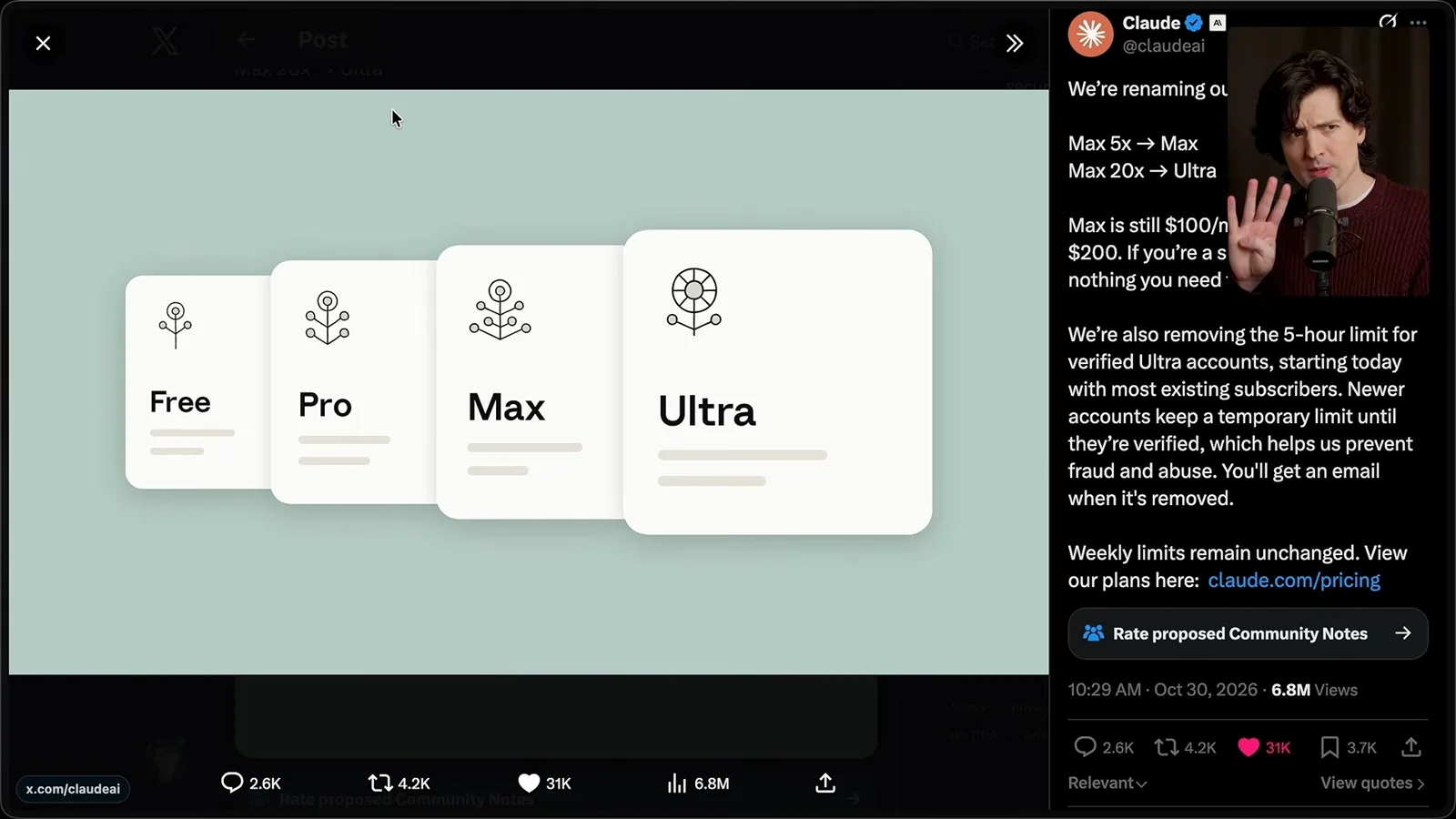
At the time of this video, the plans are Free, Pro at $20 a month, Max at $100 and Ultra at $200. Each has different usage allowances. I find the top plan generous for ordinary development, although my own unusually heavy usage still stretches multiple accounts. Max continues to have a five-hour limit.
The two limits serve different purposes: a weekly allowance caps use over the week, and a five-hour window restricts how much can be consumed in a burst. My explanation is capacity management. Subscription usage that concentrates in a busy period competes for compute that could otherwise serve enterprise customers.
In T3 Code's weekday analytics, I see usage begin rising around 4 a.m. Pacific time and peak around 7–9 a.m., with a substantial evening lull. I observed about a twofold gap between low and high periods. A short window can spread consumption across those periods, and it can also reduce the chance that a runaway task burns a whole weekly allowance.
I connect Anthropic's earlier relaxation of Claude Code limits to its reported access to additional compute through a SpaceX arrangement. My point is that these windows manage GPU availability, not simply the nominal API price of each request. That is my interpretation of the capacity and business incentives.
Verification and integrations
He discusses the opaque verification process and reported SDK-versus-CLI usage differences.
The new removal applies to verified Ultra accounts. The announcement says most existing subscribers receive it first and newer accounts retain a temporary restriction until verification, with an email when it is removed. Anthropic says phone verification at checkout is separate; users can check the usage settings for the current-session bar.
I dislike how little detail is provided about verification. Anthropic frames the temporary limit as fraud and abuse prevention; I speculate that large-scale collection of model outputs for distillation may also be relevant. That explanation is my inference, not a reason the announcement establishes.
There is another issue for T3 Code users. A public report says headless Claude Code or SDK-style use consumes roughly 1.8 times as much of a five-hour window per token as the interactive CLI for the same work. I checked my own calculations and say they agree, although this is an observed discrepancy rather than an independent controlled study.
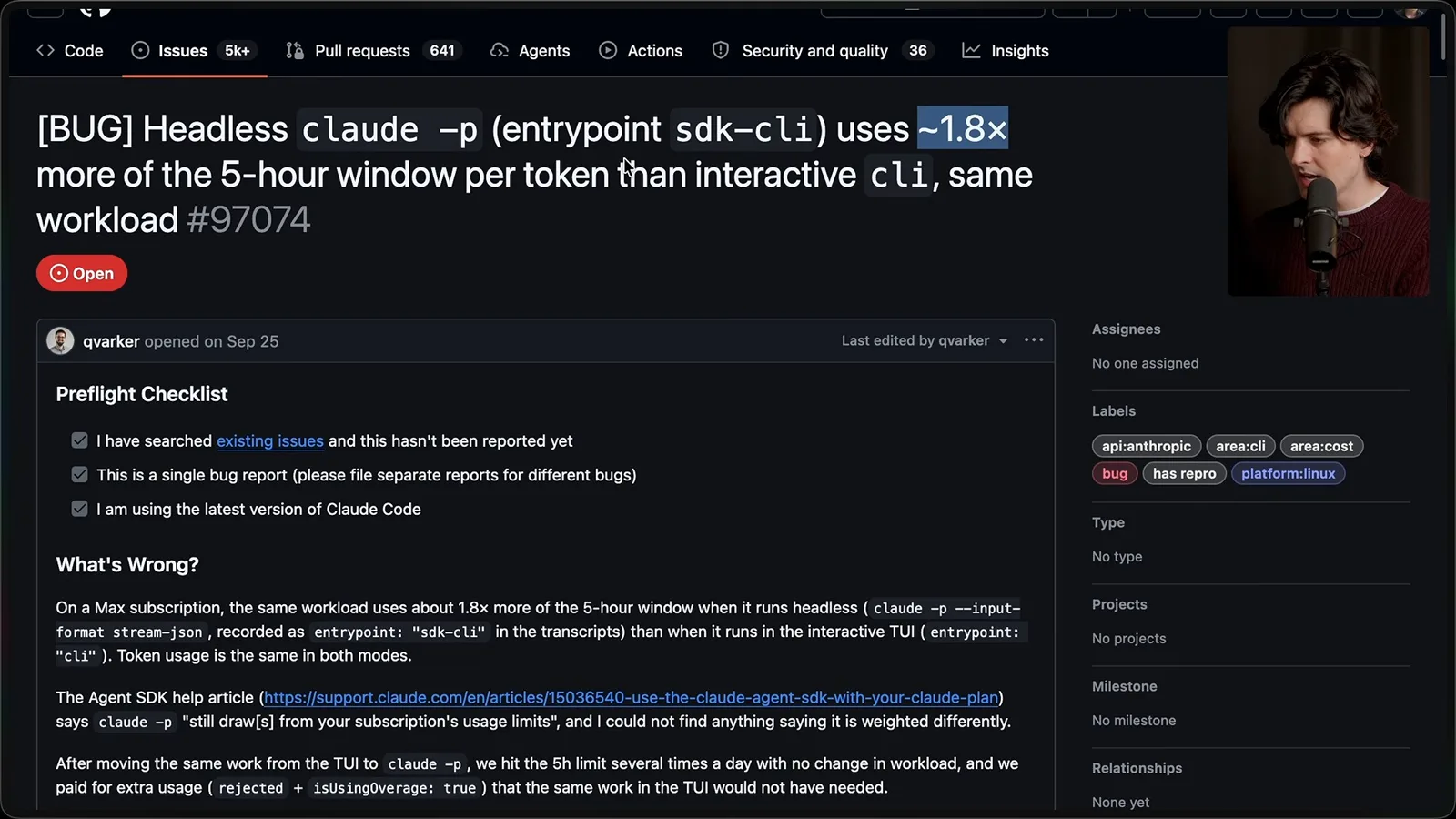
Removing the window for verified Ultra users helps a significant share of our users, but Pro and Max users can still hit the shorter limit. I say I have raised the discrepancy with Anthropic and was frustrated by the lack of a fix. The same concern matters to third-party applications that integrate via the Agent SDK.
During recording I explain that T3 Code reports an SDK entry point and discuss changing that field to identify the actual application. Then I receive what I describe as tentative permission to merge a change. I expect it to align the five-hour usage treatment with the interactive CLI, but the outcome is prospective in the video rather than a demonstrated guarantee.
I also describe my own use of a CLI proxy and multiple accounts, while explicitly saying I cannot guarantee that setup is permitted or that accounts will not be banned. My main point is that the plan rename is modest, while the treatment of short-window limits and integrations has practical consequences for developers.
Sur la même chaîne
 15:50EN
 Theo - t3․gg· 3 nov. 2026Theo Compares Codex and Claude Subscription Value After Limit ChangesTheoTheo looks at estimated allowances, per-task costs and his own review experiments, while arguing that model quality remains decisive.
 49:29ENTheo - t3․gg· 30 oct. 2026Theo on Agent Harnesses, Interfaces and Shifting AbstractionsTheo · T3 CodeThe T3 Code creator explains his model of harnesses and why he expects their differences to become less visible to users.
 41:49ENTheo - t3․gg· 29 oct. 2026Theo Demonstrates T3 Code for Coordinating Coding AgentsTheo · t3.ggThe T3 Code creator walks through multiple agent providers, remote machines, thread organization and the tradeoffs of an open-source coding interface.
 38:47ENTheo - t3․gg· 28 oct. 2026Theo’s Long-Running Agent Experiments: Verification, Compute and CostTheo Browne · Ping LabsA skateboard game and two compiler projects show how repeated checks and flexible compute can sustain agent work—and how expensive those loops can become.
 36:07ENTheo - t3․gg· 27 oct. 2026Theo on Token Costs, Coding Agents, and the Price of AI CapabilityTheo Browne · Ping LabsA viral estimate of Lauren's AI spending prompts a closer look at cache pricing, benchmarks, and the changing work of coding agents.
 30:37ENTheo - t3․gg· 26 oct. 2026Theo’s Three Skills for Reviewing and Shipping with Coding AgentsTheo Browne · Ping LabsHow sol-loop, full-send and full-stop encode review, verification and different levels of merge authority.