En 30 secondes
Tesla’s Texas factory was designed to bring battery cells, large body castings and final assembly together under one roof. At its 2022 opening celebration, Elon Musk explained a Model Y design built around front and rear castings and a structural battery pack, arguing that scaling production is harder than making a prototype. He also gave future targets for Cybertruck and Optimus and announced the first Texas-made car deliveries.
- 1Scaling production is harder than building a prototypeMusk calls the factory the machine that builds the machine and describes lessons from earlier manufacturing.
- 2The Texas plan brings production steps under one roofThe layout links cell production, castings and assembly inside one facility.
- 3A structural battery pack sits between two large castingsMusk says the design is intended to reduce parts and vehicle weight.
- 4Musk’s 2023 product dates were plans made in 2022He describes targets for Optimus and other vehicles at the event.
À retenir
- The Texas layout brings several production stages into one facility.
- The Model Y architecture described at the event places a structural battery pack between large castings.
- Musk set a goal of 500,000 Model Y vehicles a year at the factory.
- The Cybertruck and Optimus dates were targets announced in 2022.
Lire le texte remanié, chapitre par chapitre
Music before the presentation
The broadcast begins with a long musical introduction before Musk comes on stage.
Music and footage precede the Cyber Rodeo presentation. Elon Musk begins speaking at approximately 33:52.
From Roadster to the Texas factory
Musk recalls Tesla’s early car and describes the company’s expansion.
Musk welcomes the audience to the opening celebration at Tesla’s Texas factory and introduces a look at the company’s past, present and future.
Beside an early Roadster, he recalls assembling the first Tesla production car at a former dealership in Menlo Park. Tesla made the powertrain and Lotus supplied the rest of the car.
He says he initially gave Tesla a small chance of success and credits the team’s work over many years for reaching this point.
Musk names the Model S, 3, X and Y, along with residential and commercial energy products including Powerwall and Megapack.
He describes Full Self-Driving as a beta product and, in 2022, predicts a wider North American beta that year and future safety improvements. Tesla says its FSD (Supervised) requires an attentive driver ready to take over.
Musk says the Texas factory gives Tesla another major North American vehicle plant alongside its operations in China and Europe. He argues that making cars nearer customers reduces the need to ship them across oceans.
He identifies the factory as Tesla’s global headquarters and says Austin offered room to expand, transport connections and access to workers.
Musk thanks the team for building the facility through freezing weather, rain and difficult ground conditions. He compares its size with well-known buildings to illustrate its scale.
Why the factory is the product
He explains the integrated production layout, structural battery pack and large castings.
He calls the factory the machine that builds the machine. In his view, a prototype is difficult, but achieving production at scale is harder.
Musk says the Texas layout incorporates lessons from Fremont, where separate buildings required movement between facilities. The Texas plan brings more steps together under one roof.
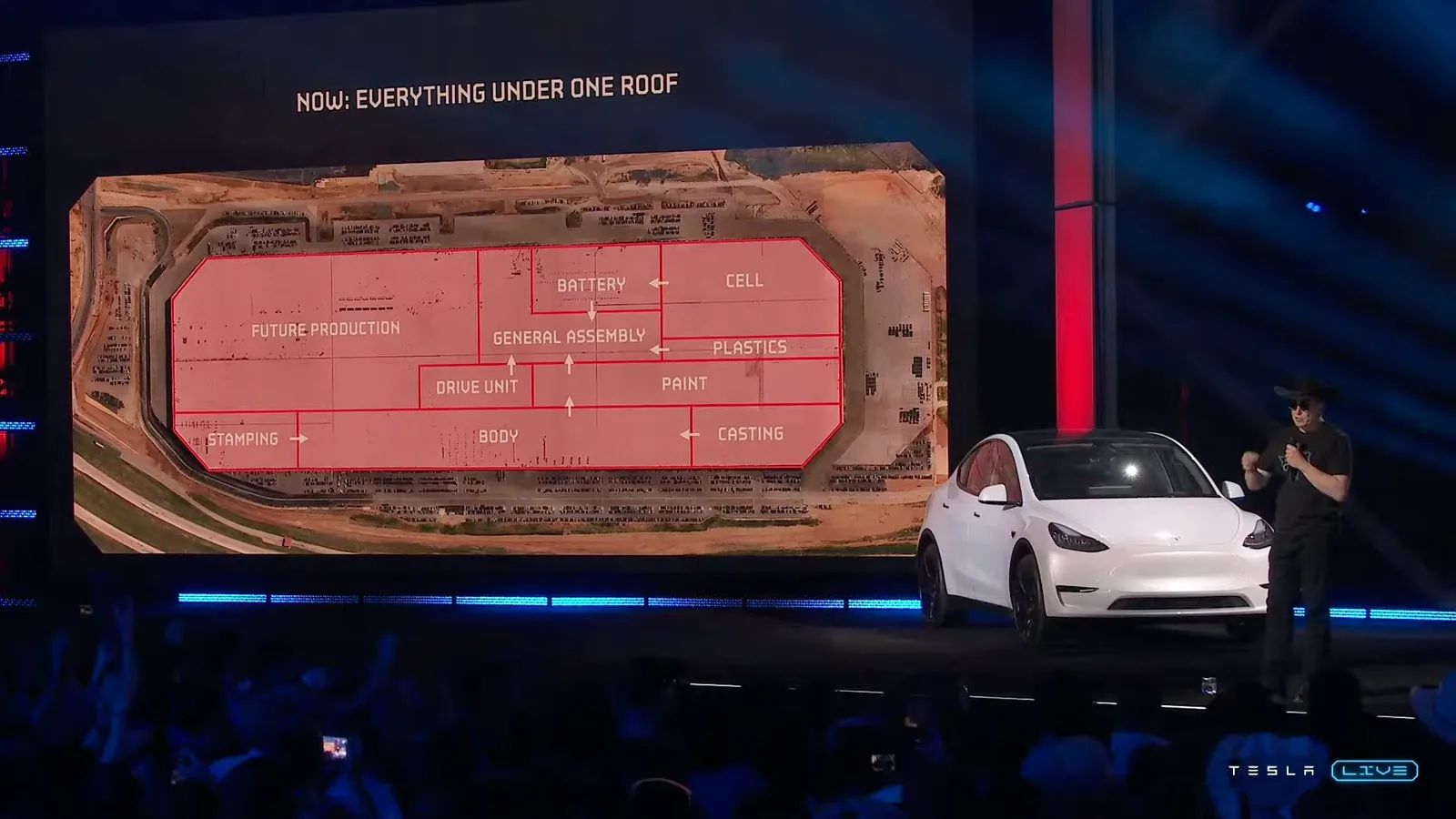
He describes materials becoming battery cells and packs, while large castings form the front and rear sections of the vehicle. The finished car emerges after assembly.
The presentation shows battery-cell production at the factory. Musk says Tesla is making its own cells there and expects the operation to grow.
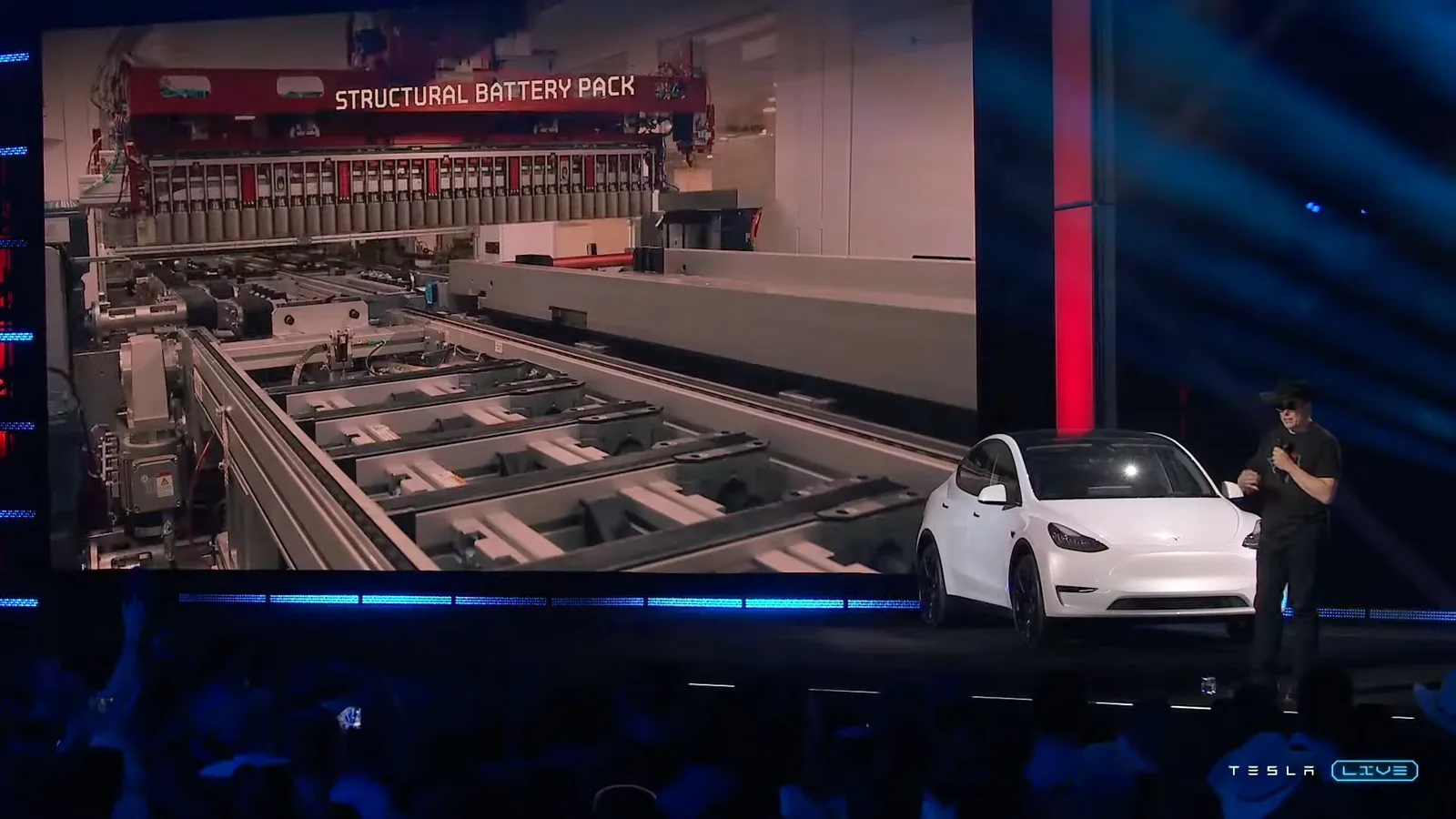
He explains the structural battery pack: the pack forms part of the vehicle structure between the front and rear castings. He expects the architecture to reduce parts and weight.
The factory uses large casting machines to make vehicle body sections. Musk recalls approaching several manufacturers before finding one willing to try making such a machine.
Production targets and future products
Musk gives 2022 targets for Model Y and outlines plans for Cybertruck and Optimus.
In 2022, he sets a target of 500,000 Model Y vehicles a year at the factory and says Cybertruck production is planned there for the following year.
Musk says Tesla had delivered more than one million cars worldwide over the previous twelve months, while noting that this was still a small share of global vehicle production.
He argues that scaling both electric vehicles and stationary energy storage is necessary to affect the transition to sustainable energy.
Musk outlines proposed future products, including a dedicated robotaxi and the Optimus humanoid robot. He predicts a broad role for Optimus and says the team needs to make it safe.
At the April 2022 event, he hopes for initial Optimus production in 2023 and also names Cybertruck, Roadster and Semi among future production plans.
First Texas deliveries and Cybertruck
The presentation ends with deliveries, a Cybertruck appearance and music.
Musk announces the first deliveries of Tesla cars made in Texas, accompanied by music and applause.
A Cybertruck appears on stage. Musk jokes about the earlier window demonstration, and a second speaker joins him to discuss the vehicle.
They describe changes to the prototype, including the absence of conventional door handles. Musk says the team plans to build and deliver Cybertruck from the Texas factory.
Musk apologizes for the delay and thanks the audience. He closes the presentation by inviting people to enjoy the celebration.
The broadcast continues with music and applause through its closing minutes.
Sur la même chaîne
 3:35:00EN
 CNET Highlights· 2 mars 2023Tesla’s 2023 Investor Day: the plan to scale clean energy and carsElon Musk, Zach Kirkhorn, Drew Baglino, Franz von Holzhausen, Lars Moravy, Colin Campbell, Pete Bannon, David Lau, Ashok Elluswamy, Rebecca Tinucci, Karn Budhiraj, Roshan Thomas, Tom Zhu, Mike Snyder, Laurie Shelby, Brandon Ehrhart · TeslaTesla leaders outline a global electrification scenario, a lower-cost vehicle platform and the factories and supply chains needed to scale.
 41:04ENCNET Highlights· 2 mars 2023Tesla’s 2023 investor Q&A puts battery supply and costs in focusElon Musk · TeslaExecutives explain refining, factory localization and dry-electrode scaling, while Musk discusses affordability and a future autonomous fleet.
 8:15ENCNET Highlights· 1 mars 2023Tesla’s 2023 plan estimates the scale of a fully electrified energy systemElon Musk, Drew Baglino · TeslaMusk and Drew Baglino describe a proposed energy transition requiring batteries, renewable generation and manufacturing investment.
 53:25ENCNET Highlights· 1 déc. 2022Neuralink researchers on implant durability, safety and wireless dataElon Musk · NeuralinkAt a 2022 Q&A, the team explained animal results, device-removal concerns and ways to compress brain signals.
 7:20ENCNET Highlights· 1 déc. 2022Neuralink’s 2022 monkey demo selected highlighted keysElon Musk · NeuralinkMusk showed cursor control with an implant, while stressing the monkey was following prompts rather than spelling independently.
 3:39:05ENCNET Highlights· 1 déc. 2022Neuralink’s 2022 update: from neural signals to a working interfaceElon Musk, DJ Seo · NeuralinkEngineers explain cursor decoding, implants and robot-assisted insertion, while separating animal demonstrations from clinical ambitions.