En 30 secondes
A news article about a copper shortage led Idealab founder Bill Gross to test whether AI could apply his method for finding startup ideas. He says an initial run on 7,000 articles produced 32,000 ideas in about an hour for $1,000, including a proposal to bring fuel-price hedging to consumers. A larger run on 17 million documents yielded more than a million filtered ideas, which he is offering free. Gross says ideas still need human judgment, funding and execution, and plans tools and partnerships to help with those steps.
- 1A lifelong idea hunter saw his own skill reproduced at scaleGross says he has started more than 175 companies and uses 31 ways to identify problems and possible enabling technologies. AI applying that method produced ideas faster than he could read them.
- 2Seven thousand articles produced 32,000 ideas in an hourGross says he supplied recent articles and his method to AI; the initial run cost about $1,000 in tokens. A fuel-price hedging proposal stood out after he filtered for accessible, urgent ideas.
- 3The system independently suggested an idea he had patentedWhen asked about expensive solar power, it proposed compact, folding solar arrays. Gross says he had patented a similar idea months earlier.
- 4A larger run turned 17 million documents into over a million ideasThe source material included patents, filings, recall notices, complaints and news. Gross says the system extracted 4.4 million opportunities, generated ideas and filtered them for factors including timing.
- 5The ideas are free, but execution still needs supportGross is releasing the ideas at idealab.ai and wants to connect founders with capital. He says an idea must be shaped by human judgment and followed by execution.
- 6A proposed table breaks execution into 118 business functionsGross wants partners to build agent capabilities for tasks ranging from demand validation to business planning, making it easier to act on an idea without an MBA or cofounder.
À retenir
- Use a repeatable method to connect a specific problem with technologies that could address it.
- Filter a large idea list by constraints such as capital, urgency, founder skills and whether a product is digital.
- Treat generated ideas as starting points that still require human judgment, funding and execution.
- Gross wants to broaden access to entrepreneurship through free ideas, funding connections and tools for business functions.
Lire le texte remanié, chapitre par chapitre
A lifelong idea finder confronts AI
Gross has spent decades turning problems and technologies into companies. He describes the shock of seeing a model reproduce his approach at speed.
When did AI first make you afraid that it could do the thing you do best better than you? I had that moment three months ago. I had never experienced anything quite like it, and I want to explain what came next.
I have been an idea person since I was six. I look at traffic, climate, advertising and other parts of life as problems that might be improved. Over time I distilled my approach into 31 ways to find startup ideas: 20 look for unmet demand, and 11 look for technologies or other enablers that might solve a problem.
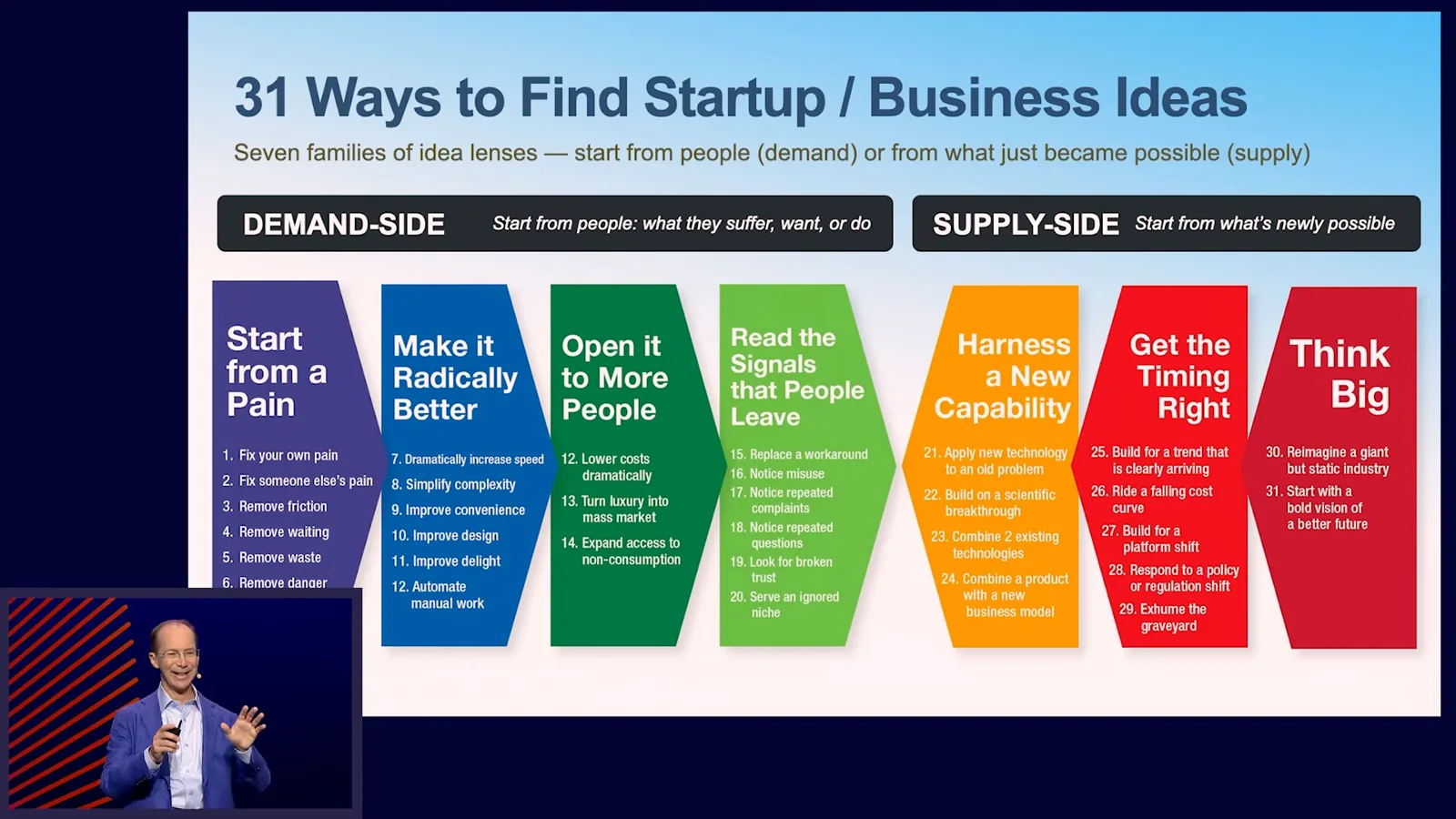
I am 68 and have started more than 175 companies over the years. To find problems beyond my own experience, I read widely across news, patents, science, blogs and videos, looking for both problems people face and possible means of solving them.
An experiment links news to startup ideas
A copper-shortage article prompted Gross to process thousands of news stories with his 31-part method. The results included a consumer fuel-price hedging concept and a folding solar idea.
A Wall Street Journal article about a copper shortage gave me a new thought. The article described rising prices and demand for transformers and electric motors. I did not have a solution, but I realized that many articles contain either a problem statement or an enabling technology.
I wondered whether AI could search for those elements automatically. I gave it about 7,000 articles from the previous few weeks, my 31-part method and instructions to identify the central problem and any technological opportunity. About an hour and $1,000 in tokens later, it produced 32,000 business ideas.
I thought many of the ideas were very good, but there were too many to read individually. So I added filters: ideas a solo founder could pursue, projects starting with less than $100,000, digital-only businesses, and urgent problems affecting many people.
One highly ranked proposal responded to rising fuel prices and the closure of the Strait of Hormuz. It suggested charging consumers $5 a month, recording their current gasoline price, and using the pooled payments to hedge gasoline on the New York Mercantile Exchange, bringing a form of airline-style hedging to consumers.
The system did not invent hedging, but it connected an existing financial practice to a consumer problem in a way I had not thought of. That ability to combine problems and enablers is what impressed me.
I had also spent years working on a cheaper solar concept and patented a compact folding design a few months earlier. When I entered the problem of expensive solar power, the system proposed folding solar arrays on the ground, drawing on the way arrays are folded for deployment in space. It arrived at an idea similar to mine.
I sat stunned for a while: a skill I had worked on my whole life was happening faster than I could read the results. Then I became excited and asked what might happen if I gave the system much more information.
From 17 million documents to a free idea library
Gross expanded the source material and says the system produced more than a million filtered ideas. He wants people to search them by skills and interests and connect to capital.
I supplied millions of patents, including expired ones, SEC filings, product recall notices, complaints from Reddit and Twitter, and years of news stories: 17 million documents in all. Applying the same method produced 4.4 million opportunities and, after generating and filtering ideas for factors such as timing, more than a million business ideas.
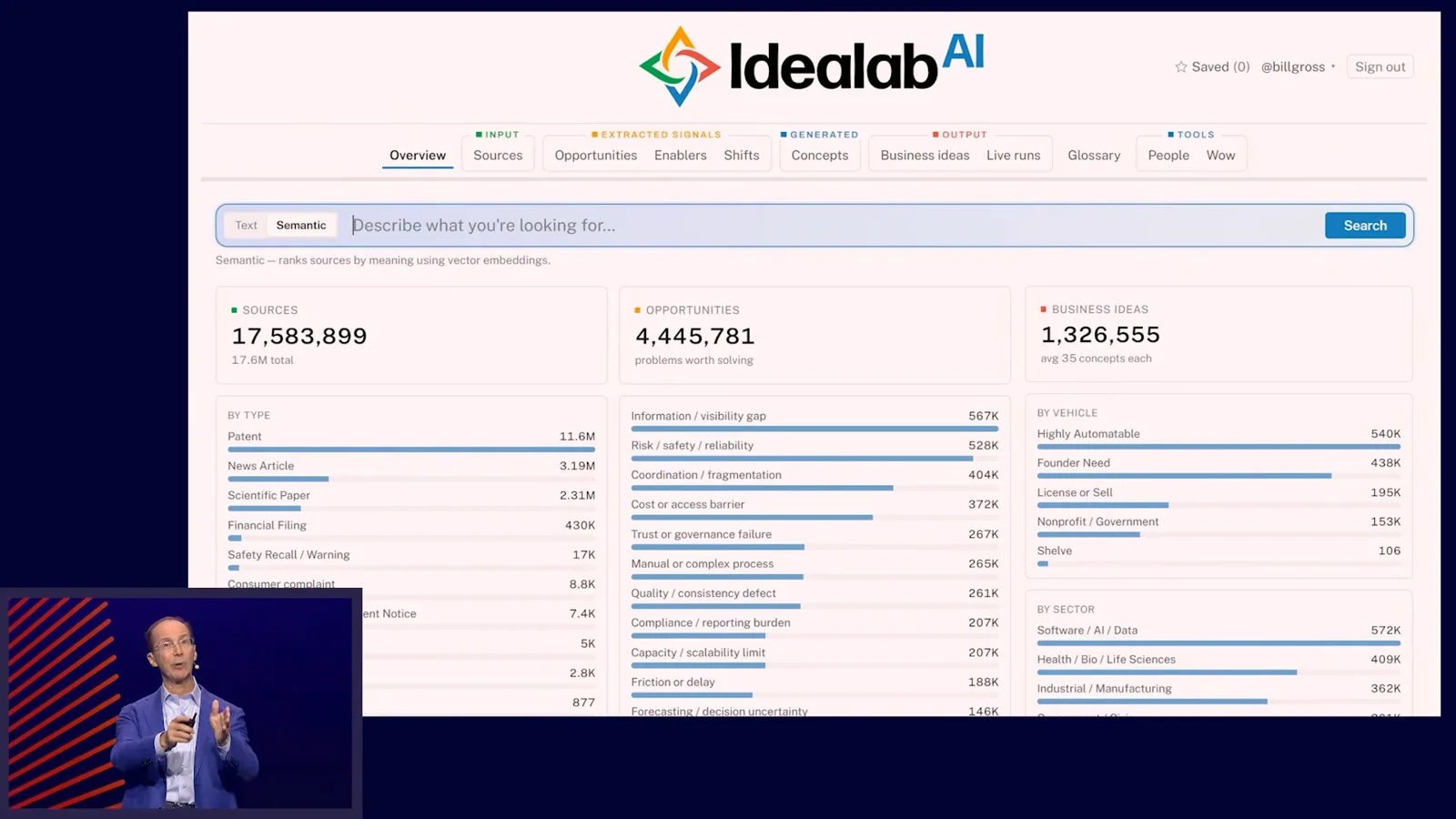
I wanted a tool people could search according to their passions and experience. Someone could enter a profile and ask for ideas matching their skills; a founder with an existing plan could look for similar businesses and use them to improve the plan. Companies could also look for other possible applications of their technology.
I am giving these ideas away for free at idealab.ai, without a paywall. I hope people can find a problem they care about and do something with it. But an idea is only a starting point: human judgment and personal goals will change it, and a business may also need money.
I am working to raise capital or connect people with funding so they can seek support for an idea. I want to make entrepreneurship accessible more widely, including for people who cannot work directly with our team in Pasadena.
Help founders execute beyond the initial idea
Gross proposes a table of 118 business functions and partnerships to build agent tools. He asks institutions and founders to test the early product and help extend its reach.
Execution is the next problem. After decades of working hands-on with Idealab companies, I tried to break down what running a business involves into a periodic table of 118 business functions. The idea is element zero; demand validation comes next, followed by business planning and the other activities.
I want to build agent capabilities for as many of those functions as possible and partner with others on the rest. A person with an idea and passion should be able to use these tools to build a business, even without an MBA or a cofounder. My goal is to narrow the gap between “I wish” and “I can.”
This is only the beginning. We have just released it, and I want to keep improving it over the coming year and the next decade. AI presents risks, including existential risks, but I also see an opportunity if we work to make it useful.
I want people to try the system, find what breaks and tell us what is missing. I am working with colleges and other institutions, and I hope others will help bring it to places around the world where people have the passion to build but need access to opportunities.
A technology incubator in Cairo called it a “hope machine for Egypt,” because so many young people want to do something and could look for ideas matching their interests. My own crisis ended with a conviction: the best use of the thing I love is to give it away so more people can act on problems.
Sur la même chaîne
 23:56EN
 Masters of Scale· 12 nov. 2026Podcast · 2 voixWalmart’s CEO wants faster change without losing the human connectionInvité : John Furner · Anime : Jeff BermanJohn Furner discusses agent shopping profiles, frontline tools and the leadership work needed to move a large retailer.
 21:35ENMasters of Scale· 11 nov. 2026Podcast · 2 voixEric Ries: Why successful companies lose the purpose that made them workInvité : Eric Ries · Anime : Krista TippettRies argues that pressure from capital can erode a company’s mission, and that trust deserves a place in business decisions.
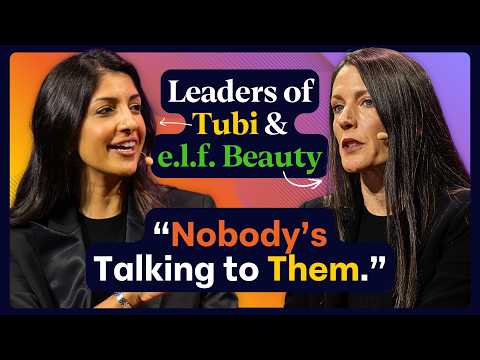 23:03ENMasters of Scale· 10 nov. 2026Podcast · 3 voixTubi and e.l.f. grew by serving audiences incumbents overlookedInvité : Anjali Sud, Kory Marchisotto · Anime : Bob SafianAnjali Sud and Kory Marchisotto explain free streaming, affordable beauty and direct feedback from fans.
 27:58ENMasters of Scale· 9 nov. 2026Podcast · 3 voixShould AI agents get your personal data? A debate over trustInvité : Meredith Whittaker, Neil Chilson · Anime : Jeff BermanSignal’s Meredith Whittaker warns that broad agent access can expose others; Neil Chilson argues for limited, verified use.
 25:32ENMasters of Scale· 5 nov. 2026Podcast · 2 voixDemis Hassabis warns against AI self-improvement without human reviewInvité : Demis Hassabis · Anime : Reid HoffmanThe Google DeepMind co-founder calls for stronger engineering, shared safety standards and broader debate about AI consciousness.
 18:26ENMasters of Scale· 4 nov. 2026Podcast · 3 voixRana el Kaliouby leaves her dating spreadsheet behindInvité : Rana el Kaliouby, Francesca Hogi · Anime : Jeff BermanAn AI scientist and a matchmaker discuss how to seek connection intentionally without reducing people to a checklist.