En 30 secondes
Theo discusses the value of Apple unified memory, local model inference and storage speed, then examines memory prices and launch-era Mac buying options. His examples and preferences are tied to June 2026; supplier rumors and future price predictions remain uncertain.
- 1Shared memory changes the comparisonA CPU and integrated GPU can share a large memory pool, which can help fit local models.
- 2A local model demonstrationTheo runs a 60 GB model on his high-memory MacBook; the result is specific to that setup.
- 3Fast sequential storageHis disk test shows high sequential throughput for his video workload.
- 4Memory price pressureTheo shows a DDR5 price chart and discusses demand, while DRAM and NAND are distinct technologies.
- 5Refurbished optionsHe compares refurbished prices and notes limitations; stock and prices are historical.
À retenir
- Unified memory can make larger local models fit, though performance depends on the model and configuration.
- A discrete GPU can be faster when a model fits its available video memory.
- DRAM and NAND flash are different technologies even when both face supply pressure.
- Prices, refurbished inventory and discounts shown in the video are historical snapshots.
- Choose hardware for the actual workload, sustained performance and current price.
Lire le texte remanié, chapitre par chapitre
A changed price calculation
Theo discusses Mac price increases and sets out the questions for buyers.
Apple computers once seemed overpriced against PCs with similar specifications. With rising memory prices and Apple silicon, I thought some Macs had become compelling values, including the M1 MacBook Air and M5 Mac mini. Now Apple has raised prices too, changing that calculation.
My fully configured M5 Max MacBook cost me around $7,000 at launch; I say the equivalent configuration now approaches $10,000. I want to explain why these machines appealed to me, what rising memory and storage costs might mean, and what options I saw at the time. Prices and availability are snapshots from June 2026.
Unified memory and local models
He demonstrates a large model on a Mac and compares shared-memory alternatives.
A Mac's specifications aren't directly equivalent to those of a conventional PC. Its unified memory can be shared by the CPU and GPU, whereas a desktop with a discrete GPU typically has separate system RAM and video memory. This matters when a local AI model needs more memory than a graphics card can hold.
A small enough model can run very fast on my Nvidia GPUs. Once a model exceeds the GPU's available memory, offloading can slow inference substantially. My MacBook's larger shared memory lets it fit models that don't fit entirely in the 32 GB on a 5090, although capacity alone doesn't determine performance.
I load GPT-OSS-120B in LM Studio, describing this version as about 60 GB, and ask it to write poems. I observe nearly 100 tokens per second on this machine. That is a demonstration with a particular model, configuration and workload, not a general speed guarantee for 120-billion-parameter models.
For models that fit a discrete GPU, I prefer using the GPU. For larger local models, a high-memory Mac can be appealing, especially if you want offline inference. I mention DeepSeek models and tools built by Redis creator antirez, while recognizing that local options do not necessarily match frontier cloud models.
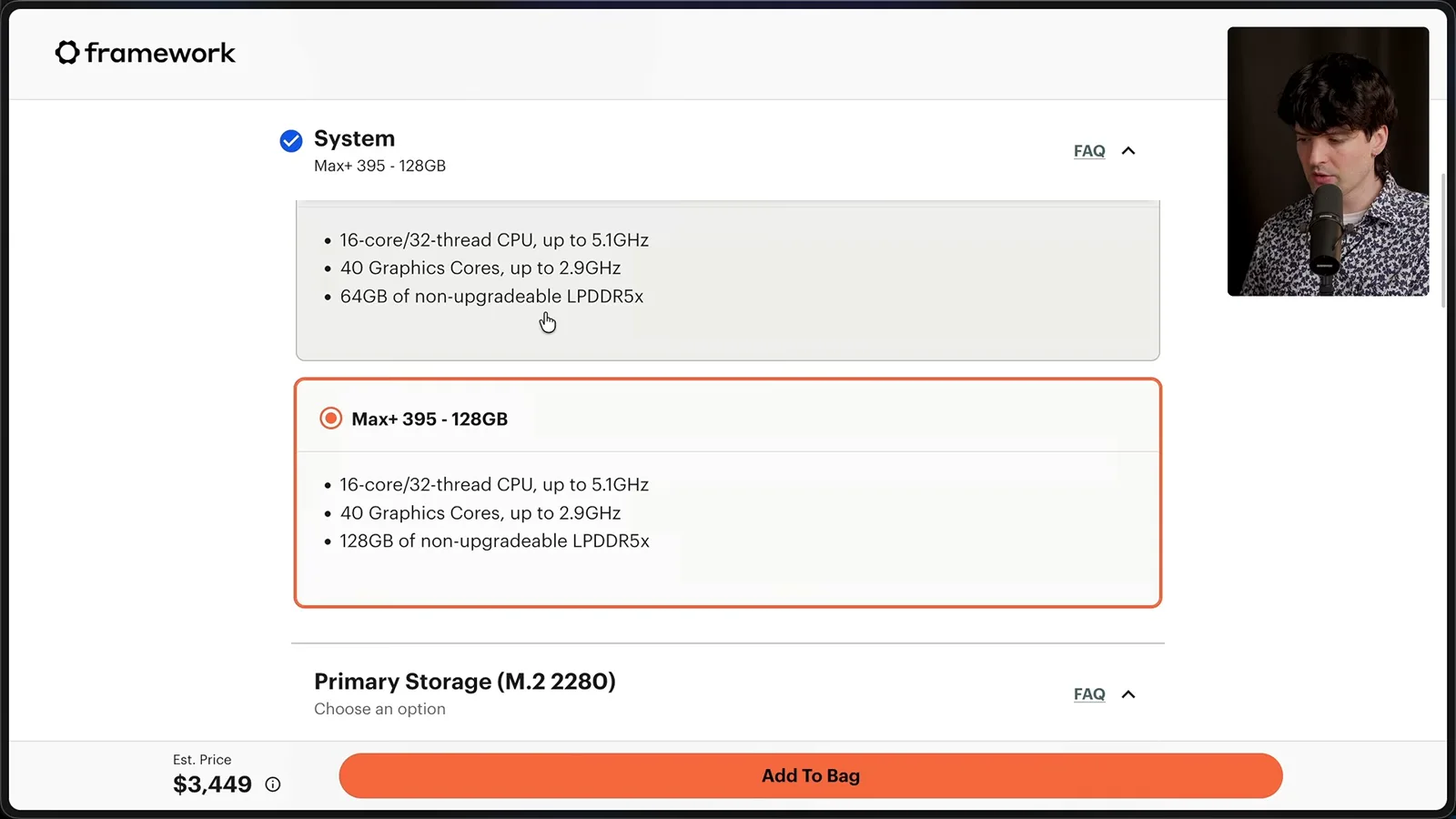
There are alternatives with shared memory. Framework Desktop uses an AMD Strix-family chip and LPDDR5X, and at recording I saw a 128 GB configuration for about $3,500 or a 64 GB configuration for about $2,000, excluding storage. A refurbished 64 GB unit was around $1,700. Those listings are historical and may no longer be available.
I also have an Nvidia DGX Spark with 128 GB of memory, but I don't like it as much. In my view its main reason to buy is needing CUDA with a lot of memory without moving to a much larger accelerator. These are my personal preferences, not an exhaustive hardware comparison.
Storage speed and supply pressure
A disk benchmark and memory price chart illustrate his experience; he discusses possible supply pressures.
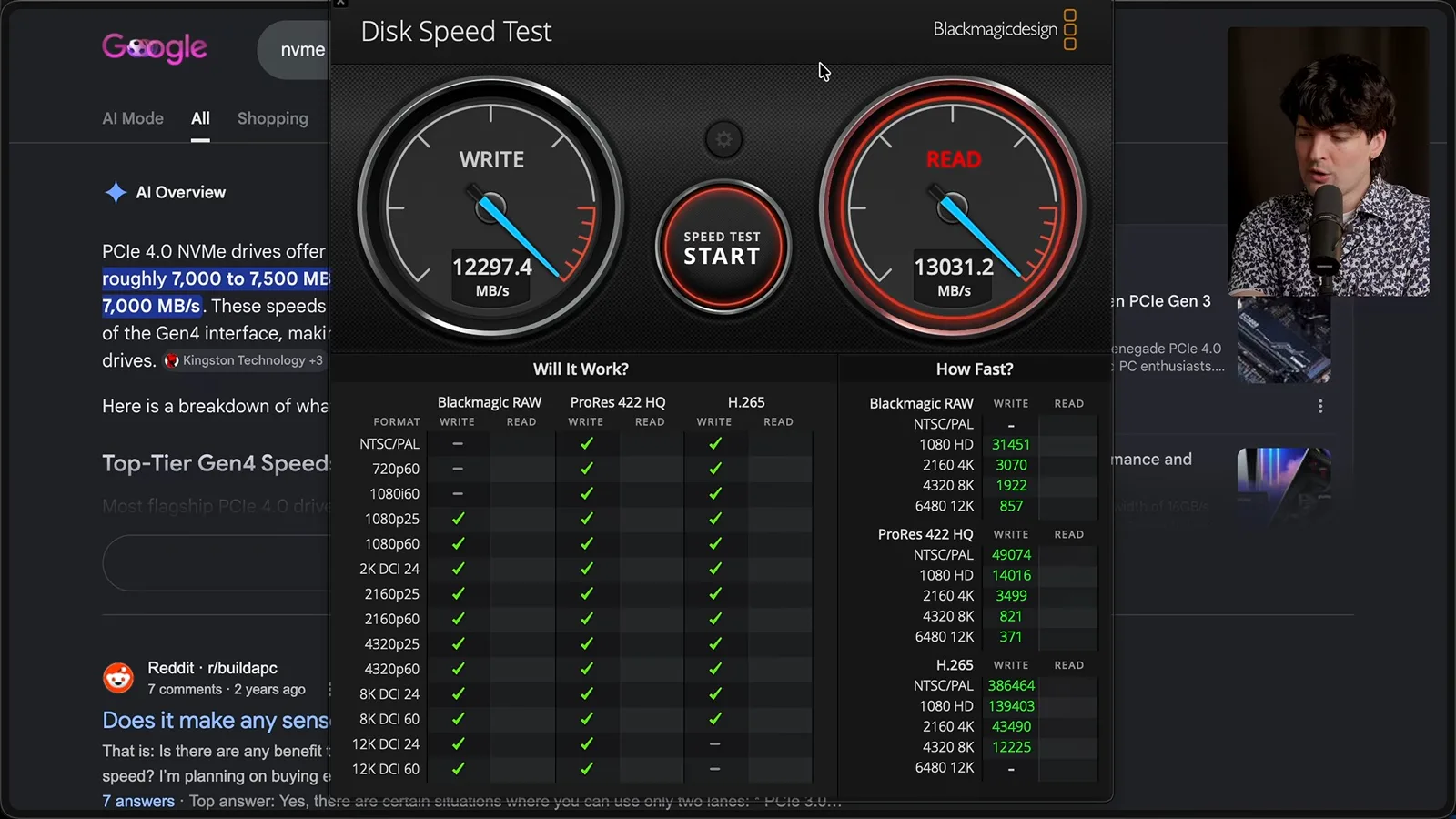
Storage performance is another reason I valued my Mac. In Blackmagic Disk Speed Test, I show sequential writes above 12,000 MB/s, useful to me when editing high-quality video. That number reflects the particular machine and benchmark; it doesn't imply all disk operations or all Mac configurations perform similarly.
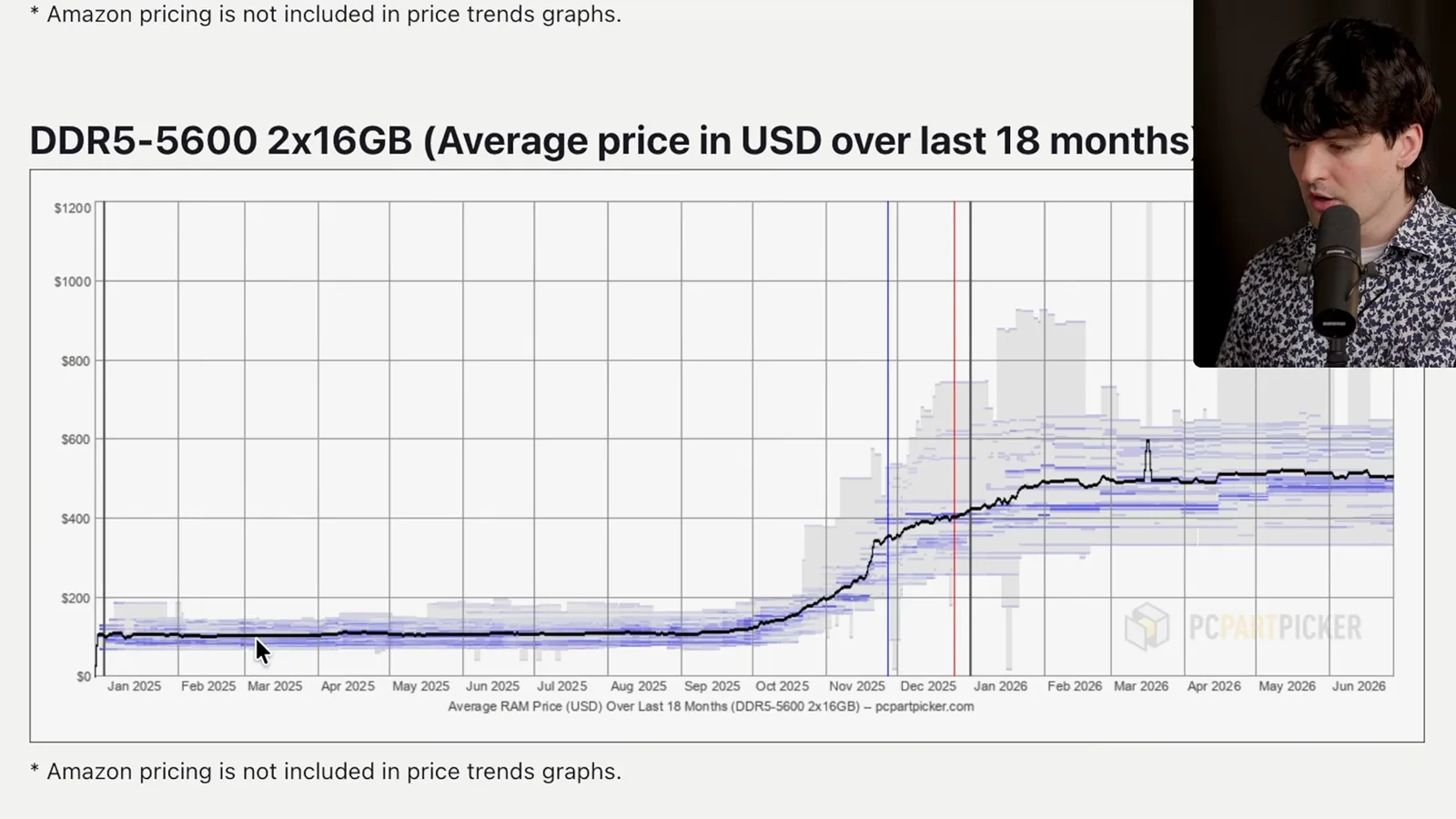
I show a PCPartPicker chart where a 32 GB DDR5 kit rose from a little over $100 to around $500–$600. I attribute pressure on memory and storage to AI infrastructure demand and constrained supply. GPU memory is DRAM, while SSDs use NAND flash; they are distinct technologies, so the market link should not be reduced to them being the same chip.
Apple supply negotiations
Theo distinguishes his explanation of contracts from an unverified supplier rumor.
I think Apple's supply agreements helped it keep retail prices stable for a time while competitors' prices rose, and that renegotiation is now changing the economics. I recount a rumor about Samsung opening negotiations at a 100% increase and Apple accepting it; I explicitly cannot verify that story.
I discuss a report that Apple was exploring memory sourcing from the Chinese supplier CXMT. The article shown says buying from CXMT could be legal but carries reputational risks, so my characterization of the legal restrictions should not be treated as a definitive statement of the rules. The report and policy situation are time-sensitive.
Choosing a Mac
He compares historical prices for lighter laptops and high-memory refurbished machines.
For lighter work, I compare the MacBook Neo with discounted older MacBook Air models. I say the Neo's starting price had moved from $600 to $700, and recall an M3 Air with 16 GB RAM and 512 GB storage on sale for $800. I prefer the Air's screen and input devices, though both are fanless and may throttle under sustained load.
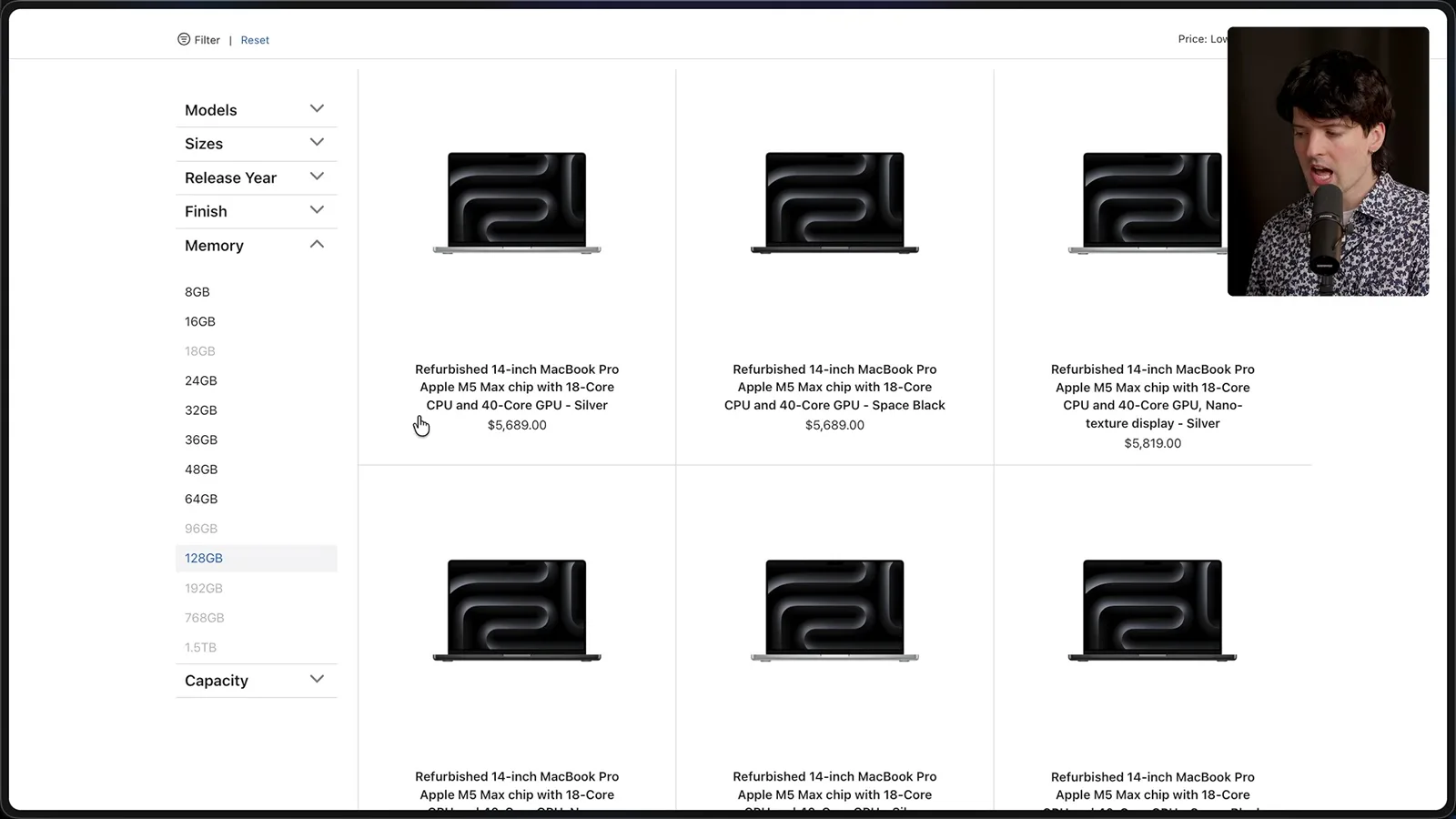
For higher-memory machines I look at Apple's refurbished store. At the time I saw a 14-inch M5 Max with 128 GB RAM and 2 TB storage for around $5,800, including the nano-texture option I prefer. Refurbished inventory and pricing change, and I point out country, financing and discount limitations.
I bought another MacBook as a backup because my main machine is central to my work and a repair can interrupt it. That's a personal risk calculation, not a reason everyone needs a spare. I prefer the Pro's 120 Hz display and fan for sustained work, and a high-memory machine can later serve models over a home network.
For people running many containers rather than large local models, I also discuss refurbished 64 GB configurations, with prices around $3,000 to $3,700 in the listings I saw. I prefer a 14-inch laptop with an external monitor to the larger 16-inch model. I wasn't finding attractive Mac mini or Studio deals then.
A base Mac mini can run some agent work, but my own unit often reaches high CPU load and temperature. My view at the time is that the market may get worse before it improves. The right choice still depends on the workload, actual current prices and whether local inference is important to you.
Sur la même chaîne
 38:47EN
 Theo - t3․gg· 28 oct. 2026Theo’s Long-Running Agent Experiments: Verification, Compute and CostTheo Browne · Ping LabsA skateboard game and two compiler projects show how repeated checks and flexible compute can sustain agent work—and how expensive those loops can become.
 36:07ENTheo - t3․gg· 27 oct. 2026Theo on Token Costs, Coding Agents, and the Price of AI CapabilityTheo Browne · Ping LabsA viral estimate of Lauren's AI spending prompts a closer look at cache pricing, benchmarks, and the changing work of coding agents.
 30:37ENTheo - t3․gg· 26 oct. 2026Theo’s Three Skills for Reviewing and Shipping with Coding AgentsTheo Browne · Ping LabsHow sol-loop, full-send and full-stop encode review, verification and different levels of merge authority.
 0:43ENTheo - t3․gg· 23 oct. 2026Theo Distinguishes Security Vulnerabilities from Active AttacksTheo Browne · Ping LabsA short explanation of why disclosed software flaws and reported attacks are different kinds of security news.
 29:22ENTheo - t3․gg· 22 oct. 2026Theo on Security Vulnerabilities, Stolen API Keys and AITheo Browne · Ping LabsA look at the gap between vulnerability disclosure and patching, and a speculative account of why stolen inference keys may be valuable.
 31:13ENTheo - t3․gg· 20 oct. 2026Theo on Why Smarter Models Help More Than DevelopersTheo Browne · Ping LabsFrom game modifications to compiler experiments, Theo revisits his assumptions about who benefits from more capable AI.