En 30 secondes
In May 2024, Matthew Berman discusses an OpenAI post on securing advanced AI infrastructure, including GPU attestation, isolation, data-center security, audits, cyber defense and resilience. He favors open weights and worries about restrictive standards; his predictions about universal hardware control are not established by the mechanisms he describes.
- 1Protecting model weightsOpenAI’s post treats weights as assets that may need protection; Berman argues for open access.
- 2GPU attestationThe proposal describes attestation and encryption for specific devices. Berman fears wider hardware controls, but that outcome is not established by the description.
- 3Isolation and data centersBerman accepts network isolation and physical security for sensitive systems while disputing the premise of private model weights.
- 4Defense in depthHe agrees that security controls need testing, redundancy and continuing research.
À retenir
- Model weights and infrastructure can be targets of attacks, whether developers choose to release weights or keep them private.
- GPU attestation and device-specific encryption are proposed security mechanisms; they do not by themselves establish universal GPU tracking.
- Berman supports open weights and worries that mandatory standards could disadvantage small competitors.
- He agrees with protecting sensitive systems, applying AI to cyber defense and testing security controls.
Lire le texte remanié, chapitre par chapitre
Threats and model weights
Berman introduces the security proposal and explains his disagreement over private model weights.
In May 2024, Matthew Berman reviews an OpenAI post proposing ways to secure advanced AI infrastructure. He favors openly available model weights and argues that the post reflects a different approach. His objections are commentary on the proposal, not evidence of a universal GPU-tracking requirement.
The post describes sophisticated cyber threats and treats model weights as an asset that developers may want to protect. Berman disagrees with prioritizing secrecy of weights and contrasts it with his preference for open-weight models.
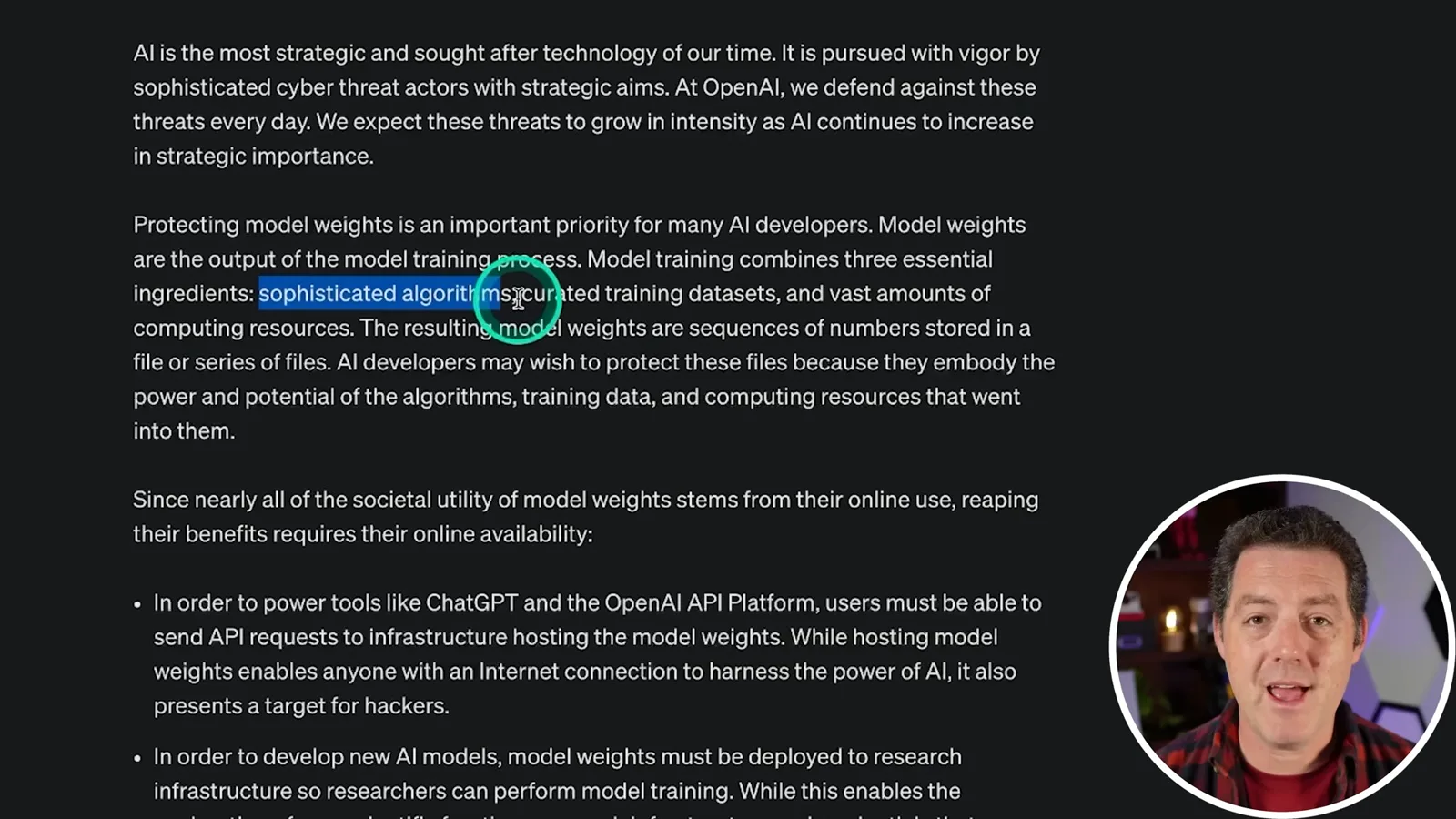
He explains the post’s account of model training: algorithms, curated data and compute produce weights stored as files. He emphasizes the costs of high-quality or proprietary data and large-scale computing, while offering his own view that algorithmic progress will be incremental.
The post identifies online service and research infrastructure as possible attack surfaces: weights must be available for models to be used or developed. Berman accepts the existence of security risks but disagrees with keeping weights private as a response.
Standards and trusted hardware
He raises a regulatory-capture concern and discusses the proposed use of GPU attestation and encryption.
Berman worries that voluntary security commitments could become mandatory standards and create burdens for smaller competitors. He describes this as a risk of regulatory capture. This is his concern and prediction; the fact that a company publishes security proposals does not itself establish that such rules exist.
The first proposed area is trusted computing for AI accelerators. The post describes cryptographic attestation of GPU authenticity and integrity, keeping weights encrypted until loaded, and encrypting weights or inference data for particular devices or groups.
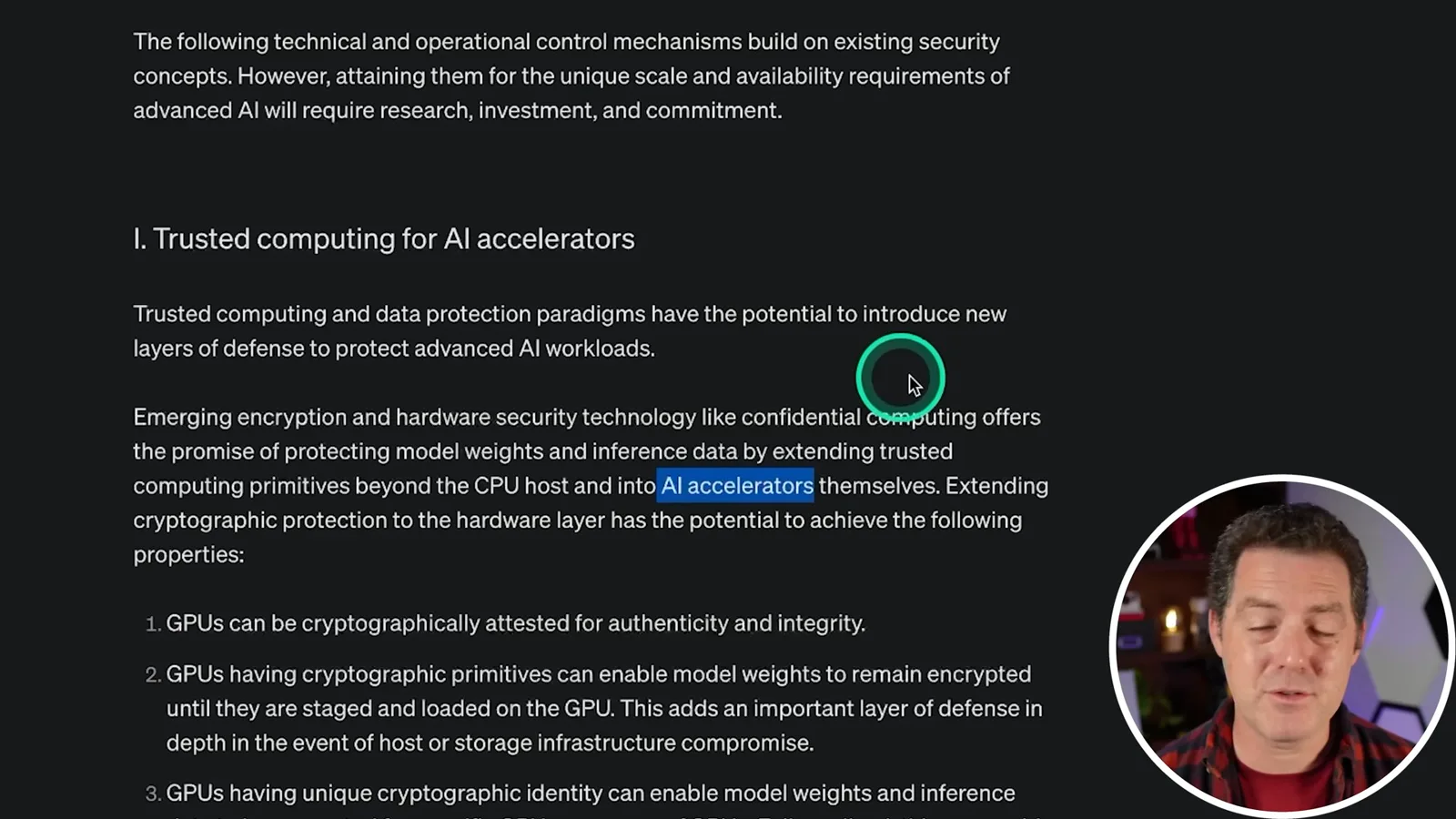
Berman interprets device identity and authorization as potentially leading to outside control over hardware, and asks who would decide which devices are authorized. He says he is not a cryptography expert and may be misunderstanding the proposal. The described attestation and encryption mechanisms do not by themselves demonstrate a requirement to register or track all GPUs.
Isolation, physical security and audits
The review covers networks, tenant boundaries, data-center security and compliance.
The second area is network and tenant isolation. Berman explains the idea of separating sensitive workloads from untrusted networks and accepts that isolation can make sense for sensitive systems. He objects to treating model weights themselves as confidential by default.
The third area is operational and physical security for data centers, including protection against insider threats. Berman agrees with protecting sensitive data and facilities, while maintaining his disagreement about whether weights should be kept private.
The fourth area is AI-specific audit and compliance. The post refers to existing security standards and anticipates that additional AI-specific requirements could develop. Berman supports security but worries about compliance expectations reinforcing closed access and disadvantaging smaller organizations.
Cyber defense and resilience
Berman discusses AI-assisted defense, open models and the importance of testing and layered security.
The fifth area is AI for cyber defense. The post proposes using models to help security teams analyze signals and reduce manual work. Berman agrees with applying AI to defense, while again expressing concern about who can afford the resulting security practices.
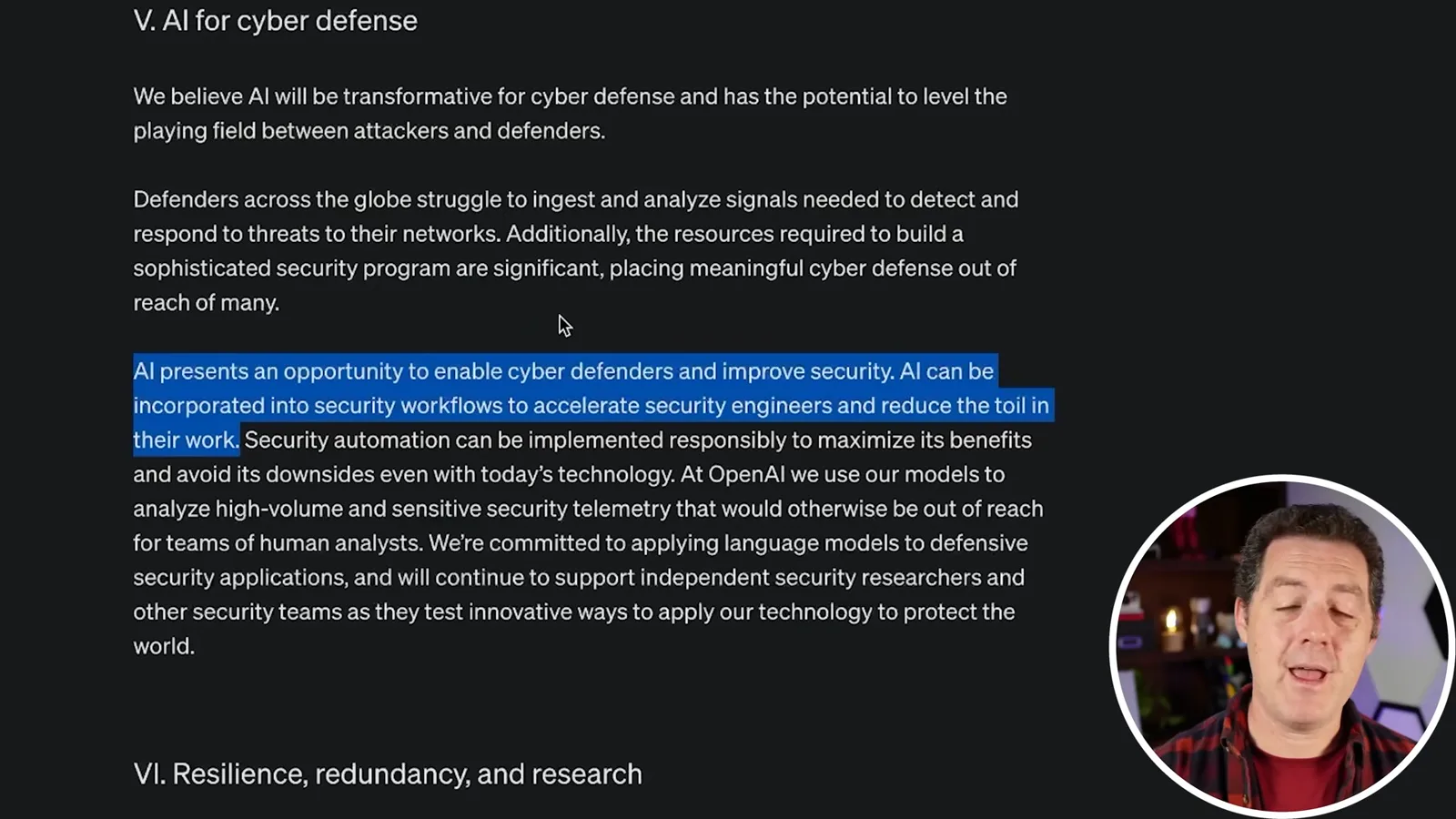
Berman argues that widely available models would benefit defenders as well as attackers. His confidence rests on his beliefs about the relative resources of good and bad actors and the pace of AI progress; these are predictions rather than conclusions proven in the video.
The final area is resilience, redundancy and research. Berman agrees with testing controls, studying how they can be bypassed and using defense in depth, since no security system is flawless.
He closes by reaffirming his support for open weights and praising Meta’s open-model efforts at the time. The debate he raises is about the tradeoffs between protecting particular model deployments and distributing model weights broadly.
Sur la même chaîne
 14:45EN
 Matthew Berman· 29 oct. 2026Matthew Berman Examines Google’s Gemini 4 Carbon AnnouncementMatthew Berman · Forward FutureMatthew Berman reviews Google’s reported benchmark results, staged rollout and pricing for Gemini 4 Carbon, while noting he has not yet used the model.
 21:11ENMatthew Berman· 28 oct. 2026Matthew Berman tests DeepSeek V4.1 Flash: coding, vision and local appsMatthew Berman · Forward FutureA hands-on tour of visual coding, image reasoning, local applications and provider economics reveals both impressive results and visible flaws.
 34:21ENMatthew Berman· 27 oct. 2026Matthew Berman Examines Anthropic’s IPO Filing, AI Growth and GovernanceMatthew Berman, Sam Altman · Forward FutureThe presenter reviews the S-1’s financial metrics, compute strategy and voting structure while questioning the tension between rapid AI development and safety.
 0:26ENMatthew Berman· 25 oct. 2026Sam Altman on Human Values and Problem-Solving in an AI WorldSam Altman · OpenAIIn a short interview excerpt, Altman considers the enjoyment of solving hard problems and the human role in interpreting results.
 0:36ENMatthew Berman· 25 oct. 2026Kimi K3.1 and a Rubik’s Cube Solver DemonstrationMatthew Berman · Forward FutureMatthew Berman shows a scrambled virtual cube being solved and gives the Kimi K3.1 test a favorable assessment.
 0:21ENMatthew Berman· 24 oct. 2026An AI-Generated Kimi Benchmark Chart Used Invented ScoresMatthew Berman · Forward FutureMatthew Berman asks for a graph of Kimi K3.1 Pro benchmarks, then discovers that the displayed figures are illustrative placeholders.