En 30 secondes
Matthew Berman examines The New York Times’ December 2023 lawsuit against OpenAI and Microsoft, including alleged training on articles, generated reproductions and false attribution. The complaint requests damages and destruction of certain models and datasets, but a request is not a court order; OpenAI disputes the claims. Berman also predicts litigation over Midjourney imagery, and Disney and Universal later filed a separate lawsuit.
- 1A remedy was requested, not orderedThe Times asks for destruction of models and training sets incorporating its works, along with damages and other relief.
- 2Allegations of copying and substitutionThe complaint alleges training use and generated outputs threaten subscriptions, licensing and other revenue.
- 3OpenAI disputes the claimsOpenAI argues that training can be fair use and disputes the Times’ characterization of output examples.
- 4The 22% correctionThe figure concerns the complete WebText2 corpus, not the Times’ share of GPT-3 training tokens.
- 5Reproduction and false attributionThe Times presents output examples and alleges false attribution; their significance and causes remain disputed.
- 6A later Midjourney caseDisney and Universal separately filed a copyright complaint in 2025; that filing is not a judgment.
À retenir
- The Times’ requested destruction of certain models and training sets is a requested remedy, not an order to reset ChatGPT.
- The complaint alleges unauthorized use and market harm; OpenAI disputes the claims and argues for fair use.
- Fair use depends on the facts and multiple statutory factors, not simply whether a work is described as transformative.
- The 22% GPT-3 training weight cited in the complaint refers to all of WebText2, not to New York Times articles alone.
- Retrieval and memorization are distinct possible causes of similar outputs, and particular examples require evidence.
- Disney and Universal filed a separate Midjourney lawsuit in 2025; filing does not establish liability.
Lire le texte remanié, chapitre par chapitre
The complaint and fair use
Berman introduces the Times lawsuit and discusses fair use and a clip featuring Elon Musk. The complaint asks for remedies, including destruction of certain materials, but does not itself order them.
The New York Times sued OpenAI and Microsoft in December 2023, alleging that their AI products used the newspaper's copyrighted work without permission and could reproduce or misattribute its content. In this video I examine the complaint and the implications for generative AI. The assertions in a complaint are allegations, not findings that the defendants broke the law.
The title asks whether ChatGPT must be reset. The [Times complaint](https://nytco-assets.nytimes.com/2023/12/NYT_Complaint_Dec2023.pdf) asks the court to order destruction of models and training sets incorporating its works, alongside damages and other relief. That is a requested remedy, not a court order requiring a reset.
Fair use is a U.S. legal doctrine that can permit some uses of copyrighted works without permission. Whether a particular use qualifies is a fact-specific legal question involving several statutory factors, including purpose, the nature and amount of the work used, and market effects. Calling a use transformative alone does not automatically decide the case.
I discuss reaction videos as an analogy for creating something new from existing material. The analogy helps illustrate the dispute, but reaction videos are not automatically fair use: the legal analysis depends on the particular use. Training, retrieval and reproduction of articles also raise distinct questions.
In an interview clip, Elon Musk asserts that AI systems are trained on copyrighted material and predicts that more advanced AI will arrive before the lawsuits are resolved. These are his claims and predictions, not proof of this case's allegations or of an AGI timeline. An unidentified interviewer asks about copyright in the clip.
Journalism, training and market harm
The complaint describes investment in journalism and alleges unauthorized copying and substitution. Berman weighs creator concerns against the potential of AI, while the parties dispute the claims.
The complaint describes the Times' investment in journalism, reporting and editing. I agree that producing original journalism takes resources. Copyright protection concerns qualifying expression, however, and effort by itself does not establish infringement; the legal dispute turns on the uses and defenses at issue.
The Times alleges that the defendants copied millions of its articles to build AI products and that outputs can compete with its journalism. It argues that extensive summaries or reproductions could reduce subscriptions, advertising, licensing and affiliate revenue. Those are the newspaper's allegations, not a court's conclusion.
The Times also alleges that its content was particularly valuable in training datasets. That assertion should be distinguished from evidence about a specific model and its actual training data. The complaint draws on previously disclosed datasets and examples to make its case.
Microsoft is also a defendant. The complaint describes Microsoft's investment, computing infrastructure, access to OpenAI models and Bing-related products. It alleges that retrieval and generation can present Times content in longer forms than ordinary search snippets, potentially reducing visits to the source.
The Times contrasts this with traditional search results that link readers to publishers. I can see the concern as a creator whose work has been copied, while also valuing technological progress. Whether particular uses compete with a publication and how fair-use factors apply are disputed questions, not automatically resolved by that contrast.
The complaint connects Microsoft's AI rollout with a large increase in its market capitalization. I doubt any such increase can be attributed exclusively to OpenAI, though I thought the relationship contributed. A market-capitalization change is not a measurement of damages caused by the alleged copying.
I say Microsoft essentially owned half of OpenAI, but the details of its economic investment and governance were not equivalent to a verified ordinary 50% ownership stake. The Times describes a close commercial and technical partnership; the precise financial arrangements were not established by my comment.
The Times says it objected to the use of its work and attempted to negotiate before filing. It characterizes the defendants' position as fair use based on transformation, while arguing that their products substitute for the original articles. These competing positions are part of the dispute.
OpenAI later [responded](https://openai.com/index/openai-and-journalism/) that training can be fair use, disputed the Times' characterization and argued that some examples relied on manipulated prompts. That response is the company's position, not a judicial determination. Both the training and output questions require examination of evidence.
The complaint emphasizes the resources involved in the Times' reporting and its transition to digital subscriptions. It argues that if publishers cannot protect and monetize their journalism, their ability to produce it will suffer. I consider that concern important while recognizing it is the plaintiff's account of potential market harm.
The Times describes seeking a negotiated license and cites examples of fees for particular uses of articles. A historical photocopy or website-posting price is not automatically the correct price for training a model; licensing depends on the rights and uses involved. My comment that a company can afford a fee does not decide whether a fee is legally required.
OpenAI, Microsoft and training data
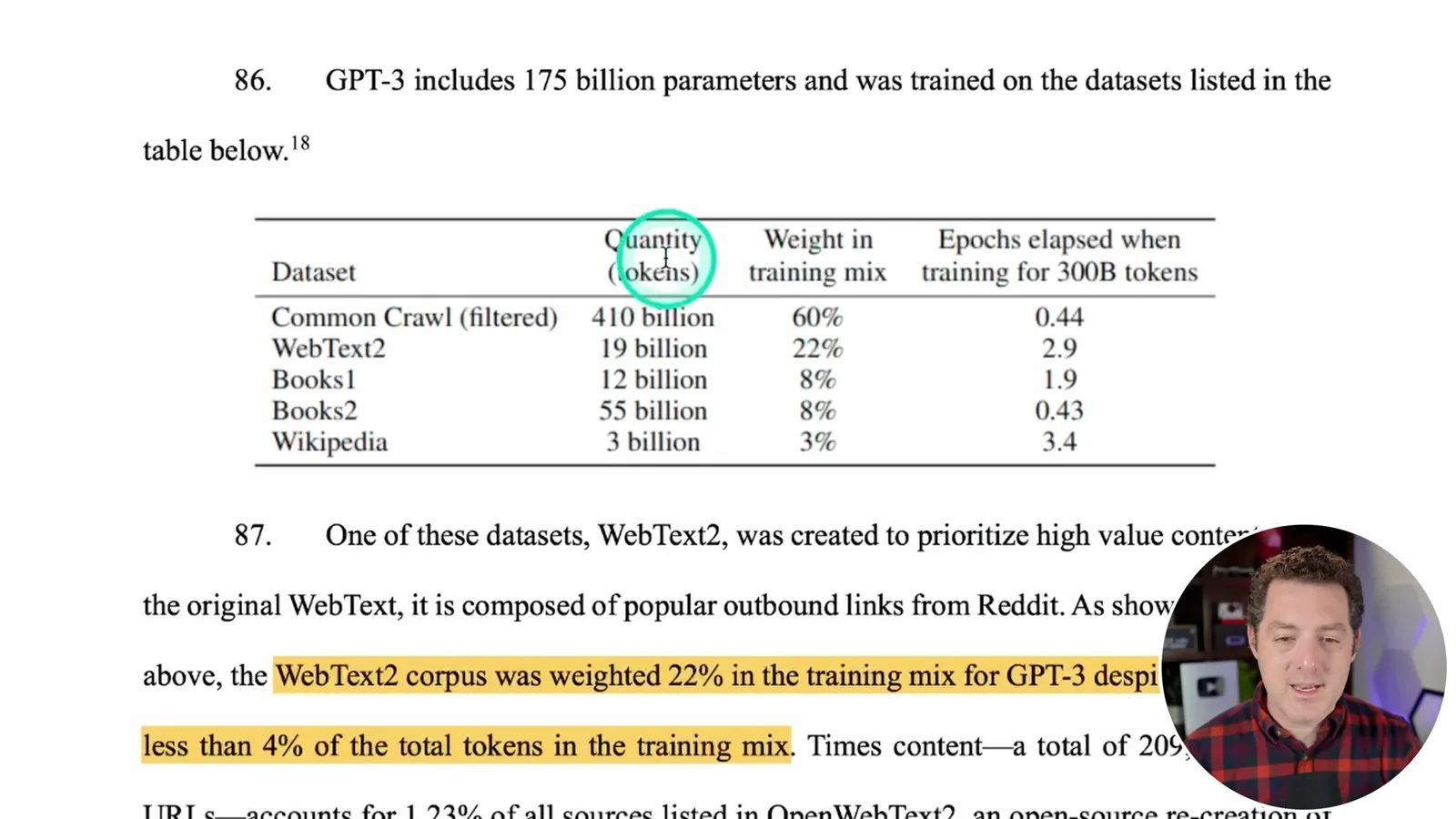
Berman discusses organizational changes, infrastructure and training corpora. The 22% weight refers to WebText2 as a whole, not Times articles.
The complaint criticizes OpenAI's move from an exclusively nonprofit structure to a commercial business and its reduced disclosure about newer models. Those are historical allegations and criticisms in the pleading. They are separate from a finding that particular uses of Times work infringed copyright.
The complaint describes Microsoft's role in infrastructure and commercialization, including the large computing system used for training. It alleges that Microsoft knew of and contributed to the challenged uses. Providing infrastructure alone does not establish liability; the legal claims and factual record must be assessed.
I discuss the GPT-3 training mixture and say Times articles account for 22% of its weight. That is incorrect: the complaint says the entire WebText2 corpus had a 22% weight in the training mix, not the Times portion. It estimates Times URLs were 1.23% of sources in OpenWebText2, an independent recreation; that is not a direct measurement of the Times' share of GPT-3 training tokens.
The Times alleges that Microsoft had knowledge of the training corpora and the ability to prevent particular uses because it controlled infrastructure. Those are contested allegations of responsibility, not proof that Microsoft selected every work or could simply remove each one from a completed model.
Outputs, attribution and legal allegations
The Times presents examples of reproduction and false attribution, and alleges removal of copyright information. The account distinguishes allegations from findings and retrieval from memorization.
The complaint presents side-by-side examples of generated text and Times articles, including long matching passages and prompts seeking additional paragraphs. I find the examples striking. Their legal significance depends on the prompts, outputs, context and other evidence, all of which the parties dispute.
The Times also alleges that a retrieval or grounding process can fetch article text and use it in a generated answer, distinct from material a model may reproduce from its parameters. Those are different mechanisms. A single example does not by itself prove which mechanism produced an answer or that every user receives the same result.
The pleading mentions reported disagreements involving Sam Altman and former board member Helen Toner. I speculate about Altman's motives and knowledge of the coming lawsuit, but there is no evidence in the video establishing that speculation. A reported board dispute does not prove copyright infringement or intent in this case.
The Times alleges that AI systems falsely attributed fabricated content to it, including product recommendations and a health-related article it says never existed. If true, false attribution could confuse readers and affect reputation; the examples are claims in the complaint, not a basis for accepting the fabricated health statement.
The complaint also describes growth in Bing usage and paid Microsoft offerings in arguing that the partnership had commercial value. Those historical figures do not isolate the effect of one model or one publisher's content. I discuss them as the Times' argument rather than a causal damages calculation.
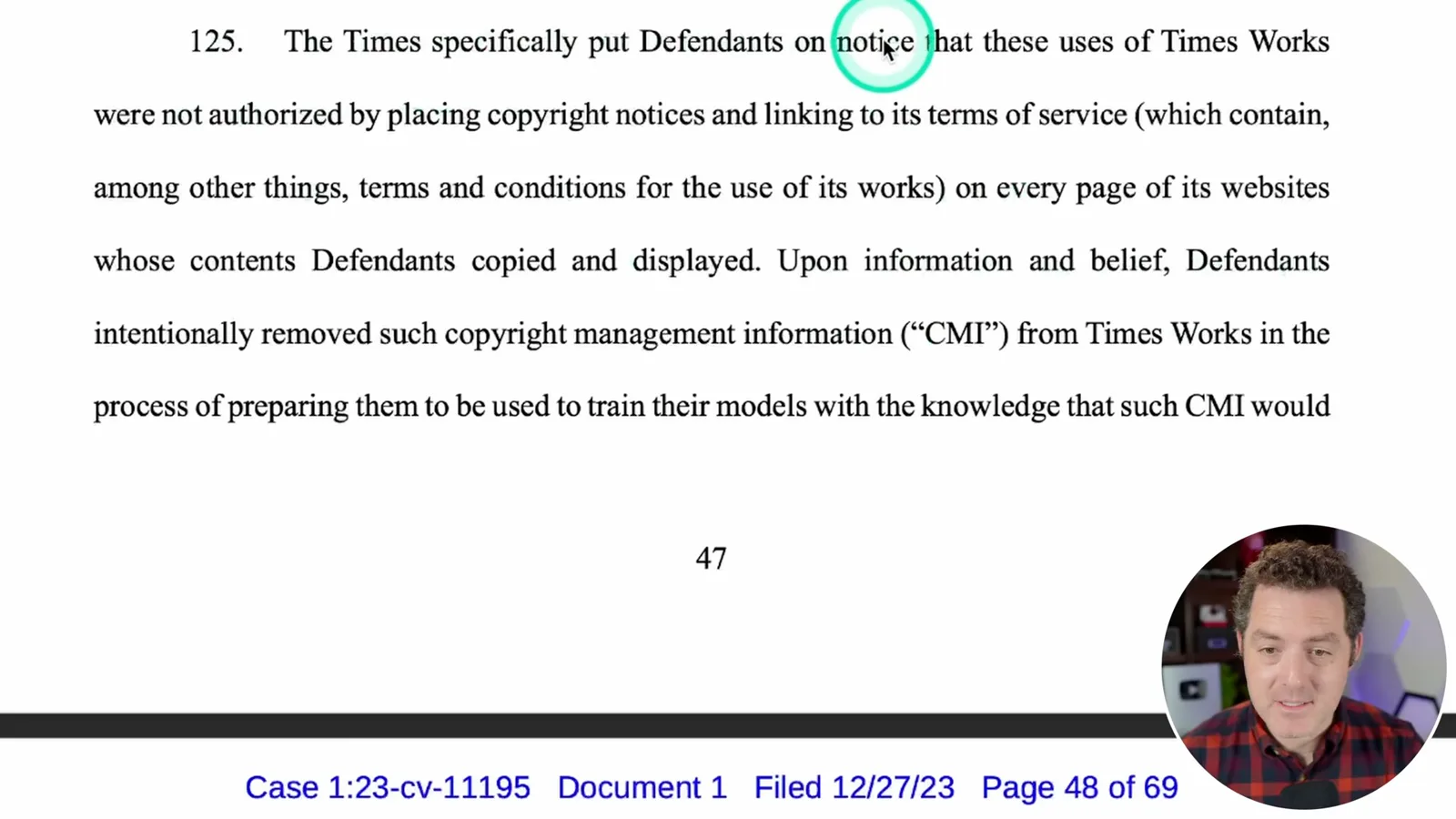
The Times alleges, on information and belief, that defendants intentionally removed copyright management information when preparing works for training. I initially describe that as established fact, but it remains an allegation subject to proof and defenses. The complaint also asserts copyright infringement, unfair competition and trademark-related claims.
Future data markets and image generation
Berman predicts value in proprietary datasets and discusses Midjourney images. Disney and Universal later sued Midjourney in a separate case.
I ask how society should balance compensation for creators and the development of AI. I predict that proprietary or licensed datasets could become more valuable. That is a market forecast, not a ruling that only proprietary data can lawfully be used for training.
I compare two explanations for reproducing a passage: retrieval from the web and model memorization. Both are technically possible in different circumstances, and the case may involve evidence about both. My preference for the memorization explanation does not establish the cause of every example.
I turn to images resembling familiar entertainment characters generated by Midjourney and predict litigation. Character resemblance and copyright ownership require case-specific analysis; Shrek and SpongeBob, for example, are not Disney properties. A side-by-side image demonstration alone does not establish infringement or the company’s liability.
Later, on June 11, 2025, [Disney and Universal filed a copyright lawsuit against Midjourney](https://dockets.justia.com/docket/california/cacdce/2%3A2025cv05275/973999). The suit alleges infringement; filing it is not a judgment. My 2023 prediction should be read with that subsequent development, not as proof of the suit's outcome.
As a creator, I want compensation when work is copied in a way the law does not permit, while also wanting new tools to develop. The Times litigation and later image-generator disputes illustrate unresolved tensions over training, outputs, licensing and remedies; the video itself does not resolve them.
Sur la même chaîne
 34:21EN
 Matthew Berman· 27 oct. 2026Matthew Berman Examines Anthropic’s IPO Filing, AI Growth and GovernanceMatthew Berman, Sam Altman · Forward FutureThe presenter reviews the S-1’s financial metrics, compute strategy and voting structure while questioning the tension between rapid AI development and safety.
 0:26ENMatthew Berman· 25 oct. 2026Sam Altman on Human Values and Problem-Solving in an AI WorldSam Altman · OpenAIIn a short interview excerpt, Altman considers the enjoyment of solving hard problems and the human role in interpreting results.
 0:36ENMatthew Berman· 25 oct. 2026Kimi K3.1 and a Rubik’s Cube Solver DemonstrationMatthew Berman · Forward FutureMatthew Berman shows a scrambled virtual cube being solved and gives the Kimi K3.1 test a favorable assessment.
 0:21ENMatthew Berman· 24 oct. 2026An AI-Generated Kimi Benchmark Chart Used Invented ScoresMatthew Berman · Forward FutureMatthew Berman asks for a graph of Kimi K3.1 Pro benchmarks, then discovers that the displayed figures are illustrative placeholders.
 25:50ENMatthew Berman· 24 oct. 2026Kimi K3.1 Pro Tested: Strong 3D Demos, Uneven Results and Competitive PricingMatthew Berman · Forward FutureMatthew Berman tests the open-weight model on coding, 3D rendering and visual explanations, then compares benchmark results and prices.
 32:20ENMatthew Berman· 23 oct. 2026Who Is Local AI For? The Costs, Trade-offs and a Hybrid FutureMatthew Berman · Forward FutureMatthew Berman weighs data control and independence against hardware cost, setup complexity and inference speed.