En 30 secondes
At Tesla’s November 2025 shareholder meeting, Elon Musk presented ambitious plans for Optimus robots, autonomous vehicles and a possible chip fabrication plant. He also discussed energy storage, factory capacity and shareholder questions. His production timelines and claims about future medical and autonomous-driving capabilities are forecasts. Tesla’s supervised Full Self-Driving requires an attentive driver ready to take over.
- 1Musk outlines Optimus production ambitionsHe describes a planned Fremont line and larger prospective production capacity in Texas.
- 2Cybercab production and autonomy are future plansMusk describes a purpose-built vehicle and projected production speed; supervised driving still requires driver attention.
- 3Chip supply could lead to a Tesla fabrication plantMusk says the company may build a large chip facility if outside supply grows too slowly.
À retenir
- Musk described proposed Optimus production lines and a future cost estimate dependent on scale.
- He proposed building chip fabrication capacity if suppliers cannot meet Tesla’s demand.
- Tesla’s supervised Full Self-Driving requires the driver to remain attentive and ready to intervene.
Lire le texte remanié, chapitre par chapitre
Shareholder vote and Optimus ambitions
The meeting reports a compensation vote and Musk describes a proposed robot production ramp.
The meeting announces that Tesla shareholders approved the 2025 CEO performance award for Elon Musk with more than 75% of votes in favor. The formal meeting closes before Musk takes the stage.
Musk points to Optimus robots moving and dancing at the event, then thanks shareholders and the board for their support. He says Tesla is entering a new phase in which robotics will play a central role.
He says Optimus robots have been walking around Tesla’s engineering office and charging themselves. Musk predicts that humanoid robots could become a vast product category, with personal helpers and additional robots working in industry; he also emphasizes safety.
Musk describes plans for a one-million-unit production line in Fremont and a ten-million-unit annual line in Texas. He speculates about much larger future volumes, describing a production ramp rather than completed capacity.
He predicts humanoid robots could increase access to medical care and reduce poverty, including by eventually performing precise procedures. These are proposed future uses, not medical capabilities demonstrated by the meeting.
Musk imagines a robot monitoring a person who has committed a crime as an alternative form of confinement. He recommends Iain M. Banks’s Culture novels as one fictional picture of a mostly optimistic AI future.
Musk speculates that AI and robotics could greatly expand economic output and eventually change the role of money. He suggests electricity could become a useful measure of resources, then encourages shareholders to hold their Tesla stock.
Musk returns to Tesla’s original mission of accelerating sustainable energy, citing electric vehicles, batteries and solar power. He says the company now describes its mission as sustainable abundance: meeting people’s needs while preserving nature.
Autonomy and vehicle manufacturing plans
Musk discusses Tesla’s mission, driving software, Cybercab and robot production.
He says many Tesla owners have not tried Full Self-Driving, including some who paid for it. Musk compares an ordinary-looking Tesla to a fictional cat with hidden abilities and says sales and service staff will demonstrate the feature to customers.
Musk predicts that Tesla may eventually allow drivers to text while the system operates, subject to its review of safety data. Tesla’s Full Self-Driving (Supervised) requires the driver to pay attention to the road and remain ready to take over; it does not make the vehicle autonomous.
Musk asks European customers to support regulatory approval of supervised FSD and says Tesla has partial approval in China. He expresses hope for broader approval there in the following months.
Musk introduces Cybercab as a vehicle designed for unsupervised robotaxi operation without pedals or a steering wheel. He says Tesla plans to start production at the Texas factory in April 2026.
He compares Cybercab manufacturing to high-volume consumer electronics and says a cycle time below ten seconds may eventually be possible, with five seconds a theoretical longer-term target. He describes the resulting annual volumes as possibilities rather than current output.
Musk describes cars as robots on wheels and says Tesla can reuse expertise in batteries, electronics, motors, vision, software and fleet management for Optimus. He identifies a dexterous hand, real-world AI and volume manufacturing as major challenges.
Musk shows a prototype Optimus production line and says a high-volume line would be more automated. He estimates production cost could reach roughly $20,000 at sustained output of about a million units per year; that figure is a future estimate, not a retail price.
He describes the robot on display as version 2.5 and says version 3 is intended to begin production in 2026, with later generations envisioned for 2027 and 2028. He predicts successive improvements and much higher production volumes.
Musk cites Tesla’s own driving safety statistics and predicts substantial benefits from FSD. He forecasts that a future software release could allow a driver to sleep; the supervised system instead requires active attention and readiness to intervene.
Chips, energy and Tesla’s products
He presents chip and battery plans, then turns to the product lineup and energy infrastructure.
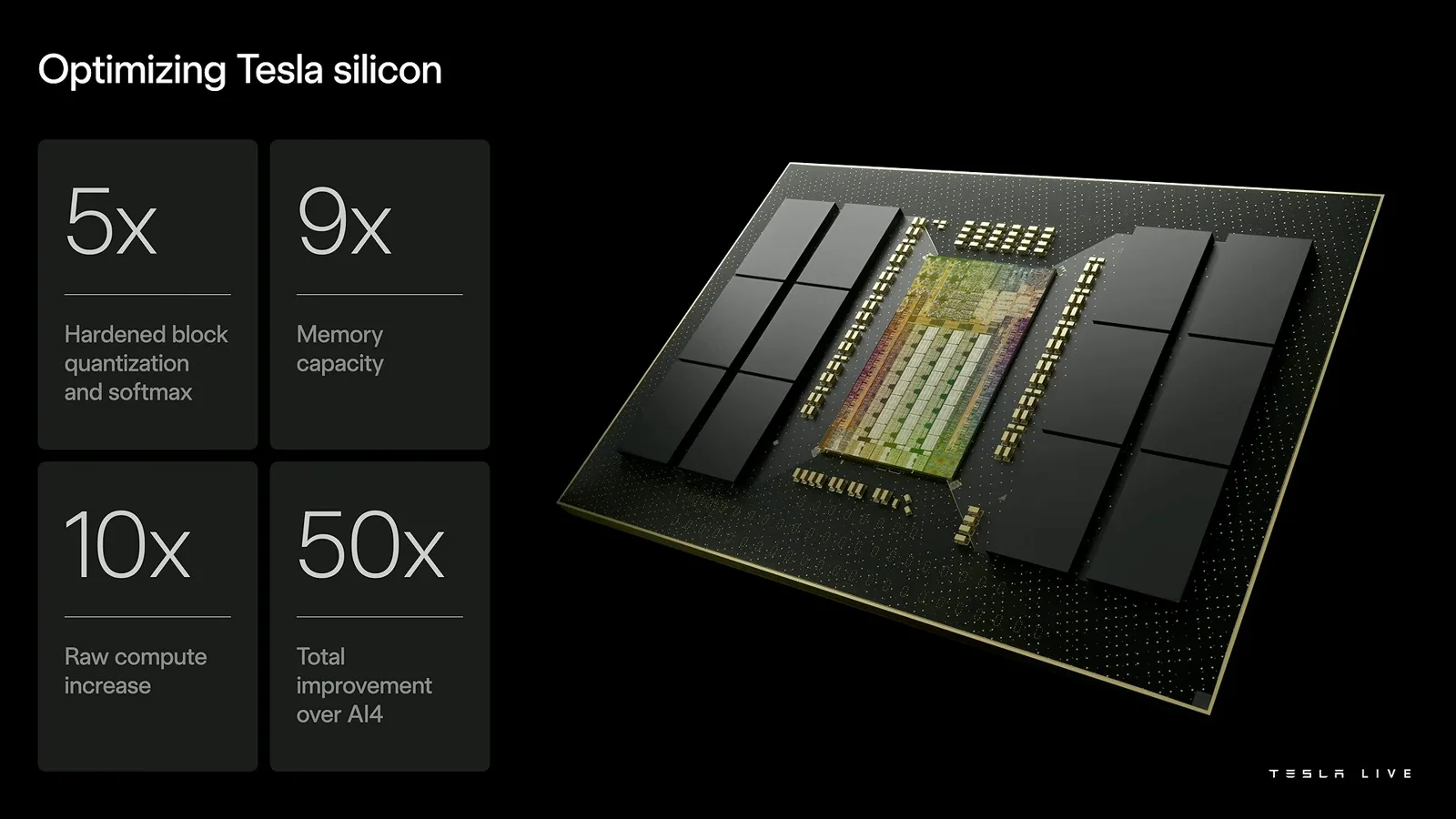
Musk says Tesla’s AI5 chip is designed for efficient inference in vehicles and robots. He predicts lower power use and cost than a general-purpose Nvidia chip, explaining that Tesla can optimize the design for its own software.
He says Tesla trains its software for integer-based inference, which he considers more efficient, and names manufacturing locations involving TSMC and Samsung. He hopes AI6 will follow AI5 rapidly with greater performance.
Musk says even optimistic projections of supplier capacity may not deliver enough chips for Tesla’s plans. He raises the possibility of a very large Tesla chip fabrication plant, which he calls a Terafab; he also says no Intel deal has been signed.
He returns to solar and batteries, arguing that the Sun’s energy makes solar a long-term power source. Musk predicts that solar-powered AI satellites will become important and that Tesla will have a role.
Musk reviews Tesla’s car lineup and Cybertruck, then says Tesla Semi prototypes are already operating. He expects volume Semi production at the northern Nevada factory in 2026, alongside planned Cybercab and Optimus ramps.
He argues that batteries could let the grid use more of its existing generating capacity by shifting electricity from low-demand periods. He describes plans to simplify utility-scale Megapack deployment and integrate more power electronics.
Musk highlights expansion of the Supercharger network and the adoption of Tesla’s charging network by other carmakers in North America. He also says the company continues to invest in factory safety.
He describes a Texas lithium refinery, a cathode factory and the 4680 battery cell as parts of Tesla’s supply-chain strategy. Musk says Tesla will also continue purchasing cells and chips from suppliers.
After showing the Semi factory, Musk closes the presentation and invites shareholder questions. He suggests Optimus might answer some questions at a future meeting.
Shareholder questions on production and ownership
Shareholders ask about vehicles, battery production, manufacturing and Tesla’s wider goals.
A shareholder asks Tesla to hold the next meeting in a larger venue so more retail investors can attend. Musk agrees to consider an arena or stadium and thanks shareholders for their support.
Another attendee asks whether Full Self-Driving purchases can transfer to a new Tesla rather than staying with the old vehicle. Musk says Tesla has allowed transfers before and agrees to extend the opportunity for at least another quarter.
Asked about a wheelchair-accessible vehicle, Musk says a larger Robovan-type vehicle would have the necessary space. He expects Tesla to make one, but says the Cybercab, Optimus and Semi ramps take priority.
A shareholder asks about dry-cathode battery manufacturing. Musk says it proved harder than expected to make reliably at high volume and, looking back, he might have chosen a wet process, although he expects dry cathodes to succeed and reduce cost.
Musk says he believes Tesla is approaching unsupervised autonomy and wants to expand production. He offers aspirational annualized exit rates of roughly 2.6–2.7 million vehicles by the end of 2026, four million by the end of 2027 and five million by the end of 2028.
A Roadster reservation holder asks about a future unveiling. Musk says early reservation holders should be invited and describes the vehicle as a showcase for technology rather than an essential part of Tesla’s abundance plan.
Asked about chip manufacturing, Musk says Tesla has agreed to buy substantial supplier output but still anticipates a shortage. He sketches the possible scale of a Terafab and says memory and packaging would also need to be addressed.
An attendee asks about expansion beyond Earth. Musk imagines Tesla vehicles and Optimus robots helping build and operate future Moon and Mars settlements, with a pressurized vehicle needed to carry people.
A shareholder asks how autonomy might reduce travel costs and change vehicle demand. Musk says Tesla sees a possible path below 20 cents a mile and predicts greater productivity could put downward pressure on prices.
On fleet size, Musk predicts autonomous vehicles could reduce the number of vehicles needed while increasing total miles traveled, because passengers could use travel time for work or entertainment.
Asked whether regulators will permit Cybercab deployment as production ramps, Musk predicts approvals and output will progress at roughly the same rate. He credits Waymo with helping establish a path for autonomous vehicles.
Space, compute and remaining questions
The discussion turns to space-based energy, computing and the company’s future products.
A shareholder asks whether human consciousness could be uploaded into an Optimus body. Musk speculates that an approximate mental snapshot might become possible using Neuralink within 20 years; he acknowledges it would not be identical to the person. This is a prediction, not a demonstrated procedure.
Asked about space-based solar power and transmitting electricity to Earth, Musk says reusable Starship launches could lower the cost of putting equipment in orbit. He sees solar-powered AI satellites as a particularly promising application.
Musk argues that space-based solar could eventually access far more of the Sun’s energy than Earth receives. He says some power could be sent back to Earth but discusses limits to how much could be transmitted.
A shareholder asks whether Tesla investors could gain access to SpaceX shares. Musk says he would like to find a way for supporters to participate but describes the costs and constraints of becoming a public company, and raises a possible future listing without announcing one.
Another attendee asks how Musk estimates uncertain milestones and whether Tesla anticipated future uses for its AI chips. Musk says he tries to estimate to the nearest order of magnitude rather than claim precision.
Musk says Tesla built its own chip team because low-cost, power-efficient car computers were a limiting factor. He describes hiring Jim Keller and moving through AI3 and AI4, says AI5 encountered mistakes, and expects a rapid transition to later designs.
He suggests that, with customer consent, idle vehicles might someday run distributed AI inference and earn their owners a payment. Musk uses a hypothetical fleet of 100 million vehicles to illustrate potential computing capacity; no such service or payment is announced as available.
During shorter exchanges, Musk agrees to consider a Cybertruck-inspired longhorn display at the factory and says a person may give away a Tesla purchased through normal channels.
Asked about the next Roadster, Musk tentatively proposes an April 1, 2026 unveiling and estimates production roughly a year or more afterward. He treats the dates as goals rather than confirmed delivery commitments.
A shareholder asks whether an abundant economy would require powerful people to surrender power. Musk speculates that an AI exceeding the combined intelligence of humanity might ultimately be in charge, and says it should be friendly.
Asked about expensive insurance and whether driving-assistance use should affect premiums, Musk says Tesla Insurance faces different regulations in each US state. He says Tesla wants to expand coverage and suggests the company could self-insure vehicles operating as robotaxis.
A shareholder asks how much computing is needed to train Optimus and whether xAI could help. Musk says significant training compute will be needed to produce efficient software for a power-limited robot, and sees potential for collaboration with xAI and SpaceX.
The final attendee asks for Hebrew and other languages in the Tesla app. Musk says the app should support all languages and closes the meeting.