En 30 secondes
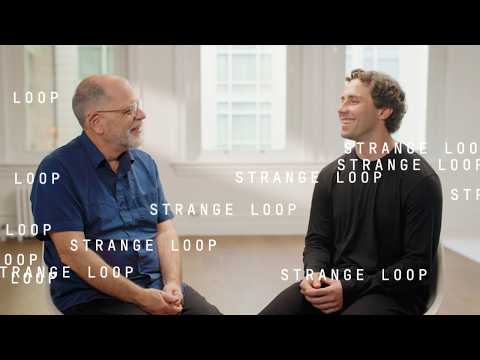
Geoffrey Hinton tells Sana founder Joel Hellermark that he expects AI systems to become much more intelligent and expresses his view that people are creating new kinds of beings. He compares learning with faster cycles of adaptation and speculates about how models might improve through self-generated inconsistencies. Hinton says competitive pressure to maximize intelligence and profit does not guarantee systems that care about people. He also discusses fast-changing weights, curated training data and his own uncertainty about whether one lab could pull far ahead. His claims about AI beings and future capabilities are presented as his views and forecasts.
- 1Faster loopsHinton compares evolution, development and learning as progressively faster cycles and expects AI to add a faster loop.
- 2Creating beingsHe predicts a difficult cultural adjustment to his view that people are creating new kinds of beings.
- 3Learning from inconsistencyHinton suggests language models could generate and resolve inconsistencies, allowing improvement without equivalent amounts of new data.
- 4More than intelligenceHe worries that competition for profit and capability will not by itself produce systems that care about people.
- 5Fast weightsHinton argues that rapidly changing weights could store recent context efficiently, though he thinks different hardware may be needed.
- 6Training examplesHe advocates more careful curation of training data and compares exposure to examples with modeling behavior for a child.
À retenir
- Hinton expects AI to improve faster than biological evolution and potentially exceed humans in more domains.
- He regards AI as the creation of new kinds of beings, a philosophical view he expects many people to resist.
- He suggests models might improve by detecting and resolving inconsistencies in their own beliefs and reasoning.
- He is uncertain whether recursive improvement will produce one dominant lab.
- Hinton wants more effort devoted to systems that care about people, not just intelligence and profit.
- His architectural bet is on fast-changing weights, potentially supported by different hardware.
Lire le texte remanié, chapitre par chapitre
Faster cycles of intelligence
Hinton recalls receiving the Nobel Prize and compares evolutionary, developmental and learning timescales. He offers forecasts about AI in mathematics and physical understanding.
Joel Hellermark welcomes Geoffrey Hinton and recalls an earlier prediction that Hinton would win a Nobel Prize. Hinton says he initially thought the call was a prank and jokes that a rough Bayesian calculation made the award seem more likely to be a dream than reality.
Hellermark asks whether human intelligence has reached diminishing returns. Hinton's guess is that people have reached a point where they can create something that becomes intelligent more quickly. He compares the long cycles of evolution with faster development and learning, then suggests AI adds a faster loop.
Asked whether greater intelligence or parallel exploration will matter more, Hinton answers both. He points to AI performance in chess and Go and says he expects systems to become much more intelligent than people in other areas as well.
Hinton refers to a recently announced mathematical result as a possible sign of AI's potential in mathematics. He argues that mathematics, like a game, has a relatively closed structure in which a system can generate conjectures and try proofs, and predicts it may surpass mathematicians in some respects within ten years.
Hellermark asks why more discoveries have not yet appeared and whether models will generate new knowledge through analogy. Hinton says language training can convey surprising amounts about space, but physical interaction adds information about objects and their properties. He regards the absence of such experience as a deficit of earlier models.
Hinton says there is still much people do not understand about human intelligence and room to improve AI. As a materialist, he does not see an inherent human characteristic that AI could never acquire. Asked about Einstein-like thought experiments, he expects such abilities over a longer horizon, perhaps within twenty years.
New beings and self-improvement
Hinton states his view that AI may become a new kind of being. He compares pretraining and self-play, and considers whether models might improve from internal inconsistencies.
Hinton compares his expected cultural adjustment with the Copernican and Darwinian revolutions, when people had to reconsider Earth's and humanity's place. He says he thinks people are creating new beings, and expects many to resist that description. This is his philosophical interpretation, not an established finding about AI consciousness.
Hellermark asks whether models should move from pretraining on human data toward reinforcement learning, as game systems did. Hinton says pretraining improves efficiency, while self-generated training can work in closed domains such as mathematics or games.
He recalls early Go systems learning to imitate expert moves, which limited them to the available data and expertise. He says self-play and search then allowed systems to generate their own training material. He proposes a possible language-model analogue based on reasoning from beliefs and finding inconsistencies.
If a model derives a conclusion that conflicts with another belief, Hinton suggests, it might revise its reasoning, premises or conclusion. He thinks this could support major improvement without an equivalent supply of new external data. He also speculates about what another lab may be doing, without claiming direct knowledge.
Hellermark asks whether better models will compound one lab's lead through recursive improvement and talent concentration. Hinton says he does not know. His intuition is that several labs may improve rather than one system racing far ahead, but he emphasizes the uncertainty.
Competition, care and uncertainty
Hinton says he does not know whether one lab will pull ahead. He argues for explicitly designing systems concerned with human welfare rather than relying on competition alone.
Asked where he would place research bets, Hinton says the answer depends on motivation. A leader seeking rapid financial returns might scale what already works; someone prioritizing humanity's future might explore many approaches to develop what he calls better beings.
Hinton worries that companies racing for intelligence and profits are paying insufficient attention to other qualities. If people are creating new kinds of beings, he argues, they should make a deliberate effort to develop systems that care about human welfare.
He draws an analogy with evolutionary competition: cooperation and loyalty within a group can coexist with hostility toward outsiders. Hinton does not think an invisible hand of corporate competition will automatically produce the human-concerned systems he wants; he calls for explicit design and research.
Hellermark asks whether repeated discussion of evil AI could itself influence training data and model behavior, comparing it with a child hearing negative predictions about itself. Hinton responds that such discussion might also prompt attention to behaving well, and repeats his call to work on that goal.
Architectures, data and a closing joke
Hinton discusses fast weights and training-data curation. He closes with an anecdote comparing himself and Oppenheimer.
Asked for an architectural bet, Hinton points to fast weights. He says efficient parallel matrix multiplication encourages models to use the same weights across many inputs, making it difficult to change those weights rapidly while processing a sequence.
Hinton contrasts this with his account of the brain, where many synapses adapt and decay quickly. He suggests fast-changing weights could encode recent history efficiently, while current models use access to earlier neural activations in a different way. He speculates that voltage- or conductance-based computing might make his proposed approach more practical.
On training data, Hinton favors curation and compares it with choosing what examples a child reads. He says model developers have at least two forms of influence: reinforcement and the examples used to model behavior. He argues that more attention should go to presenting desirable behavior.
To close, Hinton recalls being asked to compare himself with Oppenheimer. He had described Oppenheimer as a brilliant physicist and organizer while characterizing his own strength as persistence. His final joke was that Oppenheimer never received a Nobel Prize in physics.
Sur la même chaîne
 1:16EN
 Sana· 14 oct. 2026PodcastHow Volkswagen Group Middle East Uses Sana to Prepare Technicians for TrainingThierry Rochat describes using technical documents to create online courses before hands-on academy sessions.
 0:41ENSana· 8 sept. 2026PodcastSana Learn Customers Describe Bringing Training Resources TogetherA short customer montage contrasts fragmented learning resources with keeping company knowledge in one place.
 0:40ENSana· 31 août 2026PodcastSana Learn Customers Describe Their Partnership ExperienceIn a short montage, customers discuss implementation and the ongoing relationship with Sana.
 48:34ENSana· 12 août 2026Podcast · 2 voixTyler Cowen on AI Adoption, Human Agency, and the Search for BeautyInvité : Tyler Cowen · Anime : Joel HellermarkThe economist explains why AI's economic impact may arrive slowly, what people may still contribute, and why he is calling for a new aesthetic.
 0:16ENSana· 21 juil. 2026PodcastTyler Cowen on Human Presence in an AI WorldTyler Cowen predicts that charisma, physical presence and human interaction will gain importance as AI advances.
 0:23ENSana· 9 juil. 2026PodcastEthan Mollick on Measuring AI’s ImpactEthan Mollick argues that companies should allow room for new opportunities rather than relying only on old metrics.