En 30 secondes
Matthew Berman responds to OpenAI’s initially restricted GPT-5.6 preview and Anthropic’s Fable access suspension, arguing that government involvement could concentrate power. He blames Anthropic’s safety advocacy, a disputed interpretation rather than an established causal finding, and calls for greater support for open-weight AI. The article distinguishes the launch-time debate from later restoration of access.
- 1Fable access suspendedAnthropic suspended the models after a US export-control directive; access was subsequently restored on June 30.
- 2GPT-5.6 limited previewOpenAI said a small group of trusted partners would initially receive access at the government’s request.
- 3A possible early-access advantageBerman worries that well-funded companies will build ahead of startups, a prediction rather than a measured effect.
- 4Industry scenariosAaron Levie describes possible consequences for releases, sovereign AI and open models; Berman responds to those scenarios.
- 5OpenAI’s stated positionThe company described its limited preview as a temporary path toward broader availability and opposed making it the long-term default.
À retenir
- OpenAI initially limited GPT-5.6 access to trusted partners at the US government’s request.
- Anthropic suspended Fable 5 and Mythos 5 after a June 2026 export-control directive, then reported access restored on June 30.
- Berman believes restricted launches could favor large firms, but the magnitude and duration of any advantage are uncertain.
- His accusations about Anthropic’s motives and its role in government decisions are opinions, not established findings.
- Open-weight models and sovereign AI are among the alternatives discussed, with their own capability and governance tradeoffs.
Lire le texte remanié, chapitre par chapitre
The restricted preview and Berman’s criticism
Berman argues that Anthropic’s safety advocacy helped bring about government intervention. The actual sequence includes distinct government actions and company statements.
OpenAI’s June 2026 preview of GPT-5.6 Sol was initially limited to selected partners after a US government request. I see that restricted launch as a negative turning point for access to frontier AI. I blame Anthropic CEO Dario Amodei’s public campaign around model risks for helping create a climate in which officials intervene before a broader release.
That is my interpretation of the sequence and Anthropic’s role, not a finding that the company controlled the government’s decision. The government cited security concerns, and OpenAI said it had shared its launch plans with officials. Axios reported that OpenAI had been working with the administration before Anthropic’s later access suspension.
I argue that Anthropic’s warnings about cyber capabilities, restricted previews and alleged extraction of model outputs contributed to pressure for tighter controls. I also point to a report alleging that Alibaba sought to extract Claude capabilities. These are allegations and competing interpretations; they do not independently establish how much capability transferred or prove a government decision was caused by Anthropic lobbying.
I question whether the alleged extraction justifies the response and argue that model safeguards can be bypassed. Security controls can reduce risk without guaranteeing perfect protection, and my claim that every model can always be bypassed is a broad opinion, not a result established by this video.
On June 12, Anthropic suspended access to Claude Fable 5 and Claude Mythos 5 after a US export-control directive concerning foreign nationals. It had launched Fable 5 publicly on June 9. As of my June 26 recording, users had lost broad access; the interruption is separate from the later GPT-5.6 preview.
I speculate that OpenAI’s release planning was affected by the Anthropic episode, and imagine how its executives might have reacted. The specific conversations and motives I describe are hypothetical. OpenAI stated that, at the government’s request, it would begin GPT-5.6 with a small trusted-partner preview before broader availability.
The Information reported on the planned restricted release, and OpenAI confirmed the limited preview in its own announcement. At the time, a public release date was not certain. I call the process de facto AI regulation and worry that it gives a small group early access to tools others cannot yet use.
I connect the situation to Anthropic’s earlier restricted Mythos release and its public warnings about cybersecurity and employment. My accusation that Anthropic sought regulatory capture is a political and commercial judgment; the available statements do not establish the company’s intent or that its actions alone produced the government request.
Competition, access and open models
He predicts an advantage for frontier labs and large partners over smaller developers. He also speculates about an IPO delay and international competition.
My concern is that large firms can access frontier models first while startups, independent developers and experimenters must wait. If the early access materially improves their products and internal work, the gap could widen. That is a possible consequence, not a measured outcome from the preview.
I worry that the leading model developers can continue using powerful models internally and then give selected partners a head start. A founder competing against an incumbent with earlier access may find it harder to catch up. The size and duration of any advantage depend on the actual access terms and capabilities.
I also discuss a report that OpenAI was considering delaying its IPO until 2027. The reporting cited market conditions and investor demand; I disagree with that explanation and speculate that uncertainty about AI regulation is the real reason. That claim is my inference and is not established by the report.
My wider concern is that the frontier labs and their partners may continue advancing while the broader economy waits for access. I imagine a startup building against an older model while a well-funded rival has the newest one. The hypothetical six-month delay is an illustration, not an announced release schedule.
I worry that delays in the United States could matter in competition with China. I regard even a few weeks as consequential, though the economic and security effects of a particular delay are uncertain. I also criticize Anthropic for the Fable suspension, which I view as an unintended consequence of its own public advocacy.
The episode reinforces my support for open-weight AI. I want more developers around the world to be able to run and build on models themselves. Open models may currently lag the leading proprietary systems, and it remains uncertain whether release restrictions would close or widen that gap.
My concern is that restricting distribution does not necessarily stop developers from training successive models internally. I use Fable 5.1 and 5.2 as a hypothetical sequence to illustrate the risk of concentration; it is not evidence that a particular model trained another one. I intend to cover open-model developers more often.
Industry reactions and possible scenarios
Berman discusses Aaron Levie’s possible outcomes for release cycles, sovereignty and open weights. He voices concerns about future access to compute.
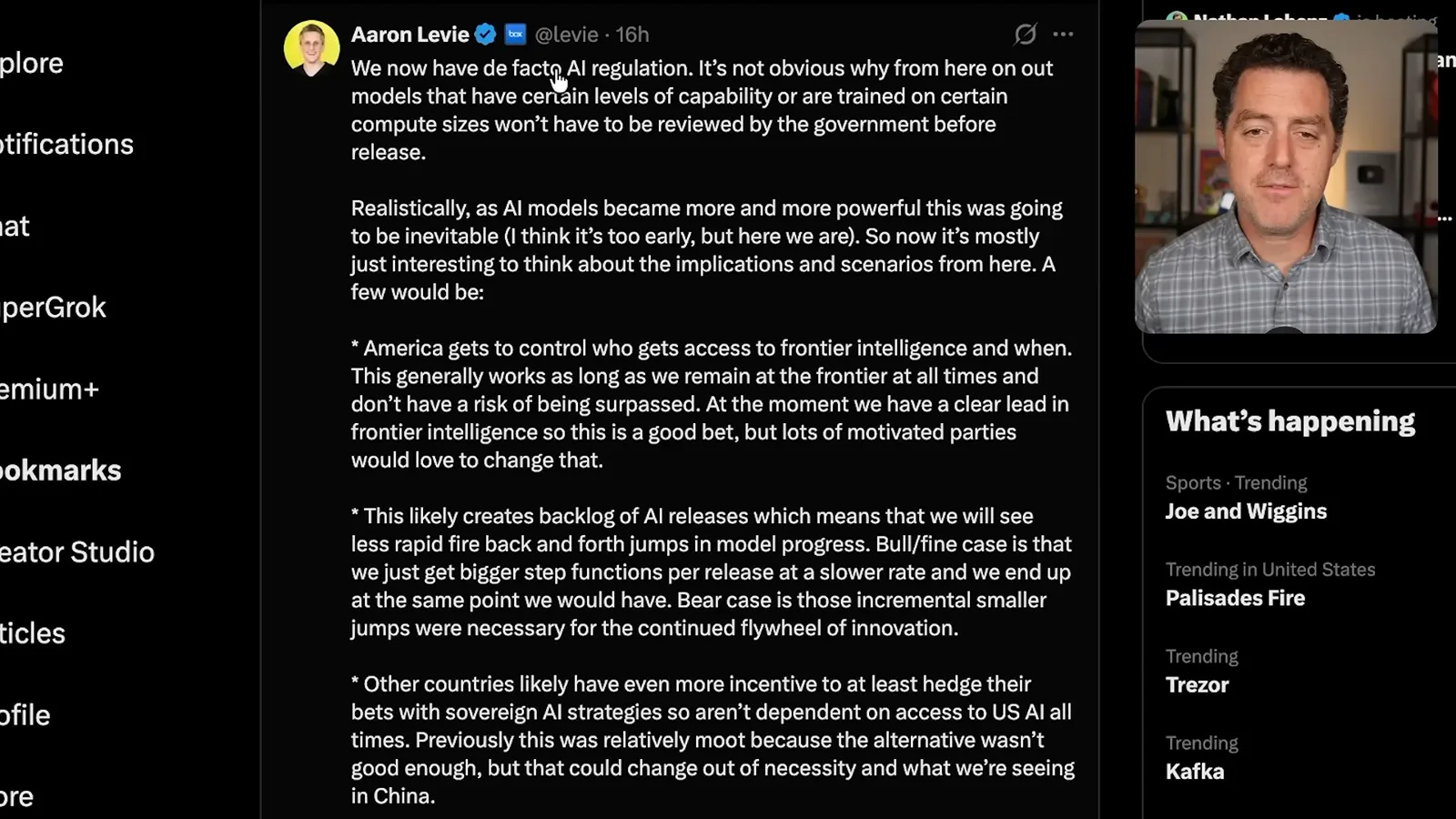
I turn to reactions from others. Box CEO Aaron Levie argues that government intervention has effectively created a new form of AI regulation, although he thinks it came too early. He outlines possible scenarios rather than asserting that all frontier releases will necessarily face the same review.
Levie suggests US control of access might work while the country maintains its lead, but could become problematic if rivals catch up. I agree that access and international competition are connected. Assessments of who leads and for how long remain uncertain and can vary by capability.
He also raises the possibility of a backlog of launches and fewer rapid exchanges between competitors. I worry that reduced pressure to release will weaken market competition, affect labs’ ability to monetize models and have consequences beyond their investors. Those effects are forecasts, not demonstrated results.
Levie describes a more optimistic possibility: less frequent releases could deliver larger improvements and ultimately reach the same point. I worry that releasing bigger jumps at once could be worse for safety than gradual deployment and feedback. That tradeoff depends on actual testing and deployment practices.
Another possible response is for countries to pursue their own AI capacity rather than depend on access to US providers. Levie sees open weights as a potential beneficiary of sovereign AI efforts. I agree that open models may help, while worrying about what future rules could mean for them.
I speculate that future restrictions might extend to open models or domestic access to GPUs. Those examples are possibilities I am concerned about, not policies announced in the preview. I fear that decisions about compute and model access could concentrate influence among governments and large AI firms.
Motives, security and OpenAI’s statement
He reviews criticism from Peter Diamandis and Bill Gurley and reads OpenAI’s explanation of the limited preview. Claims about motivations remain contested.
I cite Peter Diamandis’s concern that a small number of actors may decide which capabilities companies can use. I also read venture capitalist Bill Gurley’s accusation that Anthropic sought government protection from competition instead of pursuing a court case. His claim about the company’s motivation is an allegation, not an established fact.
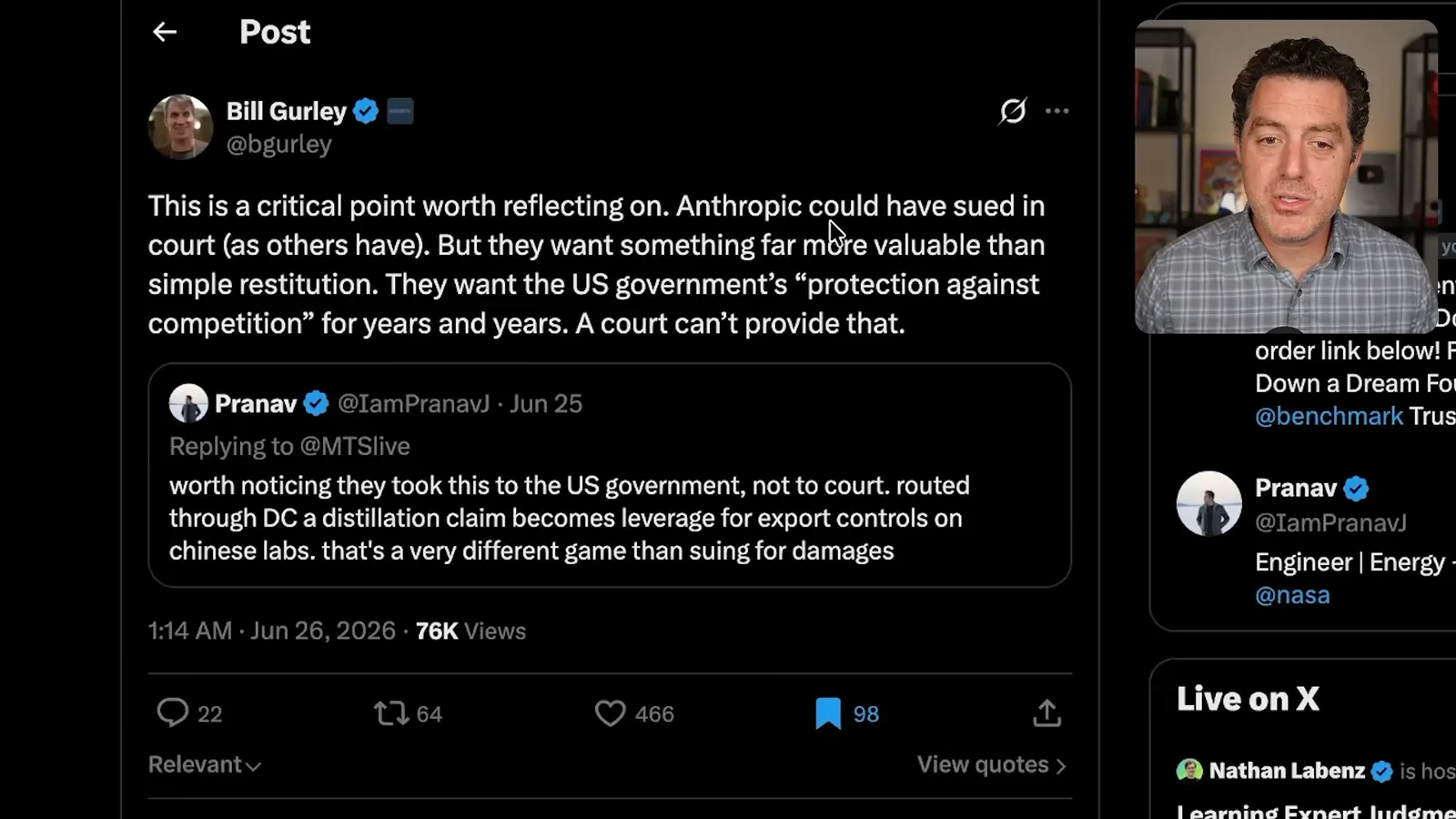
Gurley questions why a highly capable model cannot automatically stop alleged distillation, and I share that frustration. A model’s performance on reasoning or cybersecurity tasks does not by itself prove it can identify all abuse of its own service, so the comparison is an argument about security rather than a technical demonstration.
From conversations with OpenAI, I say the company wants broad availability; researcher Noam Brown also expressed hope that people could use the model soon. OpenAI’s preview announcement emphasized safeguards and cyber risk alongside performance. Its statements describe its position, not independent proof of every safety claim.
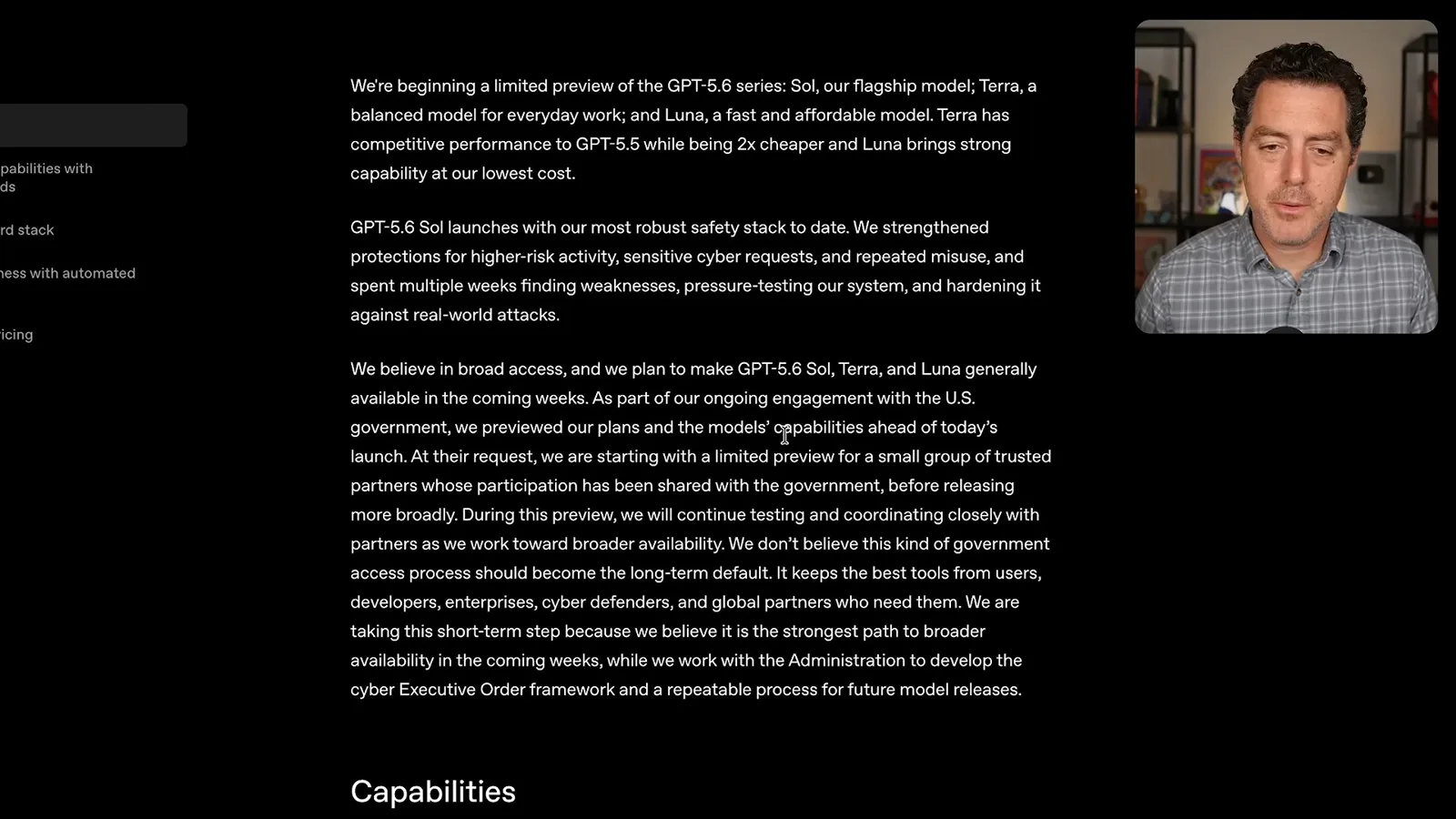
OpenAI said it had previewed the model and launch plans with the US government and, at the government’s request, started with trusted partners whose participation was shared with officials. The company said it opposed making that process the long-term default, but viewed the short-term preview as a path toward wider availability while working on a cyber framework.
A call for open models and later developments
Berman urges support for open-weight AI and civic engagement. Later announcements restored Anthropic access and expanded GPT-5.6 availability.
I encourage viewers to support open-weight models, learn to run them locally and contact elected representatives. My position is that access matters for both innovation and the distribution of power. I hope the restricted launch does not become a permanent pattern.
The video records a dispute at a particular moment, not the final outcome. On June 30, after the video, Anthropic said access to Fable 5 and Mythos 5 had been restored following a resolution with the government. OpenAI later announced broader GPT-5.6 availability; these developments do not settle the longer-term policy debate.
Sur la même chaîne
 34:21EN
 Matthew Berman· 27 oct. 2026Matthew Berman Examines Anthropic’s IPO Filing, AI Growth and GovernanceMatthew Berman, Sam Altman · Forward FutureThe presenter reviews the S-1’s financial metrics, compute strategy and voting structure while questioning the tension between rapid AI development and safety.
 0:26ENMatthew Berman· 25 oct. 2026Sam Altman on Human Values and Problem-Solving in an AI WorldSam Altman · OpenAIIn a short interview excerpt, Altman considers the enjoyment of solving hard problems and the human role in interpreting results.
 0:36ENMatthew Berman· 25 oct. 2026Kimi K3.1 and a Rubik’s Cube Solver DemonstrationMatthew Berman · Forward FutureMatthew Berman shows a scrambled virtual cube being solved and gives the Kimi K3.1 test a favorable assessment.
 0:21ENMatthew Berman· 24 oct. 2026An AI-Generated Kimi Benchmark Chart Used Invented ScoresMatthew Berman · Forward FutureMatthew Berman asks for a graph of Kimi K3.1 Pro benchmarks, then discovers that the displayed figures are illustrative placeholders.
 25:50ENMatthew Berman· 24 oct. 2026Kimi K3.1 Pro Tested: Strong 3D Demos, Uneven Results and Competitive PricingMatthew Berman · Forward FutureMatthew Berman tests the open-weight model on coding, 3D rendering and visual explanations, then compares benchmark results and prices.
 32:20ENMatthew Berman· 23 oct. 2026Who Is Local AI For? The Costs, Trade-offs and a Hybrid FutureMatthew Berman · Forward FutureMatthew Berman weighs data control and independence against hardware cost, setup complexity and inference speed.