En 30 secondes
In this September 2025 news roundup, Matthew Berman reviews AlterEgo’s silent-speech claims, new model releases, reports on OpenAI’s restructuring and financing, and developments from Microsoft, NVIDIA and Salesforce. The episode is sponsored by Spotter. Rankings, prices and financial reports are historical snapshots; company claims and speculation are identified.
- 1Silent speech claimsAlterEgo says its wearable detects signals linked to intended speech and does not read general thoughts. Berman had not tested the device.
- 2A proprietary Qwen previewQwen3-Max Preview ranked strongly in an Artificial Analysis snapshot, but its weights were not released and the ranking is evaluation-specific.
- 3OpenAI restructuringReporting described opposition and a possible relocation discussion; OpenAI denied plans to leave California. The company already had a for-profit arm under nonprofit control.
- 4ASML invests in MistralThe chip-equipment company announced a €1.3 billion Series C investment and strategic partnership, for about 11% on a fully diluted basis.
- 5A tool-assisted research benchmarkSalesforce reported 28.7% on the text-only Humanity’s Last Exam for SFR-DR-20B using search, browsing and Python. The score has a defined testing scope.
À retenir
- AlterEgo describes detecting signals linked to intended speech, not general mind reading; its performance was not independently tested in the video.
- Qwen3-Max Preview was proprietary, while model rankings shown reflect specific historical evaluations.
- OpenAI already had a for-profit arm; its 2025 restructuring retained nonprofit control and was completed after the video.
- ASML announced a €1.3 billion investment in Mistral, while other fundraising and acquisition reports were time-specific.
- NVIDIA’s rack specifications and revenue projection were company claims; Salesforce’s 28.7% score was on a specific tool-assisted text-only evaluation.
Lire le texte remanié, chapitre par chapitre
Silent speech, game worlds and new models
Berman discusses AlterEgo, Oasis 2.0, Qwen3-Max Preview and image models. The roundup distinguishes a product claim and a rumor from confirmed releases.
This September 2025 AI news roundup is sponsored by Spotter. I begin with AlterEgo, a wearable that its developer says detects subtle signals associated with intended speech. Although I describe it as nearly telepathic, the company explicitly says it does not read general thoughts; its claims about silent communication need independent testing.
I can imagine silent speech as an alternative to typing in public places, alongside voice interaction. AlterEgo calls its approach Silent Sense and claims it works across a range from mouthing words to an intention to speak without visible movement. I have not tested the device and want to try it before judging how well it works.
Decart has shown Oasis 2.0, which transforms the look of game worlds in real time. The demonstration includes Minecraft-style worlds recast as the Swiss Alps or Burning Man, with a game mod offered for trying the effect.
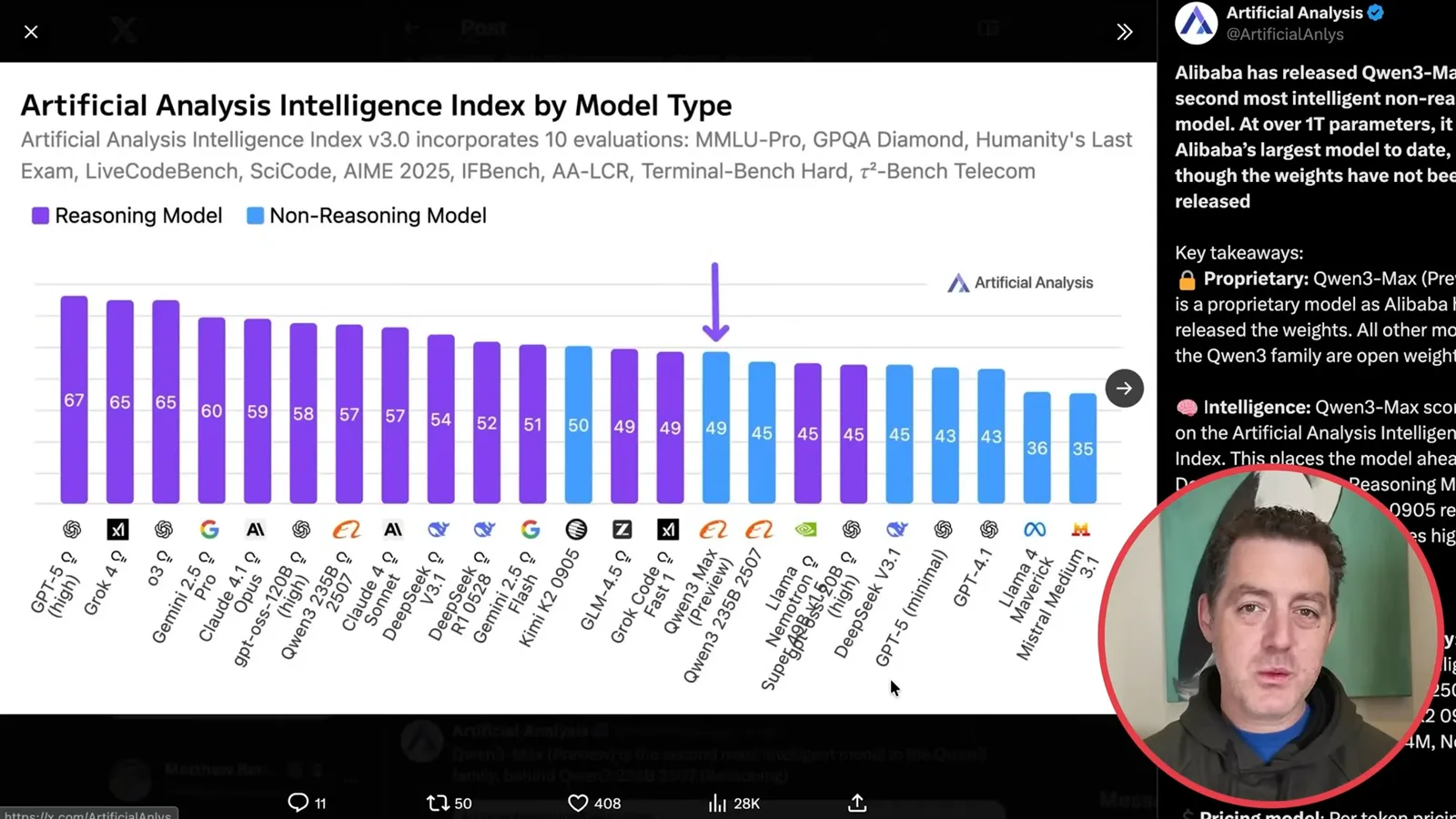
Alibaba's Qwen3-Max Preview appeared near the top of Artificial Analysis's non-reasoning model category in the snapshot I show. The preview was proprietary, with weights not released; the displayed index is a particular aggregate of tests rather than an all-purpose measure of intelligence. The ranking and pricing were snapshots from September 2025.
An apparent GPT image mini entry prompted speculation about a possible OpenAI competitor to Google's Nano Banana, but I have no confirmed details about a product or release. Separately, a report says Apple is exploring AI search; that is reporting on plans, not a launch. I question Apple's progress so far but think its devices and resources give it room to compete.
Tencent announced HunyuanImage 2.1 as an open-weight text-to-image model. It described support for long prompts, Chinese and English text rendering, multiple subjects and native 2K images. ByteDance also introduced Seedream 4.0; my team's early impressions were that it could be competitive with Nano Banana, though I had not completed a comparative test.
Spotter sponsorship and OpenAI restructuring
The episode includes a Spotter Studio sponsorship. Berman then discusses reporting about OpenAI’s proposed corporate changes and financial projections.
Today's sponsor, Spotter, offers Spotter Studio for planning videos. I describe trying its ideas feed, brainstorming, project organization, title and thumbnail tools. The advertised $99 annual promotion was a limited-time offer in 2025; it should not be assumed to be available now.
The Wall Street Journal reported mounting opposition to OpenAI's restructuring and discussion of a possible move from California. The article shown also says an OpenAI spokesperson denied plans to leave the state. Regulatory scrutiny, charitable assets and investor conditions were all part of the debate; a reported discussion is not evidence that the company decided to move.
A clarification to my shorthand: OpenAI already had a for-profit operating entity under nonprofit control. Its proposal concerned changing that entity into a public benefit corporation while retaining nonprofit control, rather than simply turning the nonprofit into an ordinary for-profit company. On October 28, 2025, after this video, OpenAI announced it had completed the recapitalization with the nonprofit still in control.
The Information reported that OpenAI projected cumulative cash burn of $115 billion through 2029, roughly $80 billion more than its earlier forecast. That is a reported projection, not an established loss or proof of future profitability. I argue that fast-growing companies can invest heavily before becoming profitable, though that outcome is not guaranteed.
Investments, embeddings and model rankings
ASML and Mistral announce a partnership, Google releases an embedding model, and Berman reviews model and funding news. Benchmark rankings are historical snapshots.
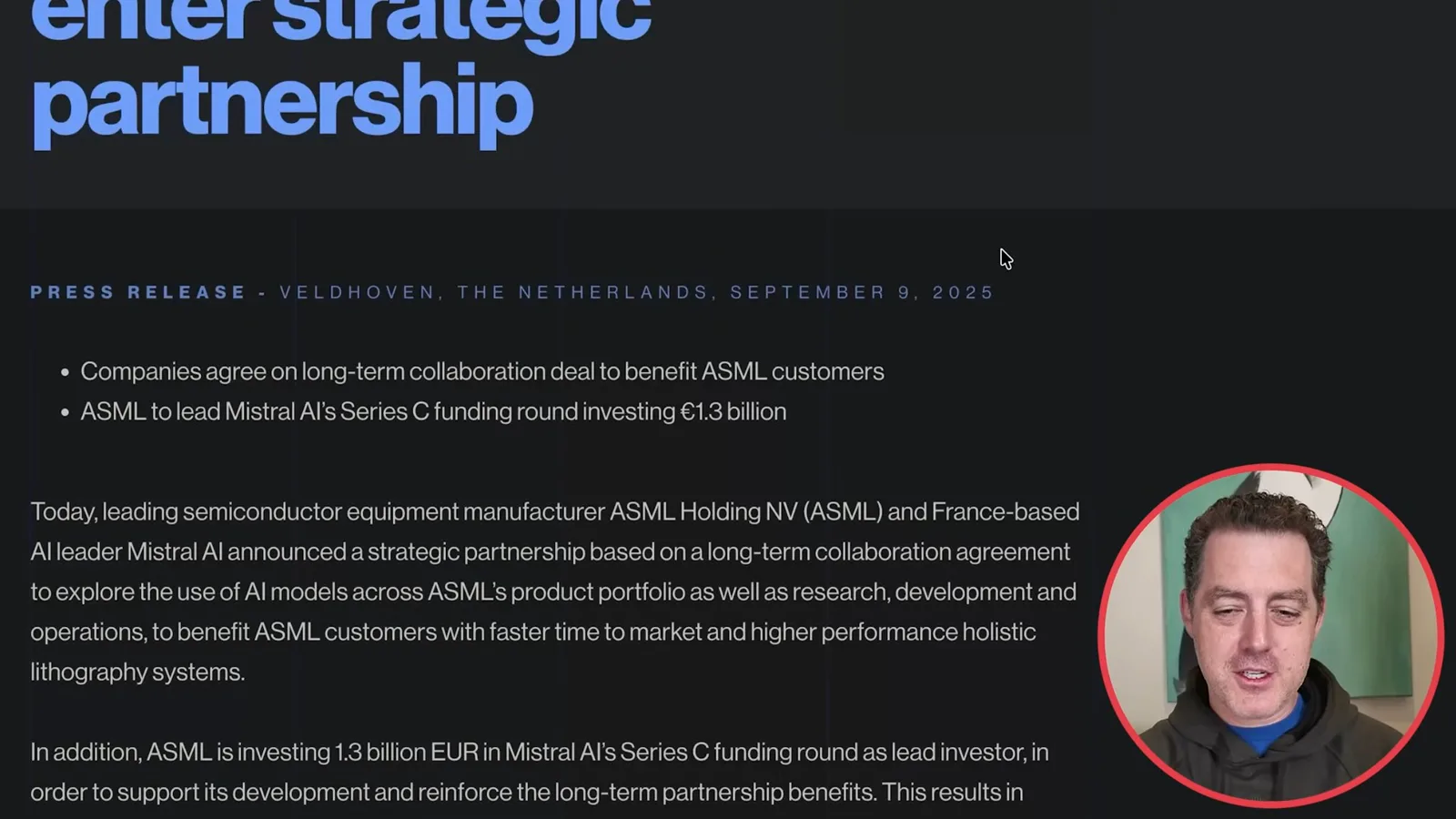
ASML and Mistral announced a strategic partnership, with ASML leading Mistral's Series C investment with €1.3 billion. ASML said the deal gave it approximately 11% on a fully diluted basis. The companies plan to explore AI across chip-equipment products, research and operations; I welcome the additional competition in AI.
Google introduced EmbeddingGemma, an embedding model designed for use on devices. Embeddings represent text as vectors that can help retrieve relevant material; retrieval-augmented generation can then provide selected material to a generative model. Google's leaderboard claim concerns open multilingual text embedding models under 500 million parameters at the time, not all models or all retrieval tasks.
Two anonymous OpenRouter models, named Soma Dusk Alpha and Soma Sky Alpha, appeared with a stated two-million-token context. Their identity was unknown when I recorded, and my suggestion that they might be from Google was speculation. I had not tested them personally, and free availability was a snapshot, not a lasting promise.
Cognition, the company behind Devin and the acquirer of Windsurf, announced more than $400 million in funding at a $10.2 billion post-money valuation. I also mention Jake Paul's participation and that AI developer and conference organizer swyx joined Cognition.
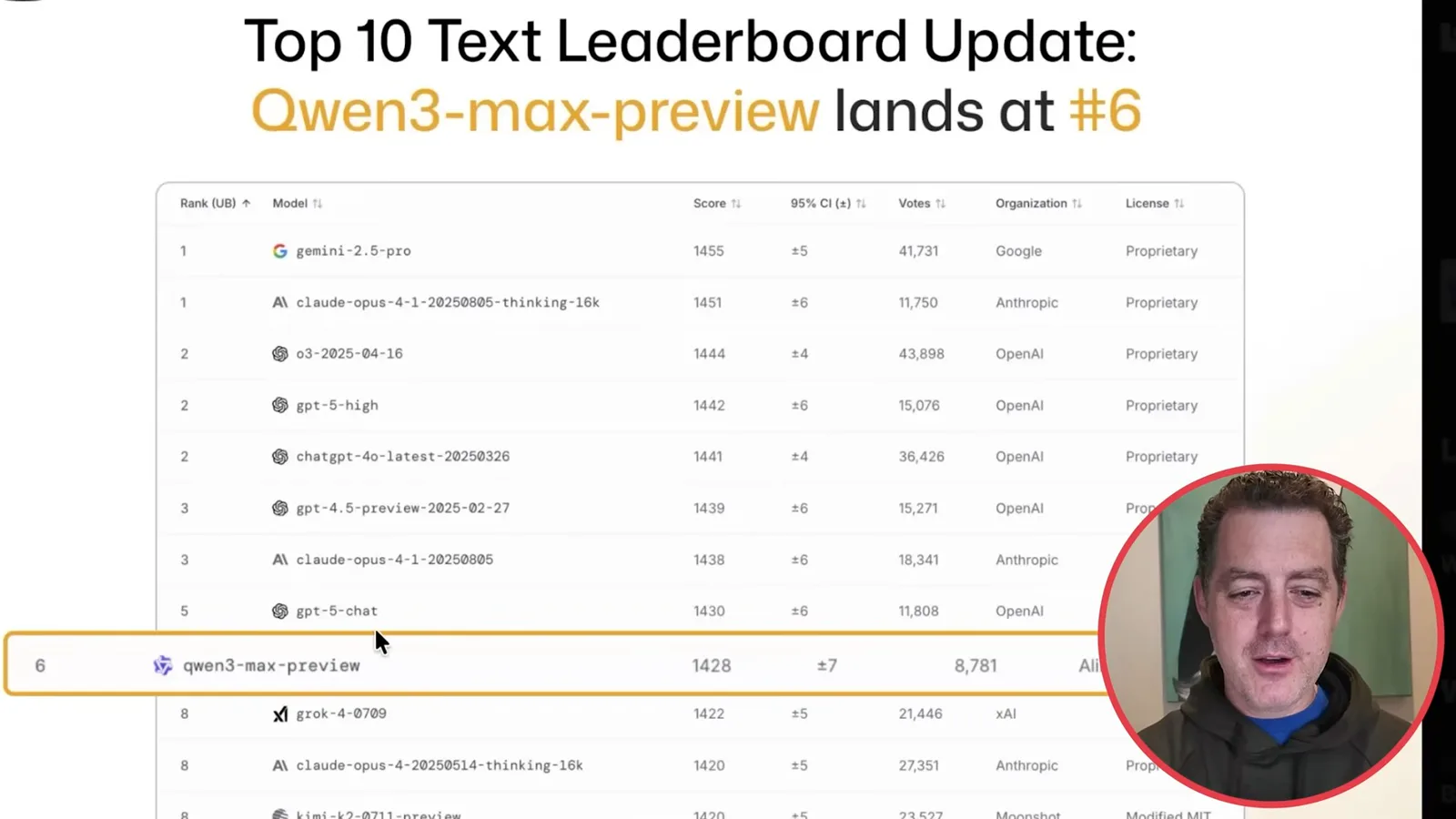
On the historical LMArena text leaderboard I show, Qwen3-Max Preview appears at rank six, with Kimi K2 also appearing near the top. The table reflects its own human-preference voting and uncertainty, not a universal ranking across applications. Kimi K2 had available weights, whereas the Qwen3-Max Preview discussed here was proprietary.
Robotics, Microsoft and Claude
Berman covers a reported Unitree IPO target and Microsoft’s reported interest in Anthropic models. He also describes Claude feature updates.
Reuters reported that Chinese robotics company Unitree was exploring an IPO at a valuation of about $7 billion. This was a reported target, not a completed listing. Unitree makes humanoid and quadruped robots; I do not have a consistent benchmark to compare its machines with those from Tesla, Boston Dynamics or Figure.
The Information reported that Microsoft planned to use Anthropic technology for some Microsoft 365 features, alongside OpenAI. I see a multi-model strategy as a way to reduce reliance on one provider, though my interpretation of negotiations is speculation. My on-air estimate of Microsoft's ownership should not be treated as an established equity stake in the nonprofit-controlled structure.
Anthropic announced mobile Claude connections that, with user permission, could use services such as maps and calendars. Claude also added the ability to create or edit files such as spreadsheets, documents, presentations and PDFs. I think direct access to useful workflows makes assistants more valuable, while the actual capabilities depend on permissions and product configuration.
Apple, NVIDIA, Oracle and Salesforce
The episode ends with translation hardware, an announced NVIDIA rack, Oracle’s cloud outlook and a Salesforce research-agent benchmark. Predictions and company claims are attributed.
Apple's 2025 event included the iPhone 17 family and AirPods Pro 3. I see earbuds as a promising voice-AI interface and highlight live translation. Such features depend on compatible hardware, software, languages and availability; my enthusiasm is not a guarantee that translation is instantaneous or works in every setting.
NVIDIA announced Rubin CPX for large-context inference. Its projected Vera Rubin NVL144 CPX rack combines CPUs and GPUs, with a stated eight exaflops of AI compute and 100 TB of fast memory for the whole rack, not a single GPU. NVIDIA expected availability at the end of 2026 at the time of announcement.
NVIDIA also promoted a potential $5 billion in token revenue per $100 million invested. This is the company's scenario-based revenue claim, not a guaranteed return, profit, or independent performance measurement. Actual economics depend on utilization, prices, infrastructure and operating costs.
Oracle shares rose sharply after a strong cloud outlook and its OpenAI-related cloud business, according to the report I discuss. The nearly $1 trillion valuation and Larry Ellison's position among the world's richest people were historical market snapshots that can change with share prices.
Salesforce introduced SFR-DeepResearch, research agents trained with reinforcement learning to plan, search and use code. The team reported 28.7% for SFR-DR-20B on the text-only Humanity's Last Exam using web search, browsing and a Python interpreter. This is a specific tool-assisted result, not evidence of equivalent performance on all research tasks.
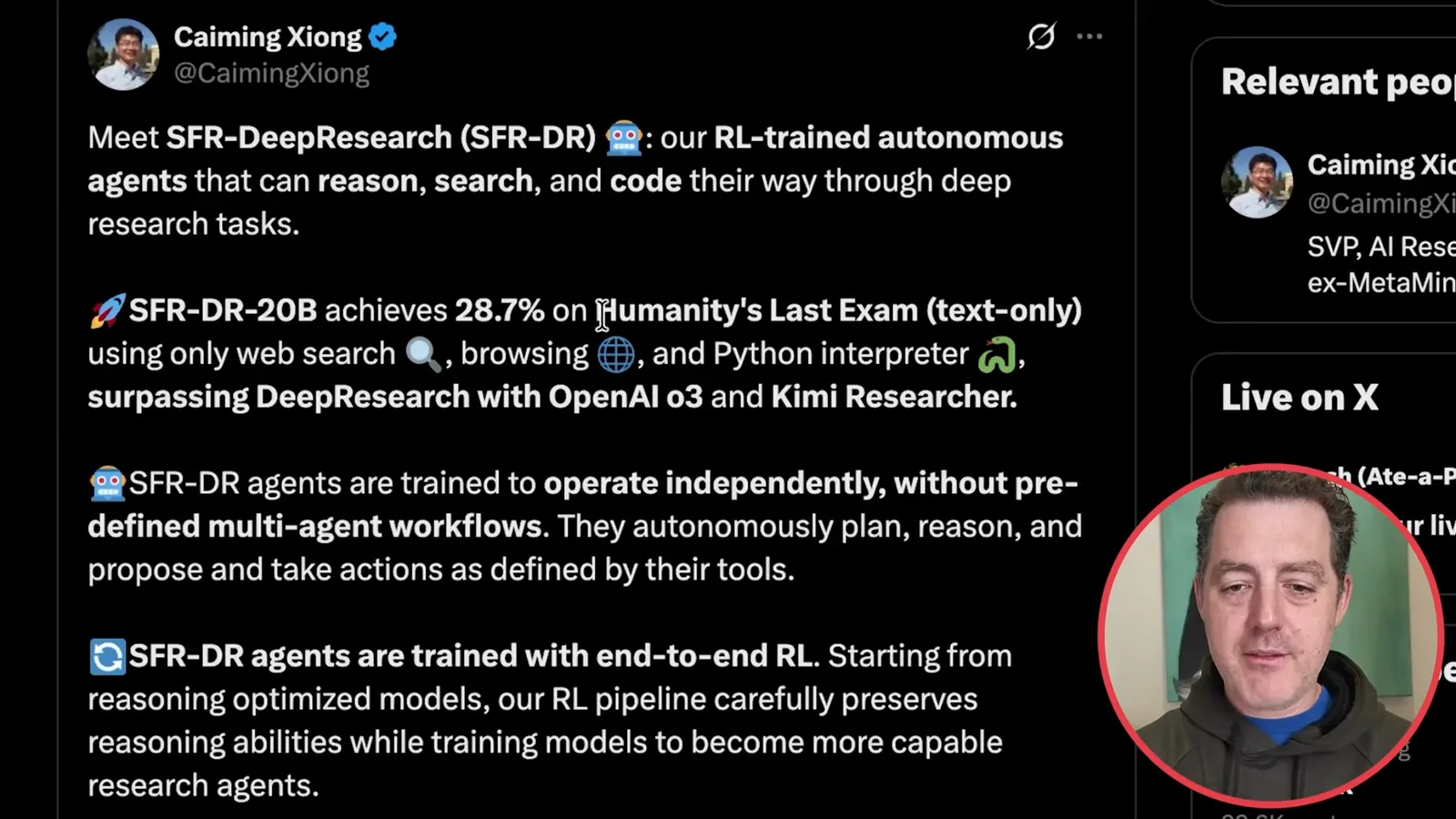
Salesforce said the agents could work without a predefined multi-agent workflow and manage their own memory. The researchers compared their result with selected deep-research systems; those comparisons depend on each evaluation's setup. I close by noting how surprising it is to see Salesforce enter this competitive research space and thank Spotter for sponsoring the episode.
Sur la même chaîne
 34:21EN
 Matthew Berman· 27 oct. 2026Matthew Berman Examines Anthropic’s IPO Filing, AI Growth and GovernanceMatthew Berman, Sam Altman · Forward FutureThe presenter reviews the S-1’s financial metrics, compute strategy and voting structure while questioning the tension between rapid AI development and safety.
 0:26ENMatthew Berman· 25 oct. 2026Sam Altman on Human Values and Problem-Solving in an AI WorldSam Altman · OpenAIIn a short interview excerpt, Altman considers the enjoyment of solving hard problems and the human role in interpreting results.
 0:36ENMatthew Berman· 25 oct. 2026Kimi K3.1 and a Rubik’s Cube Solver DemonstrationMatthew Berman · Forward FutureMatthew Berman shows a scrambled virtual cube being solved and gives the Kimi K3.1 test a favorable assessment.
 0:21ENMatthew Berman· 24 oct. 2026An AI-Generated Kimi Benchmark Chart Used Invented ScoresMatthew Berman · Forward FutureMatthew Berman asks for a graph of Kimi K3.1 Pro benchmarks, then discovers that the displayed figures are illustrative placeholders.
 25:50ENMatthew Berman· 24 oct. 2026Kimi K3.1 Pro Tested: Strong 3D Demos, Uneven Results and Competitive PricingMatthew Berman · Forward FutureMatthew Berman tests the open-weight model on coding, 3D rendering and visual explanations, then compares benchmark results and prices.
 32:20ENMatthew Berman· 23 oct. 2026Who Is Local AI For? The Costs, Trade-offs and a Hybrid FutureMatthew Berman · Forward FutureMatthew Berman weighs data control and independence against hardware cost, setup complexity and inference speed.