En 30 secondes
In this April 2026 video, Matthew Berman discusses reports that a Claude Code npm package accidentally exposed source through a source map, then reviews social-media interpretations of the coding harness. He highlights project instructions, parallel agents, permissions, context management, hooks and session continuity. Several implementation and cost claims are not independently verified, and rewriting proprietary code in another language does not automatically make it lawful or open source. The video includes a Zapier sponsorship.
- 1The reported exposureBerman discusses a source map accidentally shipped in an npm package and the resulting public discussion.
- 2Copyright and accessHis claim that rewriting in Python automatically makes the code legal is incorrect; exposure alone does not grant an open-source license.
- 3Project instructionsHe discusses CLAUDE.md as a place for coding standards and project context.
- 4Parallel agents and permissionsHe advocates subagents and permission configuration, while cost savings and safeguards depend on configuration.
- 5Compaction and continuityBerman reviews claims about context management and advises focused inputs and session continuity.
- 6Hooks and sessionsHe describes hooks, resumable sessions and interrupting an agent when it goes off track.
À retenir
- Reports said an npm source map exposed Claude Code client source in March 2026; Anthropic said no customer data or credentials were exposed.
- Publicly accessible source is not automatically open-source licensed, and a translation into another language does not eliminate copyright obligations.
- Project instructions, subagents, permissions, compaction and hooks are useful concepts, but detailed behavior depends on product version and configuration.
- Prompt caching may reduce repeated input costs, but parallel agents still incur work and are not automatically free.
- Automated permission choices and tests are fallible; the right controls depend on the task.
- Berman’s vision of a self-improving harness is a proposal, not proof of autonomous recursive model improvement.
Lire le texte remanié, chapitre par chapitre
The source-map exposure
Berman discusses the reported npm packaging incident and its potential implications. He makes legal and security claims that require qualification.
Matthew Berman discusses reports that an Anthropic npm release accidentally included a source map exposing Claude Code client source. The March 2026 incident prompted public examination of the coding-agent harness. Reporting at the time attributed the exposure to a packaging error, and Anthropic said no sensitive customer data or credentials were exposed.
Berman claims that converting the code to Python automatically makes it lawful and removes copyright protection. That is not correct: translating or adapting code does not automatically eliminate copyright or grant permission. Source becoming publicly accessible also does not make a proprietary project open source; licensing and rights depend on the applicable facts and law.
He sees the interest as evidence that developers value Claude Code’s harness: the tools and orchestration surrounding the model. Berman argues that the combination of harness and Claude models matters, and expects developers to study design ideas. His predictions about the effect on competing projects are speculative.
Berman relays a social-media analysis claiming thousands of files and a large codebase were exposed. Different public accounts reported different counts, and the video does not independently establish a complete inventory or imply that the underlying Claude model weights or training data were released.
He says developers may run local variants and combine a harness with different models, while suggesting Claude may work best. Practical compatibility depends on the implementation and provider. The legal status of a particular copy or derivative cannot be settled merely by changing programming languages.
Berman suggests that competitors could learn from permission handling, agent orchestration and other design ideas. He also says public scrutiny can reveal security weaknesses. Exposure can help defenders inspect code, but it can also help attackers, and publication alone does not ensure a system becomes secure.
He characterizes the incident as less severe than a leak of customer data or credentials, consistent with Anthropic’s reported statement, while offering his own assessment of the company’s handling. The video separately contains a paid Zapier sponsorship for its MCP service.
Instructions, subagents and permissions
He reviews social-media commentary about project instructions, parallel work and permission modes. Specific implementation and pricing assertions are not established by the video.
Berman turns to a social-media breakdown of the harness, beginning with CLAUDE.md files for project instructions, coding conventions and architecture. Such files can give an agent useful context, but the claim that every file is re-read on every turn and a specific 40,000-character limit are version-specific assertions not independently verified here.
He advocates parallel subagents and Git worktrees to separate concurrent work. He relays a claim that prompt caches are shared and make parallelism nearly free. Caching can reduce some repeated input costs, but separate agents still consume tokens and tool resources; cache hits, pricing and overall cost depend on the actual workload.
The commentary describes forked context, teammates and isolated worktrees as ways to organize agents. Berman favors parallelism, though not every task benefits from splitting work: coordination, conflicting edits and duplicated analysis can impose costs.
Berman recommends configuring permissions instead of repeatedly approving the same operations. He describes allow, bypass and automated permission choices. A permission prompt is not necessarily a configuration failure; asking for authorization can be the intended safeguard for actions whose scope or risk is uncertain.
He favors a classifier-assisted automatic mode and suggests bypassing permissions is effectively obsolete. Availability and mode behavior depend on version and settings, and automated classifications can make mistakes. Disabling checks or allowing broad actions carries different implications from granting narrowly scoped permissions.
Compaction, hooks and sessions
Berman discusses context reduction, lifecycle hooks and resumable work. He also offers practical advice about focused input and interrupting a mistaken run.
Berman discusses context compaction: reducing old conversation or tool output so a long session can continue. He relays an outside account of several mechanisms, including summarizing parts of a conversation, extracting session memory and truncating older messages. The specific internal taxonomy is not independently established by this video.
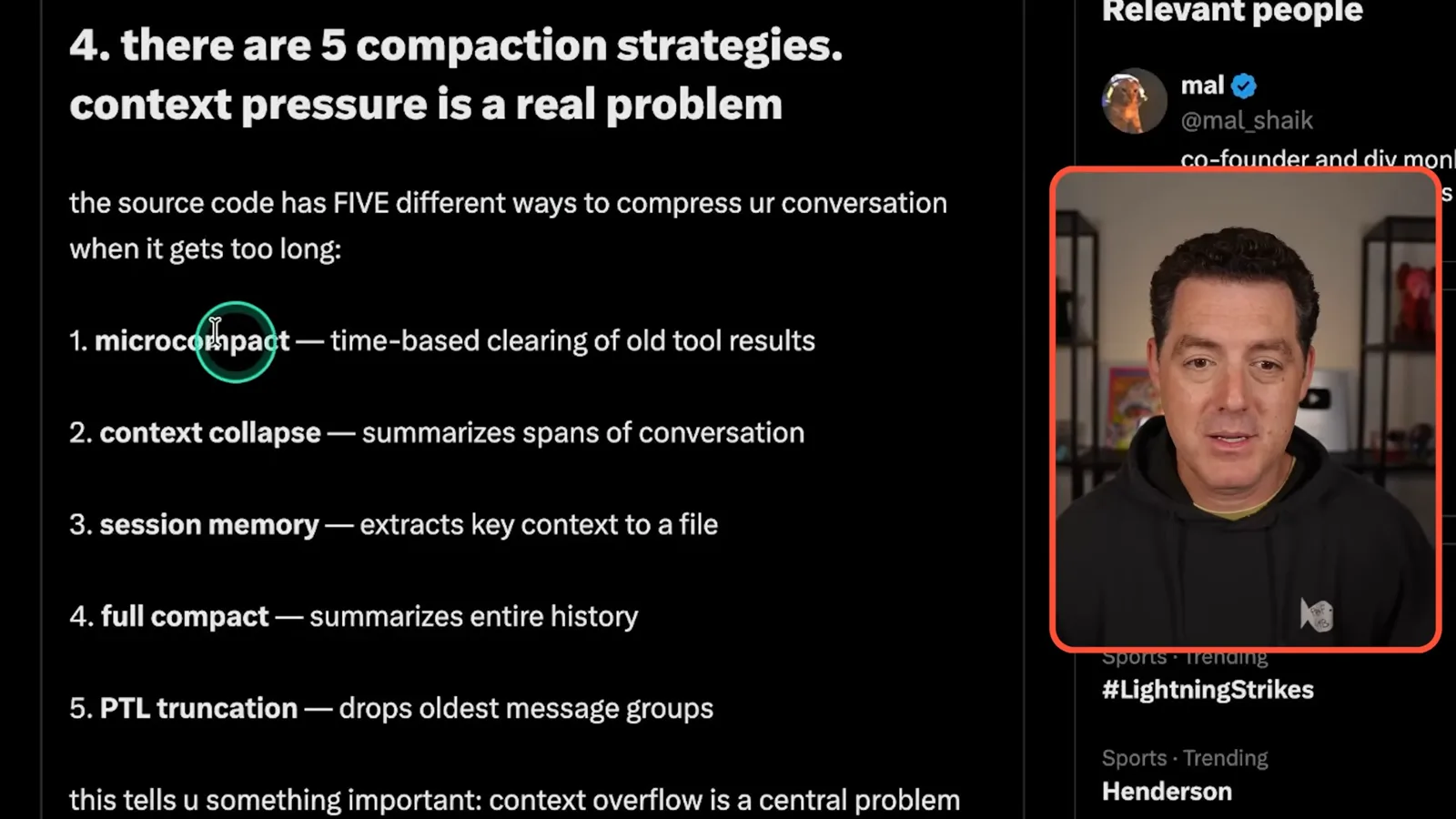
He recommends using /compact deliberately and keeping important context focused. Summaries can omit or distort details, whether triggered manually or automatically, so he advises users to think about what needs to survive. His numbers for context-window size and comparative model quality are historical claims that vary by model and configuration.
Berman says continuing an existing session can preserve useful task context and mentions claims that large tool results may be stored with a shorter preview. He recommends focused input. The exact storage and preview limits depend on implementation and version rather than being a universal guarantee.
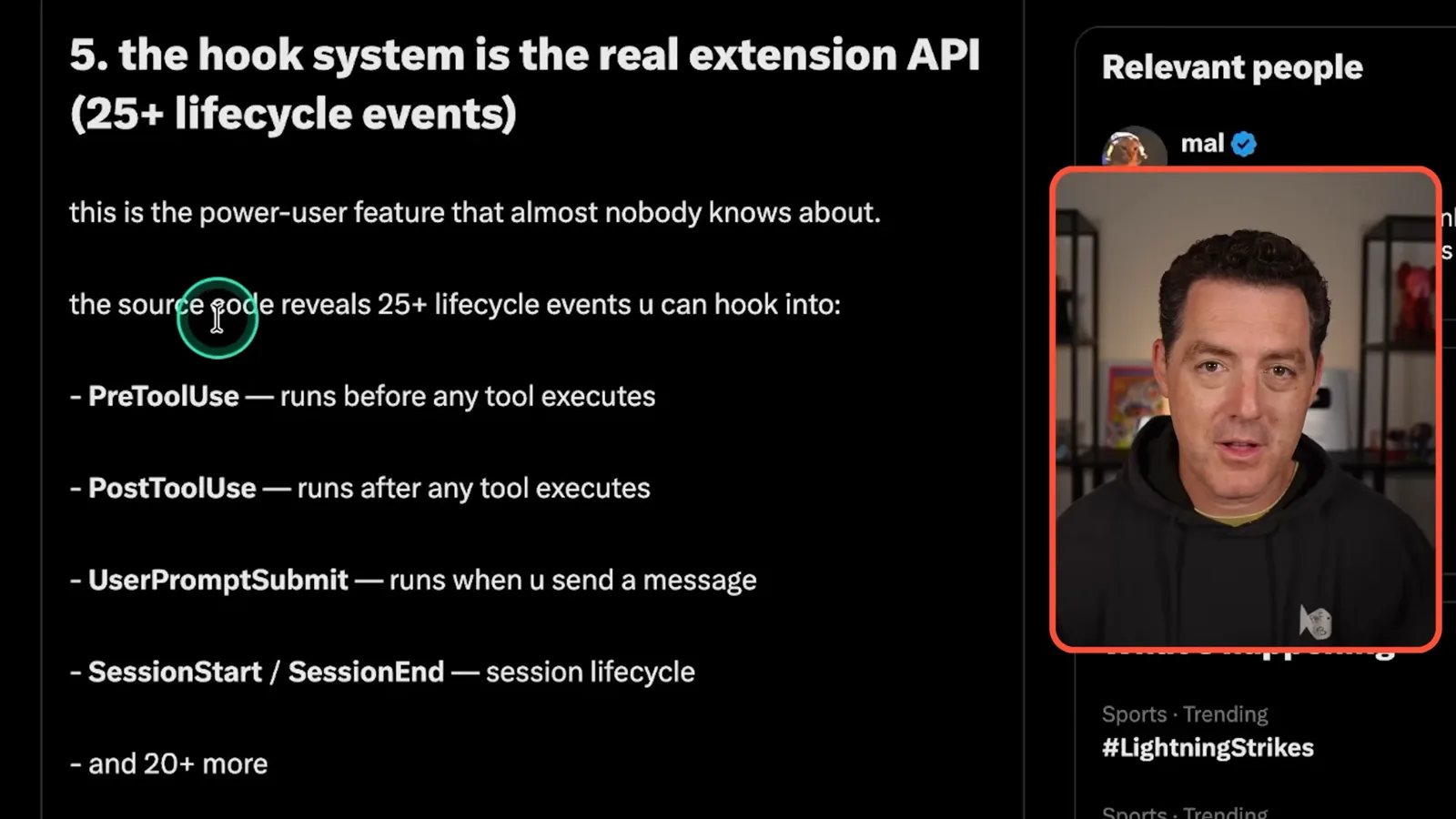
He introduces hooks that run around events such as tool use, prompt submission or session start and end. One proposed use is checking whether documentation should be updated after code changes. Hooks can automate checks, but the configuration must be designed for the intended trigger and effect.
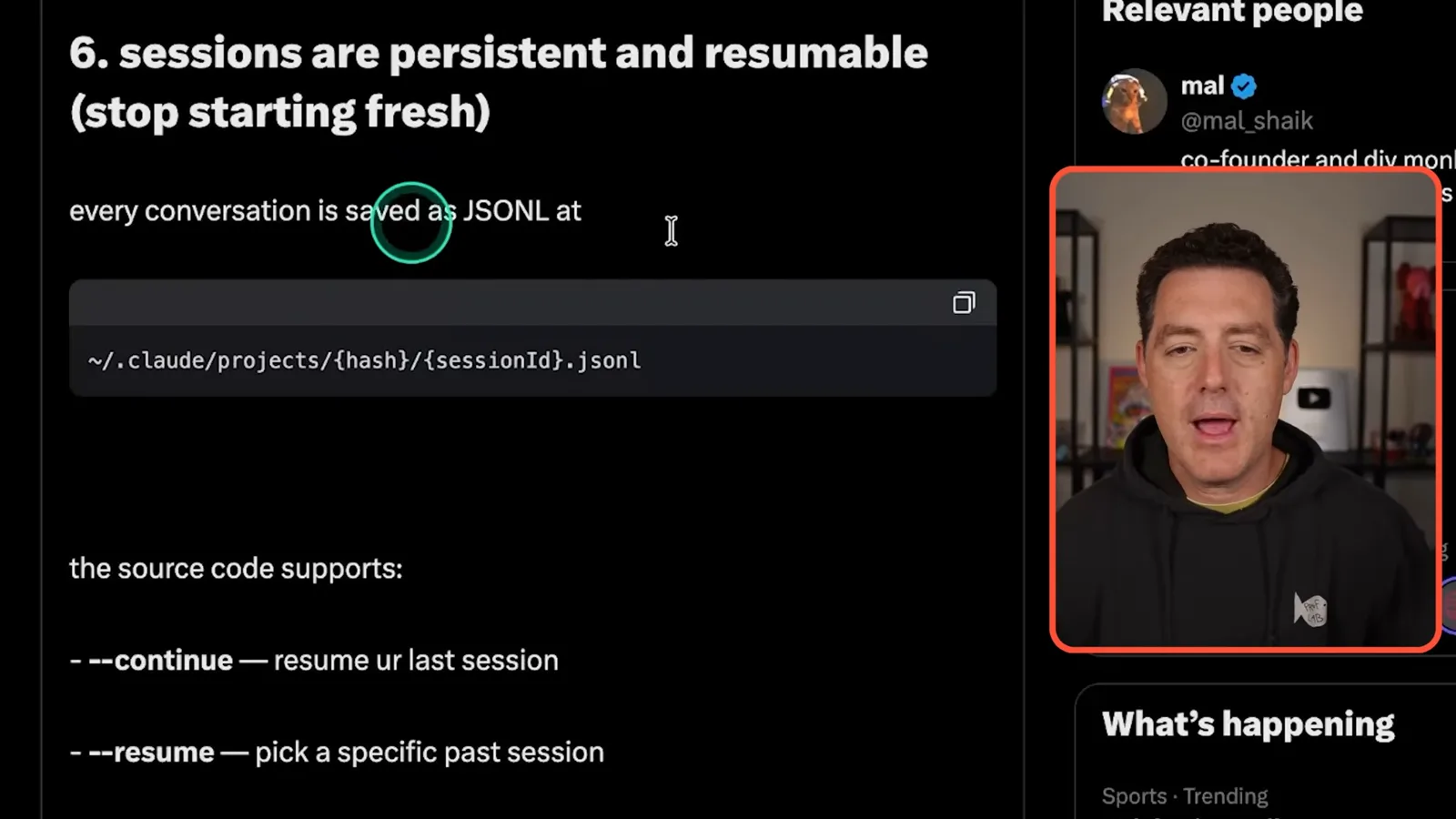
He describes continuing, resuming or forking sessions to retain relevant history, rather than starting over every time. This can help with continuity, though a fresh session can also be useful for an unrelated task; retained context is not necessarily complete after summarization.
Berman relays a claim about built-in tools and distinguishes parallel reads from serialized mutations. Exact tool counts and concurrency rules are version-dependent, and parallel agents can still conflict when they share a workspace. Worktrees can reduce overlap but do not eliminate the need to integrate and review changes.
He recommends interrupting an agent promptly when it is headed in the wrong direction instead of waiting for a bad result. Interruption may avoid further work and expense, although tokens already consumed are not recovered.
Self-improvement speculation
He imagines combining a harness with another system that modifies it. The video does not demonstrate autonomous recursive improvement.
Berman imagines using an external meta-harness to modify a coding harness and improve it over time. He welcomes the possibility of wider experimentation. This is a proposed workflow, not evidence that fully autonomous recursive self-improvement has been achieved.
Sur la même chaîne
 34:21EN
 Matthew Berman· 27 oct. 2026Matthew Berman Examines Anthropic’s IPO Filing, AI Growth and GovernanceMatthew Berman, Sam Altman · Forward FutureThe presenter reviews the S-1’s financial metrics, compute strategy and voting structure while questioning the tension between rapid AI development and safety.
 0:26ENMatthew Berman· 25 oct. 2026Sam Altman on Human Values and Problem-Solving in an AI WorldSam Altman · OpenAIIn a short interview excerpt, Altman considers the enjoyment of solving hard problems and the human role in interpreting results.
 0:36ENMatthew Berman· 25 oct. 2026Kimi K3.1 and a Rubik’s Cube Solver DemonstrationMatthew Berman · Forward FutureMatthew Berman shows a scrambled virtual cube being solved and gives the Kimi K3.1 test a favorable assessment.
 0:21ENMatthew Berman· 24 oct. 2026An AI-Generated Kimi Benchmark Chart Used Invented ScoresMatthew Berman · Forward FutureMatthew Berman asks for a graph of Kimi K3.1 Pro benchmarks, then discovers that the displayed figures are illustrative placeholders.
 25:50ENMatthew Berman· 24 oct. 2026Kimi K3.1 Pro Tested: Strong 3D Demos, Uneven Results and Competitive PricingMatthew Berman · Forward FutureMatthew Berman tests the open-weight model on coding, 3D rendering and visual explanations, then compares benchmark results and prices.
 32:20ENMatthew Berman· 23 oct. 2026Who Is Local AI For? The Costs, Trade-offs and a Hybrid FutureMatthew Berman · Forward FutureMatthew Berman weighs data control and independence against hardware cost, setup complexity and inference speed.