En 30 secondes
In this April 22, 2026 livestream, Matthew Berman records an opinion video about Anthropic’s subscription policies, reliability and computing capacity. He praises Claude’s models but criticizes the clarity of usage limits and third-party access, and argues that OpenAI is using those frustrations to compete. His claims about unit economics, company motives, relative revenue and future market outcomes are interpretations, not established facts; the episode includes an excerpt of Dario Amodei discussing hypothetical infrastructure risk.
- 1Claude Code pricing testBerman reacts to a pricing-page variant. An Anthropic executive says the experiment affected about 2% of new signups, not existing Pro and Max subscribers.
- 2A proposed coding flywheelBerman argues that coding models, enterprise revenue, data and compute reinforce one another. The degree of customer-data use depends on applicable settings and agreements.
- 3Compute and financial riskAmodei describes hypothetical infrastructure commitments and risks if forecast revenue falls short. His example is not a prediction that a specific competitor will go bankrupt.
- 4Third-party subscription accessBerman criticizes the short notice and unclear boundaries around third-party tools, while distinguishing extra usage and API billing from subscription access.
- 5Peak-hour limitsThe displayed March 26 announcement says five-hour session limits deplete faster during specified weekday peak hours; weekly limits remain unchanged.
- 6Opus 4.7 tokenizationAnthropic reported a 1.0–1.35× input token range depending on content and more output at higher effort; the net effect depends on workload.
- 7Infrastructure commitmentsThe AWS deal describes up to 5 GW and more than $100 billion over ten years; capacity is to arrive in stages.
À retenir
- Anthropic described the pricing-page change as a test involving about 2% of new signups, with existing Pro and Max subscribers unaffected; the video itself later shows Pro access restored.
- Subscription usage limits and third-party access rules differed from pay-as-you-go API access; Berman wants clearer terms and more freedom over usage.
- Anthropic reported a revenue run rate above $30 billion and acknowledged infrastructure strain in April 2026; a run rate is not booked annual revenue or proof of a larger business than OpenAI.
- Anthropic’s AWS agreement committed over $100 billion across ten years for up to 5 GW of capacity, rolling out in stages rather than immediately.
- Opus 4.7’s tokenizer can produce 1.0–1.35 times as many input tokens depending on content, while higher effort may produce more output; the effect on total usage varies.
- The assertion that either company loses money on every token, and predictions about customer migration and bankruptcy, are not established by the evidence shown.
- SpaceX announced a Cursor partnership and an option to acquire it, not an acquisition already completed at the time of the stream.
Lire le texte remanié, chapitre par chapitre
Opening and the pricing-page controversy
Berman opens the stream and describes a pricing-page experiment. He distinguishes Anthropic’s explanation from his own concerns about communication.
I want to discuss Anthropic after writing an essay about what I see as a difficult position for the company. I’m also recording a conventional video during this livestream, so some explanations are repeated and I pause to arrange material. My main concerns are communication, usage limits and the capacity needed to meet demand.
A pricing-page screenshot appeared to show Claude Code removed from lower subscription tiers. I initially describe the prospect of a Pro user needing the $100 Max plan, then note Anthropic’s explanation that this was a pricing experiment affecting around 2% of new signups. Existing Pro and Max subscribers were said not to be affected; that is not evidence of a universal removal.
I find the rollout and communications confusing, and I say the page seemed to have appeared more broadly than the stated test. That is my impression, not a verified measure of the experiment’s reach. When I check again during the stream, the page shows Claude Code back in Pro.
The coding flywheel and computing risk
He sketches how models, enterprise demand, revenue, data and compute might reinforce each other. An Amodei interview excerpt illustrates the financial risks of buying capacity against uncertain forecasts.
I characterize Anthropic’s culture as unusually focused on AGI, enterprise use and coding. That is my interpretation of its strategy, not an inside account of its priorities. I still like Opus 4.6 and 4.7 and use them regularly, but I am increasingly frustrated about what I can do within my paid subscription.
My explanation starts with a coding flywheel: build a strong coding model, sell access to enterprises, earn revenue and use resources and feedback to improve the next generation. I call it remarkable and suggest other labs have renewed their own focus on coding and enterprise. This is a conceptual business model rather than verified evidence of exactly how every company trains its models.
I suggest coding data contributes to further improvement and describe the process as self-improving AI. The statement should not be taken to mean Anthropic automatically trains on every customer’s private code: data use depends on the applicable product, settings and agreements. Model-assisted research and development also do not by themselves establish autonomous recursive self-improvement.
I begin drawing the flywheel, with a coding model leading to enterprise demand and revenue. In my view its strength is that each better model can attract more usage and support future development. The sketch is a way to explain my theory, not a disclosed financial model from Anthropic.
In the drawing I connect the coding product to enterprise customers and the money it brings in. I suggest coding is a very large AI market and that Anthropic has built an attractive product around it. My comparison of Anthropic and OpenAI revenue is not established by the chart I describe.
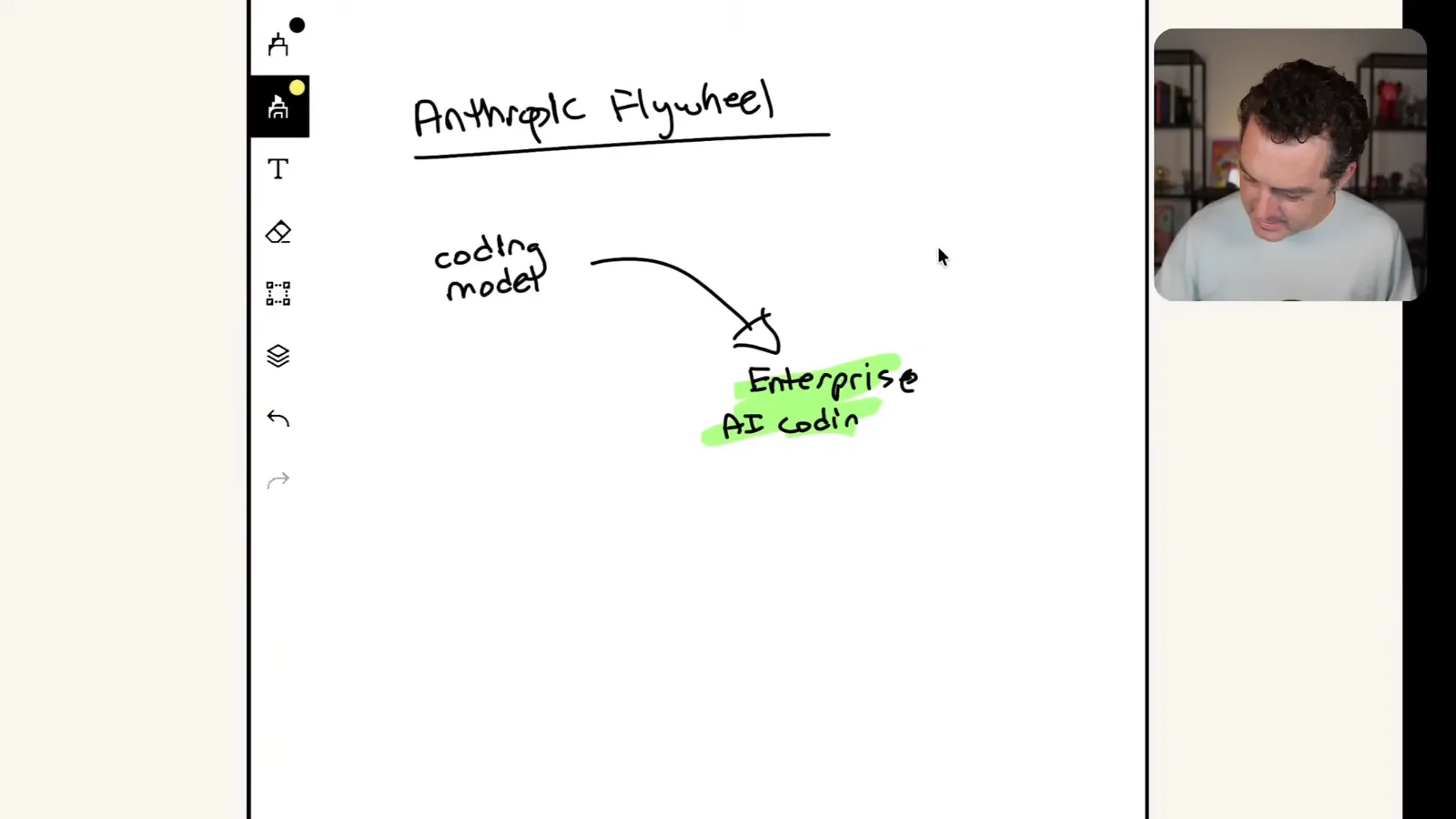
I add data to the diagram and argue that feedback and coding experience may help create better models. That link is an inference about how the business might work, with important distinctions between public training data, opted-in consumer data and protected enterprise inputs. The livestream does not establish what proportion of each is used.
I add servers and compute as another necessary link: the company needs capacity to serve existing users and train future models. My central argument is that demand has outpaced available capacity and that usage restrictions can weaken the flywheel. Anthropic itself later acknowledged demand-related reliability strain in its April 20 announcement.
I attribute the shortage to a judgment by Anthropic CEO Dario Amodei about the financial risk of buying too much compute. I believe the consequences include tighter quotas and frustrated agent users, while competitors may benefit. The specific causes of each policy and the amount of customer migration are not established by the evidence shown.
I introduce an interview clip with Amodei and interpret it as evidence that he worried about a competitor’s risk of bankruptcy. The excerpt itself is a hypothetical explanation of how overcommitting to compute can threaten a company if revenue grows more slowly than forecast; it does not establish a bankruptcy prediction for OpenAI.
I say Anthropic has passed OpenAI at roughly $30 billion in annual recurring revenue. Anthropic announced that its revenue run rate exceeded $30 billion, but a run rate is an annualized pace rather than actual annual revenue, and the stream does not provide a comparable verified OpenAI figure supporting my ranking.
In the clip, Amodei explains that data centers can take a year or two to become available. If revenue were assumed to grow tenfold each year, a company might contract for enormous future capacity; even a small miss against that projection could make the commitments unsustainable. He says his approach accepts some risk of insufficient capacity instead of committing at the highest possible forecast.
Amodei says responsible planning involves examining risks and spreadsheets rather than simply making very large commitments. He also says Anthropic spends somewhat less than some other players. These are his views in a discussion of investment risk, not independently verified financial comparisons.
After the clip I argue that choosing less aggressive infrastructure spending was a mistake because demand has exceeded supply. I expect frustrated users to move to OpenAI, which I see as responding aggressively to the opening. That is my forecast and interpretation; the clip does not prove actual migration or the eventual outcome.
I speculate that Anthropic may have counted on efficiency improvements and a smaller workforce to offset its computing needs. I say that even if efficiency improved, demand grew faster. The company’s internal forecasts and the relative effect of algorithms, infrastructure and customer behavior are not established in this stream.
Third-party tools and subscription limits
Berman describes his OpenClaw experience, disputed clarity and historical policy announcements. He contrasts subscription quotas with API pricing and checks status pages.
I describe running ten agents in parallel around the clock and argue that agentic workflows increase demand for compute. Tools such as OpenClaw and Hermes broaden the number of people running background tasks. My own usage is an example, not a measurement of how much compute the entire customer base uses.
As a paying Max subscriber, I am frustrated by what I see as barriers to using my allowance. I prefer explicit limits and pricing to policy changes that restrict the tools I can use. A subscription is governed by its terms and usage policies; it is not necessarily a purchased, freely transferable bank of tokens.
I say OpenClaw users often preferred Claude Opus for orchestration and that early guidance about using a Claude subscription in third-party harnesses was confusing. I describe switching to an Agent SDK route after seeing comments suggesting it might be acceptable for personal development. My experience does not establish the legal interpretation of every configuration.
I criticize the practice of announcing a policy, clarifying it in individual social-media replies, and then leaving users unsure how to apply it. I say I still do not know whether my particular OpenClaw setup is permitted. The relevant rules can change, so the historical comments shown should not be treated as current terms.
I find a post by Anthropic’s Thariq Shihipar saying a documentation cleanup had caused confusion and that use of the Agent SDK and Max subscriptions had not changed. He encouraged local development and experimentation and suggested API keys for businesses. I read the wording as insufficiently explicit about a personal third-party wrapper.
I look at the Claude status page as evidence of reliability problems. At that moment it displays approximately 98.8% uptime for claude.ai over 90 days and around 99% for other components. A status-page percentage is a historical, component-specific measure; differences in reporting methods and incident definitions complicate direct provider comparisons.
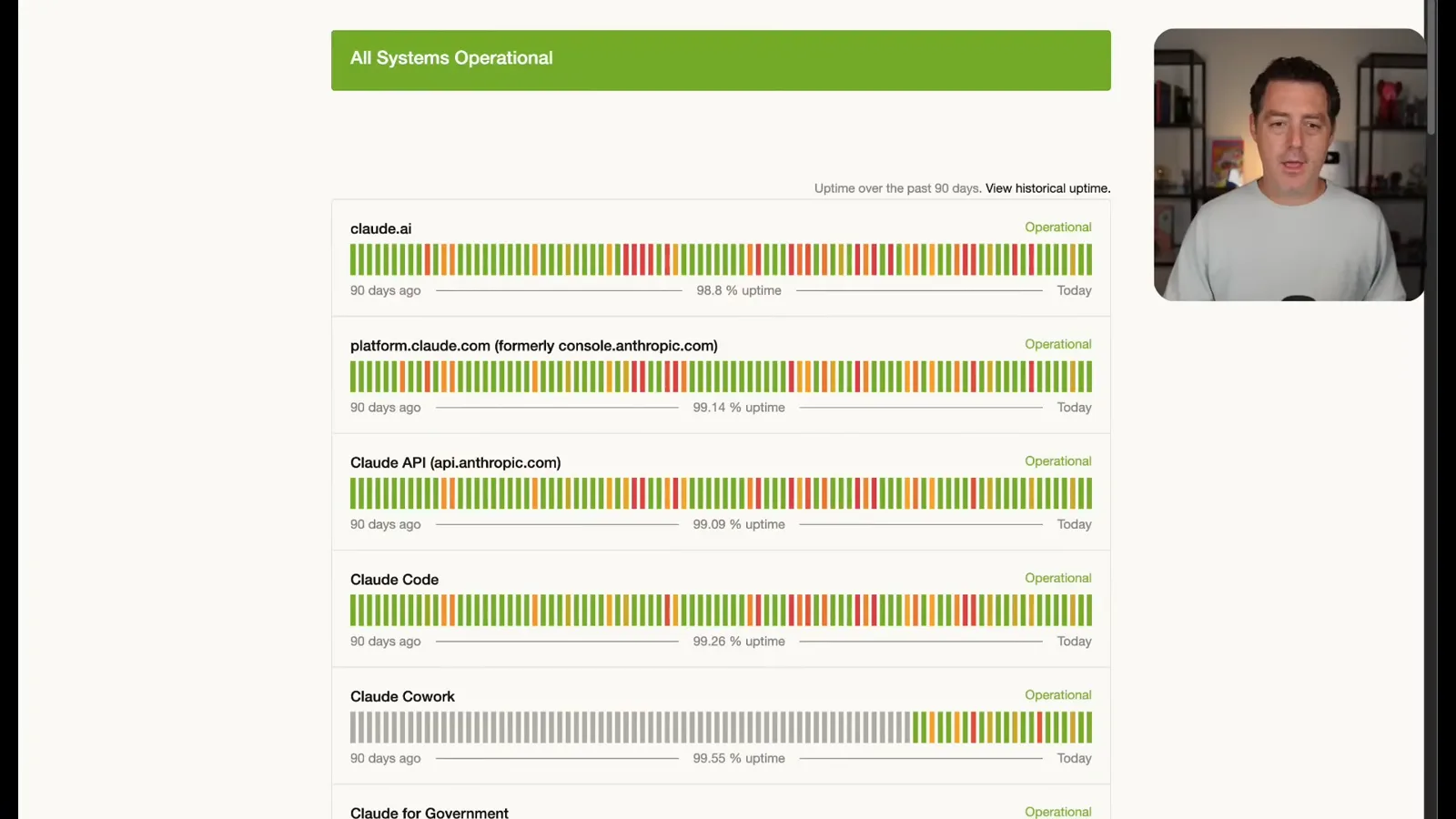
I compare those figures with OpenAI’s displayed service status, including higher percentages for the API, ChatGPT and Codex, while noting an issue appeared on ChatGPT during the stream. I consider the gap troubling. Neither page establishes that every incident has the same cause, nor proves that compute shortage alone caused each outage.
I turn to an April 3 announcement that Claude subscriptions would no longer cover usage in third-party tools such as OpenClaw starting the next day. The announcement said users could still use extra-usage bundles through Claude login or an API key. I object to the short notice, particularly over a holiday weekend.
My concern is the relationship between that announcement and previous comments about the Agent SDK and personal local tools. I want clear guidance on which configuration is allowed, how extra usage is charged and how it affects a subscription’s allowance. The stream records my uncertainty, not a definitive interpretation of the policy.
I read Anthropic’s explanation that its subscriptions were not designed for the usage patterns of third-party tools. I interpret this as a response to autonomous agents consuming more resources, and argue that a subscriber should be free to choose how to use an allowance. That is a product-policy preference; it does not establish the terms of the subscription.
I compare subscription economics to a car-wash plan where some customers use more service than others. I speculate that plans depend on many customers consuming less than the maximum. The video does not show Anthropic’s underlying cost model or prove why it made this particular change.
I note the announced one-time credit equal to a subscriber’s monthly plan cost and discounted extra-usage bundles. I then return to a public exchange about personal local tools using Claude’s own harness and an assurance that the documentation would be clearer. I remain dissatisfied that I cannot reconcile every statement with my own setup.
Peak hours, pricing tests and competitive messaging
He discusses off-peak incentives, peak-session limits and the Pro pricing experiment. He then reviews OpenAI staff responses and competing views of access and advertising.
I frame the company’s capacity management as a combination of incentives and restrictions. On March 14, a temporary promotion offered double usage during off-peak hours and weekends. I moved asynchronous work overnight and found that my allowance appeared to last longer; that is one personal experience under the promotion.
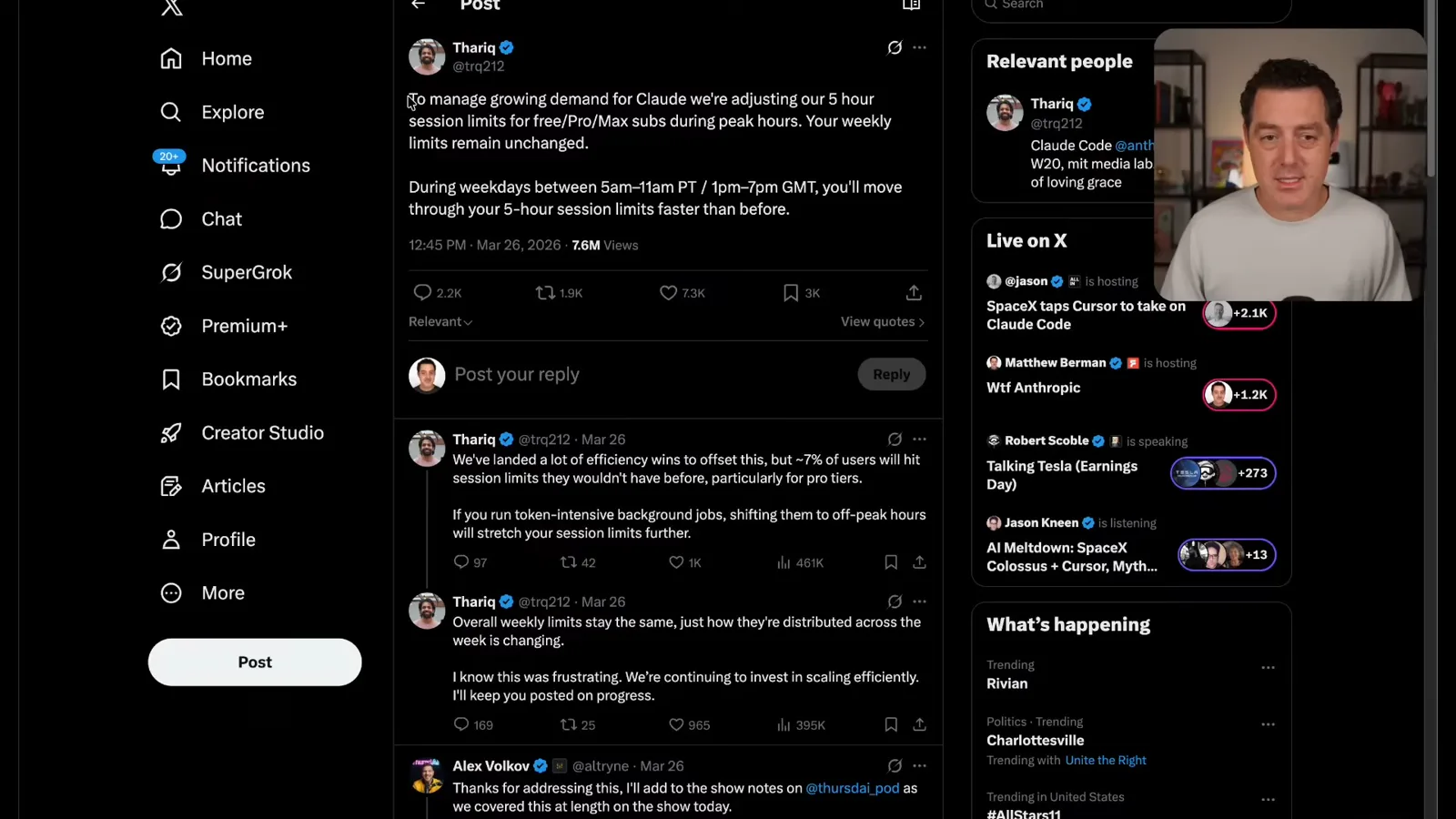
A March 26 post then announced changes to five-hour session limits during weekday peak hours, identified as 5 a.m. to 11 a.m. Pacific in the displayed post. Weekly limits remained unchanged, while usage during those hours would move users through session limits faster. I object that the company did not explain exactly how quickly different products and models would consume the allowance.
The post estimated that about 7% of users would hit a session limit they otherwise would not have, particularly on Pro tiers. I infer that these are predominantly OpenClaw and other agent users, but the announcement shown does not identify the affected 7% in that way. I describe the change as a penalty for intensive users and argue for clearer limits.
I contrast Anthropic’s restrictions with OpenAI’s public messaging. On April 7, Sam Altman announced a Codex limit reset to celebrate three million weekly users and said similar resets were planned at subsequent milestones. I see these announcements as a competitive response designed to win goodwill, though their long-term effects on retention are not shown.
I also mention Peter Steinberger, creator of OpenClaw, joining OpenAI, and say I can use an OpenAI subscription with my own OpenClaw setup. In my experience Opus works better for some uses, but I value stability and clarity in the competing offering. Product permissions and availability can change over time.
I return to the pricing-page screenshot. I argue that allowing Free or Pro users to try Claude Code within an explicit allowance could help them build projects and eventually upgrade. My criticism is about the proposed product strategy, not proof that existing subscribers had permanently lost access.
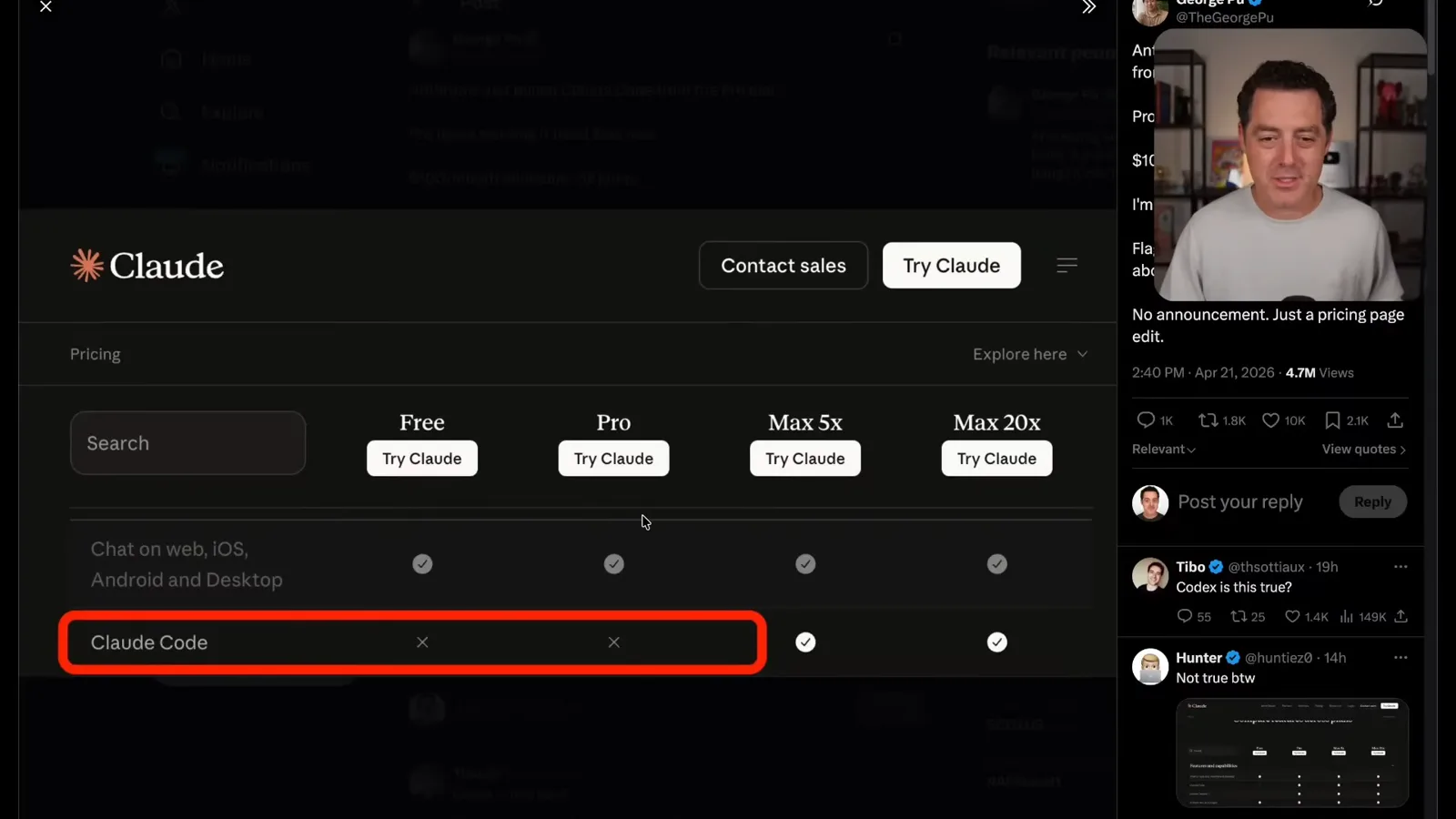
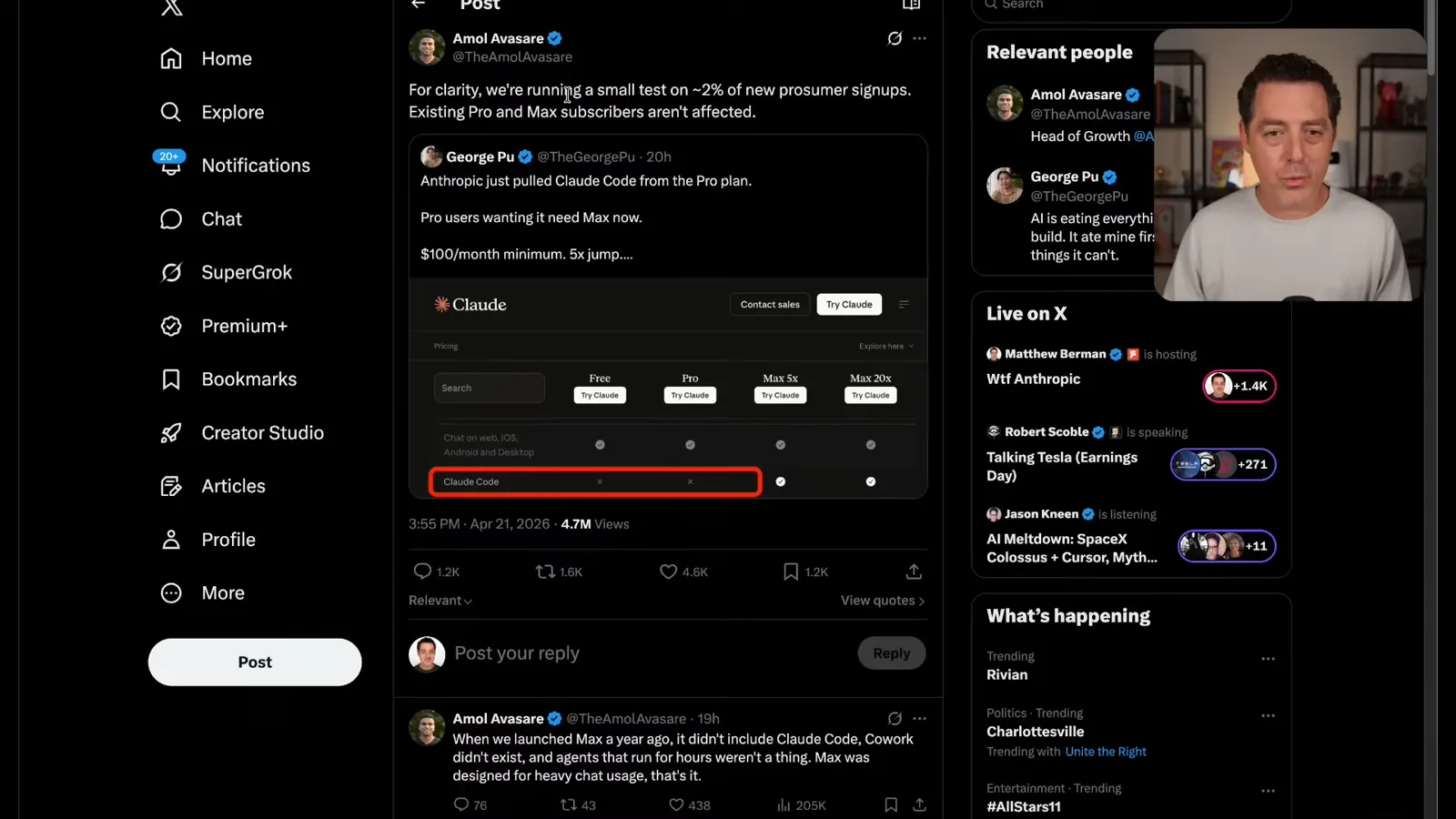
I read a statement from Anthropic growth executive Amol Avasare saying the company was testing options with approximately 2% of new signups and that existing Pro and Max subscribers were unaffected. He says Max was originally designed for heavy chat use, while Claude Code, Cowork and long-running agents later changed how subscribers use the service.
I respond that if usage patterns have changed, the company could raise prices or lower a clearly explained quota rather than restrict particular tools. I interpret the explanation as evidence that the company underestimated demand. That is my reading; the post does not prove the company expected every subscriber to leave a particular amount unused.
Avasare says weekly caps and tighter peak limits were earlier adjustments, and the company is testing options before deciding on changes. He says existing subscribers would receive notice of any changes affecting them. I challenge that promise by pointing to the short notice I experienced for third-party tool access.
I then show comments from OpenAI’s Codex team saying the product would remain available on Free and Plus plans and promising communication about important changes. I see the posts as direct competitive messaging aimed at Anthropic’s customers. Those statements describe the plans and intentions at the time, not a permanent guarantee.
Other OpenAI posts joke about making models and Codex available widely and suggest another rate-limit reset. I enjoy the rivalry and say the resets are becoming a meme. These posts illustrate how the companies communicated with users, not how many customers actually switched.
I reconsider my earlier discomfort with ChatGPT advertising: an ad-supported tier could make AI accessible to people who cannot afford a subscription. OpenAI’s US test concerned Free and Go users, including the paid Go plan; it was not limited to the free tier. I contrast that with Anthropic’s advertising critical of the approach, while acknowledging that views on advertising and access differ.
I describe Anthropic’s selective release of its Mythos model as a different approach to access and predict it might hurt the company. That is my opinion about a particular release strategy, not evidence that the company never publishes open software or that its decision will have a particular market result.
I look through Altman’s posts, including his reply to the pricing discussion and an emoji response that I interpret as a possible hint about a forthcoming GPT release. An emoji is not a confirmed release announcement or schedule. I plan to test any new model if it appears.
Model costs and compute supply
He discusses Opus 4.7 tokenization, argues about unit economics and sketches relative compute and demand. Several financial and capacity claims remain unverified.
I summarize my two biggest complaints: I want to know how my allowance is consumed and which tools I am permitted to use, and I would prefer a clear price or quota change to restrictions on the use case. I also explain why some users prefer subscription access over paying separately for API consumption.
I show criticism from Jeremy Howard and Theo about the pricing-page test. Theo reports that a new Pro account still worked with Claude Code despite the signup page he saw. These are individual reactions and observations; they do not independently establish the full test population, its implementation or intent.
I turn to Opus 4.7. Some users report preferring 4.6, while I still like both and particularly value the speed of Opus 4.6 fast. These are user impressions rather than a controlled comparison of the models.
I read Anthropic’s explanation of two separate changes. The updated tokenizer can map the same input to roughly 1.0–1.35 times as many tokens depending on content, while higher effort may generate more reasoning output, particularly in later agentic turns. That range is not a universal 35% increase in every request.
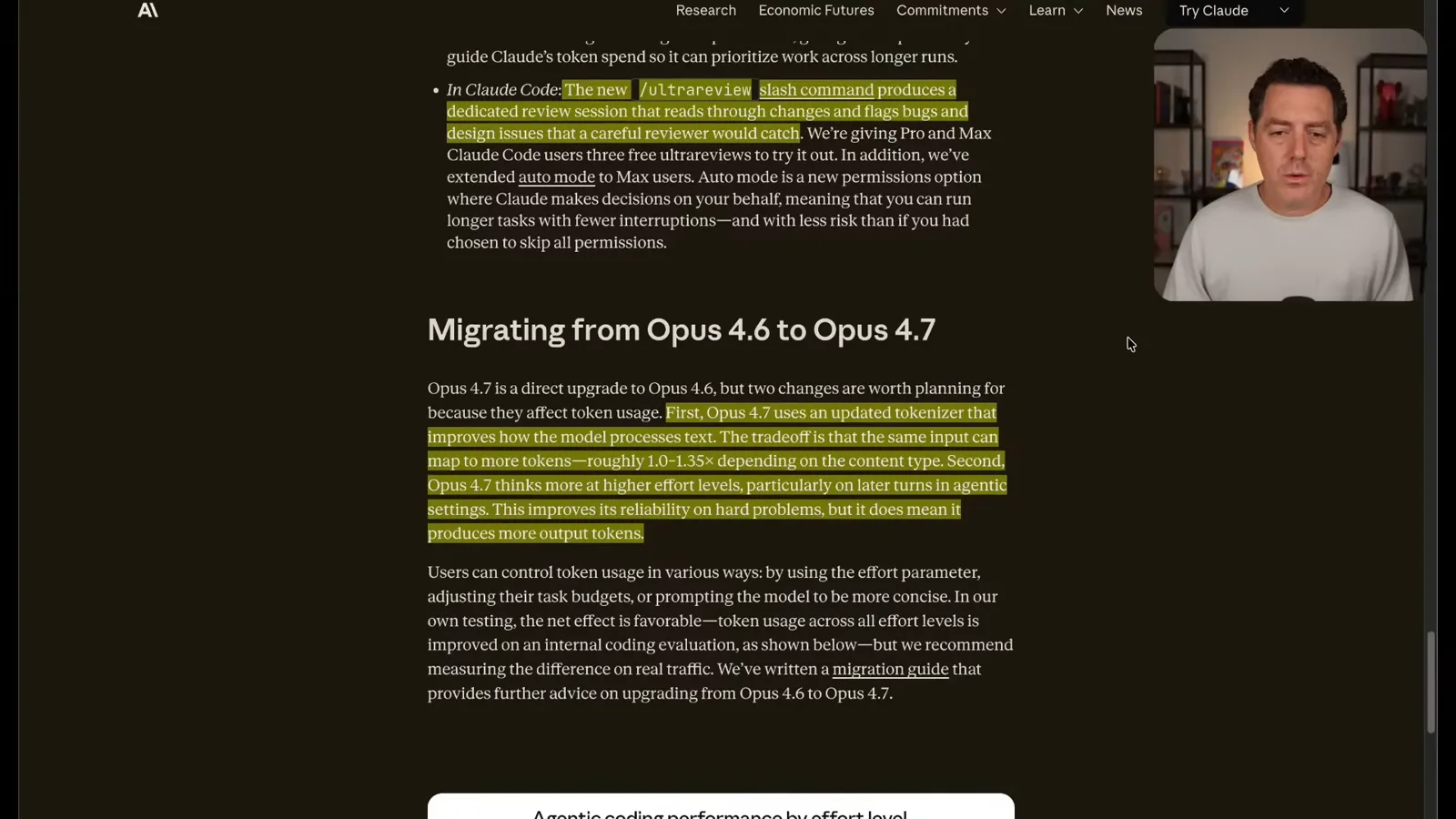
I argue that the changes may make scarce quota harder to manage. Anthropic also reports that on its internal coding evaluation the net token usage was improved across effort levels and recommends measuring real traffic; the outcome therefore varies with task, effort and configuration. The video does not prove that every subscriber’s quota will run out faster.
I discuss the business economics and argue that frontier labs may subsidize heavy users, comparing the situation to venture-funded companies that operated at a loss while growing. My specific assertion that Anthropic loses money on every token, and later that OpenAI does too, is not supported by disclosed per-token cost evidence in the stream.
I think the company faces a difficult choice: higher prices might send customers to alternatives, while insufficient capacity can constrain service. I describe policy restrictions and opaque quotas as indirect price increases. Those are my interpretations of trade-offs; the actual financial effect varies across users and plans.
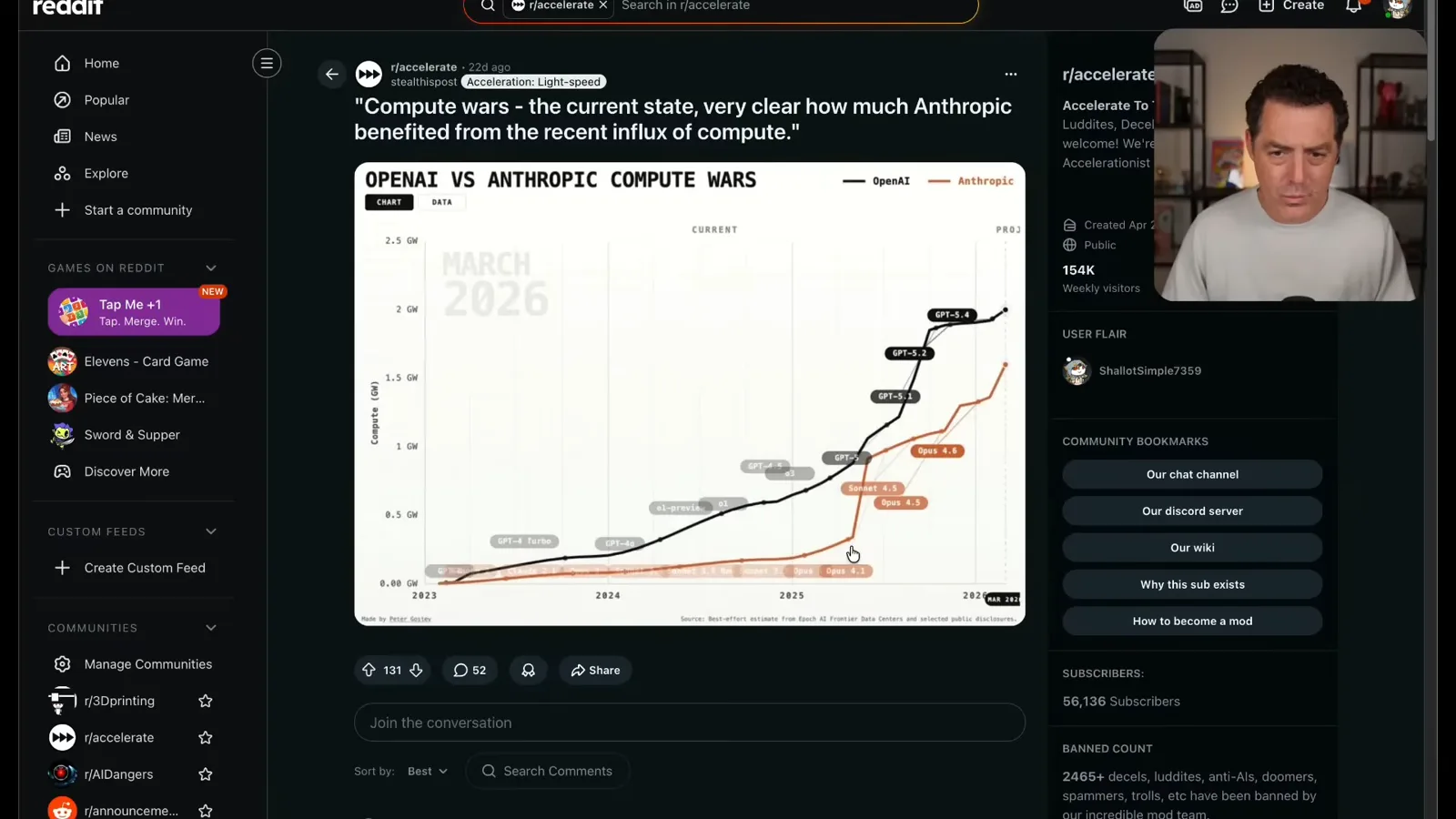
I say OpenAI has invested more aggressively in infrastructure and search for a comparative compute chart. The chart shown is a best-effort estimate based on public data, not an audited account of either company’s deployed compute. Capacity, hardware and availability are difficult to compare directly from a single gigawatt line.
I note that both OpenAI and Anthropic have announced new infrastructure arrangements, but delivery can take time. I then draw a spectrum comparing supply and demand among xAI, Google, OpenAI and Anthropic. The diagram expresses my judgment of their relative positions, not verified utilization measurements.
I put xAI toward the compute-rich side and Anthropic toward the demand-heavy side. I speculate that xAI has spare capacity and that Anthropic cannot meet all demand. The stream does not provide utilization data sufficient to quantify unused capacity or establish the precise balance for either company.
I place Google closer to the compute-rich side and discuss its TPUs, Gemini and cloud services for competitors. I am impressed by the breadth of its infrastructure, but my sweeping claim that Google has no downtime is not established; any provider can experience incidents, and capacity available to one customer is not necessarily available to another.
I put OpenAI nearer the middle, judging that it has substantial demand and more compute than Anthropic. I then acknowledge that the sketch would work better with two axes for supply and demand. The ranking and quantities are my approximate interpretation, not audited cross-company figures.
AWS, Cursor and closing reflections
Berman reviews Anthropic’s AWS agreement and the announced SpaceX–Cursor collaboration. After recording his conclusion, he returns to the live chat and closes.
I mention a recent interview with Google Cloud CEO Thomas Kurian and ask how Google can serve its own models, cloud customers and hardware demand. I contrast the company’s strategy with AWS. The comparison is simplified: AWS also develops its own AI models and chips alongside offering other providers’ models.
Anthropic’s April 20 announcement says it committed more than $100 billion over ten years to AWS technology for up to 5 GW of new capacity, including Graviton and Trainium generations. It says new capacity would come online in stages, including nearly 1 GW by the end of 2026, while Amazon would invest $5 billion with up to $20 billion more in future.
I argue that customers may look elsewhere while waiting for new capacity to arrive. Anthropic’s announcement itself acknowledges rapid growth and reliability strain, but the video does not quantify how many customers left or establish that all lost demand went to OpenAI.
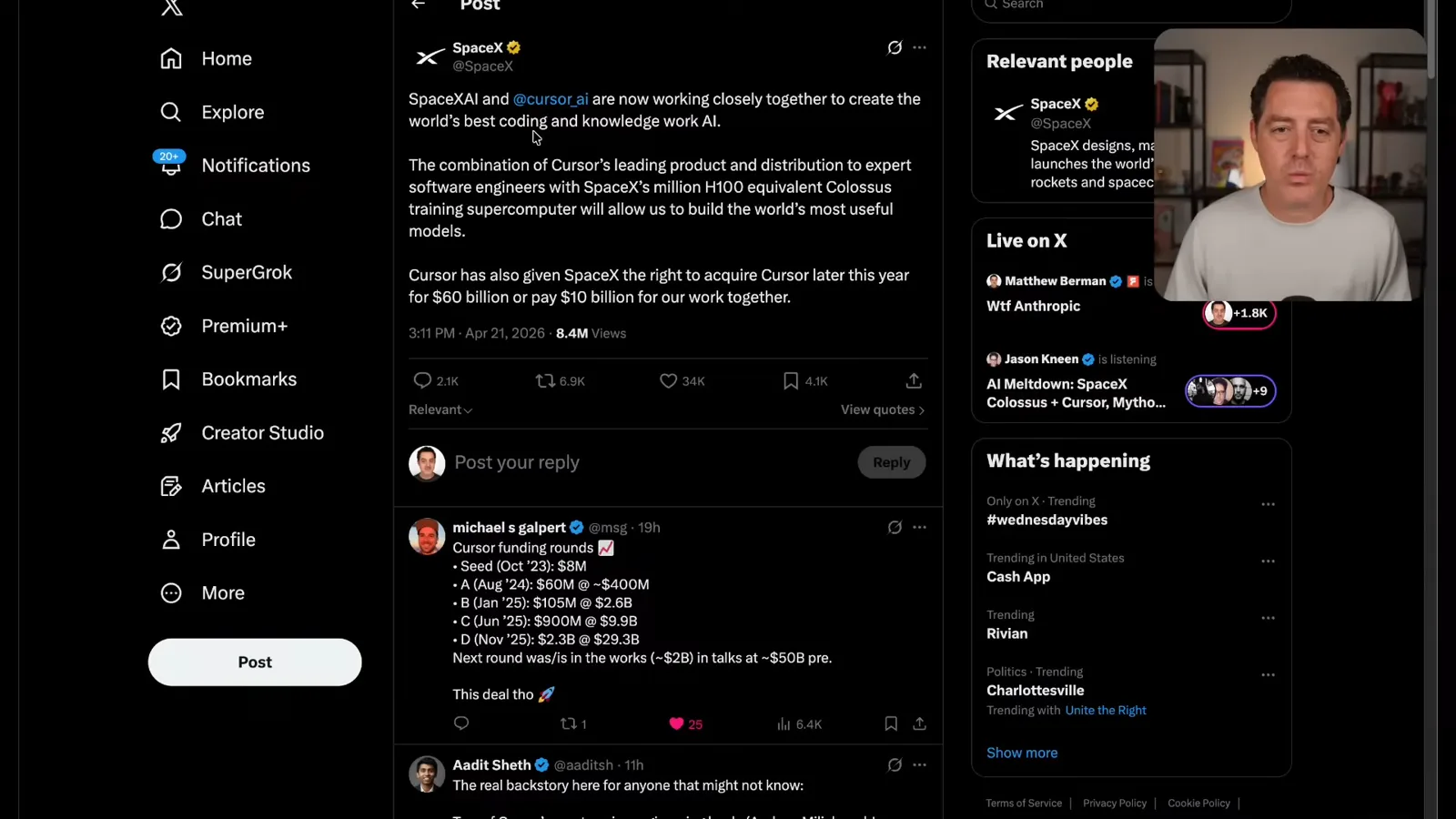
I turn to the SpaceX and Cursor collaboration. The announcement describes working together on coding and knowledge-work models, using Cursor’s product and xAI’s Colossus infrastructure. SpaceX said it had the right to acquire Cursor later for $60 billion, or pay $10 billion for work together; at the time described, that was an option and partnership, not a completed acquisition.
I consider the potential combination of Cursor’s product, engineering expertise and xAI compute strategically interesting. I suggest it could help use otherwise idle capacity, but the amount of idle infrastructure and the rights to any customer data are not established by the announcement. I disclose that Cursor has provided me tokens, although I say it does not sponsor my videos.
My conclusion is that Amodei underestimated demand while Altman was more willing to risk large commitments, and that OpenAI may gain from Anthropic’s mistakes. This is my assessment, not proof that either company’s strategy will win or that one CEO’s forecasts are definitively correct. I regard competition as potentially useful to customers.
I finish recording the prepared video by returning to the proposed flywheel: in my view, Anthropic needs more compute and clearer quota decisions while new capacity comes online. The AWS deal is a capacity commitment with a staged timetable, and the outcome for customers and competitors remains uncertain.
Back in the live chat, a viewer accuses me of favoring OpenAI. I say OpenAI does not pay me or give me free tokens and that I have long liked Anthropic’s products; I am presenting my own reading of the situation. I also say I choose topics based on what interests me, rather than deliberately avoiding Kimi.
I discuss experimenting with a format that combines a livestream with recording an edited video, inspired by other creators. After an unexpected loud noise, I briefly leave to investigate and later explain that someone moving furniture dropped something near my office.
Before closing, I read a comment that Claude remains an excellent product and that unusually strong demand is a favorable problem, even if managing it creates awkward restrictions. I agree that I still consider Claude excellent, and compare the tension to a place whose appeal remains high despite frustrating policies. I thank viewers and the team and end the stream.
Sur la même chaîne
 34:21EN
 Matthew Berman· 27 oct. 2026Matthew Berman Examines Anthropic’s IPO Filing, AI Growth and GovernanceMatthew Berman, Sam Altman · Forward FutureThe presenter reviews the S-1’s financial metrics, compute strategy and voting structure while questioning the tension between rapid AI development and safety.
 0:26ENMatthew Berman· 25 oct. 2026Sam Altman on Human Values and Problem-Solving in an AI WorldSam Altman · OpenAIIn a short interview excerpt, Altman considers the enjoyment of solving hard problems and the human role in interpreting results.
 0:36ENMatthew Berman· 25 oct. 2026Kimi K3.1 and a Rubik’s Cube Solver DemonstrationMatthew Berman · Forward FutureMatthew Berman shows a scrambled virtual cube being solved and gives the Kimi K3.1 test a favorable assessment.
 0:21ENMatthew Berman· 24 oct. 2026An AI-Generated Kimi Benchmark Chart Used Invented ScoresMatthew Berman · Forward FutureMatthew Berman asks for a graph of Kimi K3.1 Pro benchmarks, then discovers that the displayed figures are illustrative placeholders.
 25:50ENMatthew Berman· 24 oct. 2026Kimi K3.1 Pro Tested: Strong 3D Demos, Uneven Results and Competitive PricingMatthew Berman · Forward FutureMatthew Berman tests the open-weight model on coding, 3D rendering and visual explanations, then compares benchmark results and prices.
 32:20ENMatthew Berman· 23 oct. 2026Who Is Local AI For? The Costs, Trade-offs and a Hybrid FutureMatthew Berman · Forward FutureMatthew Berman weighs data control and independence against hardware cost, setup complexity and inference speed.