En 30 secondes
In February 2025, Matthew Berman discusses a paper on recurrent-depth language models alongside Yann LeCun’s criticism of language-only AI. The paper reports improvements on selected benchmarks as a 3.5-billion-parameter model repeats a block at inference time, but the results have finite compute costs, vary by task and do not establish human-like thought, unlimited improvement or AGI. Berman’s broader claims about human cognition and future systems are analogies and speculation.
- 1Computation in latent spaceA shared block iterates internally before predicting the next token, without requiring a textual reasoning token at every iteration.
- 2LeCun on world modelsInterview excerpts argue that fluent language alone does not establish human-like planning or a predictive world model.
- 3A proof-of-concept modelThe paper reports a 3.5-billion-parameter recurrent model trained on 800 billion tokens and evaluates test-time scaling.
- 4Costs and trade-offsReusing parameters can reduce parameter and communication demands, but extra iterations still require computation and latency.
- 5Benchmark resultsSelected HellaSwag, GSM8K and HumanEval results improve over tested recurrence counts, with gains flattening in parts of the chart.
- 6Adaptive exitsThe paper’s histograms measure steps to a prediction-stability threshold across MMLU questions, not guaranteed correctness.
À retenir
- The recurrent-depth model repeatedly updates a latent state before predicting an output token; input and generated text still use tokens.
- The proof-of-concept model has 3.5 billion parameters and was trained on 800 billion tokens, without specialized chain-of-thought training data for the proposed approach.
- More recurrence improved several reported benchmarks within the tested range, but some results plateau or vary, and additional steps consume time and compute.
- Figure 10 plots per-token iterations until a prediction-change threshold is met, not the number of steps required to answer correctly.
- The authors propose that latent computation and textual chain of thought can complement each other; they do not establish human-equivalent reasoning or AGI.
- LeCun’s objections to language models and Berman’s proposed connection to this paper are viewpoints, not settled conclusions.
Lire le texte remanié, chapitre par chapitre
Language, planning and LeCun’s critique
Berman introduces latent computation and plays excerpts of Yann LeCun discussing planning and language fluency. He considers whether chain of thought addresses those objections.
A new research paper explores language models that perform additional computation in latent space before predicting a token. Many reasoning systems scale test-time compute by generating intermediate text; here the model can instead repeat a learned internal block. The model still reads input tokens and generates output tokens, and its internal iterations consume computation.
I connect this to Yann LeCun’s arguments about the limits of language models. In a Lex Fridman interview, he argues that planning requires a predictive model of the world and uses examples of an object falling or moving when pushed. These are his views on the requirements for human-like planning, not a settled verdict on every language model.
LeCun’s example is that people can anticipate the results of actions and plan a sequence toward an objective. I interpret his argument as requiring more than what language alone describes. I also note that the interview predates the widespread adoption of the recent generation of test-time reasoning models.
I find written chain-of-thought steps persuasive as an illustration of problem solving, while LeCun warns that fluent language can make a system seem more generally intelligent than it is. I acknowledge that verbal reasoning could still amount to language manipulation. A displayed rationale is not necessarily a complete or faithful account of a model’s internal computation.
In another excerpt LeCun expresses skepticism about generative models learning adequate representations of the real world. I contrast this with my impression of the industry’s optimism about AGI and advanced reasoning. Those are contested forecasts and positions; the interview does not establish that all major companies believe language models alone are sufficient.
A recurrent-depth model
The paper proposes repeatedly applying a shared block to latent states. Berman compares this with verbal chain of thought and discusses possible advantages.
The paper is ‘Scaling up Test-Time Compute with Latent Reasoning: A Recurrent Depth Approach.’ Its authors repeatedly apply a shared recurrent block to a latent state, allowing variable computational depth before output prediction. I wonder whether this might address some of LeCun’s concerns, but the paper does not demonstrate a learned physical world model or settle his argument.
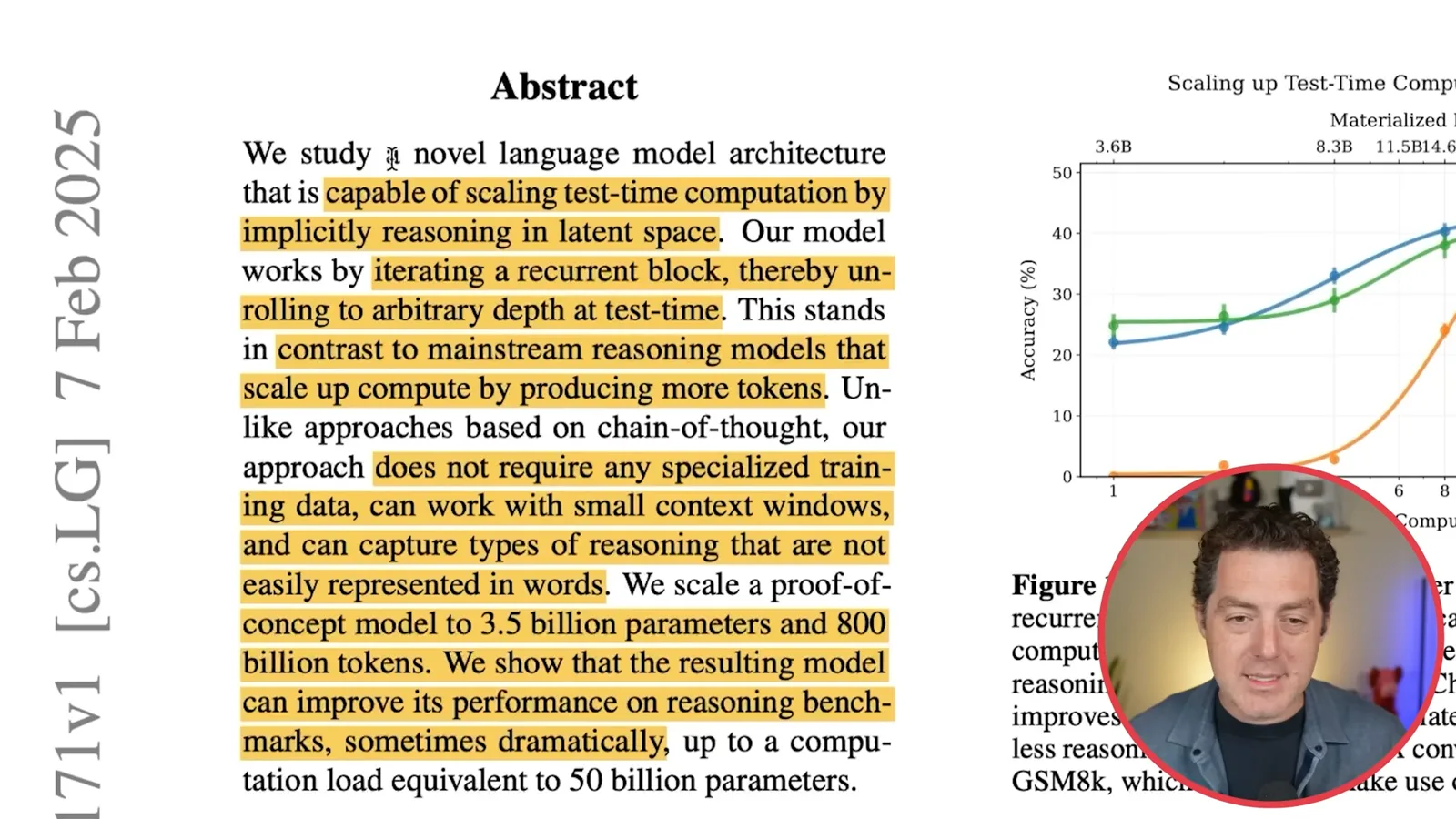
The researchers report a 3.5-billion-parameter proof-of-concept model trained on 800 billion tokens. They describe varying recurrence at test time instead of necessarily producing a long verbal chain. Although the architecture allows different numbers of iterations, running indefinitely is not practical, and the experiments do not show that more iterations always improve answers.
The authors argue their approach needs no specialized chain-of-thought training data, can operate with smaller context windows and may represent computations not easily expressed in words. This does not mean the model needs no training data: it was pretrained on a large token corpus. Memory, compute and latency comparisons depend on implementation and workload.
I compare latent computation with the human experience of forming an idea before speaking, including people who report little or no inner monologue. It is an analogy for thinking without a verbal transcript, not evidence that the model’s internal states work like human thought or have subjective experience.
Training, efficiency and architecture
He considers training data, reinforcement learning, memory and hardware trade-offs. A diagram illustrates repeated internal computation before a token prediction.
The paper contrasts its method with approaches that train models to verbalize intermediate steps. I raise a question about smaller reinforcement-learning demonstrations that elicit reasoning behavior without extensive worked reasoning examples. Training methods differ, so a claim about this architecture’s data requirements should not be read as a rule that every chain-of-thought system requires the same dataset.
The authors suggest that forcing all intermediate computation through a textual next token may be limiting, and point to prior recurrent neural networks, diffusion models and looped transformers. The idea of recurring computation is not new; the contribution here is a particular architecture and its scaling experiment, not the invention of internal model states.
The reported model can spend more inference compute by iterating its recurrent block. The authors compare it with selected open models that have different parameter counts and training data. Performance comparisons are task- and compute-dependent; the paper does not establish that this method is universally more efficient or better than larger models.
The paper discusses potential memory and accelerator communication advantages from a smaller parameter set reused for additional operations. I explain this as doing more work per parameter, but it does not imply that all workloads fit on one GPU or eliminate multi-device communication. Additional recurrent steps still increase computation, and their actual cost depends on deployment.
The authors hope a compute-heavy architecture may encourage general strategies rather than simple memorization. I relate that hope to the debate about whether models generalize beyond training examples. Both memorization and generalization can occur; this experiment does not resolve the debate or demonstrate artificial general intelligence.
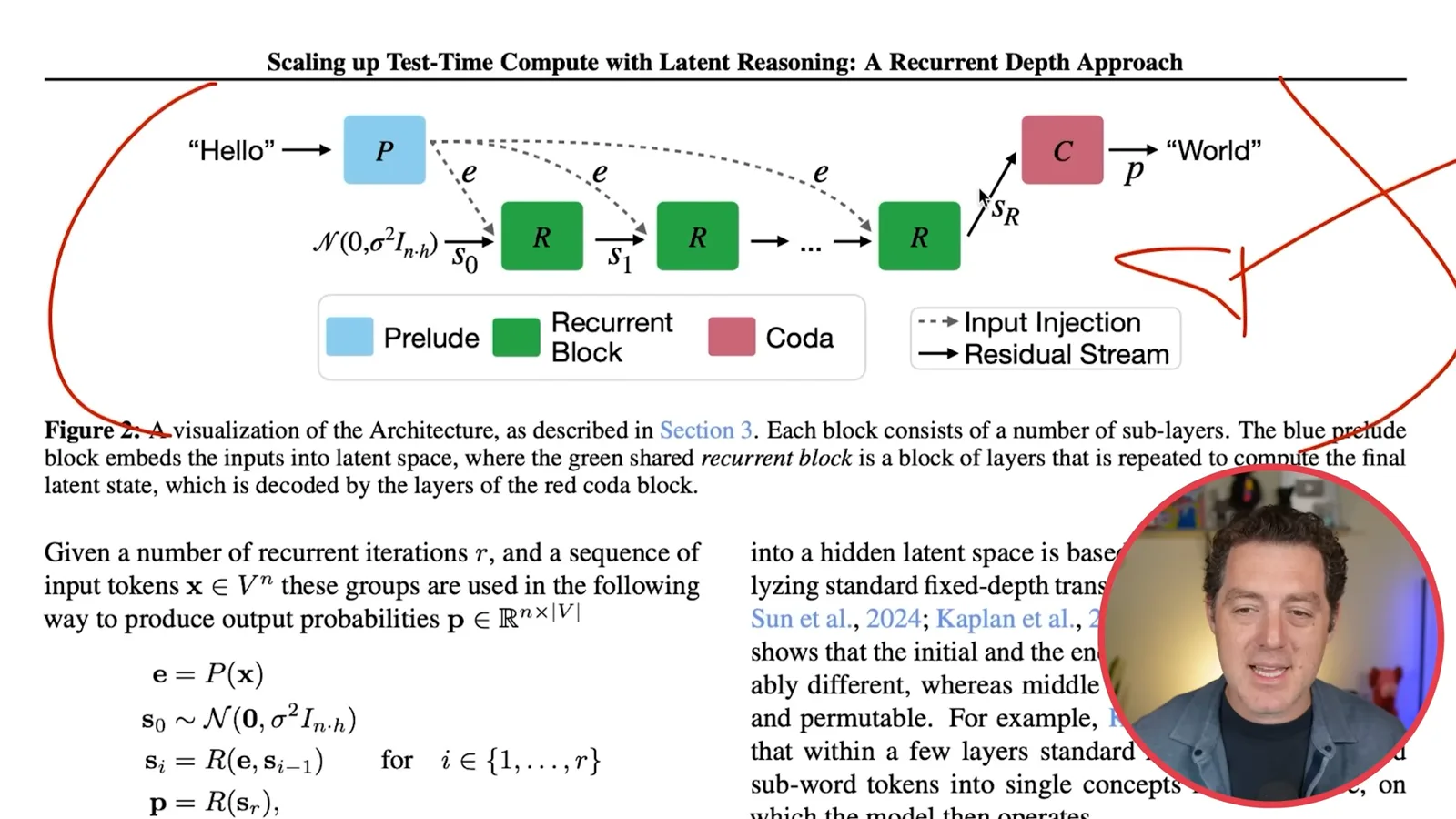
The architecture diagram starts with an input such as ‘Hello’: a prelude maps it into a representation, the shared recurrent block updates a state repeatedly, and a final block predicts the next token, illustrated as ‘World.’ The iteration happens before that prediction, and analogous computation can occur at later token positions as well.
Results and adaptive computation
Berman reviews benchmark curves and adaptive-exit distributions. The experiment supports specific observations rather than unlimited gains or a general measure of problem difficulty.
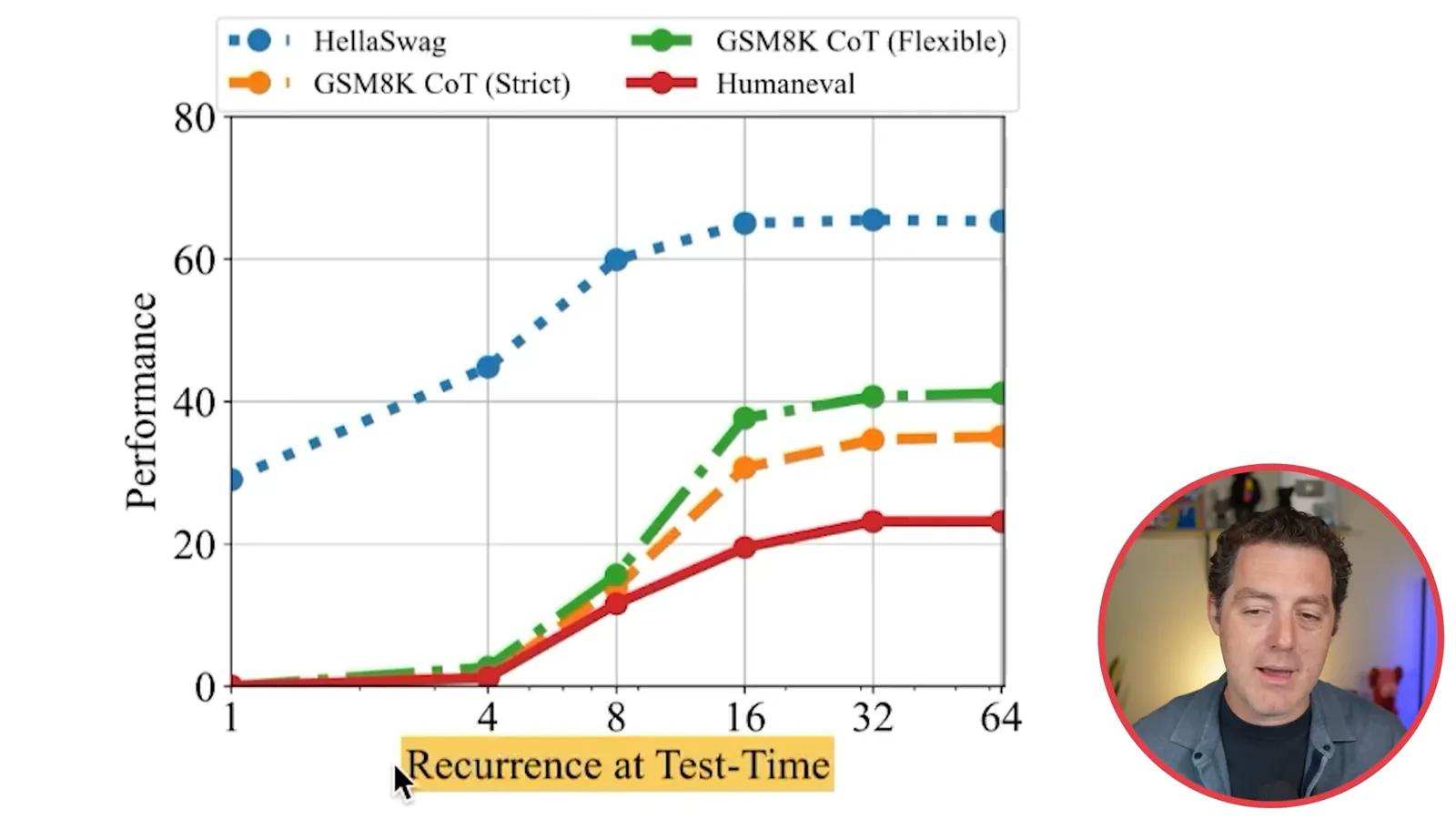
The displayed results compare performance against recurrence counts on HellaSwag, GSM8K and HumanEval. Several curves improve as tested iterations increase, but gains flatten in parts of the plot. These benchmark results support a finite-range empirical finding, not proof that unlimited iterations or every extra step improve the final answer.
I also point to results from checkpoints trained on increasing amounts of data, up to 800 billion tokens. The paper’s results show how this particular model changes with training and inference compute; they should not be treated as a guarantee of the same scaling behavior for every model or dataset.
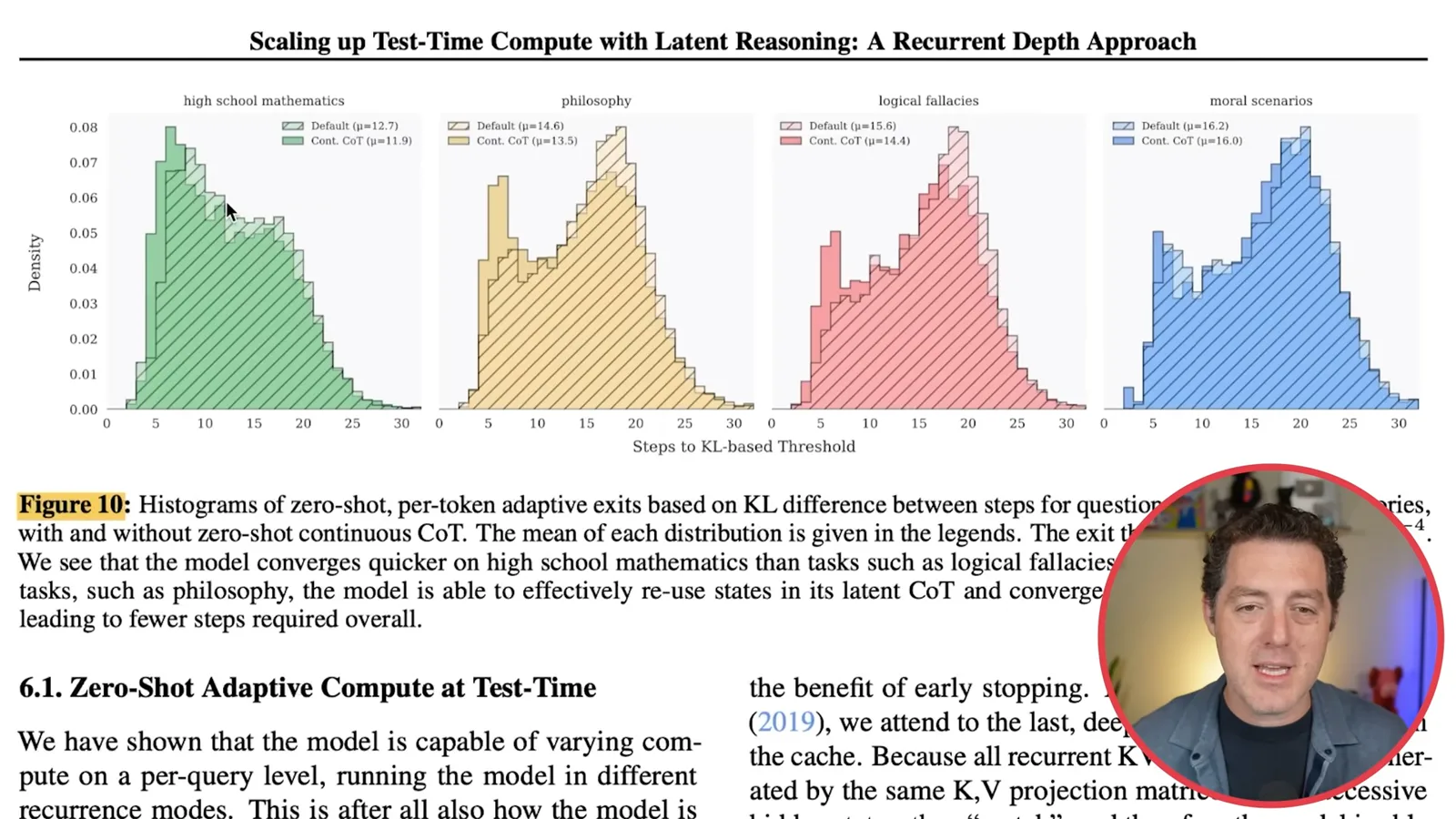
Figure 10 shows adaptive per-token exits for questions from MMLU categories including high-school mathematics, philosophy, logical fallacies and moral scenarios. The researchers stop when the difference between successive predictions falls below a fixed KL-divergence threshold, and plot the distribution of iterations. This measures convergence to the chosen threshold, not how many steps were needed to reach a correct answer or a general ranking of task difficulty.
Combining latent and verbal reasoning
He suggests combining internal computation with textual chain of thought. He closes by describing the model as a downloadable proof of concept.
Latent computation need not exclude a verbal chain of thought: the two approaches could be combined, just as I might think, write down an intermediate result and revisit it. That is a useful analogy and a research direction, not evidence the model reasons like a person. I close by noting that the authors released the proof-of-concept model for others to try.
Sur la même chaîne
 34:21EN
 Matthew Berman· 27 oct. 2026Matthew Berman Examines Anthropic’s IPO Filing, AI Growth and GovernanceMatthew Berman, Sam Altman · Forward FutureThe presenter reviews the S-1’s financial metrics, compute strategy and voting structure while questioning the tension between rapid AI development and safety.
 0:26ENMatthew Berman· 25 oct. 2026Sam Altman on Human Values and Problem-Solving in an AI WorldSam Altman · OpenAIIn a short interview excerpt, Altman considers the enjoyment of solving hard problems and the human role in interpreting results.
 0:36ENMatthew Berman· 25 oct. 2026Kimi K3.1 and a Rubik’s Cube Solver DemonstrationMatthew Berman · Forward FutureMatthew Berman shows a scrambled virtual cube being solved and gives the Kimi K3.1 test a favorable assessment.
 0:21ENMatthew Berman· 24 oct. 2026An AI-Generated Kimi Benchmark Chart Used Invented ScoresMatthew Berman · Forward FutureMatthew Berman asks for a graph of Kimi K3.1 Pro benchmarks, then discovers that the displayed figures are illustrative placeholders.
 25:50ENMatthew Berman· 24 oct. 2026Kimi K3.1 Pro Tested: Strong 3D Demos, Uneven Results and Competitive PricingMatthew Berman · Forward FutureMatthew Berman tests the open-weight model on coding, 3D rendering and visual explanations, then compares benchmark results and prices.
 32:20ENMatthew Berman· 23 oct. 2026Who Is Local AI For? The Costs, Trade-offs and a Hybrid FutureMatthew Berman · Forward FutureMatthew Berman weighs data control and independence against hardware cost, setup complexity and inference speed.