En 30 secondes
In this December 2025 roundup, Matthew Berman discusses Google’s Gemini 3 Flash, NVIDIA’s Nemotron 3 announcement, OpenAI image generation, Zoom’s Federated AI, Bernie Sanders’s data-center proposal and Meta’s SAM Audio. He also covers reported app integrations and OpenAI–Amazon investment discussions. The video includes a HubSpot sponsorship. Benchmark figures and prices describe specific 2025 configurations; the larger Nemotron variants were not yet available at the original announcement, and the investment was still reported as talks in the video. Later, Amazon and OpenAI announced a separate $50 billion investment arrangement.
- 1Gemini 3 Flash benchmarksGoogle reported 78% on SWE-bench Verified in a single-attempt setup and listed separate input and output prices.
- 2Nemotron 3 rolloutNano was released first; Super and Ultra were announced for later availability.
- 3Updated image generationBerman compares selected examples from the new and previous ChatGPT image systems.
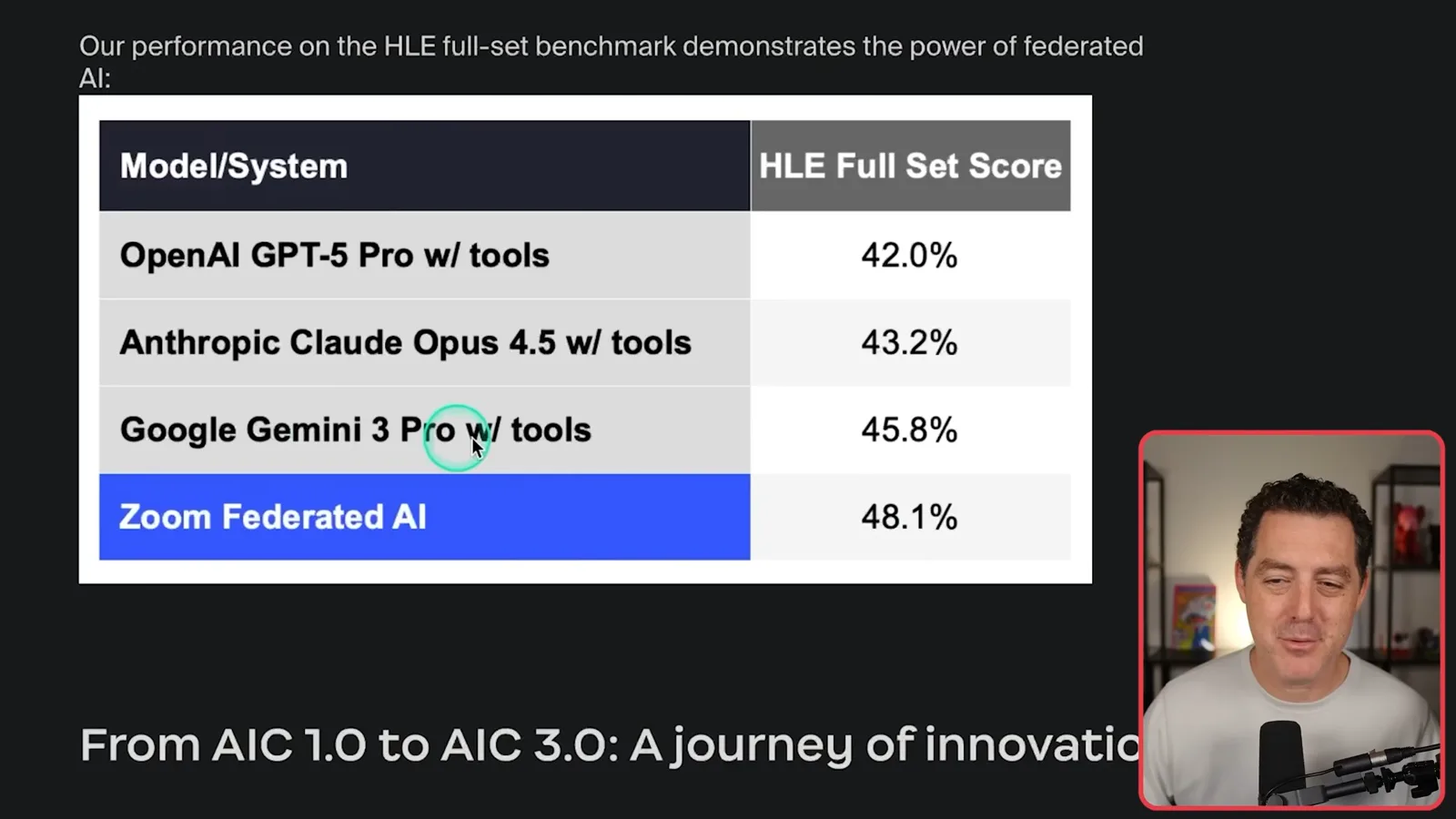
- 4Zoom’s multi-model scoreZoom reports 48.1% on HLE for a federated system, not a single standalone model.
- 5Data-center policyBerman opposes Sanders’s moratorium proposal and offers an argument based on competition and energy infrastructure.
- 6Investment talks and later agreementThe video discusses a reported negotiation; a later 2026 announcement described a $50 billion arrangement.
- 7SAM AudioMeta’s system uses text, visual or time-span prompts to isolate sound from mixtures.
À retenir
- Gemini 3 Flash’s reported 78% SWE-bench Verified score applies to Google’s specified single-attempt setup, not every coding task.
- The 2025 launch listed input and output API prices separately; free product access did not mean unrestricted API usage.
- NVIDIA released Nemotron 3 Nano first and announced Super and Ultra for later; its fourfold throughput claim compared Nano with Nemotron 2 Nano.
- Zoom’s reported HLE result concerns a routed multi-model system and depends on benchmark conditions.
- Sanders’s data-center moratorium and Berman’s objections are competing policy positions and predictions.
- The December 2025 Amazon investment figure was a report about talks; the companies announced a later $50 billion arrangement in 2026.
- SAM Audio separates sounds using prompts, and model availability is subject to its license.
Lire le texte remanié, chapitre par chapitre
Gemini 3 Flash and Nemotron 3
Berman reviews model pricing, benchmark results and NVIDIA’s open-model announcement. The figures are tied to the 2025 release and specific comparisons.
In this December 18, 2025 roundup, Matthew Berman highlights Gemini 3 Flash, NVIDIA’s Nemotron 3, updated ChatGPT image generation, Zoom’s multi-model system, a debate over AI data centers, and Meta’s SAM Audio. He also discusses app integrations and a reported OpenAI–Amazon investment. The video includes a HubSpot partnership. Product availability, prices, rankings and negotiations are historical snapshots.
Berman praises Gemini 3 Flash for speed and cost, calling it his preferred coding model. Google’s launch comparison listed $0.50 per million input tokens and $3 per million output tokens; these are separate 2025 API rates, not a claim that all usage was free. Google reported 78.0% on SWE-bench Verified with a single attempt, versus 76.2% for Gemini 3 Pro and 80.0% for GPT-5.2 in its table. Results depend on the tested configuration and do not establish the best model for every task.
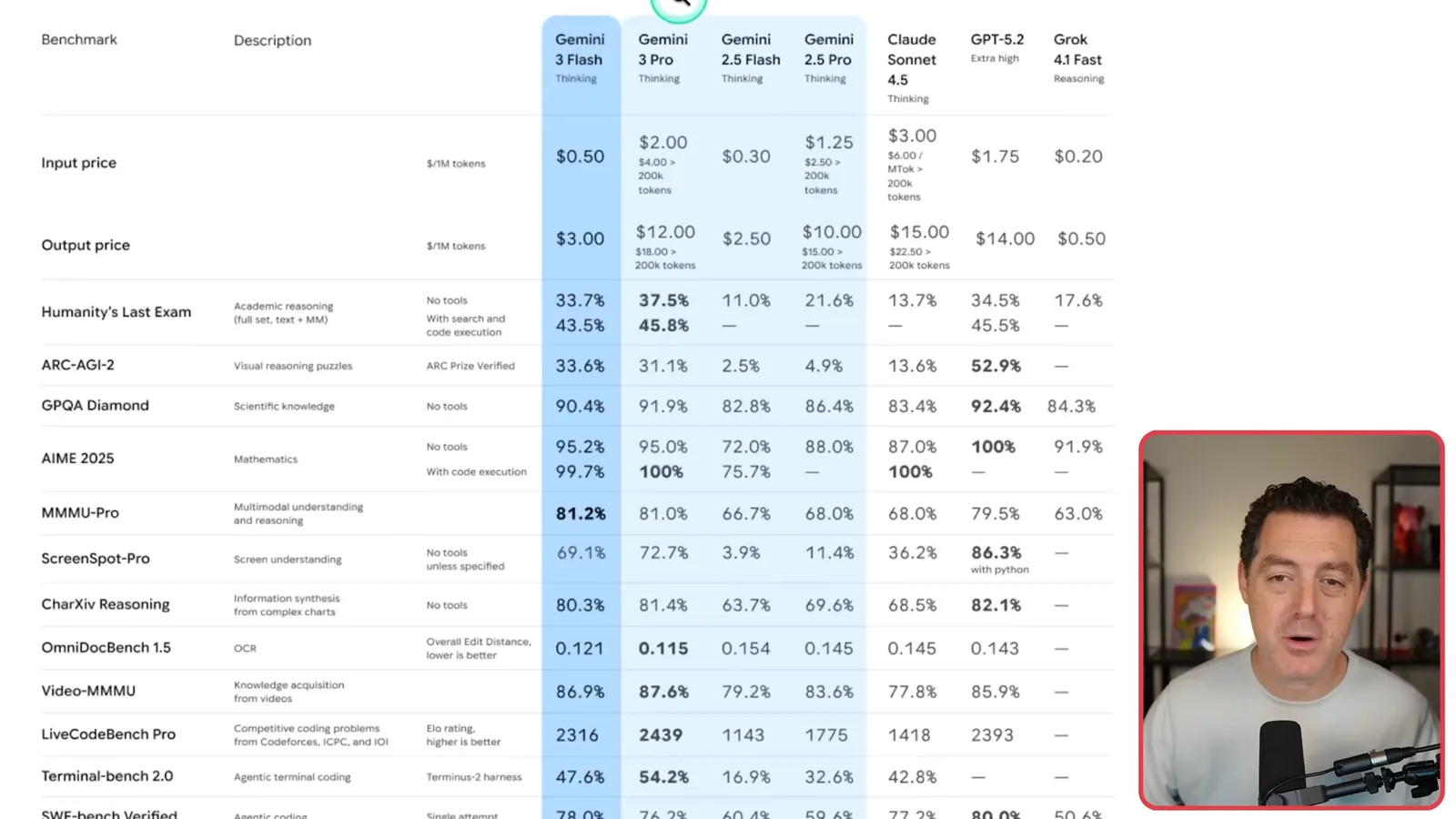
He cites a then-current Artificial Analysis ranking and notes the model’s multimodal inputs, including text, images, audio and video. His “best model” assessment is an opinion about that moment. Availability and free-tier limits differed between products and may change; his statement that everything was free should not be read as unlimited API access.
NVIDIA announced the [Nemotron 3 family](https://nvidianews.nvidia.com/news/nvidia-debuts-nemotron-3-family-of-open-models) in Nano, Super and Ultra tiers. At the December 2025 announcement, Nano was available while Super and Ultra were expected later; the announcement estimated roughly 30B/3B, 100B/10B and 500B/50B total/active parameters respectively. Those were launch descriptions, not proof all three were downloadable then.
NVIDIA’s claim of up to four times higher throughput compared Nano with Nemotron 2 Nano under its specified conditions, not every model in the family. Berman also mentions released datasets, training tools and support for LM Studio, llama.cpp, SGLang and vLLM. Open weights and accompanying materials are subject to their licenses; check the exact release and terms.
Sponsorship and ChatGPT Images
The HubSpot partnership precedes selected comparisons of OpenAI’s image-generation update. Examples do not establish universal accuracy.
The video is sponsored by HubSpot. Berman says he worked with the company on a free guide describing nine automations for his business, including content, research and lead generation. His description of their applicability is promotional and based on his experience.
Berman reviews OpenAI’s December 2025 [ChatGPT Images update](https://openai.com/index/new-chatgpt-images-is-here/), which the company said improved editing, instruction-following and speed. The video highlights a six-by-six grid, text and photorealistic scenes, contrasting selected new and previous outputs. These examples are illustrative rather than a controlled estimate of error rates or a guarantee that every image is flawless.
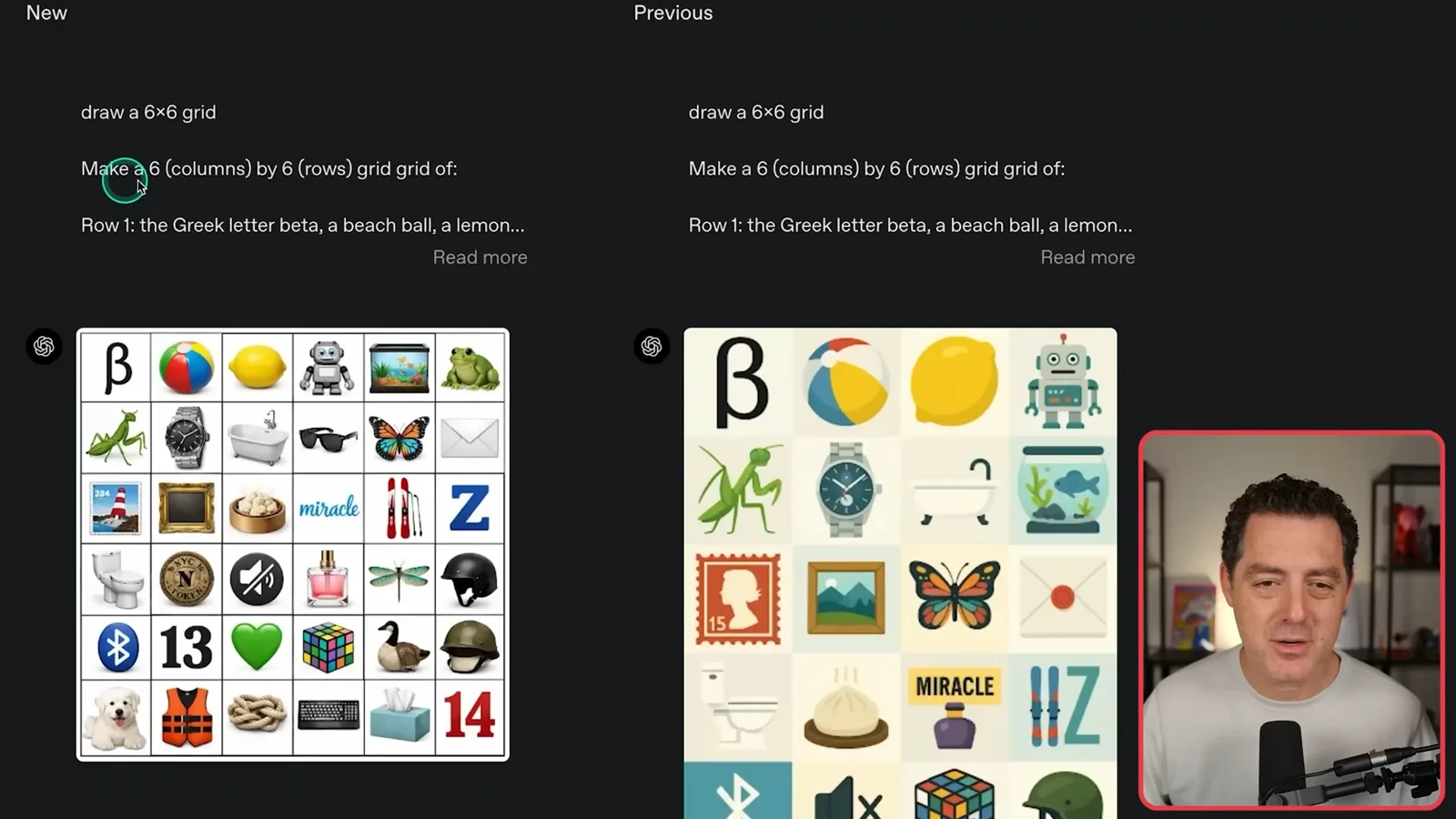
He compares scenes featuring crowds and a London bus, and discusses a humorous generated holiday calendar featuring Sam Altman. Berman judges the selected examples favorably, but visual similarity and correct-looking text should be checked against the prompt and sources rather than assumed across all generations.
Zoom’s federated AI and data centers
Zoom reports a benchmark result for a system combining models. Berman then argues against Sanders’s data-center moratorium proposal.
Zoom reported 48.1% on the full Humanity’s Last Exam set for its Federated AI system, alongside company-selected comparisons with other systems. Berman notes that this is a multi-model system rather than a single standalone Zoom frontier model. Zoom describes combining its smaller models with open and closed models and a Z-score selection and refinement process; benchmark comparisons depend on tools, budgets and other settings.
Berman strongly opposes Senator Bernie Sanders’s call for a moratorium on constructing AI data centers. Sanders framed the proposal around democratic oversight and the distribution of benefits; he has also raised electricity, water and other community concerns. Berman argues a pause would hurt US competitiveness and that building energy infrastructure would create jobs. These are opposing policy arguments and forecasts, not established outcomes of a particular policy.
App integrations, investment and audio
Berman discusses reported integrations and OpenAI–Amazon talks. He closes with Meta’s SAM Audio demonstrations.
Berman mentions reports that Apple Music could integrate with ChatGPT to help create playlists, alongside Adobe app integrations. These were product announcements or reports at the time, with availability and functionality depending on rollout and access. His claim that ChatGPT was becoming the default gateway to the internet is an interpretation, not a measured market share.
The Information reported that Amazon was in talks to invest at least $10 billion in OpenAI; Berman treats the figure as a negotiation and discusses the valuation reported by sources. Separately, Amazon had announced a $38 billion, seven-year AWS computing agreement with OpenAI. A cloud spending commitment and an equity investment are different transactions; the video’s suggestion that providers simply return the same money is an interpretation, not the disclosed deal structure.
Berman highlights Amazon’s Trainium chips and the demand for computing infrastructure. The later record changed: in February 2026 [OpenAI and Amazon announced](https://openai.com/index/amazon-partnership/) a $50 billion investment arrangement, initially $15 billion with another $35 billion conditional at announcement. This later agreement should not be confused with a completed $10 billion deal in December 2025.
Finally, Berman discusses [Meta’s SAM Audio](https://about.fb.com/news/2025/12/our-new-sam-audio-model-transforms-audio-editing/), part of the Segment Anything family. Meta describes separating sounds from a mixture using text, visual or time-span prompts. His examples include isolating a sound associated with an object in video and separating voices in a noisy setting.
The presented clips illustrate possible audio-editing uses, but they do not establish perfect separation for arbitrary recordings. Meta made a downloadable model available under its terms; check the current model license and usage conditions rather than assuming that downloadable weights grant every possible use. Berman ends the news roundup.
Sur la même chaîne
 34:21EN
 Matthew Berman· 27 oct. 2026Matthew Berman Examines Anthropic’s IPO Filing, AI Growth and GovernanceMatthew Berman, Sam Altman · Forward FutureThe presenter reviews the S-1’s financial metrics, compute strategy and voting structure while questioning the tension between rapid AI development and safety.
 0:26ENMatthew Berman· 25 oct. 2026Sam Altman on Human Values and Problem-Solving in an AI WorldSam Altman · OpenAIIn a short interview excerpt, Altman considers the enjoyment of solving hard problems and the human role in interpreting results.
 0:36ENMatthew Berman· 25 oct. 2026Kimi K3.1 and a Rubik’s Cube Solver DemonstrationMatthew Berman · Forward FutureMatthew Berman shows a scrambled virtual cube being solved and gives the Kimi K3.1 test a favorable assessment.
 0:21ENMatthew Berman· 24 oct. 2026An AI-Generated Kimi Benchmark Chart Used Invented ScoresMatthew Berman · Forward FutureMatthew Berman asks for a graph of Kimi K3.1 Pro benchmarks, then discovers that the displayed figures are illustrative placeholders.
 25:50ENMatthew Berman· 24 oct. 2026Kimi K3.1 Pro Tested: Strong 3D Demos, Uneven Results and Competitive PricingMatthew Berman · Forward FutureMatthew Berman tests the open-weight model on coding, 3D rendering and visual explanations, then compares benchmark results and prices.
 32:20ENMatthew Berman· 23 oct. 2026Who Is Local AI For? The Costs, Trade-offs and a Hybrid FutureMatthew Berman · Forward FutureMatthew Berman weighs data control and independence against hardware cost, setup complexity and inference speed.