En 30 secondes
In this December 25, 2025 video, Matthew Berman discusses the announced Groq–Nvidia deal, comparing specialized inference hardware with GPUs and Google TPUs. He discloses that he is a Groq investor, says he has no inside information, and does not know when or whether he will be paid. Groq announced a non-exclusive license, the transfer of some staff and continued independent operation; reports valued the arrangement at approximately $20 billion, a figure the announcement did not confirm. Berman’s views about Nvidia’s motives, regulatory strategy and future products are interpretations and predictions rather than announced terms.
- 1A deal and an investor disclosureBerman cites a reported $20 billion figure and discloses his investment in Groq. He says he has no inside information and does not know about his payout.
- 2Different chip strategiesHe contrasts Nvidia GPUs and CUDA with Groq’s inference-focused LPU and Google’s TPUs. Their relative performance depends on the actual workload and system.
- 3Why inference mattersA clip of Jonathan Ross distinguishes spending on model training from earning revenue through inference. Berman sees recurring inference demand as strategically important.
- 4What Groq announcedGroq described a non-exclusive license and staff joining Nvidia while its own business continues independently. The announcement did not disclose a price.
- 5Licensing and competitionBerman compares the structure with other AI talent and licensing deals and speculates about antitrust motives. The examples differ in their actual legal and financial structures.
- 6Predictions for productsHe predicts combined chip offerings and software integration; these are not confirmed by the December announcement.
À retenir
- Groq and Nvidia announced a non-exclusive inference-technology license, not the announced purchase of Groq as a company.
- Jonathan Ross, Sunny Madra and other Groq team members were to join Nvidia, while Groq said Simon Edwards would become CEO and GroqCloud would continue.
- The approximately $20 billion figure was reported by media and not specified in Groq’s announcement.
- Berman disclosed that he invested in Groq and did not know the timing or outcome of any investor payment when recording.
- GPUs, TPUs and LPUs involve different design and software trade-offs; relative cost and speed depend on the workload and deployment.
- Predictions about regulatory motives, future chip packages and CUDA integration are Berman’s analysis, not confirmed transaction terms.
Lire le texte remanié, chapitre par chapitre
The deal and Berman’s investment
Berman introduces the reported deal value and discloses his financial interest. He also introduces Groq founder Jonathan Ross and his prior work at Google.
Groq and Nvidia have announced a deal around AI inference technology, with media reports putting its value at approximately $20 billion. I describe it as effectively an acquisition, but the announced structure is a non-exclusive license and staff transfer, not the purchase of Groq as a company. I invested in Groq roughly a year and a half ago, have no inside information, and learned of the deal on Christmas Eve like everyone else. At the time of recording, I do not know whether or when my investment will be paid out.
Groq founder Jonathan Ross previously helped develop Google’s Tensor Processing Unit, or TPU, before founding Groq. His premise was that growing AI workloads would benefit from specialized hardware. Google’s TPUs demonstrate that purpose-built accelerators can support substantial AI workloads; the exact trade-offs against other chips depend on how each system is designed and used.
GPUs, TPUs and inference economics
Berman compares chip architectures and discusses the role of CUDA and inference. An excerpt from a prior interview presents Ross’s view of training and inference.
Nvidia GPUs support a wide range of computing tasks, including AI training and inference. Its CUDA software ecosystem provides developers with tools and libraries that help make those systems usable at scale. Groq’s language processing units, or LPUs, focus on inference: running a trained model to generate an answer. The distinction is useful, though modern Nvidia GPUs also contain specialized AI hardware.
I see the trade-off among these systems in speed, latency, cost and specialization. I speculate that Nvidia is watching the growth of inference demand and competition from dedicated hardware such as Groq and Cerebras. Whether an accelerator is faster or cheaper depends on the model, workload, system configuration and measurement; the announcement does not establish a universal comparison.
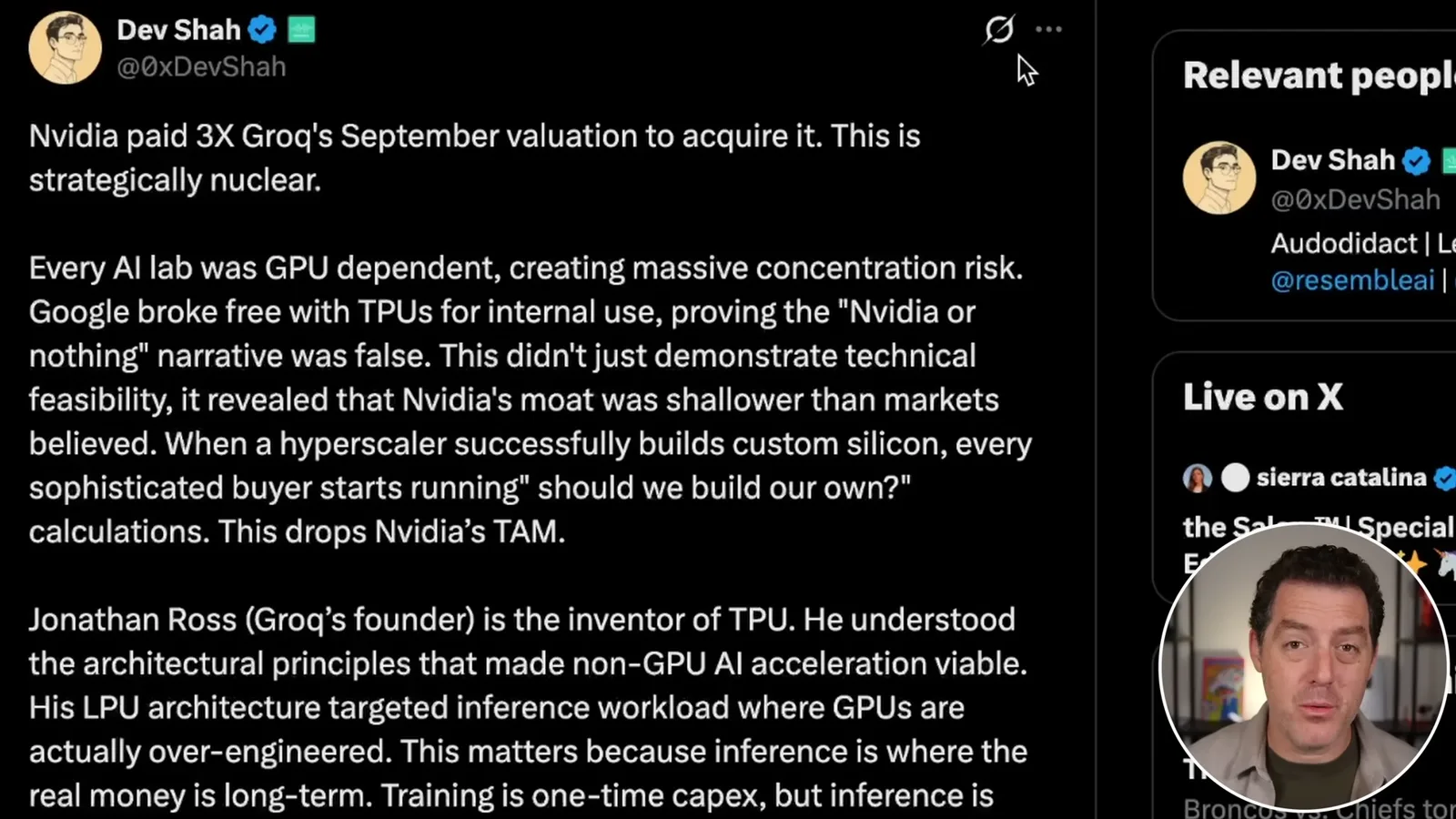
I refer to a post by Dev Shah arguing that Google’s TPU shows alternatives to Nvidia GPUs can scale, and that Groq’s architecture targets inference. The post compares the reported deal value with Groq’s earlier valuation and argues that recurring inference demand could matter commercially. Those are strategic interpretations, and the reported $20 billion figure was not stated in Groq’s announcement.
My view is that inference can generate recurring demand as users repeatedly query models, while training involves a major upfront effort. In a clip from my earlier interview, Jonathan Ross similarly distinguishes spending money to train models from making money on inference. In practice, training and retraining can recur, and the costs and revenues of either activity depend on the business model.
Groq’s business and the licensing announcement
He describes Groq’s inference service and reads the December 24 announcement. The agreement is a non-exclusive license with staff transitions and continued independent Groq operations.
I describe Groq’s shift from selling chips toward providing inference through an API, where developers can run open-weight models without buying a full system. I think the cost and complexity of adopting a new hardware platform, and Nvidia’s established software, help explain why a hosted service can be attractive. This is my interpretation rather than a complete account of every sales arrangement.
I speculate that Nvidia sees specialized inference chips as a competitive opportunity alongside its general-purpose GPU business. Ross’s earlier TPU work and Groq’s focus on low-latency inference make the technology and team interesting to Nvidia. The parties did not say that Nvidia had conceded GPUs were uncompetitive, and my account of its internal motivations is conjecture.
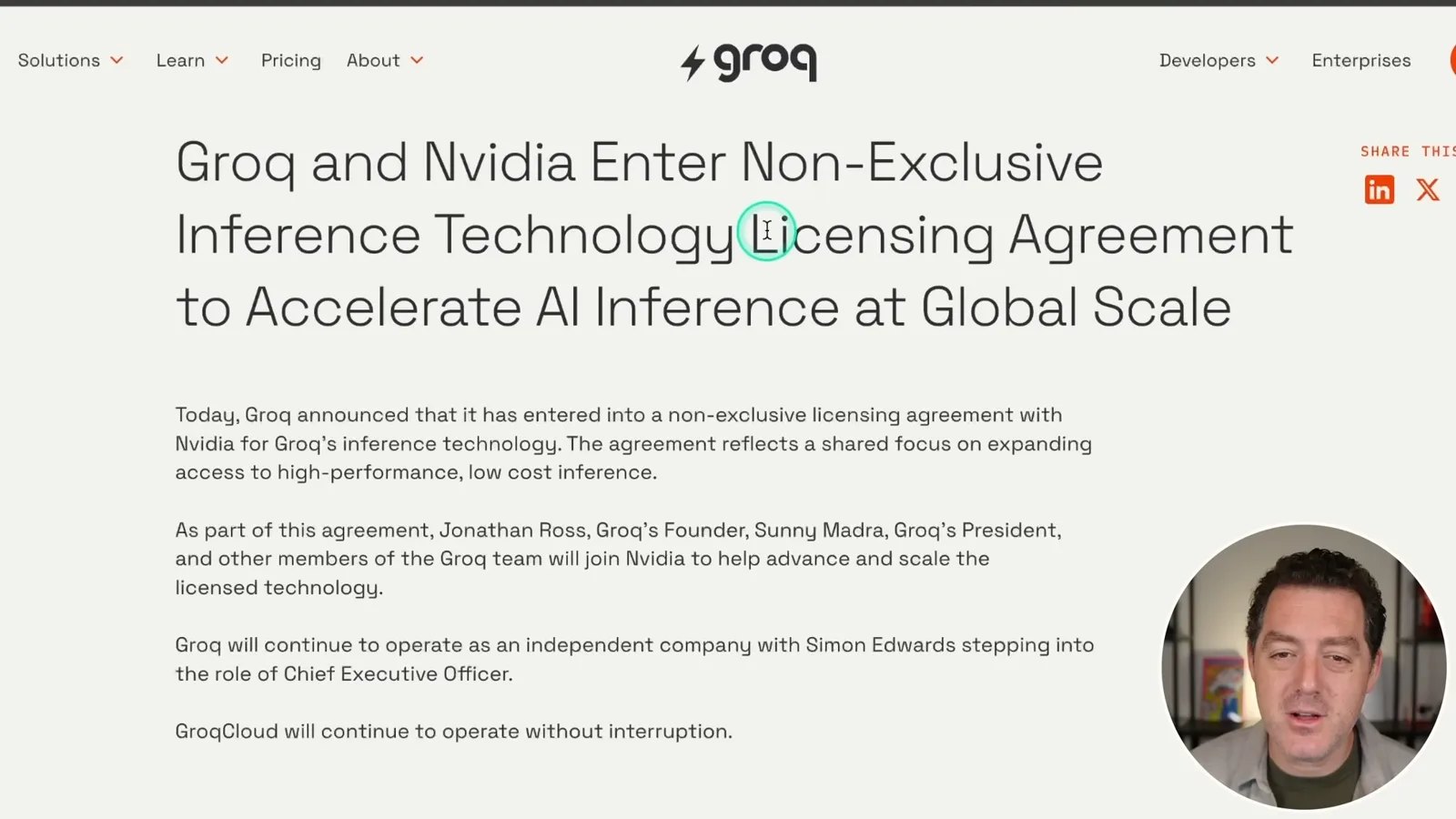
The actual December 24, 2025 announcement says Groq entered a non-exclusive licensing agreement with Nvidia for its inference technology. It says founder Jonathan Ross, president Sunny Madra and other team members will join Nvidia. Groq will continue as an independent company under incoming CEO Simon Edwards, and GroqCloud will continue operating. The announcement does not specify the transaction price.
Deal structures and future competition
Berman compares other AI company transactions and offers his view of antitrust incentives. He speculates about the future of specialized chips, commercial packaging and software integration.
I compare this arrangement with other deals involving AI-company leaders and technology. I suggest that licensing and hiring rather than buying a whole company may reduce antitrust exposure, but the parties did not establish that motive in their announcement, and such deals can still receive regulatory scrutiny. My description of Meta as buying all of Scale AI is too broad: Meta disclosed a non-voting minority investment, while Scale continued operating.
I also mention Google’s arrangement involving Windsurf staff and technology, followed by Cognition’s acquisition of Windsurf. These are useful comparisons for talent and licensing structures, but their terms differ; it would be inaccurate to assume they all transferred the same assets or had the same regulatory purpose. A non-exclusive license also does not by itself show that no other company could license the technology.
Looking ahead, I see the deal as a possible hedge against competition from Google and a way for Nvidia to expand its inference offerings. I note that TPUs can support training, fine-tuning and inference, while Groq’s products have focused on inference. I also discuss chip process generations, but those labels alone cannot establish cost, speed or the economics of a complete system.
I think inference demand will grow with usage, making dedicated hardware strategically valuable. That does not establish that all future AI profits will come from inference or that training is a one-time cost. My interpretation of the deal as defensive against competitors and offensive in the inference market is a forecast about strategy, not an announced rationale.
I speculate that Nvidia might sell or package hardware using Groq’s technology with its existing chips, and that CUDA or related tools could eventually support a combined workflow. Those product, pricing and software plans were not promised in the announcement. How the licensed technology will actually be integrated remains to be seen.
Sur la même chaîne
 34:21EN
 Matthew Berman· 27 oct. 2026Matthew Berman Examines Anthropic’s IPO Filing, AI Growth and GovernanceMatthew Berman, Sam Altman · Forward FutureThe presenter reviews the S-1’s financial metrics, compute strategy and voting structure while questioning the tension between rapid AI development and safety.
 0:26ENMatthew Berman· 25 oct. 2026Sam Altman on Human Values and Problem-Solving in an AI WorldSam Altman · OpenAIIn a short interview excerpt, Altman considers the enjoyment of solving hard problems and the human role in interpreting results.
 0:36ENMatthew Berman· 25 oct. 2026Kimi K3.1 and a Rubik’s Cube Solver DemonstrationMatthew Berman · Forward FutureMatthew Berman shows a scrambled virtual cube being solved and gives the Kimi K3.1 test a favorable assessment.
 0:21ENMatthew Berman· 24 oct. 2026An AI-Generated Kimi Benchmark Chart Used Invented ScoresMatthew Berman · Forward FutureMatthew Berman asks for a graph of Kimi K3.1 Pro benchmarks, then discovers that the displayed figures are illustrative placeholders.
 25:50ENMatthew Berman· 24 oct. 2026Kimi K3.1 Pro Tested: Strong 3D Demos, Uneven Results and Competitive PricingMatthew Berman · Forward FutureMatthew Berman tests the open-weight model on coding, 3D rendering and visual explanations, then compares benchmark results and prices.
 32:20ENMatthew Berman· 23 oct. 2026Who Is Local AI For? The Costs, Trade-offs and a Hybrid FutureMatthew Berman · Forward FutureMatthew Berman weighs data control and independence against hardware cost, setup complexity and inference speed.