En 30 secondes
In this September 2025 livestream, Matthew Berman and Nick Wentz discuss AI news and interview Jessica Jung about Supercell’s gaming incubator, Scott Santens about universal basic income and Keith Sakata about mental health and chatbot use. The guests offer forecasts and clinical or policy interpretations; the article distinguishes these from established evidence and historical announcements.
- 1An AI game incubatorJung describes an 11-week program intended to explore new gameplay and bring outside perspectives to Supercell.
- 2Persistent worlds remain hardJung identifies data, compute and memory as obstacles to generated game worlds and offers a speculative timeline.
- 3What UBI meansSantens defines it as periodic, unconditional, universal cash for individuals and explains how a tax-funded scheme could work.
- 4Pilot evidence needs contextSantens discusses community-based experiments; results depend on program design, samples and methods.
- 5Psychosis and chatbotsSakata describes his clinical observations, emphasizes that the popular term is not a diagnosis and calls for more research.
- 6Companionship has different contextsSakata considers both isolation risks and the potential to support people with limited access to social connection.
À retenir
- Jung sees AI-native games as an opportunity for new unscripted interactions, while latency, local compute and persistent worlds remain challenges.
- Santens defines universal basic income as unconditional, universal, regular cash paid to individuals and argues for an income floor.
- The effects of cash programs on work, prices and health depend on their design and cannot be inferred from one pilot alone.
- Sakata says “AI psychosis” is not a clinical diagnosis and describes a limited set of cases in which he believes chatbot use worsened pre-existing psychosis.
- AI companionship may meet some needs but requires careful study of isolation, vulnerable users and access to human care.
Lire le texte remanié, chapitre par chapitre
Opening and AI news
The hosts introduce the guests and discuss The Browser Company, Apple and ChatGPT. The news is framed as it stood in September 2025.
Matthew Berman opens the September 5, 2025 show with co-host Nick Wentz and introduces three guests: Supercell’s Jessica Jung on AI and games, basic-income advocate Scott Santens, and psychiatrist Keith Sakata on AI companionship and psychosis. The news and forecasts discussed are from that date.
Wentz starts with Atlassian’s agreement to acquire The Browser Company for $610 million in cash. The company said it would focus on its Dia browser.

Wentz sees a fit with Atlassian’s work tools; Berman, who dislikes Jira, notes that some users worried the purchase could blunt the browser company’s independence and innovation.
The hosts turn to a report that Apple was exploring an AI answer engine and a possible Google partnership for Siri. Both hope for better Apple AI, but Berman says his experience with Siri left him skeptical; plans reported at the time were not finished products.
Wentz speculates that Apple may be betting on ownership of the interface while renting intelligence from a model provider. Berman thinks voice and AirPods could be an important interaction layer, provided the underlying software actually works well.
They mention ChatGPT’s conversation branching on the web. Wentz says branching helped him explore features and user personas while drafting a product requirements document for a job board; Berman has not used it much and plans to try it.
Jessica Jung on games and AI
Jung describes Supercell’s incubator, creative tools, local inference, game worlds and character safety. She explains how the lab works and what it seeks in builders.
Jessica Jung joins to discuss Supercell’s San Francisco AI Innovation Lab. She says AI leader Otto Söderlund’s initiatives include improving monetization and retention models, modernizing development and exploring future interactive entertainment.
Her lab focuses on the last of those.
Jung describes an 11-week incubator for founders working on AI-native games, tools and experimental interactive experiences. Supercell’s successful franchises make outside perspectives valuable, she says; the lab is intended to explore types of interaction that might depend on AI at their core.
Asked what already feels new, Jung calls current projects the “zero generation” of AI games. She sees potential in unscripted outcomes and social-like emergent stories for a single player, while also questioning whether AI companions should be classified as games.
Jung hopes AI tools will let more people realize game ideas without the resources associated with large productions. Wentz recalls games as his own route into programming.
Her claim is an outlook on accessibility, not a requirement that every earlier game needed a large studio or budget.
On local versus cloud inference, Jung says minimum specifications are hard to generalize. She describes independent developers experimenting with code-oriented tools and says latency is a major concern for multimodal voice and video experiences.
Mobile connectivity is another constraint, particularly in rural areas, Jung says from her experience at Niantic. She wants capable models that can run locally rather than requiring every interaction to call a remote API; the feasibility depends on hardware and the application.
Jung argues that recognizable characters, stories and intellectual property may become more valuable as content creation gets cheaper. She wants developers to be able to adapt models to their own worlds and retain control of that material.
Berman asks whether player-created assets will drown games in noise. Jung distinguishes people making commercial products from those bringing a personal vision to life.
In her view, an abundance of low-quality content already existed on platforms such as Roblox and Steam.
Jung sees the opportunity in giving players creative tools within a game’s stylistic constraints. Discovery, marketing and distinctive intellectual property still matter, she says; AI may accelerate existing pressures rather than create all of them from scratch.
Wentz asks what distinguishes applicants to the lab. Jung emphasizes adaptability, first-principles thinking and a willingness to update workflows as models change.
She also wants disciplined experimentation: many game concepts fail before a team finds one that is genuinely fun.
Jung values some experience shipping games or running live services, but not such rigid assumptions that new approaches are ruled out. She also points to younger Roblox creators whose sense of contemporary culture can produce viral ideas that industry veterans might overlook.
The hosts note that the program offers housing, meals and compute without requiring equity. Jung says Supercell can discover potential investments, recruit builders and exchange expertise on scaling games.
The arrangement also brings external perspectives into the company.
Jung says the San Francisco lab can carry ideas from the local AI ecosystem back to a company headquartered in Helsinki. Its goal is not simply to acquire projects, but to inspire teams across Supercell to think differently about games and AI.
Wentz asks about games as a source of technology for other fields. Jung sees world models as a possible new layer of abstraction over game engines: rather than editing every scene manually, a developer might eventually prompt an interactive world.
She points to simulations, digital twins, epidemiology and robot-training environments as possible downstream uses. These are prospects and analogies, not evidence that generated worlds currently provide reliable high-fidelity models for all those applications.
Asked for a timeline, Jung says it is difficult to forecast. She identifies spatial data, inference about unseen surroundings, persistent state and memory as bottlenecks.
She guesses that developers might experiment with Genie 3 sooner but that deep, persistent interactive worlds could take five to seven years; this is a prediction.
Berman asks how AI non-player characters could stay in character when players try to jailbreak them. Jung argues that fictional villains sometimes require behavior general-purpose assistants restrict, while games still need guardrails appropriate to their context.
Jung describes an approach in which AI characters converse with one another in simulated tests to expose edge cases before release.
Fine-tuning and targeted infrastructure may help, but she acknowledges that developers are still discovering how to constrain such systems.
Berman remains concerned that nondeterministic characters could be steered beyond a designer’s intentions and break the experience. Jung turns to monetization: highly engaged players may pay for generation, model access or better assets, much as some enthusiasts already pay for expensive hardware.
Jung also predicts more personalized content and monetization based on player behavior.
She thinks tailoring could make offers feel more relevant; that is her view of a potential business model, not a demonstrated outcome.
Jung says applicants can use the lab’s website and that a demo or vertical slice is preferred. She stresses that the small team reviews applications manually and is exploring more flexible ways for builders to participate.
Asked whether nostalgic local multiplayer games still have a place, Jung says shared in-person experiences, familiar characters and intellectual property may become more important. After she leaves, the hosts discuss favorite older games and imagine AI-assisted additions to them.
Code, citations and compute
The hosts consider a Coinbase coding claim, a chart of AI citations and reports about Google TPUs. They distinguish citations from training data.
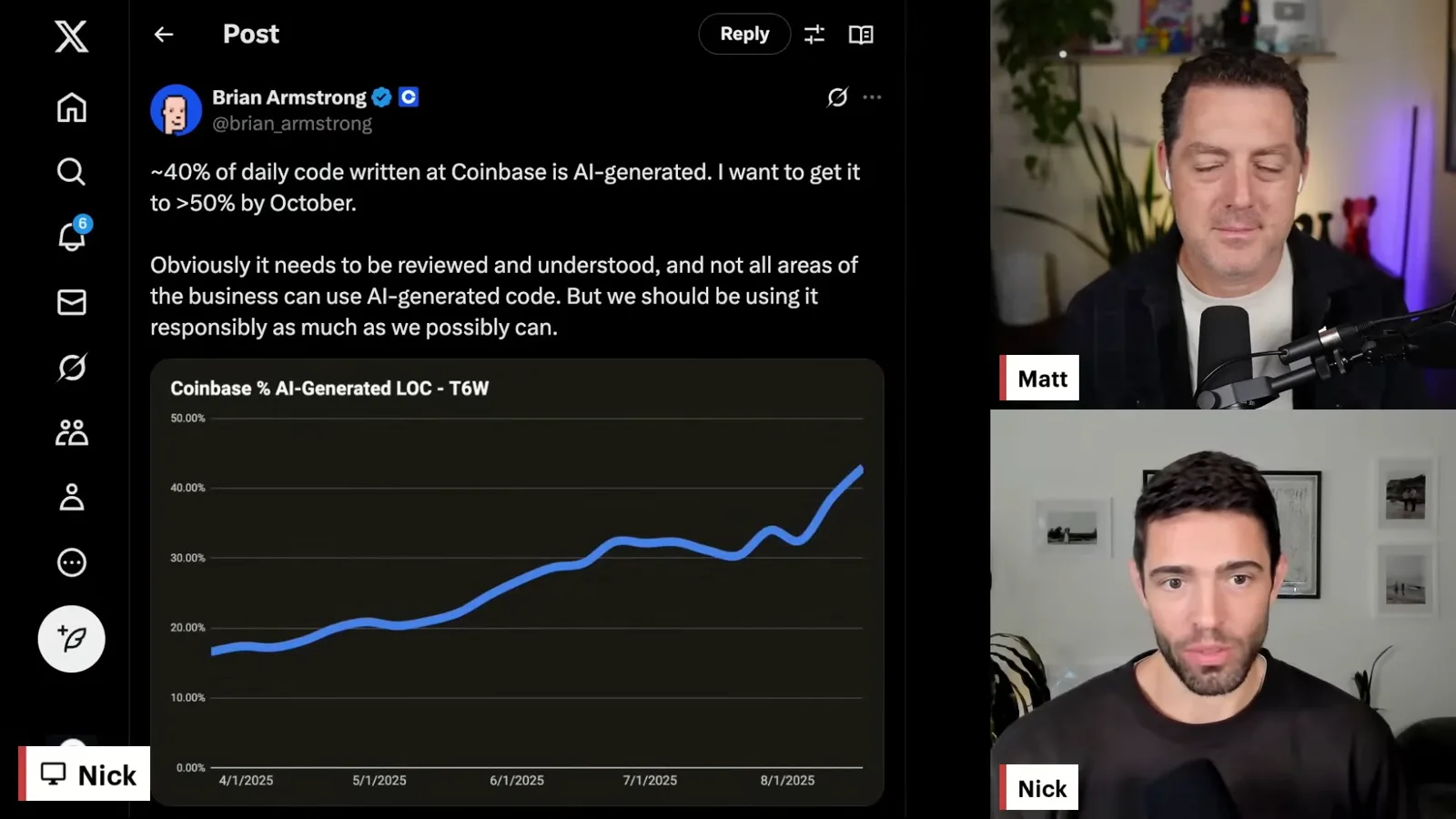
The hosts review Coinbase CEO Brian Armstrong’s claim that roughly 40% of daily code was AI-generated and his goal of exceeding 50%. Armstrong said generated code still needed review.
Berman finds the number surprising for systems handling financial transactions and assumes rigorous checks, though he does not independently verify the review process.
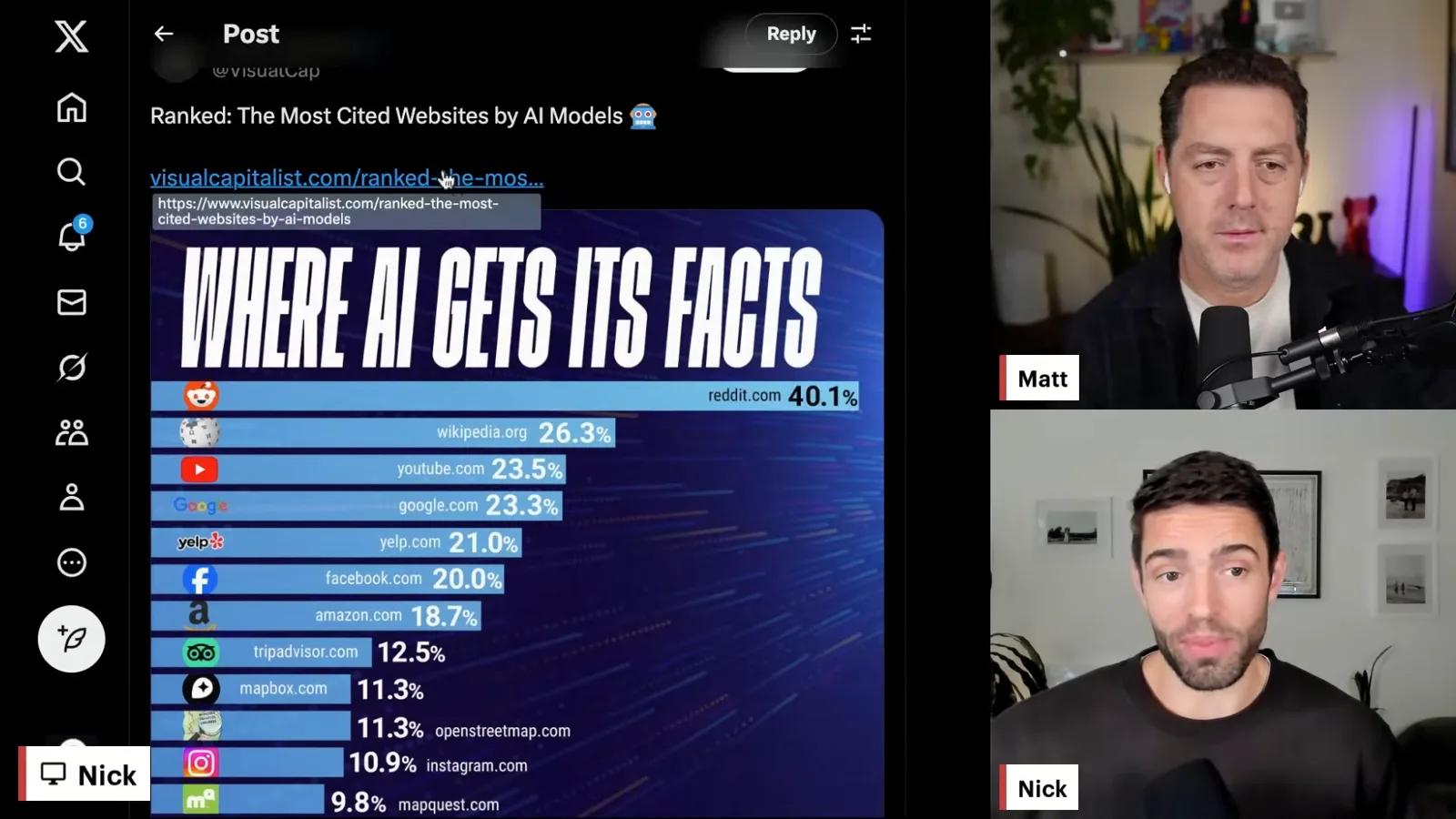
A chart on websites cited by AI tools prompts the hosts to discuss Reddit and Wikipedia. Berman correctly distinguishes citations in the displayed analysis from a measurement of training data.
Their guesses about political bias and why news sites rank lower are speculation; the percentages cannot simply be added as shares of a single total without knowing the methodology.
The hosts discuss reports about Google making TPUs available externally. Wentz sees a potential hardware opportunity, while Berman wonders whether scarce compute would create greater value inside Google’s own AI products.
They present competing interpretations, not confirmed internal economics.
Scott Santens on basic income
Santens defines UBI and discusses financing, pilots, child savings, services and a negative income tax proposal. He argues that cash and access to compute serve different needs.
Scott Santens, founder and CEO of the ITSA Foundation, joins to discuss universal basic income. Asked whether AI means mass displacement or abundance, he stresses uncertainty and argues that the safety net should be prepared for multiple outcomes.
Santens thinks entry-level workers may be especially exposed to disruption. He compares current AI to an intern whose output needs checking, and suggests that more productive workers could lead some teams to need fewer people.
This is his interpretation of a changing labor market, not proof that AI caused a particular hiring outcome.
He defines basic income using the Basic Income Earth Network’s formulation: a periodic cash payment made to individuals universally and unconditionally, without a means test or work requirement.
He distinguishes that definition from payments limited to particular households or groups.
Santens rejects the idea that an unconditional income necessarily means nobody works. He says people with passive income also work, and that universality can coexist with taxes that make higher-income households net contributors.
Actual effects depend on the policy and population.
Berman asks whether giving everyone more purchasing power would cause inflation. Santens describes a tax-funded, deficit-neutral scheme as redistribution rather than creation of new money. That does not by itself rule out price effects: the effects depend on changes in spending, supply and the design of the policy.
Santens uses the Alaska Permanent Fund dividend as an example of distributing returns from shared resources. He compares oil wealth with the public contributions, research and data behind AI and argues for treating people as beneficiaries of productivity.
The analogy is an argument about policy and ownership, not a settled legal conclusion.
Asked about pilots, Santens distinguishes transfers to selected individuals or households from community-wide or “saturation” programs.
He argues the latter can better reveal local effects because recipients are also potential customers for one another’s businesses.
He discusses Chelsea Eats during the pandemic, saying benefits reached roughly 15% of the Massachusetts city, and cites changes in hospital use as well as earlier Canadian research. His account of the figures is not a universal result: programs differ in eligibility, timing and study design, and association or pilot evidence should not be treated as proof of a nationwide UBI effect.
Santens claims some community pilots saw large increases in entrepreneurship and contrasts them with the OpenResearch cash-transfer study.
The study’s results should be read in context: its researchers reported recipients worked about 1.3 fewer hours per week on average and were two percentage points less likely to be employed than the control group. Neither outcome means everyone stopped working.
The hosts ask about shares or savings accounts for children.
Santens says a capital grant available later in life can help reduce wealth inequality, but it is different from regular income available while a child is growing up and experiencing poverty.
Asked about Elon Musk’s “universal high income” framing, Santens worries it can obscure the immediate role of basic income as a floor. A small payment would not replace an $80,000 salary, he says; he expects jobs and human services to remain important alongside an income floor.
Santens offers an example from his own tastes: he values a sushi chef’s skill and a live concert even when cheaper alternatives exist. He sees continuing demand for human experiences, while acknowledging that AI could transform work. That is a forecast, not a guarantee for every occupation.
A viewer asks whether universal basic services would be more suitable than cash.
Santens favors services plus income, or treating income as one service: cash can adapt to different needs, such as transportation choices in rural areas where fixed services may be harder to provide.
Asked whether spending should be restricted, Santens says people should be trusted to decide.
He argues restrictions can add friction and that benefits may be exchanged indirectly, while recipients also find constructive uses policymakers did not anticipate.
For a first step, Santens proposes a small universal monthly payment, perhaps $100–$200, financed through reform of the standard deduction into a fully refundable credit. He uses the advance payments of the 2021 child tax credit as an example of how a credit can be delivered monthly.
The hosts discuss Thailand’s then-reported interest in a negative income tax. Santens explains the mechanics with an illustrative threshold and 50% rate: payments decrease as earnings rise, so a person generally retains part of each additional unit earned within that simple example.
He notes details were not settled; this was a proposal, not proof of implementation.
Santens suggests bringing more people into the tax system could improve coverage and information, while Berman questions why people above the threshold would start filing.
Santens replies that people may value access if their income later falls; the effect on participation and revenue remains uncertain.
On an AI dividend, Santens distinguishes access to computing from cash.
He compares compute access to education: it can be useful and may help people earn income, but it cannot automatically pay for food or housing. He prefers cash’s flexibility while supporting access to AI tools.
Image generation and robotaxis
The hosts discuss their image workflow and compare individual ride experiences. Anecdotes are not a population-wide price or safety analysis.
After Santens leaves, the hosts agree that the details of funding and implementation matter. They then discuss image generation as a route to AI adoption and describe using Nano Banana to create or revise images for their own newsletter.
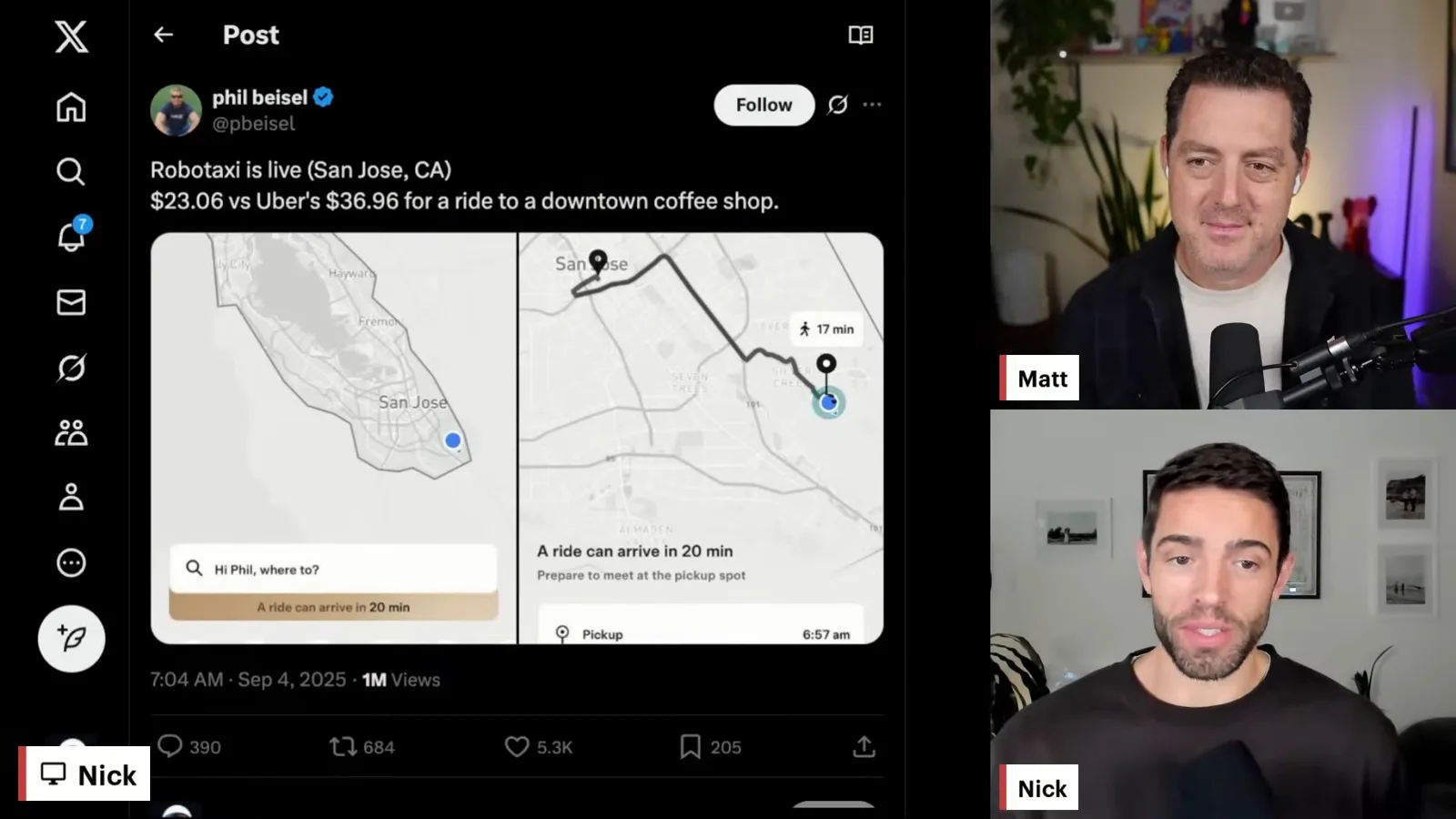
A social-media post compares one San Jose robotaxi fare of about $23 with an Uber quote of about $37.
Berman says Waymo had been more expensive on trips he had taken in San Francisco. One comparison does not establish typical prices, which vary with trip and time.
Both hosts describe enjoying Waymo rides, while acknowledging difficult cases. Wentz recounts a vehicle blocked by a reversing bus that required support, and Berman recalls a car pausing at a green light before moving.
Their confidence and anecdotes are personal experiences, not a safety comparison.
Keith Sakata on AI and mental health
Sakata explains psychosis and shares limited clinical observations about chatbots. He discusses safeguards, companionship, youth and the need for further research and access to care.
UCSF psychiatrist Keith Sakata joins to discuss AI companionship and the phrase “AI psychosis.” He says it is not a clinical diagnosis. Psychosis can involve delusions, hallucinations or disorganized thinking, and its causes and circumstances vary.
Sakata describes 12 patients he treated who already had psychotic episodes and in whose cases, he believes, chatbot use worsened or accelerated their experience.
These are clinical observations, not a controlled study establishing frequency or causation. He worries that a chatbot can reinforce beliefs without testing them against reality.
Asked about vulnerability, Sakata names sleep loss, substance use, prior mental health conditions and stressful events as possible contributing factors.
He suggests sleep deprivation can induce psychotic experiences, though his broad assertion that everyone would develop psychosis after three sleepless days is not established and individual responses vary.
Sakata contrasts a chatbot feedback loop with a trained therapist’s effort to help someone evaluate beliefs and reconnect with reality. The hosts ask whether general-purpose AI tools are suitable for therapy when they might also intensify a vulnerable person’s difficulties.
He sees AI as a potentially useful tool rather than inherently good or bad, and says he uses it for writing. Emotional support is more complicated: he argues that general-purpose assistants were not originally designed to detect every crisis or consistently connect someone to appropriate care.
Given shortages of mental health professionals, Sakata understands why people seek help from AI.
He sees potential in tools that support clinicians and expand access, but says careful evaluation is needed to identify useful applications and avoid harm; his numerical hopes for productivity are aspirational.
Asked what concerning conversations look like, Sakata describes isolation and hours in the same chat.
In his account, a person experiencing delusions may interpret a chatbot’s irrelevant or inconsistent responses as meaningful signs, producing a reinforcing loop. He is describing observations and a possible mechanism, not proving it occurs in all long conversations.
The hosts ask about routing sensitive conversations to different models and parental controls.
Sakata calls safeguards a first step and compares the process to improving vehicle safety with technology and social rules: identify failure modes, protect vulnerable users and make routes to help clear.
Berman asks whether teenagers are more vulnerable to AI companionship.
Sakata says he is reasoning from first principles and lacks direct research to establish that claim. He worries that overreliance on chatbots during social development could displace human connections and skills; this is a hypothesis requiring study.
Berman describes a viewer’s counterpoint to his own concerns: an older person unable to leave home may have few opportunities for companionship.
Sakata agrees that the answer cannot be reduced to a single label for everyone; circumstances, access and how the system is used matter.
Sakata imagines supportive applications for older adults, such as helping them feel comfortable in a new setting or engage with memories.
He distinguishes technology that further isolates someone from tools designed to help them connect with family, friends and care. These proposed benefits are possibilities rather than established treatment effects.
For families and individuals, Sakata suggests noticing increasing immersion, irritation when access is interrupted, offloading more thinking and emotional processing, or withdrawal from relationships.
He presents these as signs worth discussing and assessing in context, not diagnostic criteria.
The hosts ask how psychiatry might respond to AI-related problems and refer to gaming disorder. WHO includes gaming disorder in ICD-11, while the American Psychiatric Association’s DSM-5 lists internet gaming disorder as a condition for further study.
Sakata says different pathways to distress may require different responses and more research.
Sakata says many adults already use AI, so his approach is to encourage mindful use rather than simply demand abstinence.
He wants clinicians to learn which people are vulnerable, how to identify problems earlier and how best to help those already experiencing psychosis.
On industry standards, Sakata favors collecting better data about prevalence, companionship use and failure modes before deciding where safeguards should be set.
He calls for honest product design and alternatives that can connect people with human care when appropriate.
Looking ahead, Sakata hopes AI might support reflection, goal-setting and mental wellness while preserving people’s own thinking and relationships.
His preferred outcome also includes access to human therapists for those who need them; these are goals, not evidence that existing systems can reliably deliver them.
Sakata says people can follow his work on X or LinkedIn. The hosts thank him, close the discussion and note plans for their next live show.
Sur la même chaîne
 34:21EN
 Matthew Berman· 27 oct. 2026Matthew Berman Examines Anthropic’s IPO Filing, AI Growth and GovernanceMatthew Berman, Sam Altman · Forward FutureThe presenter reviews the S-1’s financial metrics, compute strategy and voting structure while questioning the tension between rapid AI development and safety.
 0:26ENMatthew Berman· 25 oct. 2026Sam Altman on Human Values and Problem-Solving in an AI WorldSam Altman · OpenAIIn a short interview excerpt, Altman considers the enjoyment of solving hard problems and the human role in interpreting results.
 0:36ENMatthew Berman· 25 oct. 2026Kimi K3.1 and a Rubik’s Cube Solver DemonstrationMatthew Berman · Forward FutureMatthew Berman shows a scrambled virtual cube being solved and gives the Kimi K3.1 test a favorable assessment.
 0:21ENMatthew Berman· 24 oct. 2026An AI-Generated Kimi Benchmark Chart Used Invented ScoresMatthew Berman · Forward FutureMatthew Berman asks for a graph of Kimi K3.1 Pro benchmarks, then discovers that the displayed figures are illustrative placeholders.
 25:50ENMatthew Berman· 24 oct. 2026Kimi K3.1 Pro Tested: Strong 3D Demos, Uneven Results and Competitive PricingMatthew Berman · Forward FutureMatthew Berman tests the open-weight model on coding, 3D rendering and visual explanations, then compares benchmark results and prices.
 32:20ENMatthew Berman· 23 oct. 2026Who Is Local AI For? The Costs, Trade-offs and a Hybrid FutureMatthew Berman · Forward FutureMatthew Berman weighs data control and independence against hardware cost, setup complexity and inference speed.