En 30 secondes
In March 2025, Matthew Berman reviews QwQ-32B, Alibaba’s Apache 2.0 open-weight reasoning model. He discusses Qwen’s training recipe, independent benchmark results, a Groq inference demonstration, and the practical limits of the model. The video is sponsored by Browserbase, and its description discloses that Berman is a small investor in Groq.
- 1Benchmark comparisonsQwen’s chart puts QwQ-32B close to DeepSeek-R1 on AIME 2024, with differences across coding, instruction-following and tool-use tests.
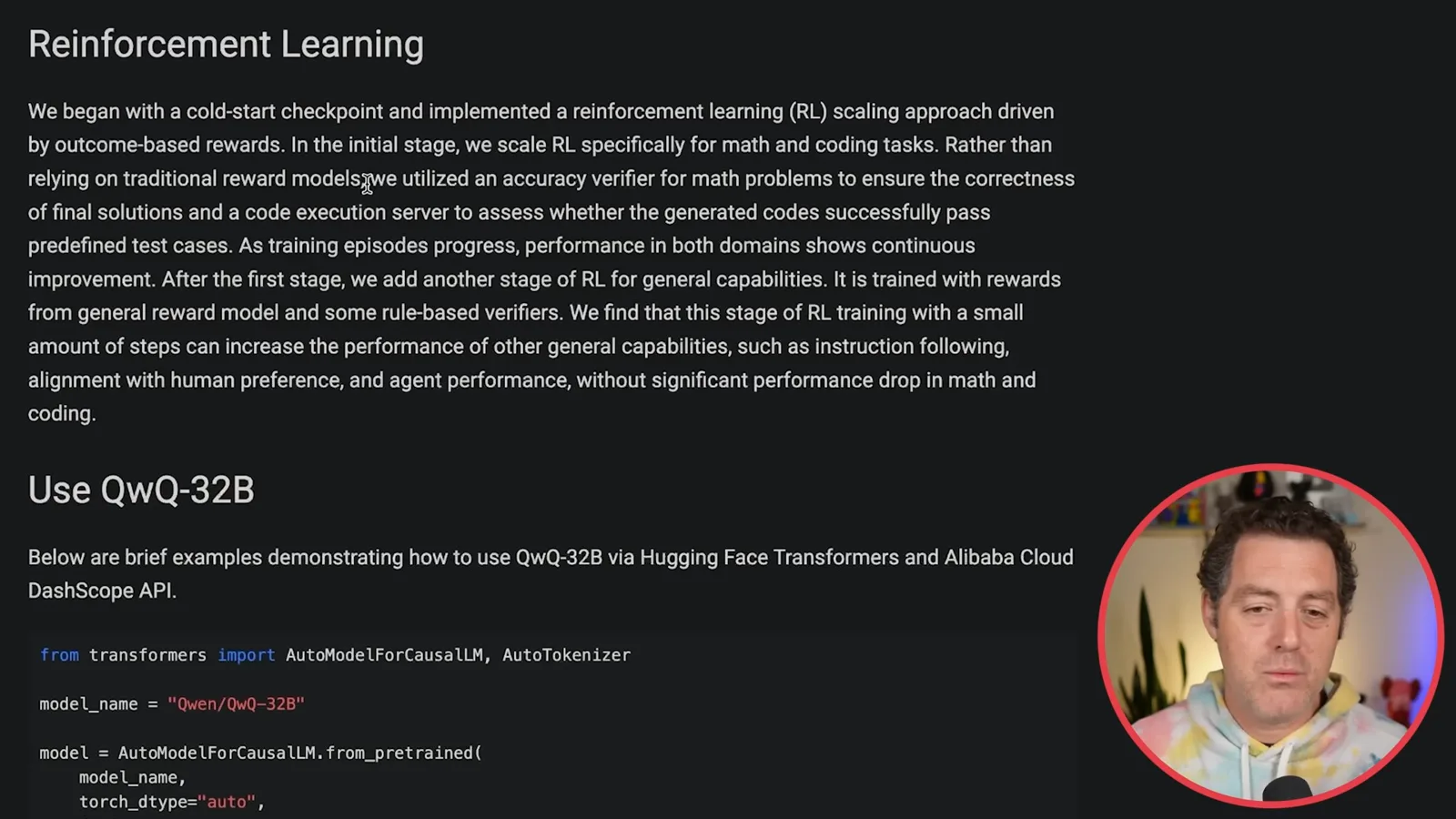
- 2Outcome-based trainingQwen describes math answer verification and code execution tests followed by another reinforcement-learning stage for general capabilities.
- 3A coding testA bouncing-ball simulation runs but has imperfect collision behavior; Berman then asks the hosted model to revise it.
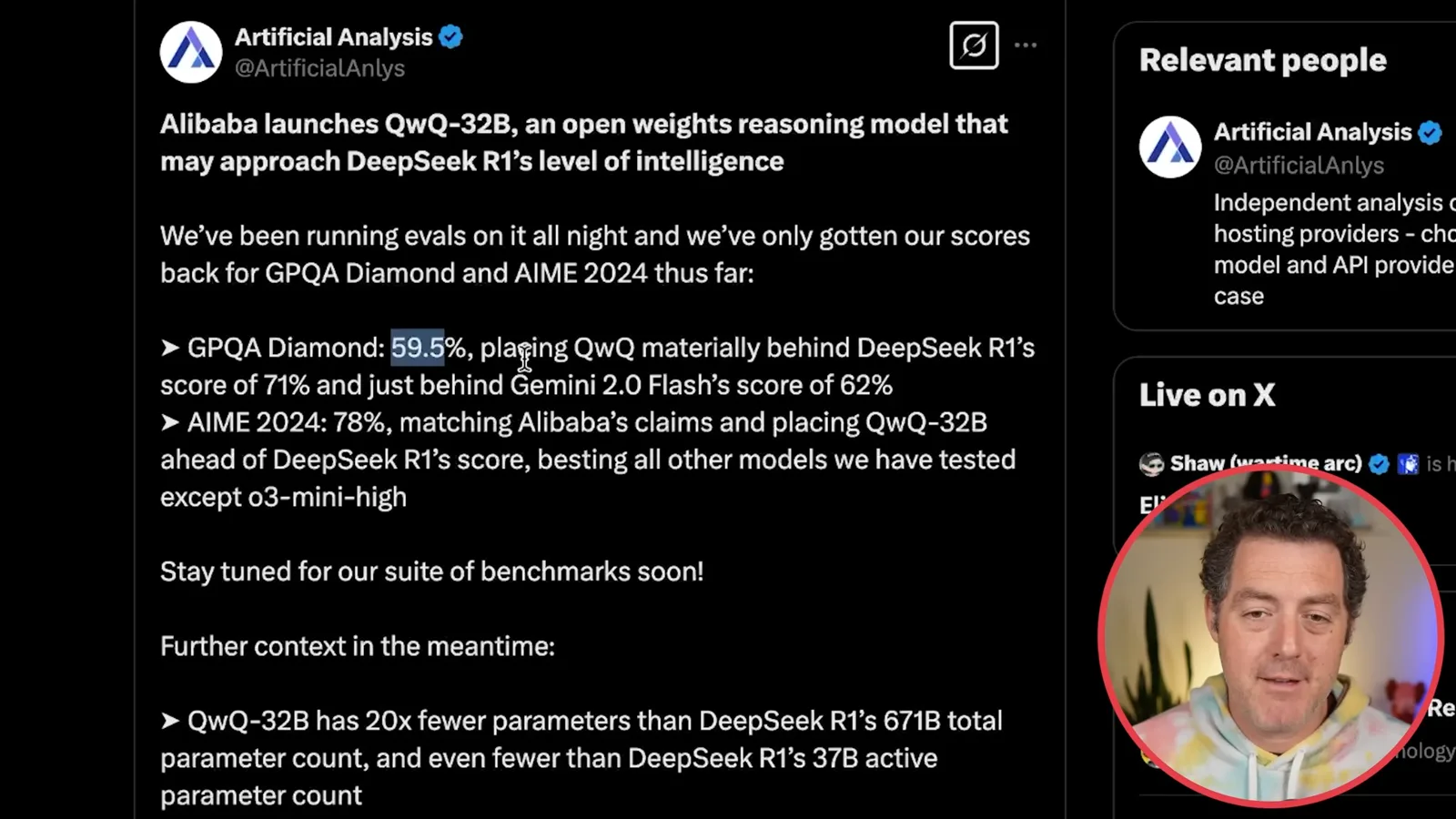
- 4Independent evaluationArtificial Analysis reported a 59.5% GPQA Diamond score for QwQ compared with 71% for R1, alongside a 78% AIME score.
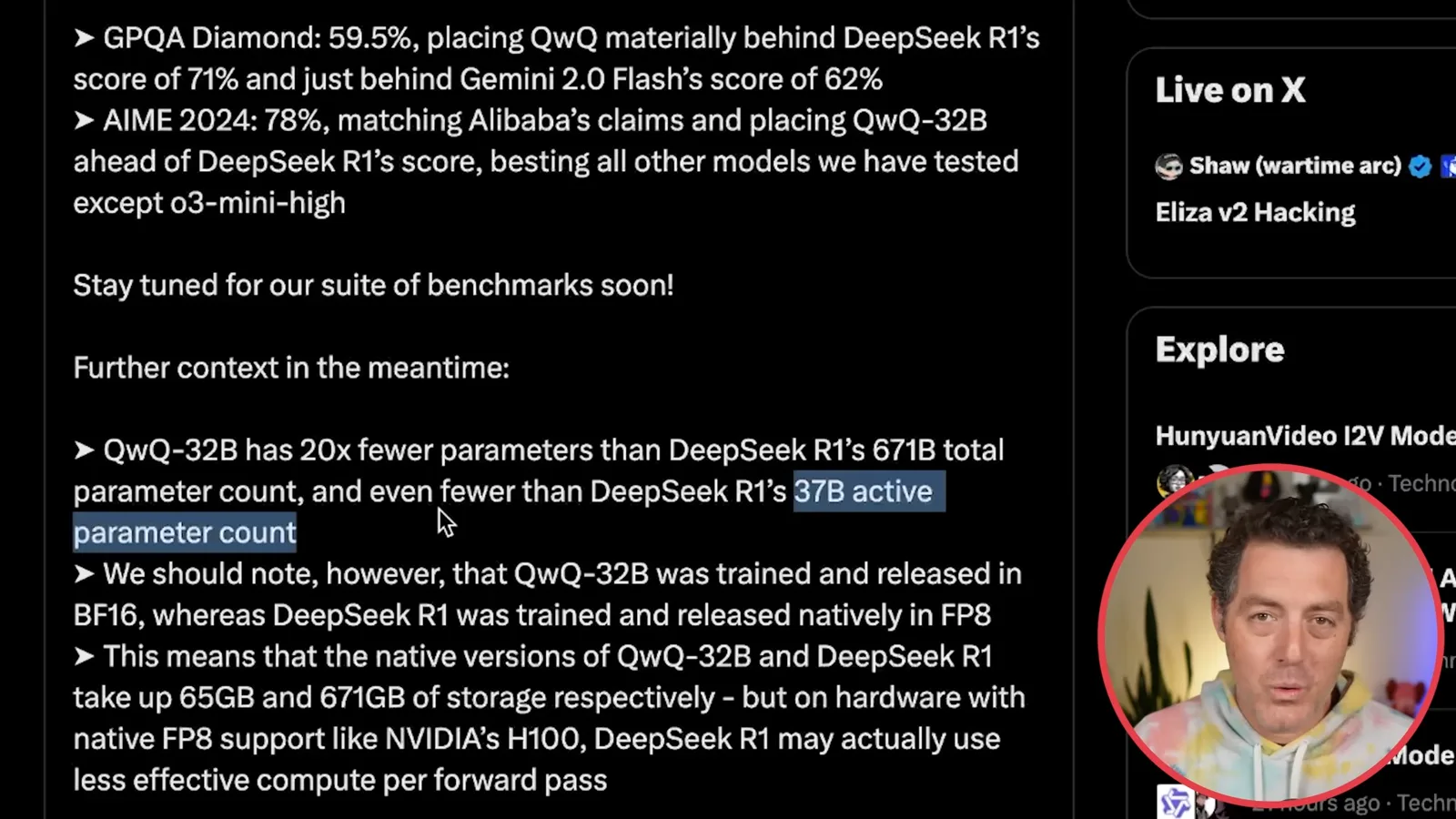
- 5Hardware and efficiencyThe native formats and the mixture-of-experts architecture complicate a straightforward comparison based on parameter counts.
À retenir
- QwQ-32B approached DeepSeek-R1 on some reported benchmarks, though an independent science benchmark showed a substantial gap.
- Qwen used outcome-based reinforcement learning for math and coding, followed by a stage focused on broader capabilities.
- A demonstration reached roughly 450 tokens per second on Groq, a result specific to that hosted setup.
- Native BF16 weights were estimated at about 65 GB; local deployment depends on available memory, quantization and overhead.
- DeepSeek-R1 is a mixture-of-experts model, so total parameter count alone does not capture per-token compute.
Lire le texte remanié, chapitre par chapitre
A compact reasoning model
Berman introduces QwQ-32B and Qwen’s benchmark chart. He argues that the smaller open-weight model makes reasoning more accessible.
Qwen’s QwQ-32B is a reasoning model with 32 billion parameters, released as open weights under Apache 2.0. Its appeal is that it is much smaller than the full 671-billion-parameter DeepSeek-R1 while approaching it on several reported tests. Smaller does not mean it runs easily on every computer: memory, quantization and inference configuration matter.
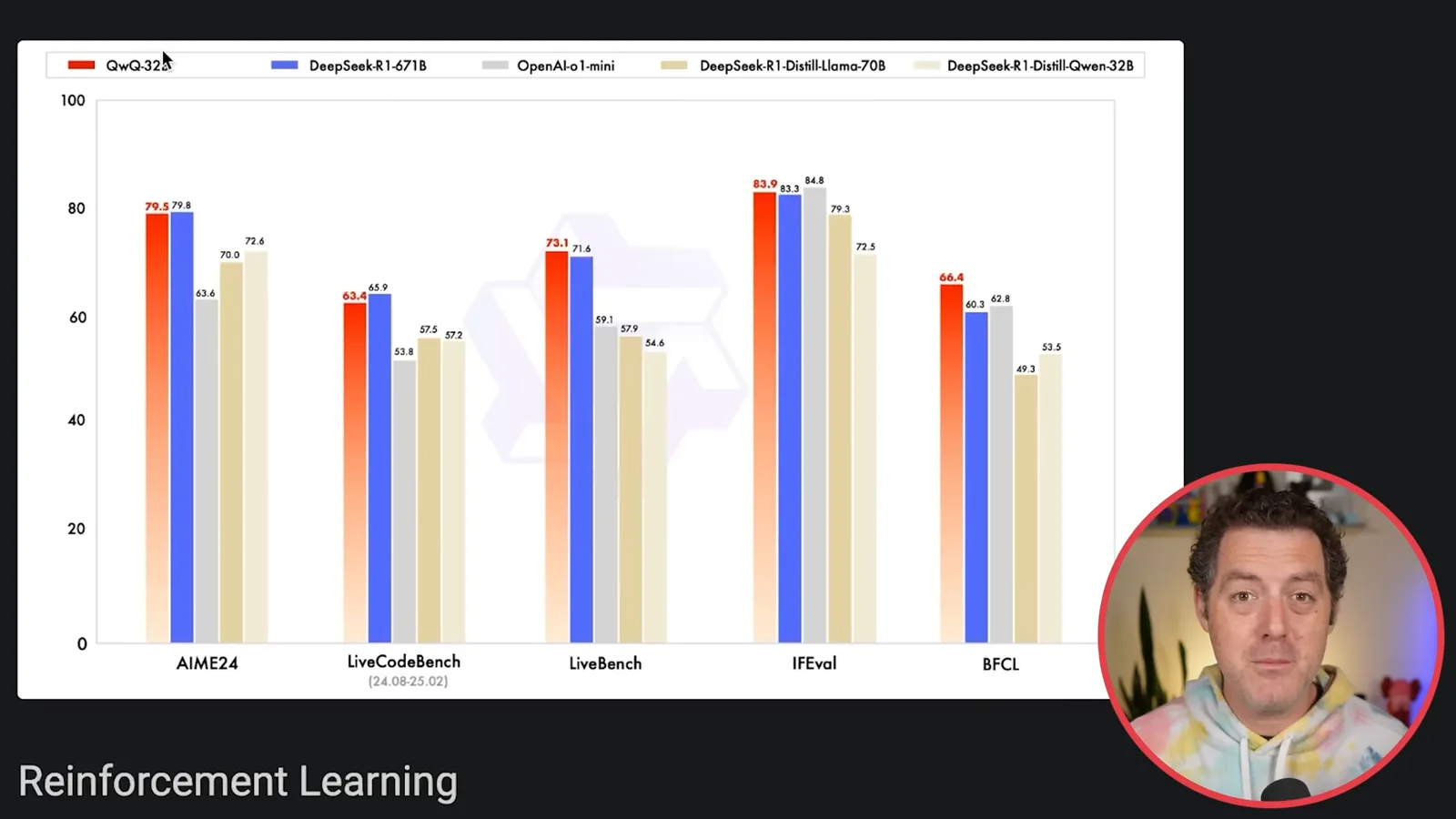
Qwen’s chart reports 79.5 on AIME 2024 for QwQ versus 79.8 for R1, and a somewhat lower LiveCodeBench score. QwQ scores higher on the chart’s LiveBench, IFEval and BFCL comparisons. Those are selected benchmark results, not a finding that the model wins on every task.
The team emphasizes reinforcement learning, an approach also central to the reasoning models I have discussed from OpenAI and DeepSeek. Starting with a strong foundation model, Qwen trained reasoning and agent-related capabilities, including tool use. In its [release post](https://qwenlm.github.io/blog/qwq-32b/), Qwen describes two stages rather than a single generic training step.
The reinforcement-learning recipe
Qwen describes outcome-based verification for math and code, followed by broader reward signals. Berman contrasts outcome and process rewards.
The first stage starts from a cold-start checkpoint and rewards outcomes. I tend to prefer process rewards in principle: a model could receive feedback for useful intermediate steps even when its final answer is wrong. With outcome rewards, a final failure can receive a negative signal despite much of the reasoning being correct.
For math, the team used a verifier to check final solutions; for coding, a code execution server tested generated programs against predefined cases. Qwen then added a second reinforcement-learning stage using a general reward model and rule-based verifiers. It reported improvements in instruction following, human preference alignment and agent performance without a significant drop in math and coding.
Foundation models and agents
Berman speculates about stronger foundation models combined with reinforcement learning. He explains why tool use matters for agentic coding.
Qwen argues that stronger foundation models combined with more reinforcement-learning compute could advance reasoning. I am excited by the possibility of applying that recipe to a stronger base such as GPT-4.5. My suggestion that an o3 Pro model might already do something similar was speculation at the time, not a confirmed description of its training.
Qwen also says it is exploring agents, reinforcement learning and longer-horizon reasoning. That matters to my agentic coding workflow: tool and function calling can affect whether a model works well in an editor such as Cursor. An editor’s support for a model and its tools is a separate question from the model’s general reasoning scores.
A simulation and fast inference
The model generates a bouncing-ball simulation with imperfect collisions. Berman uses Groq to ask for a correction and observes fast output.
I ask QwQ to write a Python simulation of a ball bouncing under gravity and friction inside a rotating hexagon. A free Hugging Face Space shows the model thinking for a long time and returns a runnable result, but the ball does not collide with the walls correctly. The value of a fast model is that I can iterate on that first attempt.
I paste the previous code into Groq’s hosted QwQ and ask it to fix the collision. During this demonstration I observe around 450 tokens per second, making further iterations feel much faster. That number describes one hosted run, not a guaranteed local or universal rate. The video is sponsored by Browserbase, and its description discloses that I am a small investor in Groq.
Independent tests and hardware tradeoffs
Independent science and math scores complicate Qwen’s comparisons. Model format, mixture-of-experts computation and context length matter for practical use.
Artificial Analysis provides a useful counterpoint to the launch chart. Its initial GPQA Diamond result was 59.5% for QwQ, compared with 71% for DeepSeek-R1 and 62% for Gemini 2.0 Flash in its evaluation. Its AIME 2024 score was 78%, close to Qwen’s reported result and ahead of R1 in that particular evaluation. Differences between benchmarks and testing setups matter.
QwQ has about 32 billion parameters, compared with R1’s 671 billion total and roughly 37 billion activated per token in its mixture-of-experts architecture. Artificial Analysis estimated the native BF16 QwQ weights at about 65 GB and native FP8 R1 weights at about 671 GB. These are weight-storage estimates, not complete runtime requirements; quantized versions can reduce memory needs. On hardware with native FP8, R1 may use less effective compute per forward pass despite its larger total size.
I also see limitations: the roughly 131,000-token context is not exceptionally large by the standards I was comparing in 2025, and the model often emits a great deal of reasoning. That costs tokens. A technique such as chain of draft might encourage more concise intermediate output, though whether it helps depends on the task. With open weights and multiple hosting options, there is room to experiment, including with editor and tool support.
Sur la même chaîne
 14:45EN
 Matthew Berman· 29 oct. 2026Matthew Berman Examines Google’s Gemini 4 Carbon AnnouncementMatthew Berman · Forward FutureMatthew Berman reviews Google’s reported benchmark results, staged rollout and pricing for Gemini 4 Carbon, while noting he has not yet used the model.
 21:11ENMatthew Berman· 28 oct. 2026Matthew Berman tests DeepSeek V4.1 Flash: coding, vision and local appsMatthew Berman · Forward FutureA hands-on tour of visual coding, image reasoning, local applications and provider economics reveals both impressive results and visible flaws.
 34:21ENMatthew Berman· 27 oct. 2026Matthew Berman Examines Anthropic’s IPO Filing, AI Growth and GovernanceMatthew Berman, Sam Altman · Forward FutureThe presenter reviews the S-1’s financial metrics, compute strategy and voting structure while questioning the tension between rapid AI development and safety.
 0:26ENMatthew Berman· 25 oct. 2026Sam Altman on Human Values and Problem-Solving in an AI WorldSam Altman · OpenAIIn a short interview excerpt, Altman considers the enjoyment of solving hard problems and the human role in interpreting results.
 0:36ENMatthew Berman· 25 oct. 2026Kimi K3.1 and a Rubik’s Cube Solver DemonstrationMatthew Berman · Forward FutureMatthew Berman shows a scrambled virtual cube being solved and gives the Kimi K3.1 test a favorable assessment.
 0:21ENMatthew Berman· 24 oct. 2026An AI-Generated Kimi Benchmark Chart Used Invented ScoresMatthew Berman · Forward FutureMatthew Berman asks for a graph of Kimi K3.1 Pro benchmarks, then discovers that the displayed figures are illustrative placeholders.