En 30 secondes
Long-running coding agents can increase parallel work, but Prasanna Sankar says teams then have to coordinate, review and merge more changes. He describes Vorflux’s approach to cloud setup, testing evidence and merge queues, followed by bots that start routine work from existing signals. He also warns that unbounded automation can create noise, cost and superficial fixes.
- 1Cloud agents need a working application environmentDependencies, ports, authentication and test data affect whether work can be validated.
- 2Testing should produce evidence a person can inspectSankar describes browser tests, videos and staging links.
- 3More parallel tasks move the bottleneck to coordinationPeople need to track progress, blockers and whether results are useful.
- 4Unbounded automation can flood a team with low-value workSankar says agents need goals, limits and visible decisions.
À retenir
- Make cloud environments capable of running and testing the real application.
- Provide inspectable evidence such as tests, videos or staging links.
- Plan for review and merge as parallel work increases.
- Bound automated work and keep its decisions visible.
Lire le texte remanié, chapitre par chapitre
Move long-running coding work to the cloud
Sankar describes the motivation for Vorflux and the environment setup needed for agents to work.
Prasanna Sankar describes building Vorflux to increase the amount of work a person can coordinate with coding agents. As agents run longer and more tasks in parallel, he says the bottleneck moves from writing code to managing and landing the work.
Sankar recounts his path from Microsoft to founding companies including Rippling. He says recent coding models and longer-running agents prompted him to build a system that spends more compute to save human time.
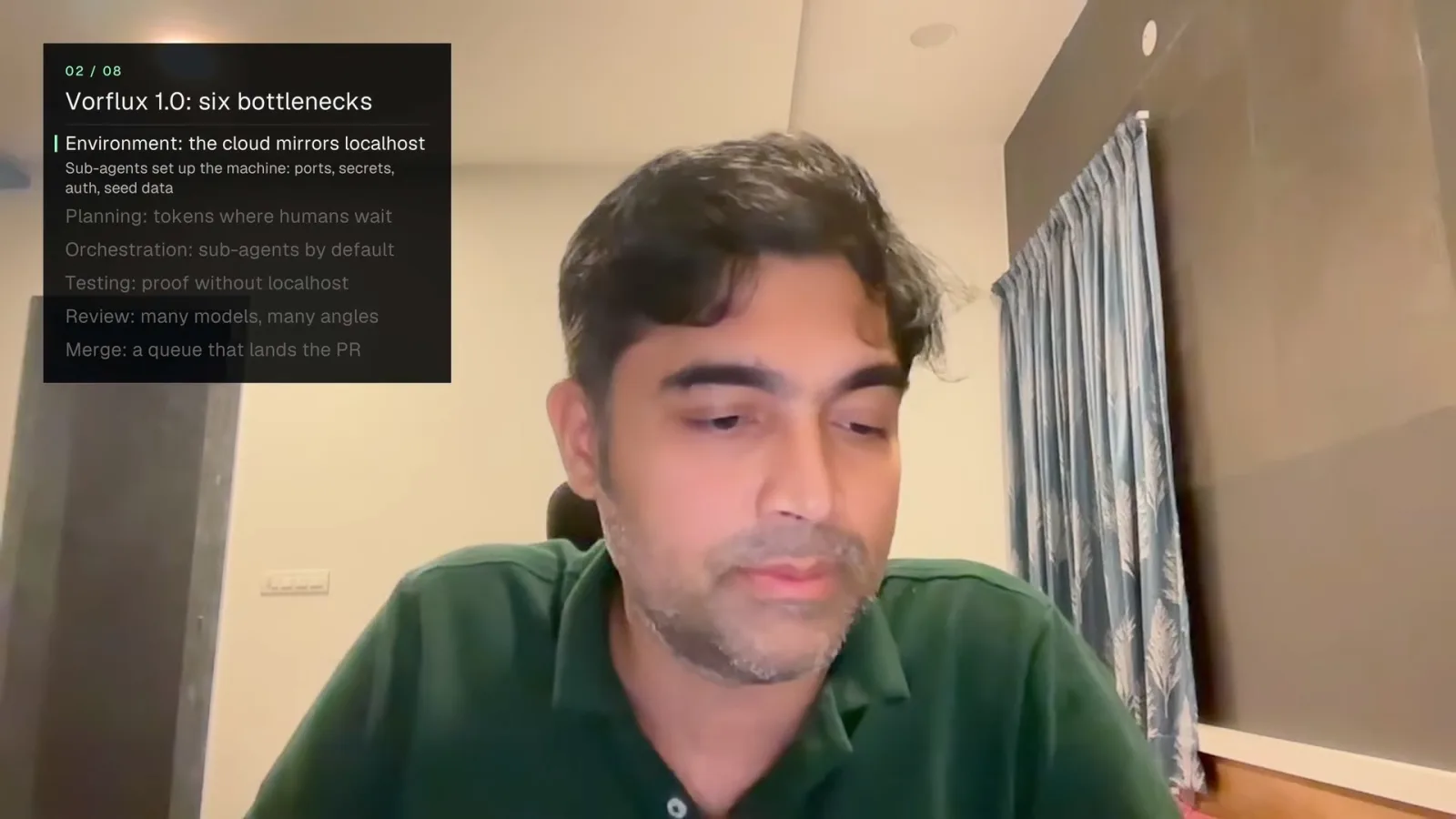
Moving work to the cloud requires an environment that can actually run and test the application. He lists dependencies, ports, authentication, secrets and seed data as setup problems; his team uses agents to help prepare a machine.
Address planning, testing, review and merge
Parallel exploration, inspectable testing and merge queues target the bottlenecks his team observed.
He says teams spend time iterating on plans, so Vorflux uses parallel exploration to produce a more detailed plan. Independent implementation work is then organized according to dependencies.
Testing should produce something a person can inspect without rebuilding the environment locally. Sankar describes browser tests, a video of the feature or a staging link as ways to review the result.
He describes multiple model reviewers looking at changes from different angles, followed by a merge queue that keeps branches current and lands pull requests. These are product design choices for the bottlenecks his team observed.
Coordinate work that agents can start themselves
The proposed bots use existing signals to initiate routine tasks. Sankar discusses risks of unbounded automation and human approvals.
When more tasks run at once, Sankar says project management becomes harder: a person must remember what started, what is blocked and whether the result is useful. He frames the next product version around coordinating that work.
His proposed bots monitor signals such as customer-call follow-ups or production alerts and initiate work within a goal and limits set by a team. He distinguishes routine follow-through from the creative work of deciding what to build in the first place.
Sankar acknowledges that naive automation can flood a team with pull requests, silence symptoms rather than solve root causes, and spend money on unwanted work. His analogy is a new hire whose responsibilities expand gradually and whose work remains visible.
He gives a product example in which a bot identified a follow-up from a customer call, asked for approval, involved an engineer and prepared a fix. He says the engineer reviewed the change and he approved the customer follow-up.
His longer-term vision is a company where routine loops respond to calls, alerts and slow builds while people focus on new problems. He acknowledges that bots will make mistakes and that some responsibilities are not ready to hand over.
Sur la même chaîne
 38:50EN
 AI Engineer· 10 nov. 2026LinkedIn’s self-improving agent first had to fix its judgesZiwei Guo, Saloni Gandhi · LinkedInA prompt-optimization loop improved a career agent, but unreliable evaluators required human calibration first.
 12:48ENAI Engineer· 10 nov. 2026Brian Douglas: Turn agent corrections into reusable review knowledgeBrian Douglas · Paper ComputeThe Paper Compute developer captures expert pushback in coding sessions and tests ways to reuse it during review.
 12:20ENAI Engineer· 10 nov. 2026Ayush Bhardwaj: Agent workarounds are feedback for your CLIAyush Bhardwaj · Allos AIAn audit of coding sessions shows where output, errors and stale instructions force agents to improvise.
 12:57ENAI Engineer· 10 nov. 2026Harvey’s agents scaled until their platform and merge queue brokeJoey Wang · HarveyAfter an alert spawned 900 agents and one engineer launched 950 tasks, Harvey added deduplication and fair scheduling.
 23:00ENAI Engineer· 10 nov. 2026A passing PR check needs evidence tied to the submitted codeStephen Chin, Cassandra Chin · Neo4jStephen and Cassandra Chin show how Tracetoon connects agent traces, code changes and checks before writing a reviewable pull request.
 22:49ENAI Engineer· 10 nov. 2026When many coding agents share one codebase, delivery must handle concurrencyPatrick Debois · TesslPatrick Debois explains how shared planning, merge strategies and risk-based review can help teams coordinate agents.