En 30 secondes
Matthew Berman introduces MemPalace, a project associated with Milla Jovovich that organizes AI memories using a palace metaphor. He cites a 96.6% LongMemEval result and calls it the best memory system. The project describes that figure as raw Recall@5 for its retrieval setup; it is not a general proof of best end-to-end memory performance.
- 1An open projectBerman introduces MemPalace and associates it with Milla Jovovich. He describes the project as free and open source.
- 2Remembering across sessionsHe frames the project around information lost between AI conversations, while acknowledging that other memory systems already address the problem.
- 3The palace metaphorThe project groups memories into wings, halls and rooms. Its reported benchmark figure concerns a particular retrieval metric.
À retenir
- MemPalace uses wings, halls and rooms as labels for organizing memories.
- Berman notes that AI memory systems already exist, even though he considers them imperfect.
- The project's reported 96.6% is a raw Recall@5 figure on a specific LongMemEval retrieval setup.
- A retrieval score and a project ranking claim do not establish superiority across all memory tasks or configurations.
Lire le texte remanié, chapitre par chapitre
Introducing MemPalace
Berman introduces the project and its association with Milla Jovovich. He frames persistent memory as a problem for AI agents.
Matthew Berman introduces MemPalace, an open-source AI memory project associated with Milla Jovovich. He calls it the best agent memory system and cites a reported 96.6% LongMemEval result. The project describes that figure as raw Recall@5 under a specific retrieval setup; it does not establish superiority for every end-to-end memory task.
Berman frames the problem as conversations, decisions and debugging context being lost when an AI session ends. He acknowledges that memory systems already exist, though he finds them imperfect. MemPalace is presented as another way to organize and retrieve past material.
Organization and benchmark claim
He explains the palace metaphor and cites a 96.6% benchmark figure. That number is a specific retrieval metric, not a universal ranking.
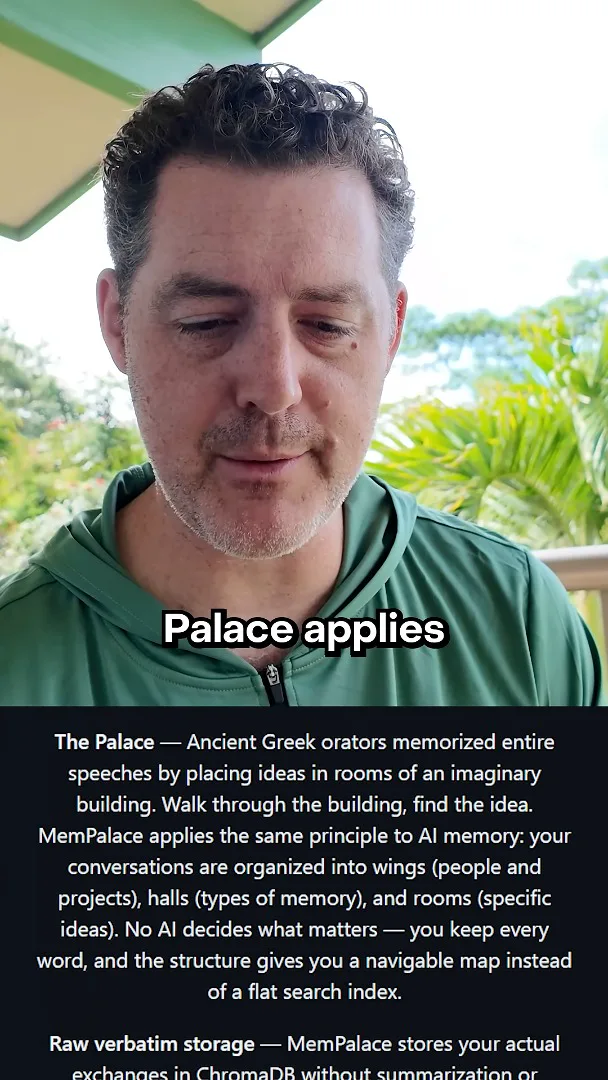
The project borrows the memory-palace metaphor: wings represent people and projects, halls represent types of memory, and rooms represent specific ideas. Berman compares it to arranging ideas in an imagined building. This is an organizational metaphor, not proof that the software reproduces how human memory works.
Sur la même chaîne
 34:21EN
 Matthew Berman· 27 oct. 2026Matthew Berman Examines Anthropic’s IPO Filing, AI Growth and GovernanceMatthew Berman, Sam Altman · Forward FutureThe presenter reviews the S-1’s financial metrics, compute strategy and voting structure while questioning the tension between rapid AI development and safety.
 0:36ENMatthew Berman· 25 oct. 2026Kimi K3.1 and a Rubik’s Cube Solver DemonstrationMatthew Berman · Forward FutureMatthew Berman shows a scrambled virtual cube being solved and gives the Kimi K3.1 test a favorable assessment.
 25:50ENMatthew Berman· 24 oct. 2026Kimi K3.1 Pro Tested: Strong 3D Demos, Uneven Results and Competitive PricingMatthew Berman · Forward FutureMatthew Berman tests the open-weight model on coding, 3D rendering and visual explanations, then compares benchmark results and prices.
 32:20ENMatthew Berman· 23 oct. 2026Who Is Local AI For? The Costs, Trade-offs and a Hybrid FutureMatthew Berman · Forward FutureMatthew Berman weighs data control and independence against hardware cost, setup complexity and inference speed.
 1:03:37ENMatthew Berman· 23 oct. 2026Matthew Berman’s Team Tests Kimi K3.1 on Animation, Games, and ChartsMatthew Berman, Alex, Brian · Forward FutureA live team AMA turns into an informal test of Kimi K3.1, from personal-agent workflows to motion graphics, a browser game, and a benchmark chart.
 0:53ENMatthew Berman· 22 oct. 2026Sam Altman on AI and the Discovery of New KnowledgeSam Altman · OpenAIAltman expects progress in mathematical discovery to extend to biology, materials and energy.