En 30 secondes
On August 29, 2025, Matthew Berman and Nick Wentz host a live discussion spanning biomedical AI, enterprise automation and how agents may access the web. Derya Unutmaz shares research anecdotes and ambitious medical predictions; Mihir Shukla describes vendor-reported automation cases; Caleb Peffer explores publisher compensation and web standards. Their claims and forecasts have different levels of evidence.
- 1A research hypothesisUnutmaz says GPT-5 suggested a new experiment from an immunology figure; the idea had yet to be tested.
- 2Ambitious health predictionsUnutmaz predicts broad disease treatment and aging reversal on aggressive timelines; these are speculative.
- 3Customer-service automationShukla reports that 40% of his company’s requests are handled without a human in the loop, a company claim.
- 4Vendor-reported savingsShukla cites Petrobras and inventory cases, but the interview does not present independent audits.
- 5Web access for agentsPeffer describes search, fetching and formatting as the layers Firecrawl aims to provide.
- 6Bot standards and publishersPeffer supports standards and publisher compensation while questioning centralized intermediaries.
À retenir
- Unutmaz’s biomedical examples are personal research accounts; proposed experiments and disease or aging timelines require independent validation.
- AI-generated medical outputs and legal liability cannot be assumed reliable or settled from a guest’s opinion.
- Shukla describes both autonomous and assisted work, with reported company examples that the interview does not independently audit.
- The widely repeated 95% enterprise AI figure depends on the underlying report’s definition and sample.
- Peffer sees search, fetching and structured formatting as key functions for agents accessing the web.
- Publisher compensation, advertising and bot authentication involve unresolved technical and governance trade-offs.
- The conversation’s model announcements and market predictions reflect August 2025.
Lire le texte remanié, chapitre par chapitre
News: chips, images and voice
Berman and Wentz discuss Nvidia, Nano Banana, voice APIs and predictions about abundance. Their market interpretations and future scenarios are opinions.
On August 29, 2025, Matthew Berman and co-host Nick Wentz open Forward Future Live with news and interviews with immunologist Derya Unutmaz, Automation Anywhere CEO Mihir Shukla and Firecrawl co-founder Caleb Peffer. The guests discuss possible futures for biomedical research, enterprise work and an agent-mediated web.
Wentz notes Nvidia’s record earnings and a muted share-price reaction. He and Berman speculate about China-related uncertainty, growth expectations and a $60 billion share-buyback authorization. Their interpretations of management’s motives and the company’s innovation are opinions, not established explanations for the stock reaction.
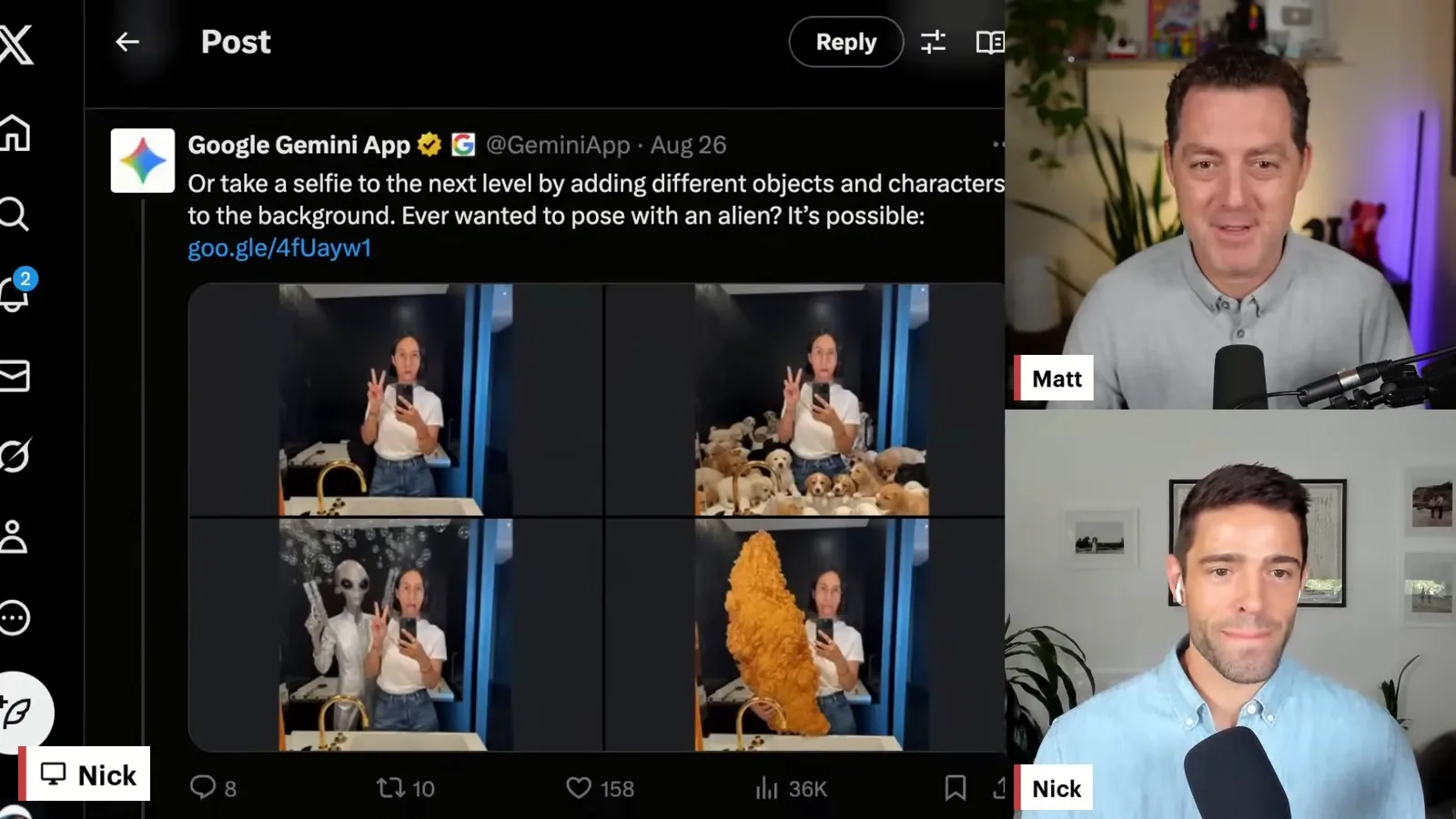
The hosts turn to Google’s image model known as Nano Banana, or Gemini 2.5 Flash Image. Berman praises its editing and describes transforming a map screenshot into an imagined street-level or historical scene. Such images can be creative illustrations, but generated depictions of a location or past event are not verified records.
Wentz highlights OpenAI’s Realtime API moving out of beta and the GPT-realtime speech model. Berman expects voice to become an important interface and thinks earbuds could be a convenient device; Wentz sees potential in customer support and accessibility. They also mention a troubled fast-food voice-ordering example, showing that deployments still need testing.
The hosts discuss Elon Musk’s prediction of universal high income and abundance. Berman is optimistic about a future in which intelligence becomes cheaper, while acknowledging that predictions range from abundance to dystopia. None of those outcomes is established by the present technology.
Derya Unutmaz: AI in biomedical research
The immunologist describes retrospective research examples, model choices and proposed virtual cells. The anecdotes and medical timelines remain unverified or speculative.
Berman introduces Derya Unutmaz, an immunologist and professor at The Jackson Laboratory. Unutmaz traces his interest in AI to the 1990s and says ChatGPT and later reasoning models convinced him that AI could accelerate scientific and medical work.
Unutmaz argues that biology is too complex for researchers to follow every interaction unaided. He sees increasingly capable models as a way to analyze data and propose experiments. These are his expectations for research, not a claim that today’s systems have a complete understanding of biology.
Asked about colleagues’ attitudes, Unutmaz says skepticism has given way to greater adoption among scientists and doctors he knows. He believes some resistance reflects professional anxiety as well as real concerns about errors and hallucinations. His account is personal experience, not a representative survey of medical professionals.
Unutmaz describes uploading a figure from an immunology experiment with conflicting results. He says GPT-5 suggested an experiment his team had already devised and another idea he found surprising. The second idea was still to be tested; it was a hypothesis, not a validated cancer treatment or a published discovery.
He reports another retrospective exercise in which a model analyzed metabolite data that had taken his team about a month, and says it reproduced prior findings and suggested additional ones. In a separate cell-and-cancer experiment he estimates that the model predicted about 90% of outcomes. These are his descriptions of examples, without a detailed independent evaluation in the interview.
Unutmaz hopes researchers can simulate parts of biology to prioritize a smaller set of laboratory experiments. His long-term goal is a virtual cell that can be tested in silico; he stresses that it would require much more biological data and computing power. A future simulation would still need validation against physical experiments.
The hosts ask about time spent on grants. Unutmaz cites an estimate of around 30% of scientist time and says work that took his team months can sometimes be drafted in days with AI. He describes testing Google’s AI co-scientist to suggest and rank hypotheses, but these claims are examples from his work rather than a controlled productivity study.
On general versus specialized models, Unutmaz expects both to matter. He describes AlphaFold as a specialized system for protein structure and says molecular dynamics and biological perturbation data require domain-specific methods and datasets. He does not rule out future general systems taking on more of that work.
Unutmaz says he uses Google models for some fine-tuning but has not yet tried local open models himself. He sees a role for local deployment when data is confidential or proprietary, while noting the time and computing resources required. Berman asks how the choice between open and closed systems might affect biomedical research.
AGI, medicine and careers
Unutmaz offers his own AGI definition and forecasts, discusses clinical adoption and worries about junior careers. The hosts consider different perspectives.
Berman asks about AGI timelines. Unutmaz predicts that a basic form may arrive by the end of 2025 or early 2026 and speculates about capabilities inside leading labs. His definition and assertions are personal forecasts and are not evidence that AGI had already been achieved.
Unutmaz identifies memory and learning across longer tasks as gaps. He imagines agents progressing from tasks requiring frequent human input to tasks lasting days or weeks. These are scenarios for future development, not demonstrated capabilities of the systems discussed.
On clinical adoption, Unutmaz argues that patients and doctors will increasingly demand AI assistance, while recognizing regulation and liability as barriers. His claim that failing to use AI could become unethical or malpractice is a personal position, not a statement of the legal standard or proof that any chatbot is appropriate for diagnosis.
Unutmaz worries about entry-level researchers and doctors. He speculates that senior scientists with AI and skilled technicians might need fewer junior researchers, and that medical jobs and incomes could change. Wentz contrasts this with executives who see value in hiring AI-fluent junior workers; neither prediction is established by the discussion.
Unutmaz offers an optimistic vision of broad access to care, cheap goods and less routine work. He predicts all diseases could be treatable in about ten years and aging reversed in about fifteen. Those are highly speculative timelines, not demonstrated medical outcomes or advice to defer treatment or training.
Microsoft, model data and browser agents
The hosts review Microsoft’s model announcements and discuss data sources and a limited browser-agent preview. Prompt injection is a key risk.
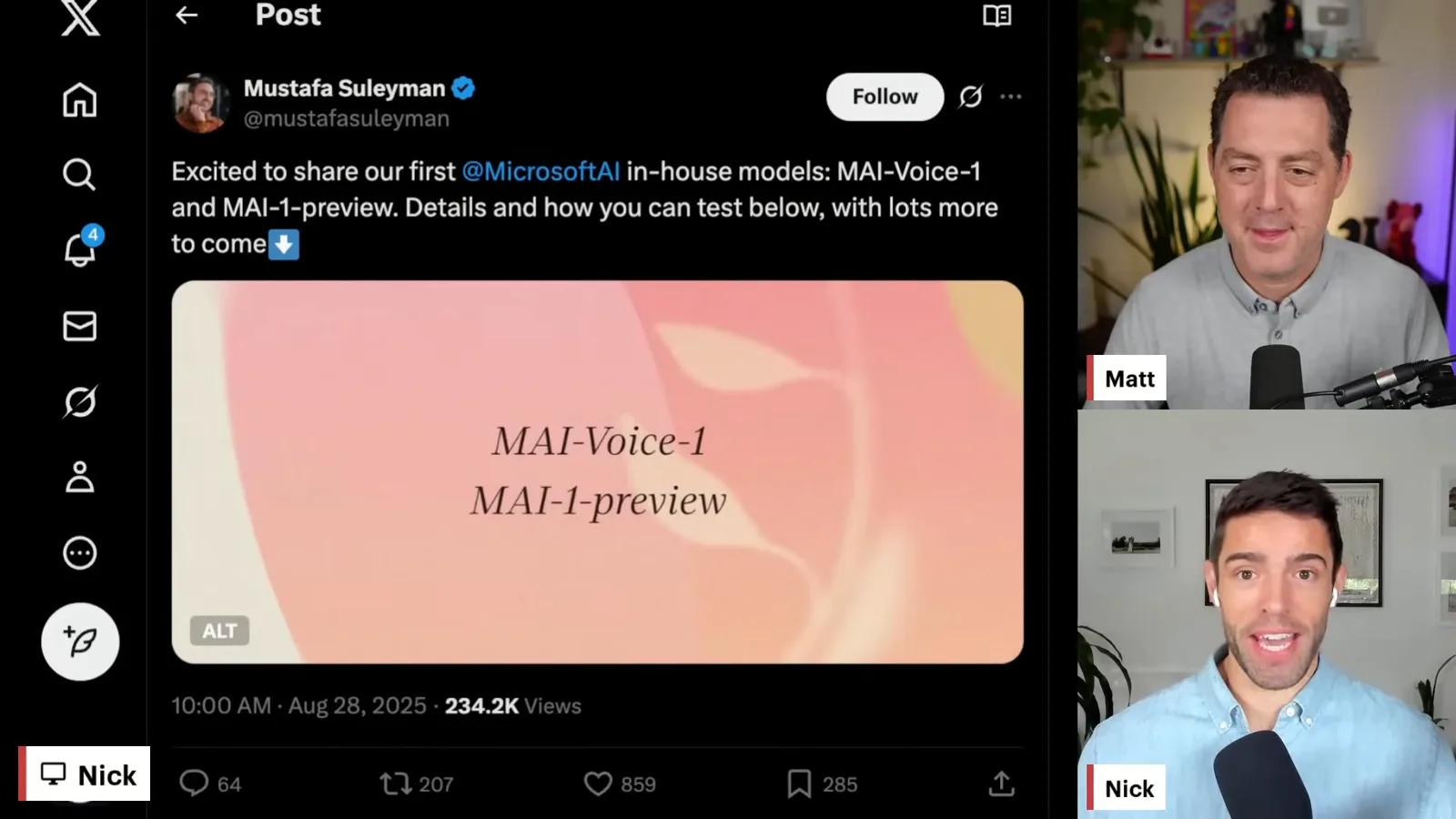
After thanking Unutmaz, the hosts return to the news. Wentz introduces Microsoft’s MAI-Voice-1 and MAI-1-preview announcements, and Berman interprets Microsoft’s in-house work as a way to gain strategic control alongside its OpenAI partnership. Their comments about corporate motives and Apple’s choices are speculation.
The hosts discuss Yuchen Jin’s observation that labs may have distinctive data sources, such as social platforms. Berman says model behavior can also reflect filtering, training choices and system instructions. The speakers speculate about companies’ datasets; they do not establish exactly which private content any model was trained on.
Wentz introduces Anthropic’s limited Claude for Chrome research preview and cites reported prompt-injection risks. Berman, who says he has access but has not yet tested it, compares a browser extension with Perplexity’s Comet browser. Both see potential in agents operating with a user’s existing browser context, alongside security risks.
Mihir Shukla: enterprise automation
Shukla discusses potential automation, employment, customer-service examples and company-reported outcomes. The conversation distinguishes vendor claims from independently verified results.
Berman welcomes Mihir Shukla, CEO of Automation Anywhere, and asks about his estimate that 40% to 80% of work could be autonomous or AI-assisted depending on the function. Shukla presents this as a potential range and says the harder challenge is redesigning organizations and processes, not simply obtaining new technology.
Asked whether smaller teams mean fewer workers, Shukla says AI can make teams productive but that new ideas and unmet needs could create new roles. He cites a World Economic Forum projection involving millions of created and affected roles, and describes retraining as a major challenge. The numbers are his account of a forecast, not a guaranteed employment outcome.
Berman asks whether humans must remain at the ends of every workflow. Shukla disagrees as a universal rule and says about 40% of his company’s customer-service requests are handled without a human in the loop, while customers can still choose human help. He claims satisfaction improved for the remaining cases; the interview does not independently verify the figures.
Shukla says Automation Anywhere serves thousands of customers across many industries. He cites Petrobras as an example where tax recalculation allegedly saved $120 million in three weeks, and says another customer’s inventory process allegedly saved $200 million. These are vendor-reported examples, not audited results presented in the interview.
Berman raises a widely cited MIT report and describes it as saying 95% of enterprise pilots fail. Shukla instead emphasizes the successful subset and claims back-office and end-to-end processes deliver value. The report’s measures concern returns and value in its study; the shorthand should not be treated as a verified failure rate for all AI pilots.
Shukla argues that a small pilot in one department may miss a larger end-to-end opportunity. He gives the example of balancing inventory across 32 warehouses and 385,000 items four times a day. He attributes the customer result to redesigning a process around an outcome rather than automating an isolated task.
Automation strategy and future work
Shukla argues for outcome-focused projects and describes his company’s process reasoning engine. He offers a speculative vision for work in three years.
Asked what distinguishes successful adopters, Shukla says many enterprises should start with capable general models rather than building a new foundation model from scratch. He favors short paths to measurable outcomes, leadership support and specific process improvements over open-ended technology projects. He acknowledges there may be exceptions.
From his perspective as an AI buyer, Shukla warns that vendors may recommend approaches aligned with their own pricing incentives. He argues that seat-based software economics can conflict with automation that reduces the number of seats. As an automation vendor, he also has a commercial interest in the approach he recommends.
Shukla describes mapping a company’s finances and processes to a proposed AI operating model, then identifying where value might be created. He discusses Automation Anywhere’s process reasoning engine, saying it was trained using aggregate work metadata and can plan steps and connect to systems. His broad capability claims are company statements, not independent proof that it can reliably execute any complex task.
Shukla says the company also reaches smaller businesses through partners and managed-service providers, which package industry-specific agents. Looking three years ahead, he imagines people issuing natural-language commands to dynamically execute work and spending more time on fulfilling activities. He treats the pace of adoption as uncertain.
Caleb Peffer: agents and the web
After a brief image contest announcement, Peffer explains Firecrawl’s origins, search, fetching and formatting, and the potential for agent-mediated browsing.
The hosts briefly introduce a Nano Banana image-editing competition using their own headshots. Wentz then leaves the stream, and Berman welcomes Firecrawl co-founder and CEO Caleb Peffer for the final interview.
Peffer explains that Firecrawl grew out of Mendable, a documentation chatbot project. His team found web crawling and turning pages into usable data difficult, so they packaged the infrastructure as a developer product and released an open-source repository. He reports rapid growth in users and GitHub stars; these are company figures from the interview.
Peffer imagines AI researchers and software products that continuously gather current web information. He describes Firecrawl’s role as an interface between agents and the web. Berman asks how agents can filter growing amounts of generated content rather than overwhelm users with noise.
Peffer breaks the job into finding information through search, fetching pages, and formatting or filtering them. He says converting pages to Markdown made them easier for language models to ingest, and describes a JSON extraction feature for structured outputs. Search and extraction still depend on source access and the quality of retrieved material.
Trust, publisher economics and standards
Peffer and Berman discuss sycophancy, publisher compensation, advertising and proposals for authenticated bots. Their market and governance forecasts are unsettled.
Berman asks whether agents could reproduce social-media echo chambers. Peffer calls AI an amplifier of human intentions and warns that sycophancy or misuse could reinforce bad judgments. He suggests explicitly asking an assistant to challenge assumptions, while acknowledging he does not have a complete societal solution.
Berman raises a publisher’s business problem: if an agent retrieves or summarizes a page, the reader may never see its ads. Peffer agrees advertising may change, but argues that distinctive, high-quality information could be licensed or sold to AI systems. This is his business forecast and reflects Firecrawl’s position as a web-data provider.
Peffer compares the transition with the music industry’s move online and calls for tools, markets and respectful access standards that direct value to publishers. Berman asks where advertisers would go; Peffer predicts companies will try to make their products visible to AI systems as well as people.
The pair distinguish organic visibility from paid placement. Berman speculates that free AI services may eventually use advertising, while saying he personally prefers to pay for an ad-free experience. Peffer expects a mix of subscription and advertising options and also prefers recommendations based on merit rather than payment.
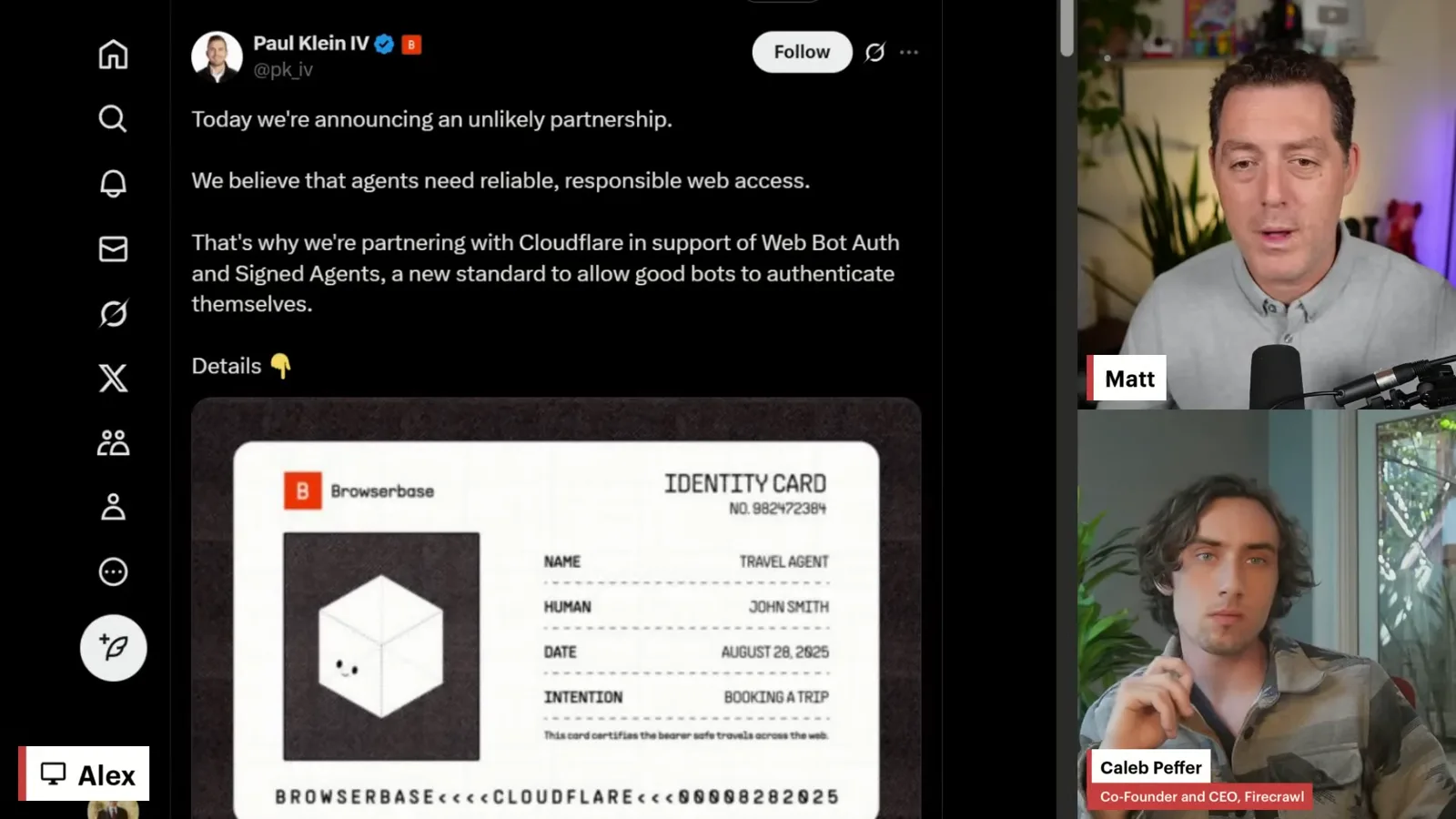
Berman asks about Browserbase and Cloudflare’s announced Web Bot Auth and Signed Agents approach. Peffer agrees that standards are needed but questions whether a single company should become a central trust intermediary. Their criticism is an opinion about a proposed ecosystem arrangement, not proof of the partners’ motives.
Peffer discusses Cloudflare’s pay-per-crawl concept, including the use of HTTP 402 to signal payment requirements. He supports compensating publishers but asks whether direct publisher relationships and existing user subscriptions could be handled better. Berman adds that publishers may need both protection and discoverability.
Asked how publishers should prepare, Peffer recommends experimenting with licensing and ways to monetize agent access while recognizing legitimate fears about lost traffic and compensation. He predicts organizations that adapt will fare better, and says publishers he has spoken with are interested in testing options. Berman thanks him and closes the show.
Sur la même chaîne
 34:21EN
 Matthew Berman· 27 oct. 2026Matthew Berman Examines Anthropic’s IPO Filing, AI Growth and GovernanceMatthew Berman, Sam Altman · Forward FutureThe presenter reviews the S-1’s financial metrics, compute strategy and voting structure while questioning the tension between rapid AI development and safety.
 0:36ENMatthew Berman· 25 oct. 2026Kimi K3.1 and a Rubik’s Cube Solver DemonstrationMatthew Berman · Forward FutureMatthew Berman shows a scrambled virtual cube being solved and gives the Kimi K3.1 test a favorable assessment.
 25:50ENMatthew Berman· 24 oct. 2026Kimi K3.1 Pro Tested: Strong 3D Demos, Uneven Results and Competitive PricingMatthew Berman · Forward FutureMatthew Berman tests the open-weight model on coding, 3D rendering and visual explanations, then compares benchmark results and prices.
 32:20ENMatthew Berman· 23 oct. 2026Who Is Local AI For? The Costs, Trade-offs and a Hybrid FutureMatthew Berman · Forward FutureMatthew Berman weighs data control and independence against hardware cost, setup complexity and inference speed.
 1:03:37ENMatthew Berman· 23 oct. 2026Matthew Berman’s Team Tests Kimi K3.1 on Animation, Games, and ChartsMatthew Berman, Alex, Brian · Forward FutureA live team AMA turns into an informal test of Kimi K3.1, from personal-agent workflows to motion graphics, a browser game, and a benchmark chart.
 0:53ENMatthew Berman· 22 oct. 2026Sam Altman on AI and the Discovery of New KnowledgeSam Altman · OpenAIAltman expects progress in mathematical discovery to extend to biology, materials and energy.