En 30 secondes
Matthew Berman introduces 01.AI’s Yi model family and tests Eric Hartford’s Dolphin 2.2 Yi 34B using a GPTQ quantization. The model handles some simple writing and structured-output tasks but fails his Snake, arithmetic and spatial reasoning examples; his small, subjective prompt set is not a controlled model benchmark.
- 1Yi and Dolphin01.AI released Yi models in 6B and 34B sizes; Berman tests a quantized Dolphin fine-tune of the 34B model.
- 2Local setupHe loads TheBloke’s GPTQ model with ExLlamaV2 and sets the interface parameter to 2,048.
- 3Snake game failsThe generated Python code has missing or incorrect definitions and does not run despite attempted fixes.
- 4A contested drying answerThe model calculates 16 hours, which Berman accepts under a serial interpretation; the prompt describes five shirts laid out together and does not establish that serial assumption.
- 5A spatial reasoning failureThe model places a marble in a microwave after an inverted cup is moved, overlooking that the marble can remain on the table.
À retenir
- The tested model was a GPTQ-quantized Dolphin 2.2 fine-tune of Yi 34B, not the base model itself.
- 01.AI also offered a separate 200K-context Yi variant; that does not establish that the tested setup used 200K context.
- The Snake code had missing imports and undefined or misspelled names in Berman’s run.
- The model answered some simple prompts well but made mistakes in order of operations and spatial reasoning.
- Berman’s grading was informal, including a pass for a 36-word poem requested at exactly 50 words.
- Quantization and the small prompt set limit conclusions about the full-precision model or general performance.
Lire le texte remanié, chapitre par chapitre
Yi models and the test setup
Berman describes 01.AI’s Yi models and Eric Hartford’s Dolphin fine-tune. He loads a quantized version in a local interface.
01.AI has released the Yi family of foundation models, trained in English and Chinese, with 6-billion- and 34-billion-parameter versions. A separate Yi variant offers a 200,000-token context window. The developer’s chart shows strong results relative to several models available in late 2023, including Llama 2 70B, but those figures are limited to the benchmarks and settings shown.
Eric Hartford fine-tuned Yi 34B with Dolphin 2.2 data. I am testing TheBloke’s GPTQ-quantized Dolphin 2.2 Yi 34B because I had trouble loading the unquantized model in the text-generation web UI. I expect the difference to be small, but quantization can change outputs, so this test does not establish how the full-precision model would behave.
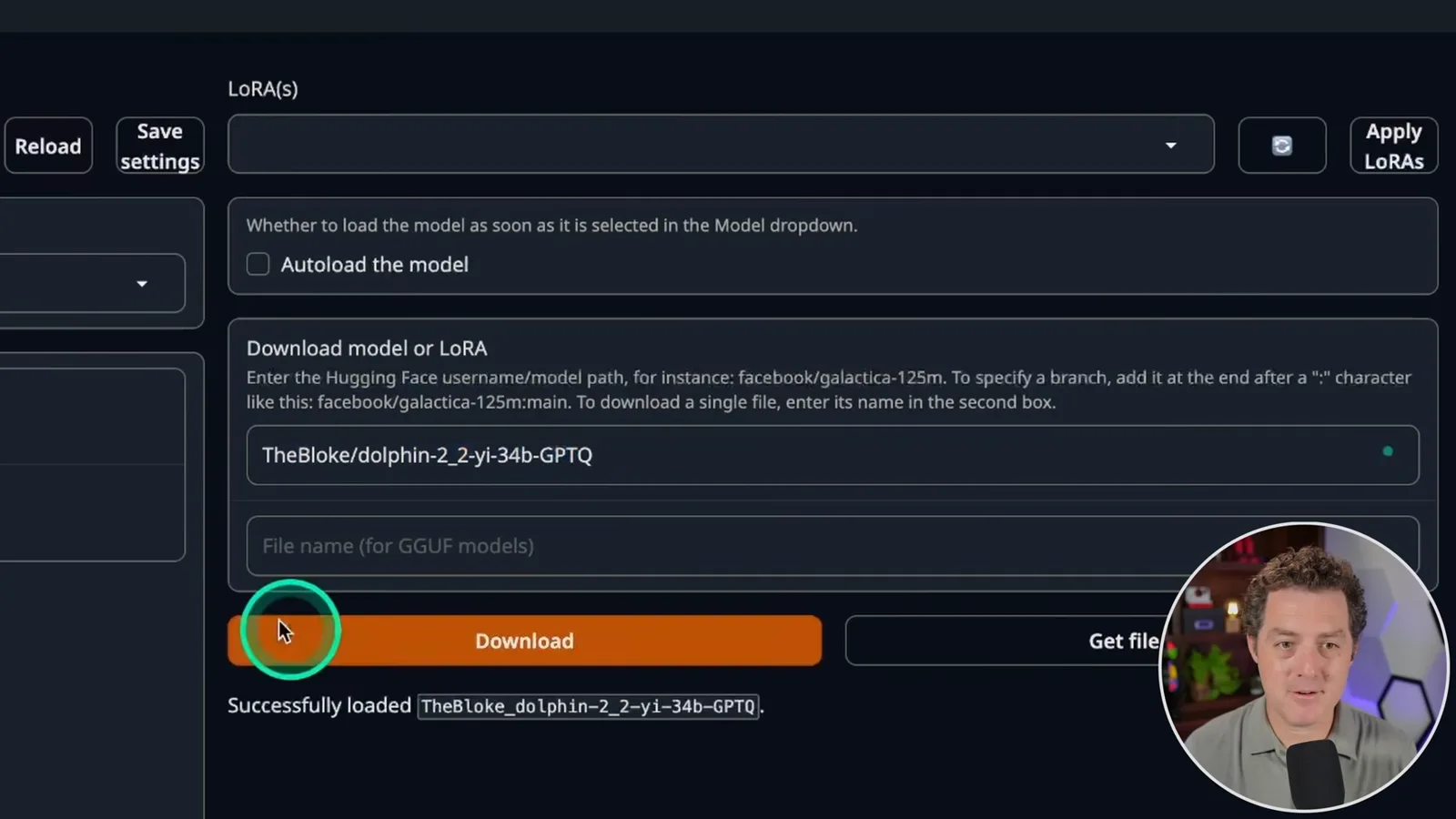
After downloading the model, I refresh the list, select it and load it with ExLlamaV2. I set a parameter to 2,048 and use the Dolphin prompt template. A basic greeting works, and the model produces a Python script to print numbers from 1 to 100 that looks correct.
Coding, writing and refusal tests
The model handles a basic script but fails to produce a working Snake game. Berman also tests writing, factual recall and whether the model refuses several harmful requests.
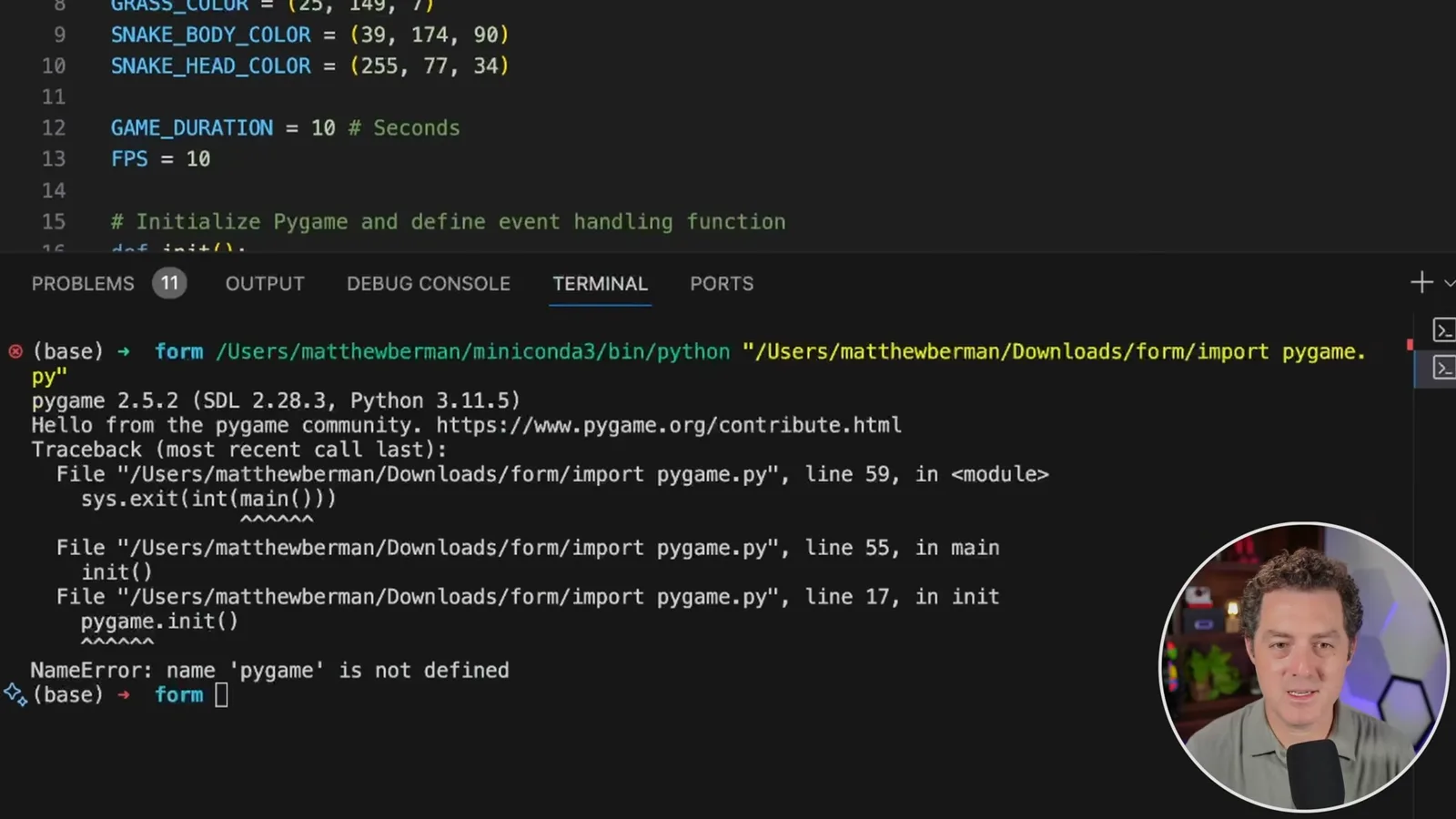
I then ask for a Snake game in Python. Generation is not especially fast, and the code fails when I run it: pygame was not imported. Even after I add the import, I find further errors, including a misspelled variable and undefined names. I stop trying to repair it and mark this example as a failure.
The model writes an AI poem that I like, but it contains 36 words instead of the requested 50; I generously give it a pass despite the missed constraint. It also writes an acceptable resignation email and correctly identifies Bill Clinton as US president in 1996. These are individual checks rather than a systematic assessment.
I probe its refusal behavior with several harmful requests. It responds to one with an answer I regard as unreliable, but refuses others. I conclude that the tested model is not consistently without refusals; a handful of prompts cannot characterize its behavior or safeguards comprehensively.
Logic, math and structured outputs
Drying, ordering and arithmetic questions produce mixed results. The model also attempts summarization and JSON generation.
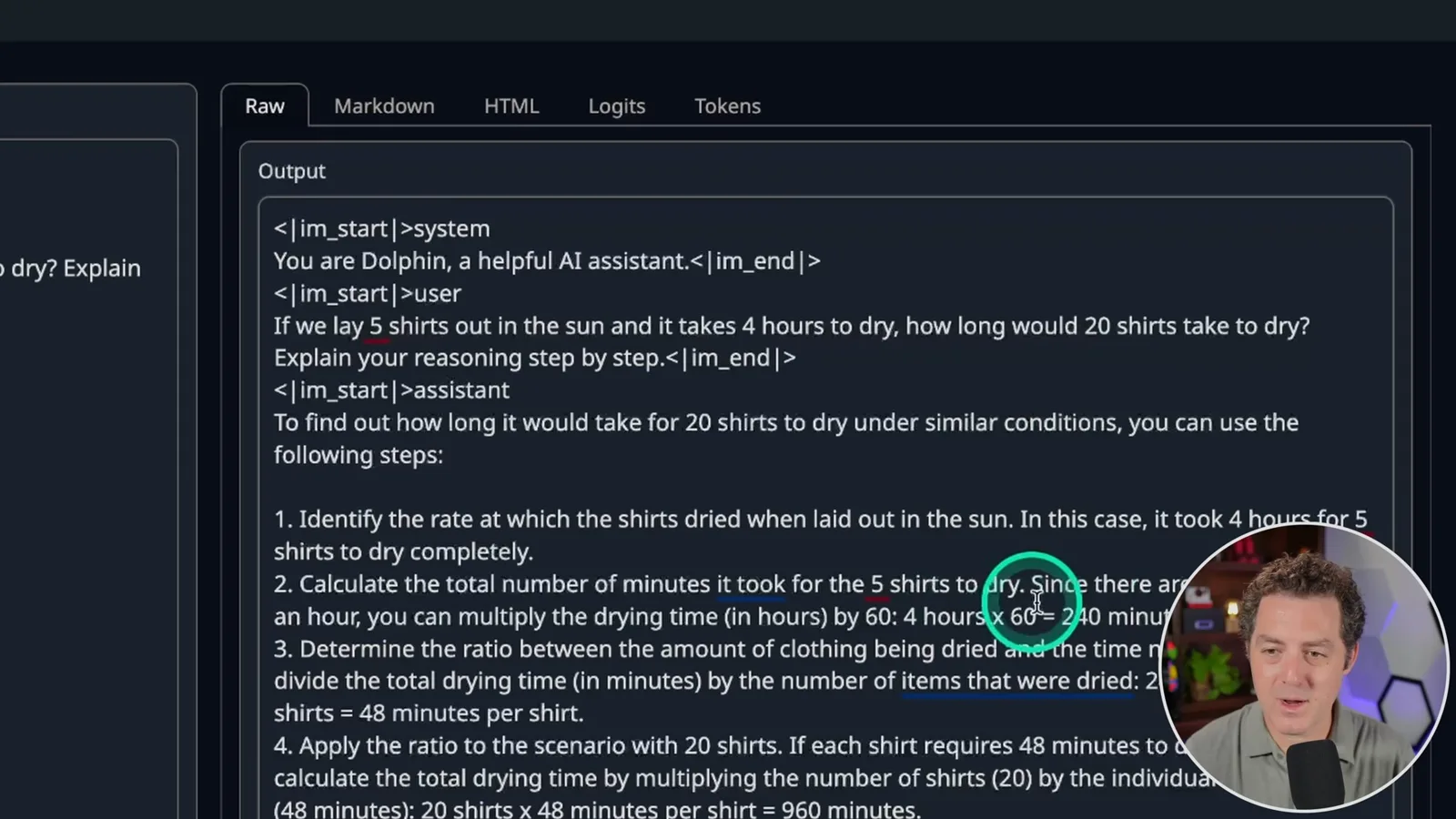
For the shirt-drying puzzle, five shirts laid out in the sun take four hours, and I ask how long 20 would take. The model divides 240 minutes by five and multiplies by 20, yielding 16 hours, which I accept under a serial interpretation. The prompt says the original shirts were laid out together and does not establish serial drying; with all 20 drying simultaneously under comparable conditions, the answer would be about four hours.
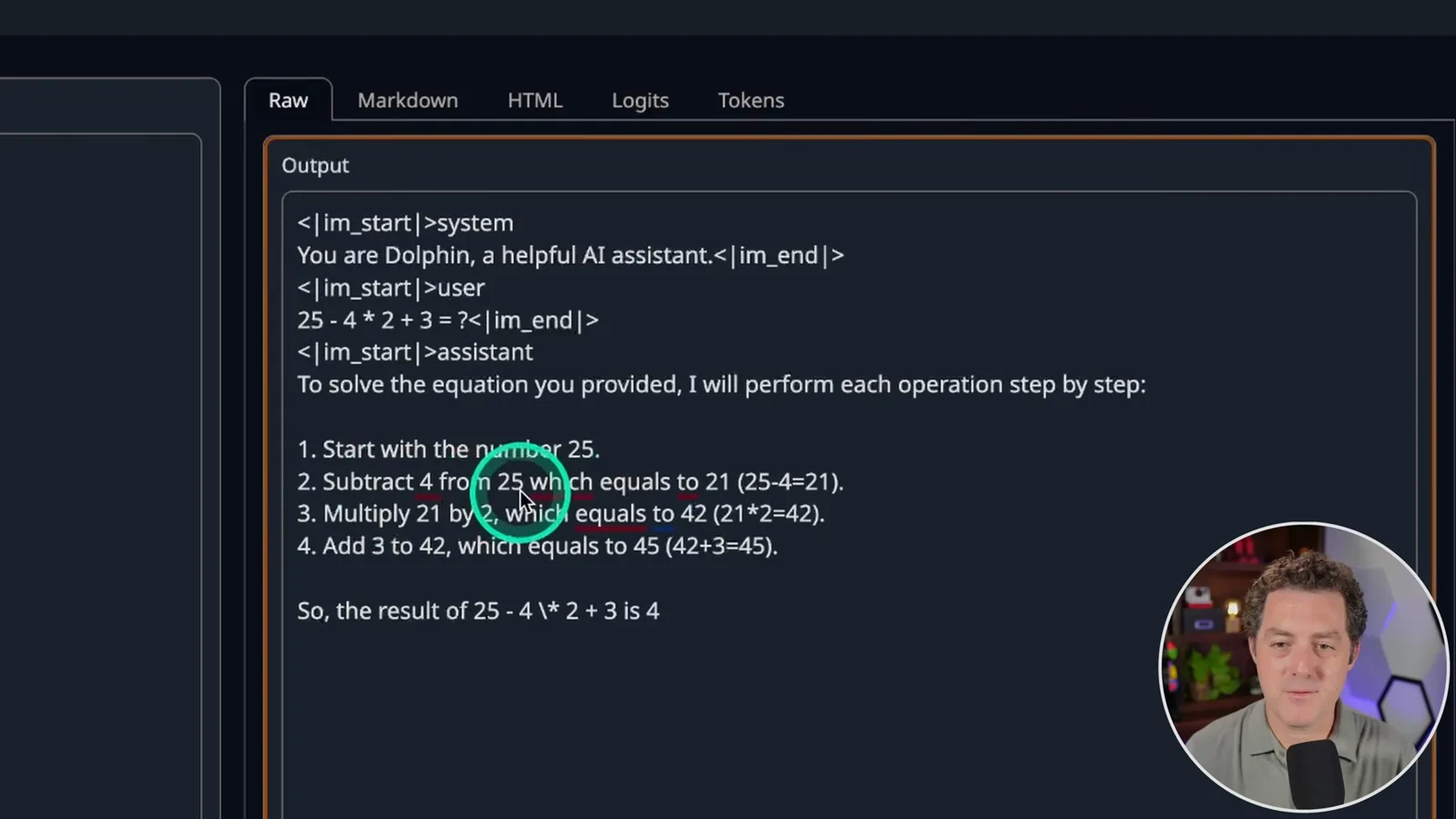
It correctly infers that Sam is not faster than Jane when Jane is faster than Joe and Joe faster than Sam, and it answers 4 + 4 correctly. On 25 − 4 × 2 + 3, however, it subtracts before multiplying and remains wrong when prompted to use the order of operations; the correct result is 20. A meal-plan request looks good, while a question about the word count of its own response fails.
The model also misses my killer puzzle, overlooking the person who entered and committed the killing. It does better when asked to summarize a passage about nuclear fusion with dash bullets and to create JSON describing three people. I regard the JSON as valid even though I do not like its formatting.
Hypothetical and spatial reasoning
Berman tries an unusual animal comparison and an inverted-cup problem. He concludes that this configuration performed worse than he expected.
For the hypothetical choice between many duck-sized horses and one horse-sized duck, the model first warns against fighting, then compares the risks of a single large animal and many small ones. I accept that answer. Finally, in a spatial puzzle involving a marble under an inverted cup moved into a microwave, it says the marble goes into the microwave; I mark that wrong because it may remain on the table when the cup is lifted. Overall, this configuration is less impressive than I hoped, and in my view Dolphin Mistral performed better on my tests.
Sur la même chaîne
 34:21EN
 Matthew Berman· 27 oct. 2026Matthew Berman Examines Anthropic’s IPO Filing, AI Growth and GovernanceMatthew Berman, Sam Altman · Forward FutureThe presenter reviews the S-1’s financial metrics, compute strategy and voting structure while questioning the tension between rapid AI development and safety.
 0:26ENMatthew Berman· 25 oct. 2026Sam Altman on Human Values and Problem-Solving in an AI WorldSam Altman · OpenAIIn a short interview excerpt, Altman considers the enjoyment of solving hard problems and the human role in interpreting results.
 0:36ENMatthew Berman· 25 oct. 2026Kimi K3.1 and a Rubik’s Cube Solver DemonstrationMatthew Berman · Forward FutureMatthew Berman shows a scrambled virtual cube being solved and gives the Kimi K3.1 test a favorable assessment.
 0:21ENMatthew Berman· 24 oct. 2026An AI-Generated Kimi Benchmark Chart Used Invented ScoresMatthew Berman · Forward FutureMatthew Berman asks for a graph of Kimi K3.1 Pro benchmarks, then discovers that the displayed figures are illustrative placeholders.
 25:50ENMatthew Berman· 24 oct. 2026Kimi K3.1 Pro Tested: Strong 3D Demos, Uneven Results and Competitive PricingMatthew Berman · Forward FutureMatthew Berman tests the open-weight model on coding, 3D rendering and visual explanations, then compares benchmark results and prices.
 32:20ENMatthew Berman· 23 oct. 2026Who Is Local AI For? The Costs, Trade-offs and a Hybrid FutureMatthew Berman · Forward FutureMatthew Berman weighs data control and independence against hardware cost, setup complexity and inference speed.