En 30 secondes
Matthew Berman argues that Google’s existing search business may have slowed its response to generative AI, citing a former employee’s account and applying the innovator’s dilemma. He discusses Demis Hassabis’s new role and Jeff Dean’s departure for Discovery Loop, while acknowledging that his explanations of their motives and Google’s culture are speculative. Despite his criticism, he sees advantages in Google’s data, infrastructure and potential open-model strategy.
- 1Leadership changesHassabis takes new roles within Alphabet, while Dean leaves Google to help start Discovery Loop.
- 2An internal chatbot claimBerman cites Thibault Sottiaux’s account of an earlier chatbot and alleged internal barriers; it remains his account of those decisions.
- 3The innovator’s dilemmaBerman argues that a successful search and advertising business could discourage changes that threaten existing revenue.
- 4Motives are uncertainHe speculates about why Hassabis changed roles and Dean left, but their public statements do not establish his full explanation.
- 5An open-model proposalBerman suggests pairing widely available models with TPU-based infrastructure and cloud services.
À retenir
- Hassabis moved from leading Google DeepMind to chair and Alphabet chief scientist, while Jeff Dean and three colleagues founded Discovery Loop.
- A former team member alleged that Google withheld a chatbot and blocked disruptive products; the video does not independently establish the full internal decision process.
- Berman interprets Google’s situation through the innovator’s dilemma, but his explanations of leadership motives and internal culture are speculation.
- Google’s research and products include major contributions to transformers, AI systems and computing infrastructure, alongside its commercial AI offerings.
- Berman recommends a stronger open-model strategy coupled with Google’s TPU and serving infrastructure; its success is a prediction, not an established outcome.
Lire le texte remanié, chapitre par chapitre
Google’s history and leadership changes
Berman describes Google’s AI research and recent departures and role changes. He asks why a company with major research achievements faces such intense competition.
In August 2026, I look at Google’s AI position and two significant leadership changes. I believe Google has stumbled since an earlier period of strong model performance, though claims about which model leads depend on the task and date. Jeff Dean is leaving to co-found a startup, while Demis Hassabis is stepping away from the Google DeepMind CEO role.
Google has been deeply involved in AI research for years. Its researchers published the 2017 transformer paper ‘Attention Is All You Need,’ which influenced many modern language models, and DeepMind built systems such as AlphaGo and AlphaStar. My criticism is that its research leadership did not always translate into the earliest consumer products; that does not mean Google did nothing with transformers or AI.
The chatbot and the innovator’s dilemma
He discusses a former employee’s account of an internal chatbot and claims of organizational resistance. He interprets the situation through the tension between an established business and disruptive technology.
I discuss a post about an internal Google chatbot that preceded ChatGPT. In a reply displayed in the video, former team member Thibault Sottiaux says he worked on a system called LMChat and alleges that Google was nervous about release and DeepMind faced restrictions on products that might disrupt Google. This is his account, not independent verification of every internal decision or a direct comparison of the systems’ capabilities.
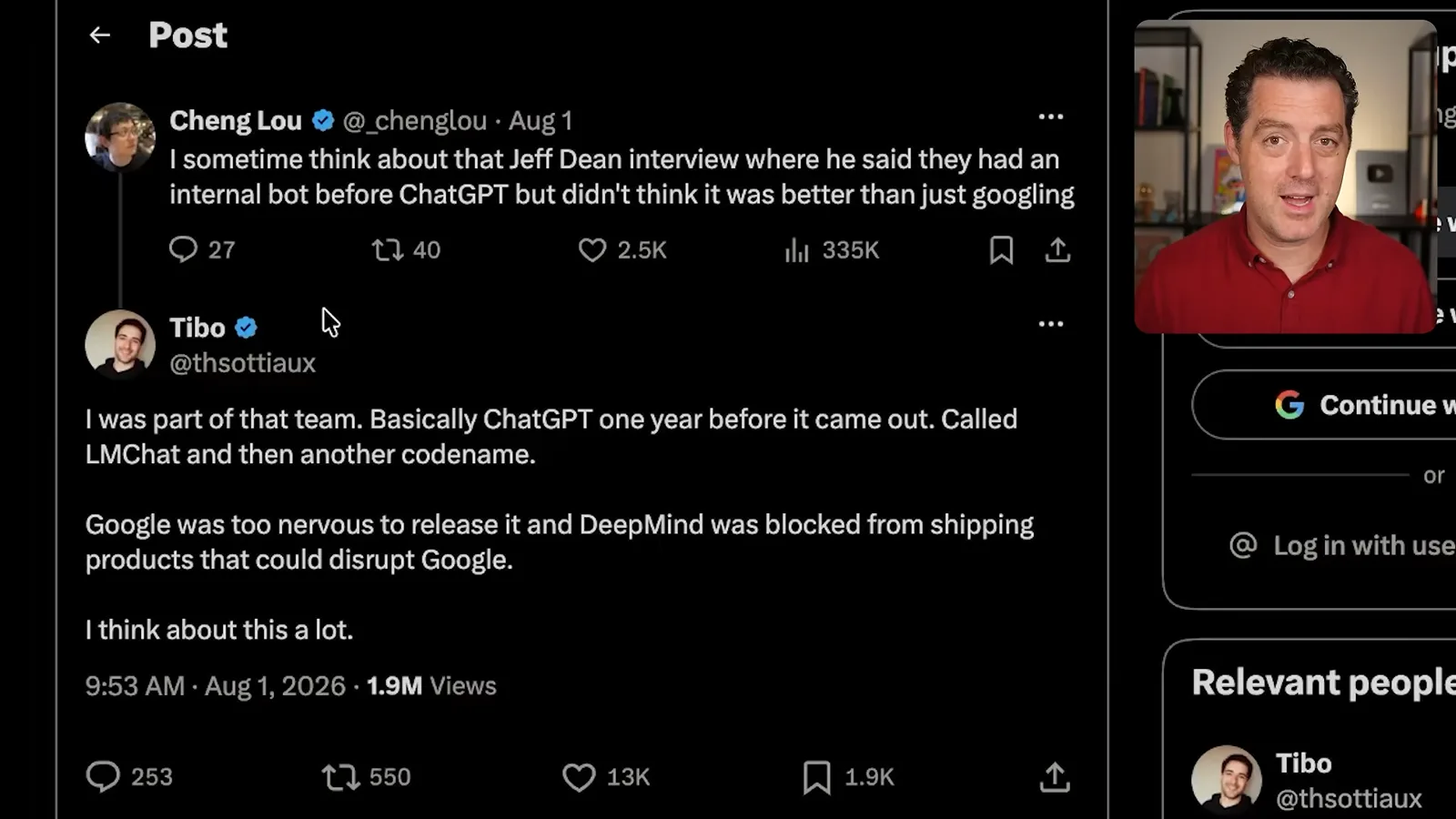
My interpretation is that Google’s highly profitable search and advertising business could make an alternative conversational product seem threatening, even if Google itself developed it. I also speculate that concerns about unpredictable model outputs and reputational risk may have played a role. The video does not establish the precise reasons for the internal decision.
I connect this to the innovator’s dilemma: decisions that protect an incumbent’s existing customers and near-term business can leave it vulnerable when a new technology changes the market. In my view, traditional search links and advertising face disruption as users turn to assistants such as ChatGPT, Claude and Gemini. Personal observations about how people search are not a measurement of Google’s overall market position.
Hassabis and Dean
Berman reviews the leaders’ public announcements. His account of their motivations and Google’s internal culture is explicitly speculative.
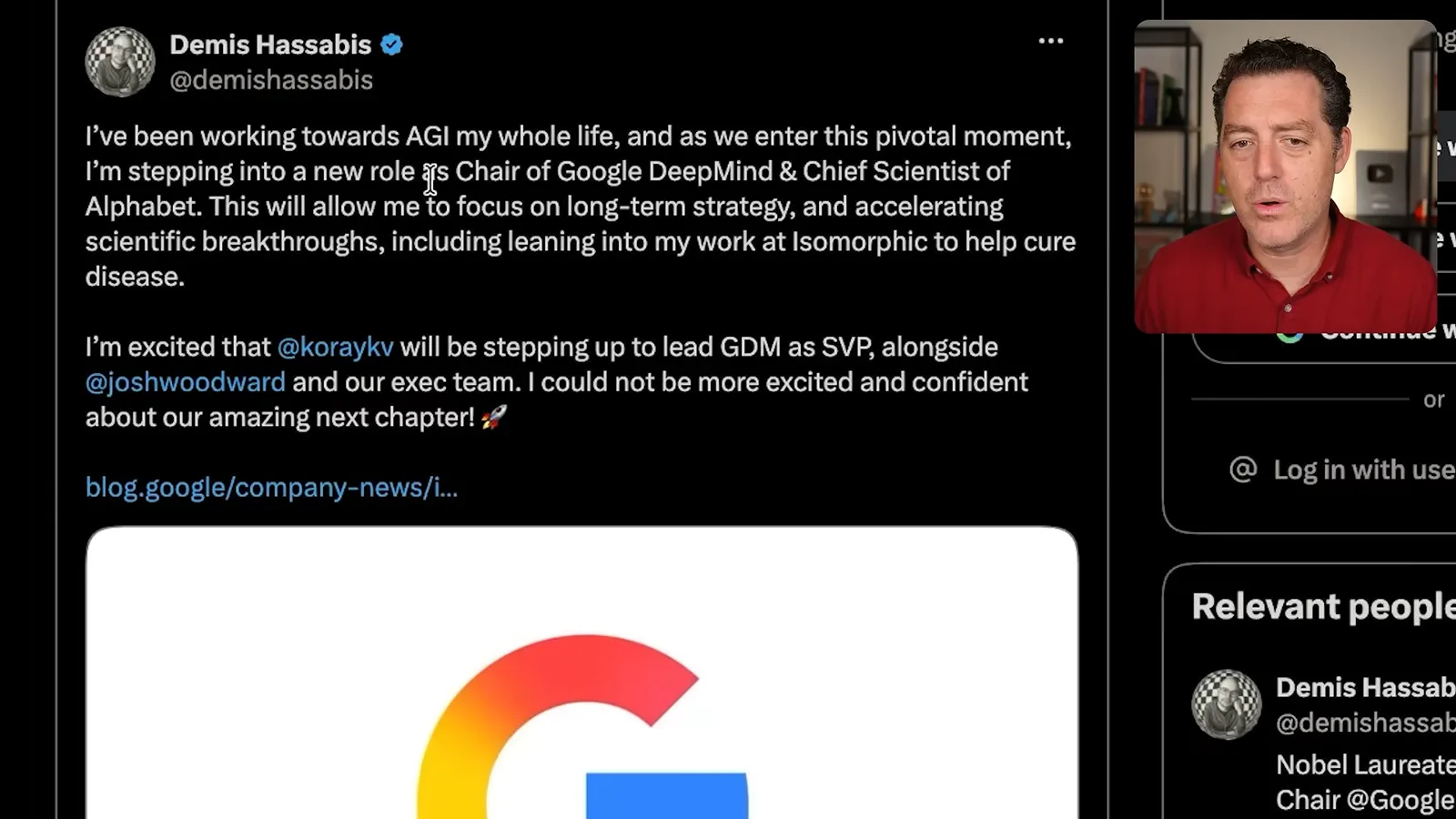
Hassabis announced that he was becoming chair of Google DeepMind and Alphabet’s chief scientist, with more focus on long-term strategy and scientific breakthroughs, including work at Isomorphic. He remains within Alphabet’s leadership structure. I interpret the shift as a desire to focus on the frontier rather than day-to-day management, but my further claims about what he thought of Google’s business pressures are speculation.
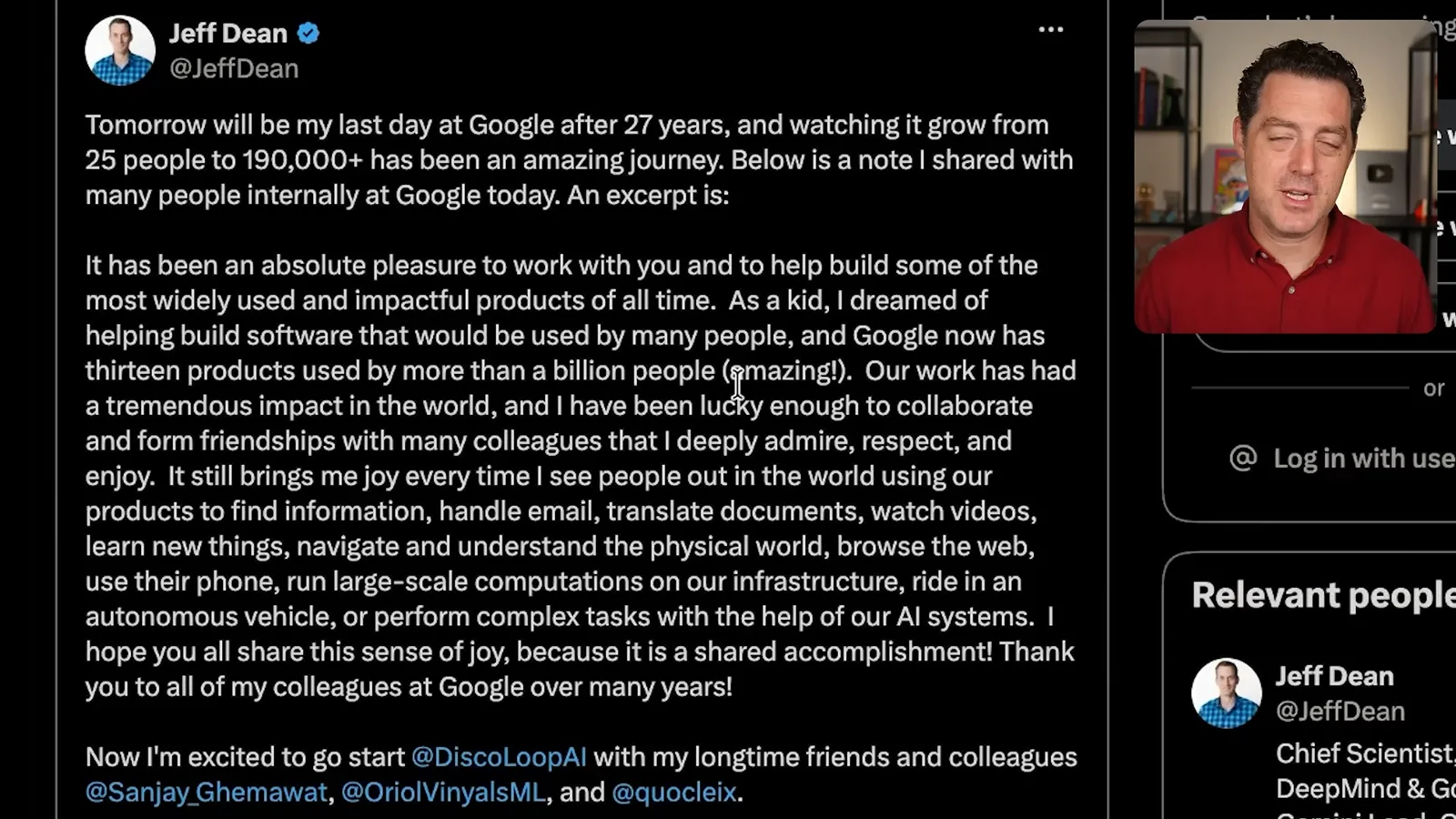
Dean is leaving Google after a long career to establish Discovery Loop with Sanjay Ghemawat, Quoc Le and Oriol Vinyals. Their stated goal is to use AI to accelerate scientific and engineering discovery. I speculate that Dean wanted a different environment, including imagining what resources Google might have offered him; those imagined conversations and his private motivations are not established by the announcement.
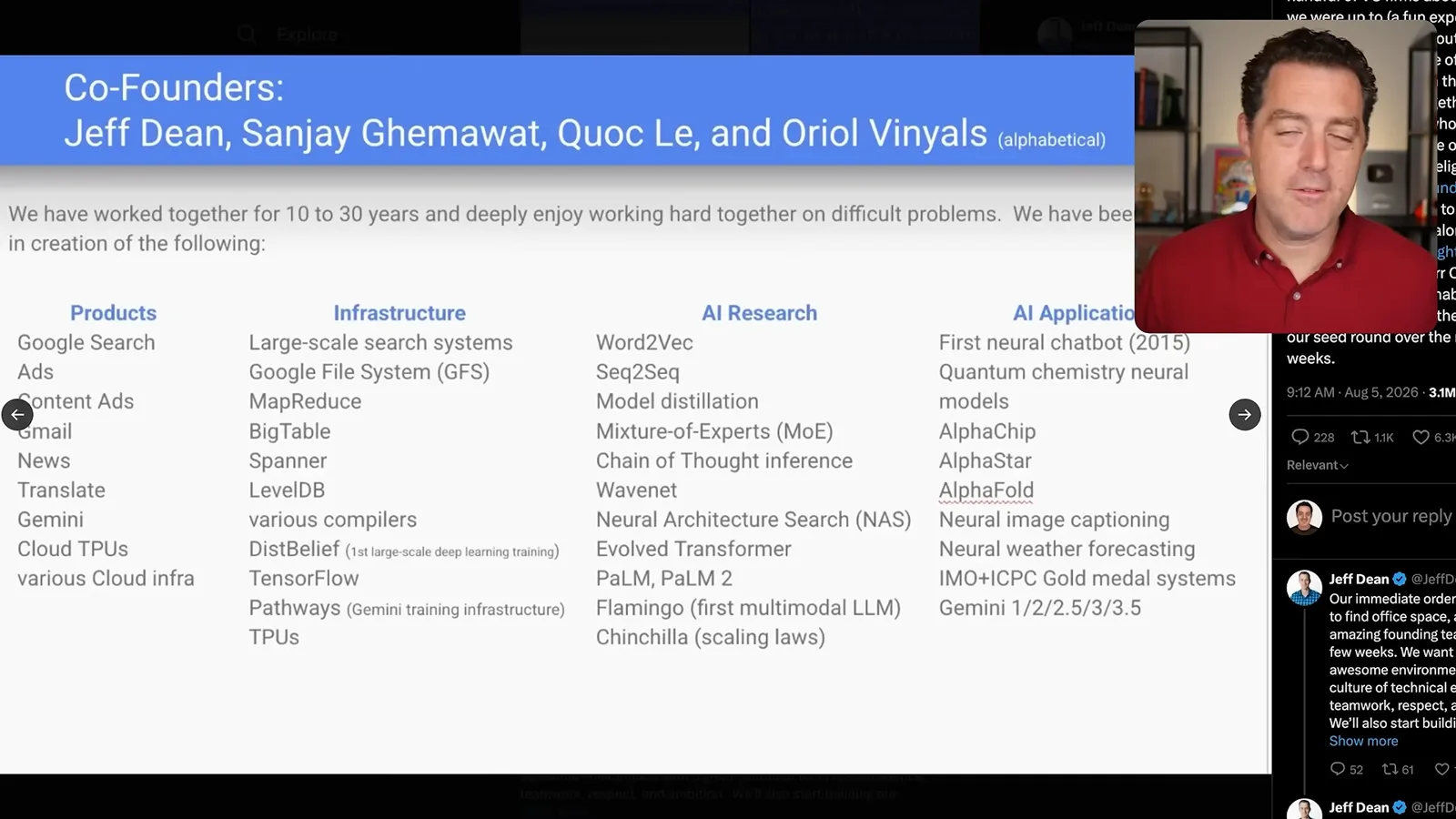
The founders list contributions spanning Google Search and Ads, Gemini, TPUs, MapReduce, AlphaStar and AlphaFold. These are achievements involving many collaborators, not work attributable to four people alone. MapReduce is an influential framework for distributed data processing; it is one part of a much larger infrastructure, not a complete explanation of how all Google services operate.
Strengths and a proposed strategy
Despite his criticism, Berman points to Google’s data, chips, distribution and cash flow. He recommends investing more heavily in open models and supporting infrastructure.
I return to the former employee’s claim and the possibility that established incentives slowed product decisions. I also speculate that layers of management and resistance to change may have contributed to cultural difficulties. I want to be clear that this is my interpretation, not direct evidence about the motives of Google’s managers.
Despite losing some prominent researchers, I remain optimistic about Google. Teams can adapt after departures, and the company still has many talented people. I see several assets: data and distribution, experience building TPUs, access to other hardware, a broad Android ecosystem and substantial cash flow. The availability and permitted use of particular datasets are separate questions from simply having access to them.
My recommendation is to put more emphasis on open models rather than treating frontier rankings as the only measure of success. I would try to build highly capable models that developers can build on, then improve them with the ecosystem. My assessment of Google’s relative model standing is a judgment at the time of the video, not a fixed fact about every benchmark.
Google already offers the Gemma family of open-weight models. I argue that broader adoption of models supported by Google’s TPUs and cloud services could create a reinforcing business: developers gain accessible models while Google supplies infrastructure. Open-weight licenses and genuine open-source licenses can differ, and this proposed business outcome is a forecast rather than a demonstrated result.
I am far from counting Google out. Its research talent, distribution and infrastructure give it room to pursue a different strategy, and I believe a stronger open-model ecosystem could be a valuable part of that future. Whether it succeeds will depend on execution, competition and how the market develops.
Sur la même chaîne
 34:21EN
 Matthew Berman· 27 oct. 2026Matthew Berman Examines Anthropic’s IPO Filing, AI Growth and GovernanceMatthew Berman, Sam Altman · Forward FutureThe presenter reviews the S-1’s financial metrics, compute strategy and voting structure while questioning the tension between rapid AI development and safety.
 0:36ENMatthew Berman· 25 oct. 2026Kimi K3.1 and a Rubik’s Cube Solver DemonstrationMatthew Berman · Forward FutureMatthew Berman shows a scrambled virtual cube being solved and gives the Kimi K3.1 test a favorable assessment.
 25:50ENMatthew Berman· 24 oct. 2026Kimi K3.1 Pro Tested: Strong 3D Demos, Uneven Results and Competitive PricingMatthew Berman · Forward FutureMatthew Berman tests the open-weight model on coding, 3D rendering and visual explanations, then compares benchmark results and prices.
 32:20ENMatthew Berman· 23 oct. 2026Who Is Local AI For? The Costs, Trade-offs and a Hybrid FutureMatthew Berman · Forward FutureMatthew Berman weighs data control and independence against hardware cost, setup complexity and inference speed.
 1:03:37ENMatthew Berman· 23 oct. 2026Matthew Berman’s Team Tests Kimi K3.1 on Animation, Games, and ChartsMatthew Berman, Alex, Brian · Forward FutureA live team AMA turns into an informal test of Kimi K3.1, from personal-agent workflows to motion graphics, a browser game, and a benchmark chart.
 0:53ENMatthew Berman· 22 oct. 2026Sam Altman on AI and the Discovery of New KnowledgeSam Altman · OpenAIAltman expects progress in mathematical discovery to extend to biology, materials and energy.